A student carries out an experiment to determine the speed of sound in carbon dioxide gas by setting up stationary waves in a horizontal glass tube closed at one end and open at the other.
Fine powder is sprinkled inside the tube. A loudspeaker, connected to a signal generator producing a frequency of 1.25 kHz1.25\text{ kHz}1.25 kHz, is placed near the open end of the tube. The powder forms piles at the nodes of the stationary wave as shown.
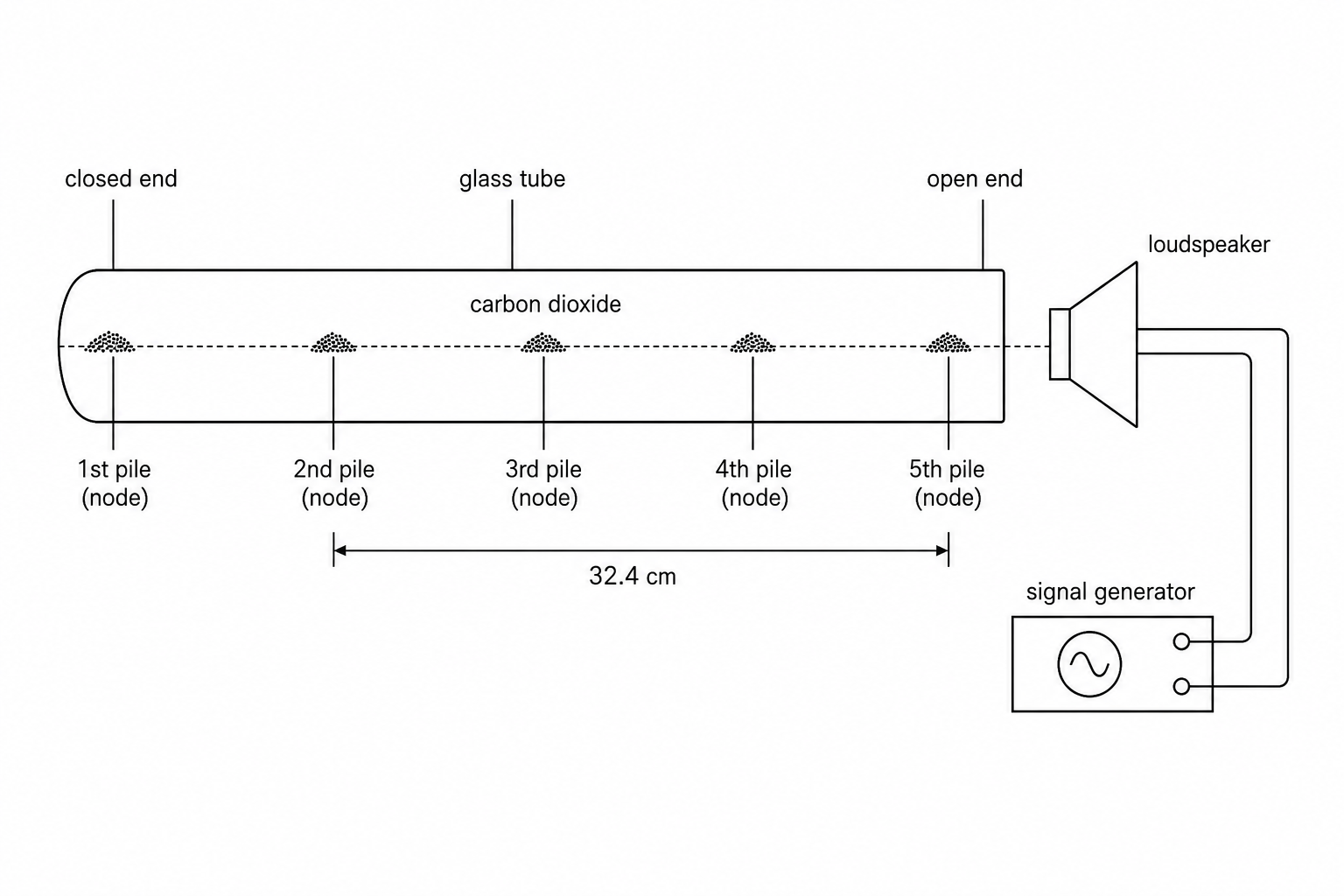
Suggest why the powder piles up at the nodes within the glass tube.
Use the provided information to determine the speed of sound vvv in carbon dioxide inside the tube.
The open end of the tube corresponds to the first antinode after the fifth pile. Determine the fundamental (minimum) frequency f0f_0f0 of the stationary wave that can be formed within this tube.

