An industrial indium arsenide (InAs) Hall sensor consists of a thin conductive strip of width www and thickness ttt that carries a current III due to the drift of conduction electrons. Each electron has a charge of −e-e−e and a mean drift velocity vvv.
A uniform magnetic field of flux density BBB is directed vertically downwards, perpendicular to the top face of the strip, as illustrated in the schematic below.
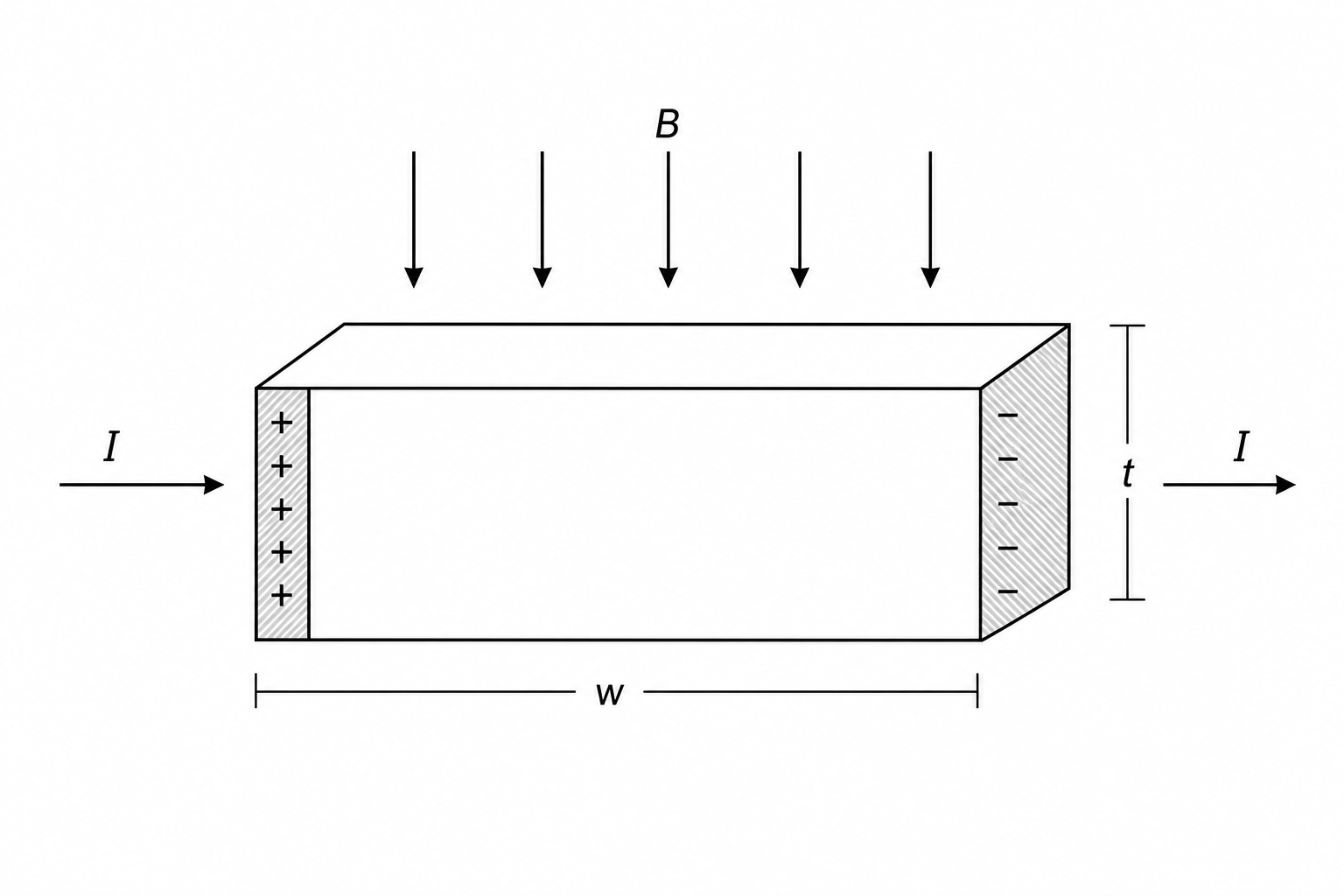
When the current is first established, the magnetic field exerts a force on the moving electrons, shifting them towards one of the side faces. This separation of charge continues until the resulting electric field exerts an equal and opposite force on the electrons. At this equilibrium, the net force on each electron is zero.
Write down expressions for both the electric and magnetic forces acting on an electron under these conditions, and show that the equilibrium potential difference VVV across the width of the strip is given by:
V=BvwV = BvwV=Bvw
In a calibration test of this Hall sensor, the following parameters are recorded:
- number of conduction electrons per unit volume, n=2.0×10²³ m−3n = 2.0 \times 10^{23} \text{ m}^{-3}n=2.0×10²³ m−3
- w=5.0 mmw = 5.0 \text{ mm}w=5.0 mm
- t=0.10 mmt = 0.10 \text{ mm}t=0.10 mm
- I=80 mAI = 80 \text{ mA}I=80 mA
- B=0.35 TB = 0.35 \text{ T}B=0.35 T
Use this data to calculate:
(i) the mean drift velocity vvv of the conduction electrons within the sensor.
(ii) the potential difference VVV generated across the width of the sensor strip.
The sensor is integrated into a high-precision Hall probe powered by a constant-current source, with the potential difference across it monitored by a digital voltmeter.
A student attempts to use this specific probe to map the weak stray magnetic field of a terrestrial magnetic field simulator. The expected magnetic flux density in this region is between 0.20 mT0.20 \text{ mT}0.20 mT and 0.50 mT0.50 \text{ mT}0.50 mT.
(i) Suggest, with a supporting calculation, why this particular Hall probe setup is not suitable for measuring magnetic flux densities in this weak range.
(ii) An alternative method to determine weak magnetic flux densities involves measuring the force on a current-carrying wire suspended between the magnetic poles. Explain how this alternative apparatus is set up and used to determine BBB, and discuss which measurement in this experiment typically introduces the largest experimental uncertainty.