A horizontal cylindrical sensor probe is used to monitor environmental conditions on a vertical housing wall of a meteorological buoy.
A technician uses a specialized dual-pronged spanner to screw the probe into its port. The distance between the parallel prongs of the spanner is 1.5×10⁻² m1.5 \times 10^{-2}\text{ m}1.5×10⁻² m. The prongs exert equal and opposite forces on the circular probe cap. The magnitude of each force is 180 N180\text{ N}180 N.
Calculate the magnitude of the torque of the couple produced by these forces.
torque=\text{torque} = torque= ............................ N m\text{N m}N m
Once installed, an external sensor package of mass MMM is mounted on the probe at point PPP, as shown below.
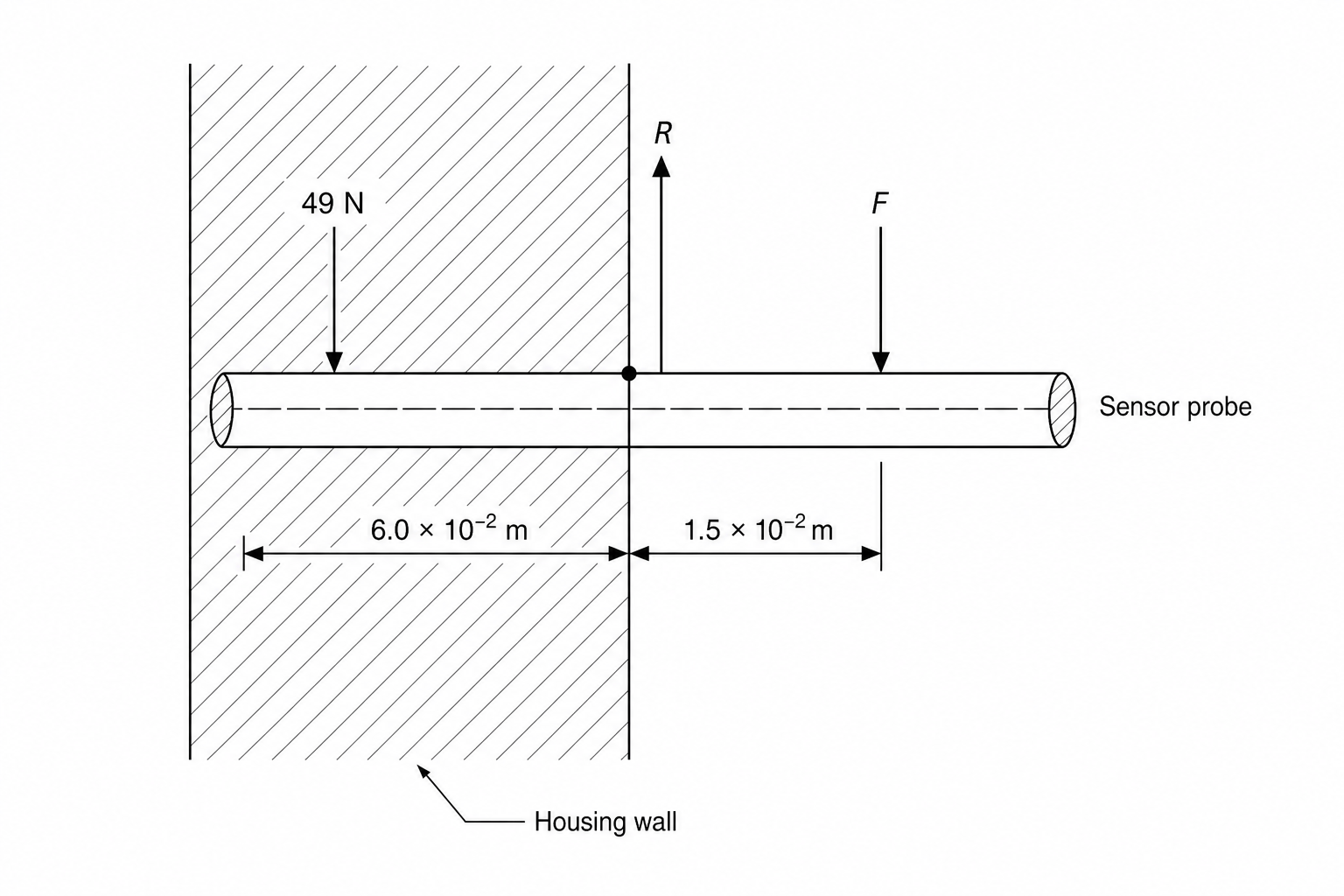
The inside section of the housing wall exerts a maximum downward holding force of 49 N49\text{ N}49 N on the embedded section of the probe at a distance of 6.0×10⁻² m6.0 \times 10^{-2}\text{ m}6.0×10⁻² m from the outer edge of the wall.
The sensor package exerts a downward force FFF on the probe at a distance of 1.5×10⁻² m1.5 \times 10^{-2}\text{ m}1.5×10⁻² m from the outer edge of the wall.
There is an upward reaction force RRR acting on the probe at the outer edge of the housing wall. The mass of the probe itself is negligible.
Use the principle of moments to calculate the maximum mass MMM of the sensor package. Take g=9.8 m s−2g = 9.8\text{ m s}^{-2}g=9.8 m s−2.
mass=\text{mass} = mass= ............................ kg\text{kg}kg

