Revision notes for Edexcel A Level Physics Wave properties and wave equation. Open the guide for explanations and worked examples. Written against the Edexcel A Level Physics (9PH0) specification, so the content matches what's examinable rather than general Physics background.
Wave properties and wave equation
What you'll learn
- What a wave transfers, and what the particles of a medium actually do.
- How to define amplitude, wavelength, period, frequency and phase difference.
- How to read wave information from displacement-distance and displacement-time graphs.
- How to use the wave equation, v=fλv = f\lambdav=fλ, with sensible units.
Starting point: what is a wave?
A wave is a repeating disturbance. In A-Level Physics, the key idea is that a wave can transfer energy from one place to another without a permanent transfer of matter.
For example, in a water wave, the water mostly moves up and down while the wave pattern travels across the surface. In a sound wave, air particles vibrate back and forth, but the sound energy travels through the air.
Definition
Wave
A wave is an oscillation or disturbance that transfers energy, and sometimes information, from one place to another without a net transfer of matter.
A medium is the material a wave travels through, such as air, water or a stretched string. A mechanical wave needs a medium. Sound is mechanical. An electromagnetic wave, such as visible light or microwaves, can travel through a vacuum.
Oscillations, equilibrium and displacement
An oscillation is one complete repeated motion about a central position. The equilibrium position is the undisturbed position of a particle or point on a wave.
The displacement of a point is its distance and direction from equilibrium at a particular instant. Displacement can be positive or negative depending on which side of equilibrium the point is.
Definition
Amplitude
The amplitude, AAA, is the maximum displacement of a point on the wave from its equilibrium position. It is measured in metres.
A larger amplitude usually means the wave transfers more energy. For many waves, the energy transferred is proportional to the square of the amplitude, so doubling the amplitude can mean four times the energy.
Describing a transverse wave
A transverse wave is a wave where the oscillations are perpendicular to the direction of energy transfer. “Perpendicular” means at 90 degrees.
In the diagram below, the wave travels horizontally, while points on the wave move vertically.
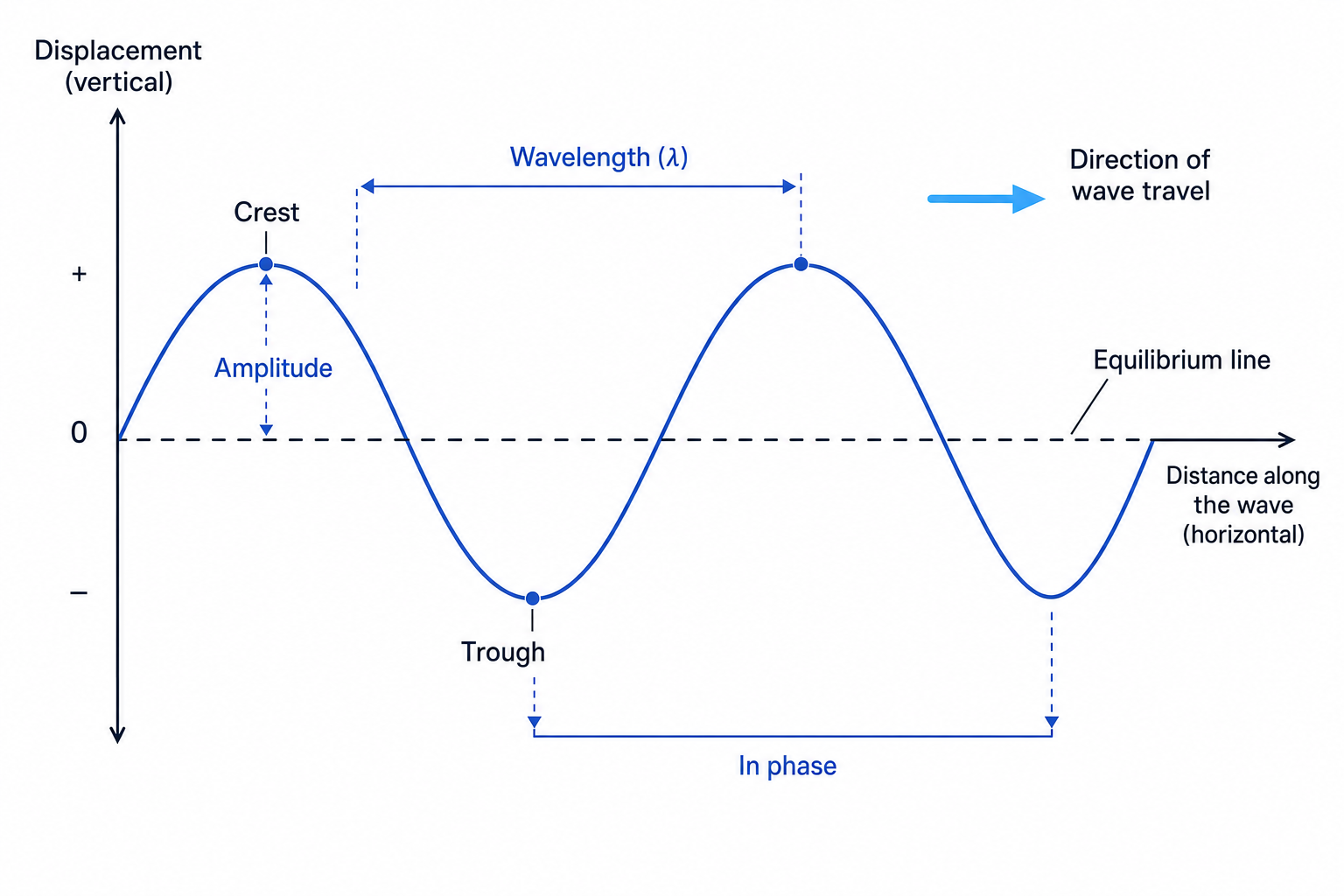
A crest is the highest point of a transverse wave. A trough is the lowest point.
Definition
Wavelength
The wavelength, λ\lambdaλ, is the distance from one point on a wave to the next point in phase with it. For example, it is the distance from one crest to the next crest. It is measured in metres.
Example
Reading amplitude and wavelength
A displacement-distance graph has crests at x=0.18 mx = 0.18\ \text{m}x=0.18 m and x=0.62 mx = 0.62\ \text{m}x=0.62 m. The maximum displacement is +3.0 cm+3.0\ \text{cm}+3.0 cm and the minimum displacement is −3.0 cm-3.0\ \text{cm}−3.0 cm. Find the amplitude and wavelength.
- The amplitude is measured from equilibrium to a crest, not from crest to trough, so A=3.0 cm=0.030 mA = 3.0\ \text{cm} = 0.030\ \text{m}A=3.0 cm=0.030 m.
- Adjacent crests are one full cycle apart, so the wavelength is λ=0.62 m−0.18 m=0.44 m\lambda = 0.62\ \text{m} - 0.18\ \text{m} = 0.44\ \text{m}λ=0.62 m−0.18 m=0.44 m.
- The crest-to-trough distance would be 6.0 cm6.0\ \text{cm}6.0 cm, which is twice the amplitude, so it is not the value of AAA.
Longitudinal waves
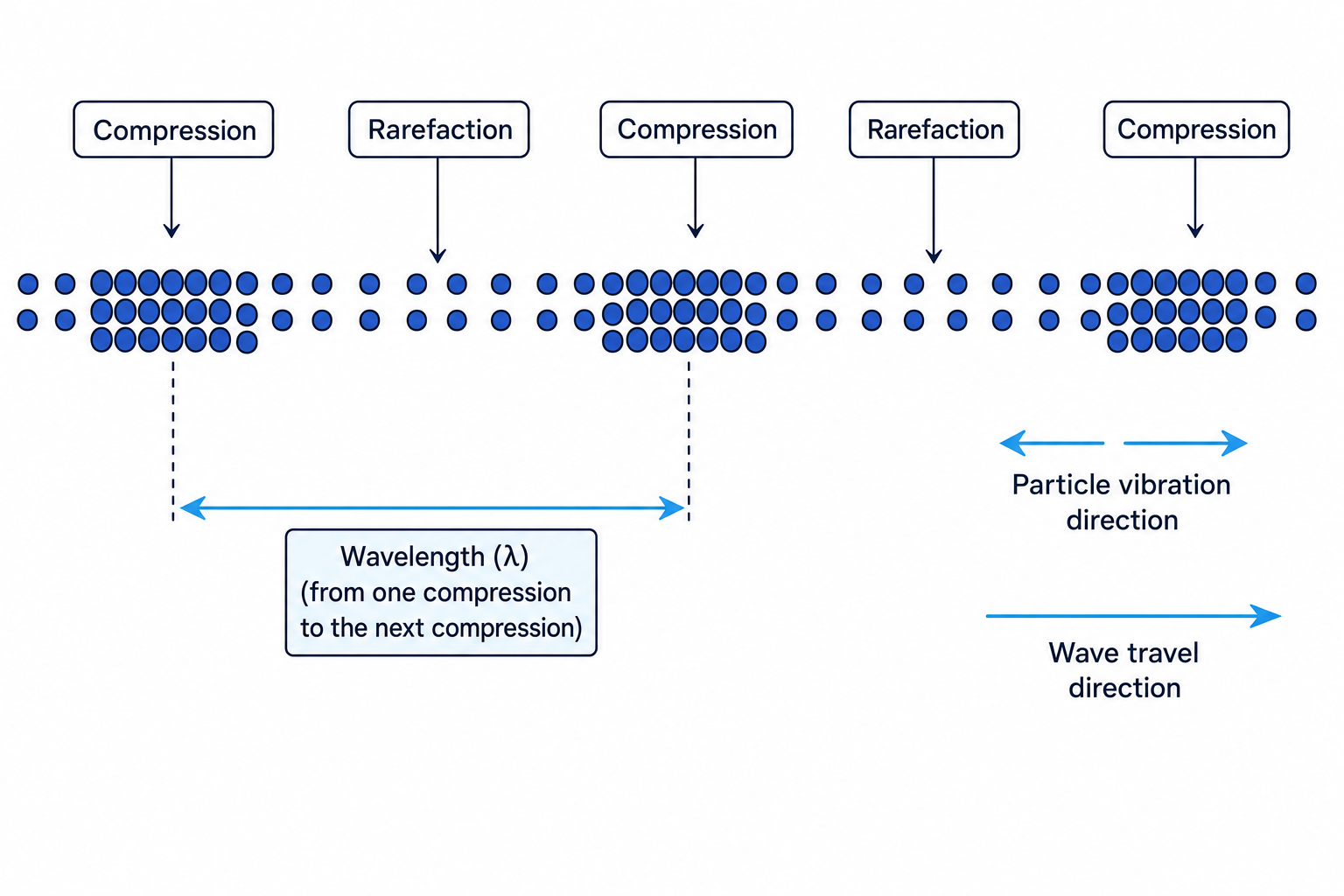
A longitudinal wave is a wave where the oscillations are parallel to the direction of energy transfer. Sound waves in air are longitudinal.
Longitudinal waves contain compressions, where particles are closer together, and rarefactions, where particles are further apart.
Common Mistake
Particle motion is not wave motion
In a wave, individual particles oscillate about equilibrium; they do not travel along with the wave overall. The wave speed is the speed of the pattern or energy transfer, not the speed of one particle vibrating.
Period and frequency
The period, TTT, is the time taken for one complete oscillation at a fixed point. It is measured in seconds.
The frequency, fff, is the number of complete oscillations per second. It is measured in hertz, Hz. One hertz means one oscillation per second.
The relationship is:
f=1Tf = \frac{1}{T}f=T1and equivalently:
T=1fT = \frac{1}{f}T=f1Example
Calculating period and frequency
A point on a string completes 12 oscillations in 3.0 s3.0\ \text{s}3.0 s. Calculate the period and frequency.
- The period is the time per oscillation, so T=3.0 s12=0.25 sT = \frac{3.0\ \text{s}}{12} = 0.25\ \text{s}T=123.0 s=0.25 s.
- The frequency is the number of oscillations per second, so f=123.0 s=4.0 Hzf = \frac{12}{3.0\ \text{s}} = 4.0\ \text{Hz}f=3.0 s12=4.0 Hz.
- The reciprocal check gives f=10.25 s=4.0 Hzf = \frac{1}{0.25\ \text{s}} = 4.0\ \text{Hz}f=0.25 s1=4.0 Hz, so the two answers are consistent.
Displacement-distance and displacement-time graphs
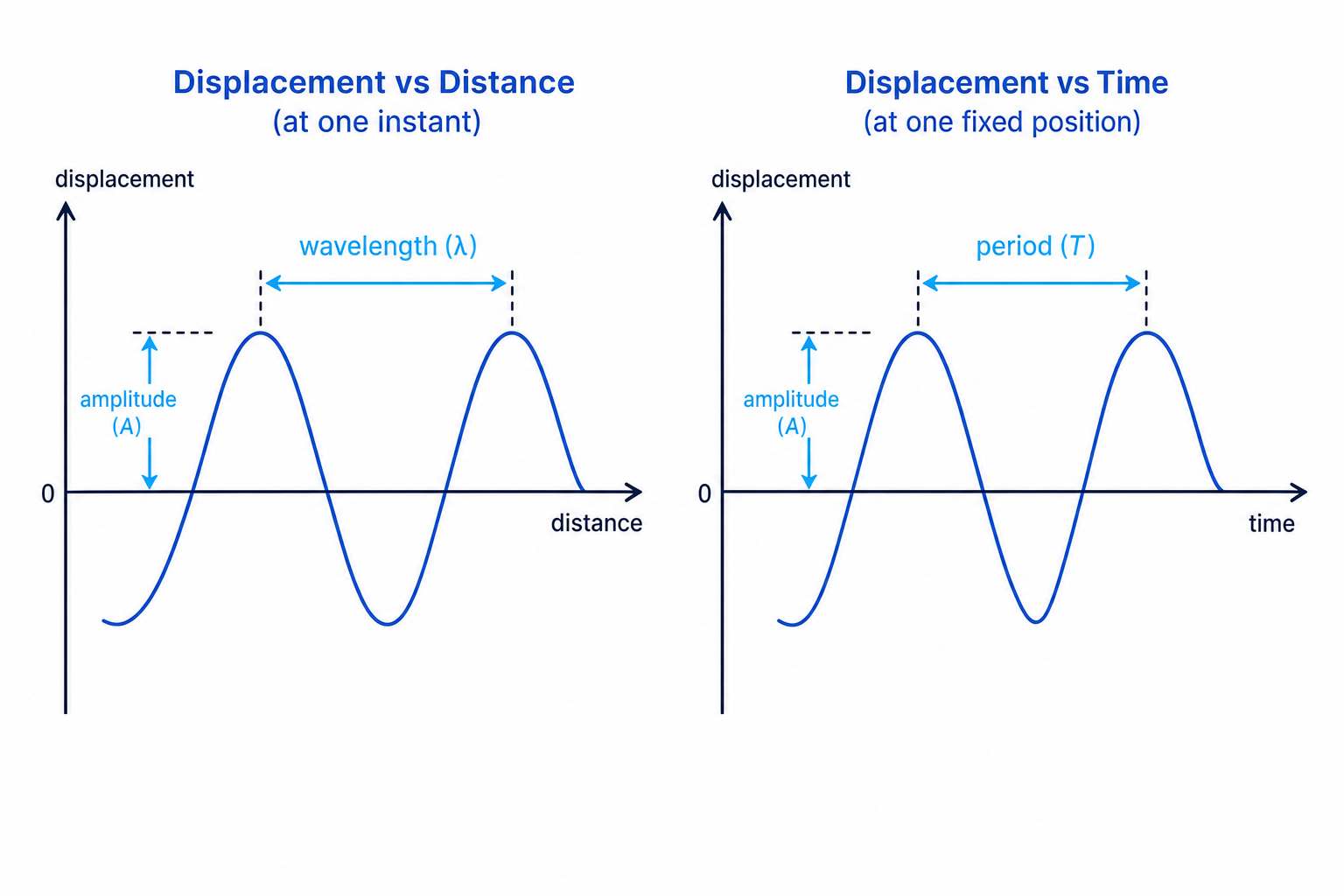
A displacement-distance graph is a snapshot of the wave shape at one instant. It tells you the wavelength.
A displacement-time graph shows how one fixed point moves as time passes. It tells you the period.
Key Idea
Which graph gives which quantity?
On a displacement-distance graph, one full cycle is a wavelength, λ\lambdaλ. On a displacement-time graph, one full cycle is a period, TTT.
Common Mistake
Mixing up wavelength and period
Wavelength is a distance measured in metres. Period is a time measured in seconds. They may look similar on graphs, but the horizontal axis tells you which one you are reading.
Phase and phase difference
The phase of a point describes where it is within its oscillation cycle. Two points are in phase if they are at the same stage of the cycle, such as crest and crest, and moving in the same direction.
The phase difference is how far one oscillation is ahead of or behind another. It can be measured as a fraction of a cycle, in degrees, or in radians.
Important cases:
- In phase means a phase difference of 0∘0^\circ0∘, 360∘360^\circ360∘, or any whole number of cycles.
- In antiphase means a phase difference of 180∘180^\circ180∘, or half a cycle.
- One complete wavelength corresponds to 360∘360^\circ360∘ or 2π2\pi2π radians.
For two points separated by distance Δx\Delta xΔx along a wave:
Δϕ=360∘×Δxλ\Delta \phi = 360^\circ \times \frac{\Delta x}{\lambda}Δϕ=360∘×λΔxor, in radians:
Δϕ=2π×Δxλ\Delta \phi = 2\pi \times \frac{\Delta x}{\lambda}Δϕ=2π×λΔxExample
Finding phase difference from separation
Two points on a progressive wave are separated by 0.30 m0.30\ \text{m}0.30 m. The wavelength is 1.2 m1.2\ \text{m}1.2 m. Find their phase difference.
- Compare the separation with one wavelength: Δxλ=0.30 m1.2 m=0.25\frac{\Delta x}{\lambda} = \frac{0.30\ \text{m}}{1.2\ \text{m}} = 0.25λΔx=1.2 m0.30 m=0.25 of a cycle.
- Convert the fraction of a cycle into degrees: Δϕ=0.25×360∘=90∘\Delta \phi = 0.25 \times 360^\circ = 90^\circΔϕ=0.25×360∘=90∘.
- In radians, the same phase difference is Δϕ=0.25×2π=π2 rad\Delta \phi = 0.25 \times 2\pi = \frac{\pi}{2}\ \text{rad}Δϕ=0.25×2π=2π rad.
The wave equation
A wave speed, vvv, is the speed at which the wave pattern or energy travels. It is measured in metres per second.
In one period, a progressive wave moves forward by one wavelength. So:
v=λTv = \frac{\lambda}{T}v=TλSince f=1Tf = \frac{1}{T}f=T1, this becomes the wave equation:
v=fλv = f\lambdav=fλwhere:
- vvv is wave speed in metres per second.
- fff is frequency in hertz.
- λ\lambdaλ is wavelength in metres.
Key Idea
The wave equation
For any progressive wave, use v=fλv = f\lambdav=fλ. If the wave speed is constant, a higher frequency means a shorter wavelength.
Example
Using the wave equation
A microwave has frequency 2.45 GHz2.45\ \text{GHz}2.45 GHz. Assume it travels at 3.00×10⁸ m s−13.00 \times 10^8\ \text{m s}^{-1}3.00×10⁸ m s−1. Calculate its wavelength.
- Convert the frequency into hertz: 2.45 GHz=2.45×10⁹ Hz2.45\ \text{GHz} = 2.45 \times 10^9\ \text{Hz}2.45 GHz=2.45×10⁹ Hz.
- Rearrange v=fλv = f\lambdav=fλ to make wavelength the subject: λ=vf\lambda = \frac{v}{f}λ=fv.
- Substitute the values: λ=3.00×10⁸ m s−12.45×10⁹ Hz=0.122 m\lambda = \frac{3.00 \times 10^8\ \text{m s}^{-1}}{2.45 \times 10^9\ \text{Hz}} = 0.122\ \text{m}λ=2.45×10⁹ Hz3.00×108 m s−1=0.122 m.
Tip
Unit check for
Hertz means per second, so Hz\text{Hz}Hz is equivalent to s−1\text{s}^{-1}s−1. Therefore fλf\lambdafλ has units s−1⋅m\text{s}^{-1} \cdot \text{m}s−1⋅m, which gives metres per second.
Common Mistake
Changing medium
When a wave crosses into a different medium, its speed can change. The frequency usually stays the same, so the wavelength changes according to v=fλv = f\lambdav=fλ.
Measuring wave quantities in practice
For a wave on a string or in a ripple tank, you can estimate wavelength by measuring across several complete wavelengths, then dividing by the number of wavelengths. This reduces percentage uncertainty.
For sound waves, an oscilloscope can show a displacement-time or voltage-time trace from a microphone. You can read the period from several cycles and then calculate frequency using f=1Tf = \frac{1}{T}f=T1.
Good practical habits include:
- Measure across multiple cycles where possible.
- Repeat readings and calculate a mean.
- Check whether the graph axis is distance or time before choosing λ\lambdaλ or TTT.
- Keep units consistent before substituting into equations.
Exam technique
In the exam
- Identify the graph type first: distance on the horizontal axis gives λ\lambdaλ; time on the horizontal axis gives TTT.
- Convert prefixes before calculating, such as kHz to Hz or cm to m.
- For wave equation questions, write v=fλv = f\lambdav=fλ, rearrange algebraically, then substitute values with units.
Self review
Check yourself
- What is the difference between a transverse wave and a longitudinal wave?
- A wave has period 0.020 s0.020\ \text{s}0.020 s. How would you find its frequency?
- On a displacement-distance graph, how could you identify one wavelength?