Revision notes for Edexcel A Level Physics Superposition and stationary waves. Open the guide for explanations and worked examples. Written against the Edexcel A Level Physics (9PH0) specification, so the content matches what's examinable rather than general Physics background.
Superposition and stationary waves
What you'll learn
- How to use the principle of superposition to find the resultant wave displacement.
- How constructive and destructive interference depend on phase and path difference.
- How stationary waves form, and how to identify nodes, antinodes and harmonics.
- How to calculate allowed wavelengths and frequencies for strings and air columns.
The wave ideas you need first
A wave transfers energy and information without a net transfer of matter. In this topic, you mainly deal with transverse waves, where the oscillations are perpendicular to the direction of travel, and waves on strings or in air columns.
Key quantities:
- Displacement is how far a point is from its equilibrium position at a particular instant.
- Amplitude is the maximum displacement from equilibrium.
- Wavelength, λ\lambdaλ, is the distance between two adjacent points in phase, such as crest to crest.
- Frequency, fff, is the number of complete oscillations per second, measured in hertz, Hz.
- Wave speed, vvv, is given by:
Definition
Phase
Phase describes where a point is in its oscillation cycle. Two points are in phase if they move together with the same displacement pattern; they are in antiphase if one is doing exactly the opposite of the other.
For points on the same wave, the phase difference is linked to their separation:
Δϕ=2πΔxλ\Delta \phi = \frac{2\pi \Delta x}{\lambda}Δϕ=λ2πΔxwhere Δϕ\Delta \phiΔϕ is the phase difference in radians and Δx\Delta xΔx is the separation along the wave.
Example
Calculating phase difference
Two points on a wave are separated by 0.30 m. The wavelength is 1.20 m. Find their phase difference.
-
Use the phase difference equation:
Δϕ=2πΔxλ\Delta \phi = \frac{2\pi \Delta x}{\lambda}Δϕ=λ2πΔx -
Substitute the values:
Δϕ=2π×0.301.20\Delta \phi = \frac{2\pi \times 0.30}{1.20}Δϕ=1.202π×0.30 -
Simplify the fraction:
Δϕ=π2 rad\Delta \phi = \frac{\pi}{2}\ \text{rad}Δϕ=2π rad
So the points are a quarter of a cycle apart.
The principle of superposition
When two waves meet, they do not bounce off each other like solid objects. Instead, the medium has one resultant displacement, found by adding the individual displacements at that point and instant.
Definition
Principle of superposition
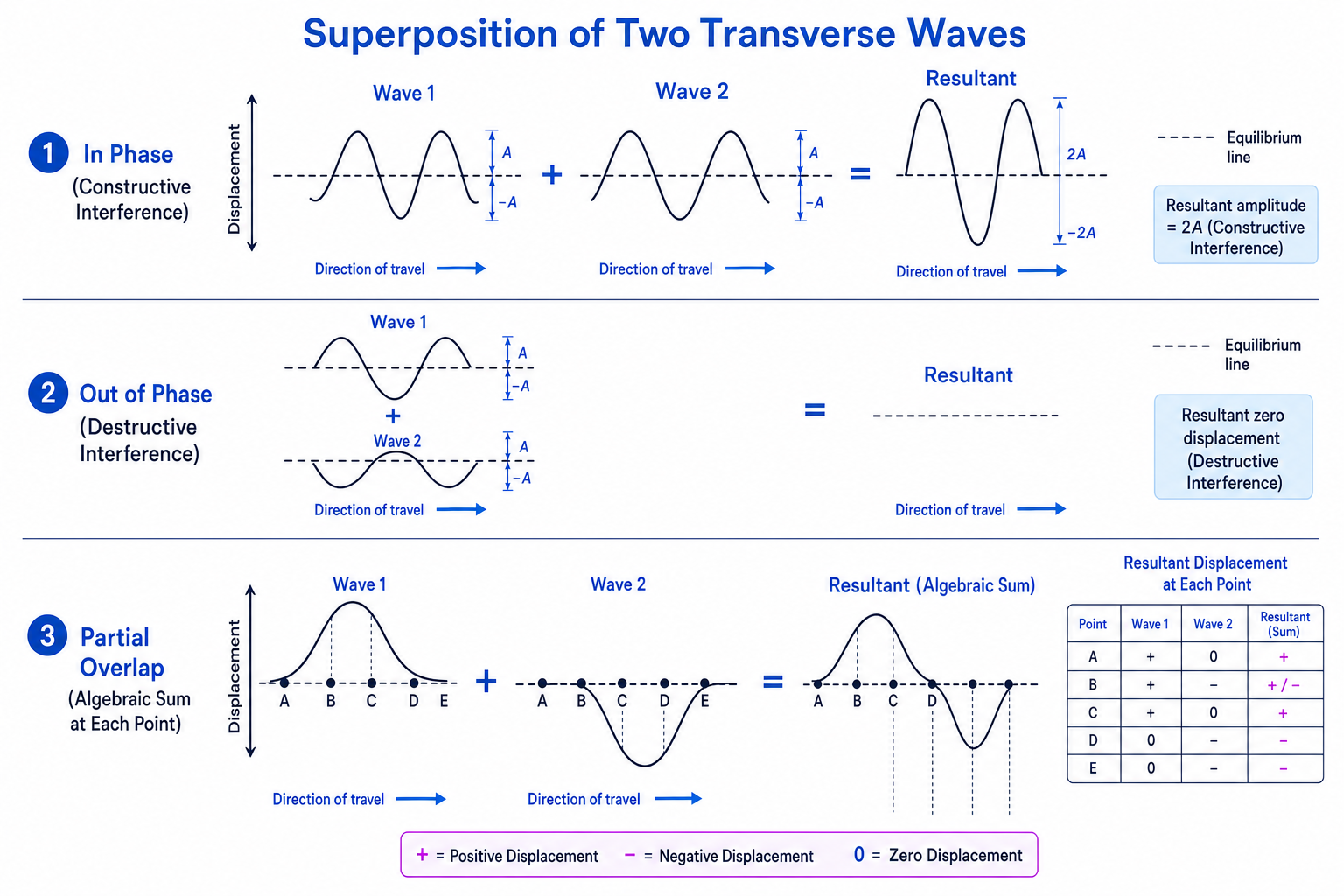
When two or more waves overlap, the resultant displacement at any point is the algebraic sum of the individual displacements of the waves at that point.
“Algebraic” matters: upward displacement and downward displacement have opposite signs.
The diagram shows how overlapping waves combine. In phase waves reinforce; waves in antiphase cancel if their amplitudes are equal.
Example
Adding displacements
At one instant, two pulses overlap on a string. Pulse 1 gives an upward displacement of 4.0 mm. Pulse 2 gives a downward displacement of 1.5 mm. Find the resultant displacement.
-
Choose upward as positive, so the displacements are:
y1=+4.0×10⁻³ my_1 = +4.0 \times 10^{-3}\ \text{m}y1=+4.0×10⁻³ m y2=−1.5×10⁻³ my_2 = -1.5 \times 10^{-3}\ \text{m}y2=−1.5×10⁻³ m -
Add the displacements:
y=y1+y2=4.0×10⁻³−1.5×10⁻³y = y_1 + y_2 = 4.0 \times 10^{-3} - 1.5 \times 10^{-3}y=y1+y2=4.0×10⁻³−1.5×10⁻³ -
Calculate and interpret the sign:
y=+2.5×10⁻³ my = +2.5 \times 10^{-3}\ \text{m}y=+2.5×10⁻³ m
The resultant displacement is 2.5 mm upward.
Common Mistake
Adding amplitudes instead of displacements
Amplitude is a maximum value, so it is not usually positive or negative. In superposition questions, add the instantaneous displacements, including their signs.
Interference
Interference is the effect produced when waves superpose. It can be reinforcement, cancellation, or anything in between.
Constructive interference
Constructive interference happens when waves meet in phase. Their displacements have the same sign, so the resultant amplitude is larger.
For two identical waves in phase:
Aresultant=2AA_\text{resultant} = 2AAresultant=2ADestructive interference
Destructive interference happens when waves meet in antiphase. Their displacements have opposite signs. If the waves have equal amplitude, they cancel completely at that instant or point.
For two equal-amplitude waves in antiphase:
Aresultant=0A_\text{resultant} = 0Aresultant=0Key Idea
Path difference rules
For two coherent sources that start in phase:
- Constructive interference occurs when the path difference is nλn\lambdanλ.
- Destructive interference occurs when the path difference is (n+12)λ\left(n + \frac{1}{2}\right)\lambda(n+21)λ.
- Here, nnn is an integer: 0, 1, 2, 3, and so on.
A coherent pair of sources has a constant phase difference and the same frequency. Coherence is needed for a stable interference pattern.
Example
Deciding the type of interference
Two coherent in-phase sources produce waves of wavelength 0.80 m. At a point, the path difference from the two sources is 1.20 m. Decide whether the interference is constructive or destructive.
-
Compare the path difference with the wavelength:
1.200.80=1.5\frac{1.20}{0.80} = 1.50.801.20=1.5 -
Write this as a multiple of the wavelength:
1.20 m=1.5λ1.20\ \text{m} = 1.5\lambda1.20 m=1.5λ -
A path difference of 1.5λ1.5\lambda1.5λ is the same as (1+12)λ\left(1 + \frac{1}{2}\right)\lambda(1+21)λ, so the waves arrive in antiphase.
The interference is destructive.
Stationary waves
A progressive wave travels through space and transfers energy from one place to another. A stationary wave looks very different: the pattern stays in the same place.
Definition
Stationary wave
A stationary wave is a wave pattern with fixed nodes and antinodes, formed by the superposition of two progressive waves of the same frequency and amplitude travelling in opposite directions.
A stationary wave often forms when a wave reflects back on itself. For example, a wave travelling along a string reflects from a fixed end and overlaps with the incoming wave.
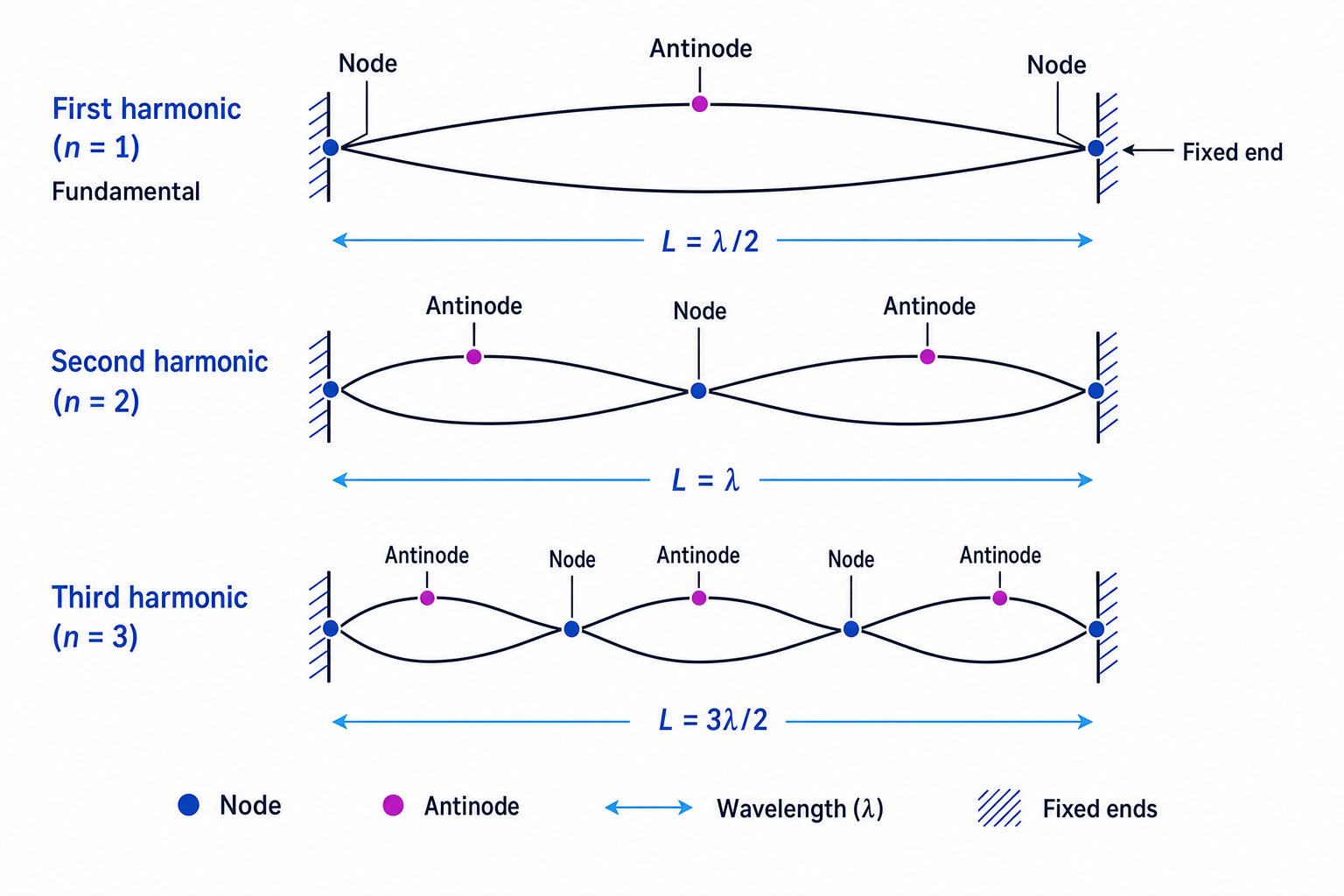
- A node is a point of zero amplitude.
- An antinode is a point of maximum amplitude.
- Adjacent nodes are separated by λ2\frac{\lambda}{2}2λ.
- Adjacent antinodes are also separated by λ2\frac{\lambda}{2}2λ.
- A node and the nearest antinode are separated by λ4\frac{\lambda}{4}4λ.
The diagram shows the first three stationary wave patterns on a string fixed at both ends.
Tip
Counting loops
Each “loop” between two neighbouring nodes is half a wavelength. So if a string has three loops, its length is 3λ2\frac{3\lambda}{2}23λ.
Harmonics on a string fixed at both ends
For a string fixed at both ends, both ends must be nodes. This restricts the wavelengths that can fit on the string.
If the string has length LLL, then:
L=nλn2L = \frac{n\lambda_n}{2}L=2nλnso:
λn=2Ln\lambda_n = \frac{2L}{n}λn=n2Lwhere nnn is the harmonic number: 1, 2, 3, and so on.
The corresponding frequencies are:
fn=vλn=nv2Lf_n = \frac{v}{\lambda_n} = \frac{nv}{2L}fn=λnv=2LnvThe fundamental frequency is the lowest possible frequency. It is also called the first harmonic.
Example
Finding harmonic frequencies on a string
A string of length 0.75 m is fixed at both ends. The wave speed on the string is 120 m s−1120\ \text{m s}^{-1}120 m s−1. Calculate the first three harmonic frequencies.
-
For a string fixed at both ends, use:
fn=nv2Lf_n = \frac{nv}{2L}fn=2Lnv -
Find the fundamental frequency:
f1=1×1202×0.75=80 Hzf_1 = \frac{1 \times 120}{2 \times 0.75} = 80\ \text{Hz}f1=2×0.751×120=80 Hz -
Use the fact that harmonics are integer multiples of the fundamental:
f2=2f1=160 Hzf_2 = 2f_1 = 160\ \text{Hz}f2=2f1=160 Hz f3=3f1=240 Hzf_3 = 3f_1 = 240\ \text{Hz}f3=3f1=240 Hz
The first three harmonic frequencies are 80 Hz, 160 Hz and 240 Hz.
Common Mistake
Using the whole string as one wavelength
For the fundamental on a string fixed at both ends, the string length is not one wavelength. It is half a wavelength, so L=λ2L = \frac{\lambda}{2}L=2λ.
Stationary waves in air columns
Stationary waves can also form in air columns, such as in organ pipes or resonance tubes. The important idea is whether each end is open or closed.
- At a closed end, the air cannot move freely, so there is a displacement node.
- At an open end, the air can move freely, so there is a displacement antinode.
For an air column open at both ends, the pattern is like a string fixed at both ends in terms of allowed wavelengths:
fn=nv2Lf_n = \frac{nv}{2L}fn=2LnvFor an air column closed at one end and open at the other, only odd harmonics are allowed:
fn=(2n−1)v4Lf_n = \frac{(2n - 1)v}{4L}fn=4L(2n−1)vwhere n=1,2,3,…n = 1, 2, 3, \ldotsn=1,2,3,…
Example
Closed-pipe resonance frequencies
A pipe is closed at one end and open at the other. Its length is 0.250 m. Take the speed of sound as 340 m s−1340\ \text{m s}^{-1}340 m s−1. Find the fundamental frequency and the next resonance frequency.
-
For a closed-open pipe, use:
fn=(2n−1)v4Lf_n = \frac{(2n - 1)v}{4L}fn=4L(2n−1)v -
For the fundamental, set n=1n = 1n=1:
f1=1×3404×0.250=340 Hzf_1 = \frac{1 \times 340}{4 \times 0.250} = 340\ \text{Hz}f1=4×0.2501×340=340 Hz -
The next allowed resonance is the third harmonic, so set n=2n = 2n=2:
f2=3×3404×0.250=1020 Hzf_2 = \frac{3 \times 340}{4 \times 0.250} = 1020\ \text{Hz}f2=4×0.2503×340=1020 Hz
The first two resonance frequencies are 340 Hz and 1020 Hz.
Practical notes: measuring wavelength from a stationary wave
In a lab, you might create stationary waves on a string using a signal generator and vibration generator. By adjusting the frequency, you can find clear resonance patterns.
To find the wavelength, measure the distance between adjacent nodes and double it:
λ=2×node spacing\lambda = 2 \times \text{node spacing}λ=2×node spacingThen use:
v=fλv = f\lambdav=fλExample
Finding wave speed from node spacing
A stationary wave is formed on a string at a frequency of 95 Hz. The distance between adjacent nodes is 0.180 m. Find the wave speed.
-
Adjacent nodes are separated by half a wavelength:
λ2=0.180 m\frac{\lambda}{2} = 0.180\ \text{m}2λ=0.180 m -
Calculate the wavelength:
λ=2×0.180=0.360 m\lambda = 2 \times 0.180 = 0.360\ \text{m}λ=2×0.180=0.360 m -
Use the wave equation:
v=fλ=95×0.360=34.2 m s−1v = f\lambda = 95 \times 0.360 = 34.2\ \text{m s}^{-1}v=fλ=95×0.360=34.2 m s−1
The wave speed is 34.2 m s−134.2\ \text{m s}^{-1}34.2 m s−1.
Common Mistake
Check the boundary conditions
The formula fn=nv2Lf_n = \frac{nv}{2L}fn=2Lnv only applies when both ends are the same type of boundary: both nodes or both antinodes. For a closed-open air column, use the quarter-wavelength pattern instead.
Exam technique
In the exam
- Draw the wave pattern first: mark nodes and antinodes, then count how many half-wavelengths fit into the length.
- For interference questions, compare the path difference with λ\lambdaλ: whole numbers give constructive interference, half-integers give destructive interference for in-phase sources.
- In stationary wave calculations, be clear whether the system is fixed-fixed, open-open, or closed-open before choosing the formula.
Self review
Check yourself
- Why are adjacent nodes separated by λ2\frac{\lambda}{2}2λ rather than λ\lambdaλ?
- A string fixed at both ends shows four loops. What harmonic is this, and how is LLL related to λ\lambdaλ?
- What path difference gives destructive interference for two coherent in-phase sources?