Revision notes for Edexcel A Level Physics Force-extension graphs and elastic energy. Open the guide for explanations and worked examples. Written against the Edexcel A Level Physics (9PH0) specification, so the content matches what's examinable rather than general Physics background.
Force-extension graphs and elastic energy
What you'll learn
- How to interpret a force-extension graph for a spring, wire or rubber band.
- How to use Hooke’s law, F=kxF=kxF=kx, and find the spring constant from a graph.
- How to calculate elastic strain energy from the area under a graph.
- How to recognise elastic deformation, plastic deformation and energy losses.
Starting point: forces, length and extension
When you stretch an object, such as a spring or a metal wire, its length increases. In this topic we usually measure:
- the original length before loading
- the new length after a force is applied
- the extension, which is the increase in length
For a hanging mass, the stretching force is usually its weight:
W=mgW=mgW=mgwhere mmm is the mass in kg and ggg is the gravitational field strength, about 9.81 N kg^-1 near Earth’s surface.
Definition
Extension
The extension xxx of an object is the change in its length:
x=L−L0x=L-L_0x=L−L0where L0L_0L0 is the original length and LLL is the stretched length. Extension is measured in metres, m.
Common Mistake
Using length instead of extension
A force-extension graph uses extension on the horizontal axis, not total length. If a spring grows from 12.0 cm to 15.0 cm, the extension is 3.0 cm, not 15.0 cm.
Example
Finding the extension and load
A spring is originally 18.0 cm long. A 250 g mass is hung from it, and its new length is 21.5 cm. Find the extension and the stretching force.
-
Convert the lengths into metres and subtract the original length from the stretched length: x=0.215 m−0.180 m=0.035 mx=0.215\ \text{m}-0.180\ \text{m}=0.035\ \text{m}x=0.215 m−0.180 m=0.035 m.
-
Convert the mass into kg so it can be used in W=mgW=mgW=mg: m=250 g=0.250 kgm=250\ \text{g}=0.250\ \text{kg}m=250 g=0.250 kg.
-
Calculate the load: W=mg=0.250 kg×9.81 N kg−1=2.45 NW=mg=0.250\ \text{kg}\times 9.81\ \text{N kg}^{-1}=2.45\ \text{N}W=mg=0.250 kg×9.81 N kg−1=2.45 N.
-
This measurement would be plotted as the point x=0.035 mx=0.035\ \text{m}x=0.035 m, F=2.45 NF=2.45\ \text{N}F=2.45 N on a force-extension graph.
Hooke’s law and the spring constant
For many springs and wires, small extensions are very predictable: doubling the force doubles the extension. That is Hooke’s law.
Definition
Hooke’s law
Hooke’s law states that the force applied to a spring or wire is directly proportional to its extension, provided the limit of proportionality has not been exceeded:
F=kxF=kxF=kxHere FFF is force in newtons, N, xxx is extension in metres, m, and kkk is the spring constant in N m^-1.
The spring constant kkk tells you how stiff the object is. A larger kkk means more force is needed for the same extension.
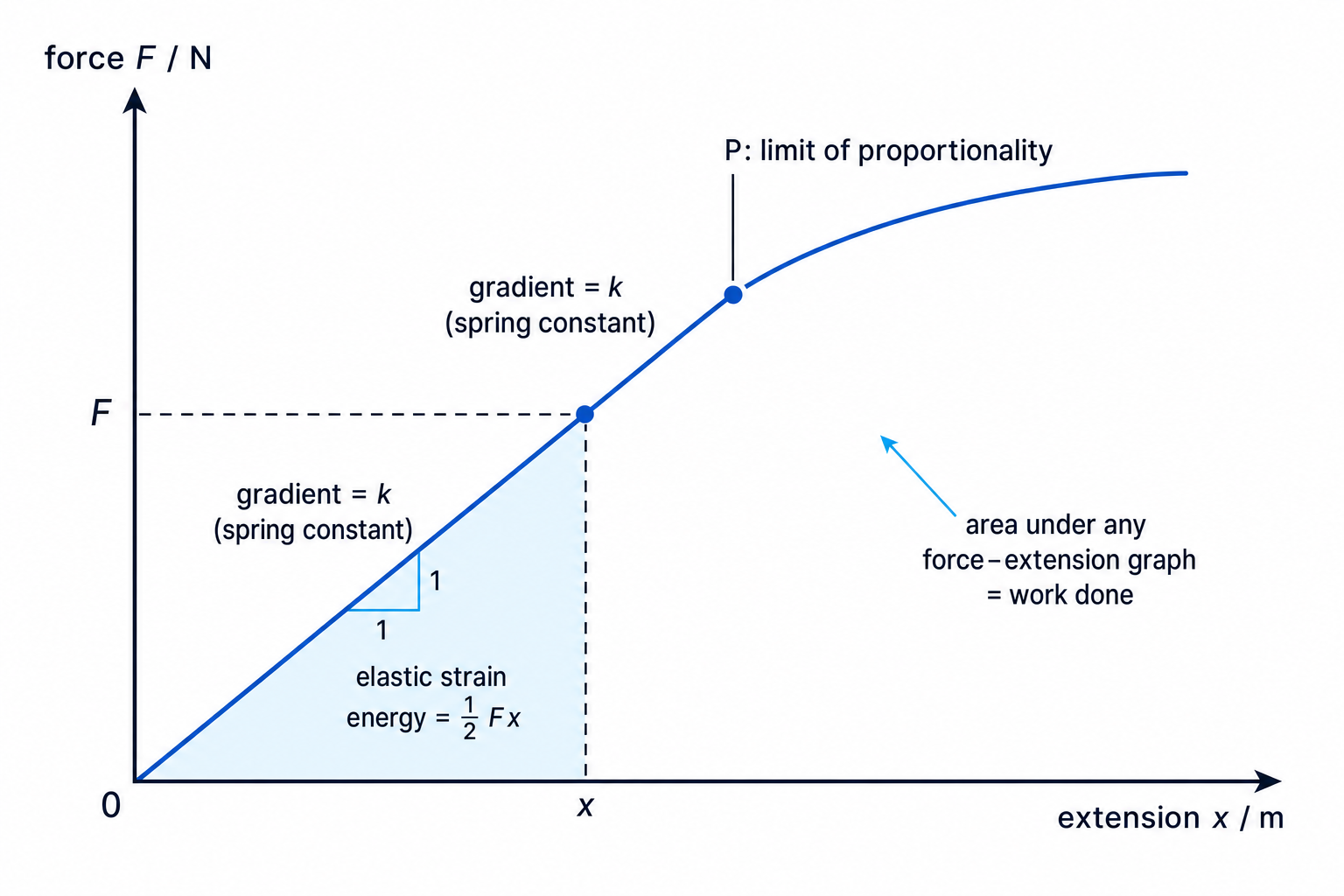
On a force-extension graph, the straight-line section has gradient:
k=ΔFΔxk=\frac{\Delta F}{\Delta x}k=ΔxΔFKey Idea
Gradient means stiffness
For a force-extension graph, the gradient of the straight-line section is the spring constant kkk. A steeper line means a stiffer spring or wire.
Example
Finding the spring constant from a graph
A spring has a straight-line force-extension graph. At an extension of 0.040 m, the force is 8.0 N. Find the spring constant and predict the extension when the force is 5.0 N.
-
Use the gradient of the straight-line graph: k=ΔFΔxk=\frac{\Delta F}{\Delta x}k=ΔxΔF.
-
Substitute the graph values: k=8.0 N0.040 m=200 N m−1k=\frac{8.0\ \text{N}}{0.040\ \text{m}}=200\ \text{N m}^{-1}k=0.040 m8.0 N=200 N m−1.
-
Rearrange Hooke’s law to find extension: x=Fkx=\frac{F}{k}x=kF.
-
Substitute the new force: x=5.0 N200 N m−1=0.025 mx=\frac{5.0\ \text{N}}{200\ \text{N m}^{-1}}=0.025\ \text{m}x=200 N m−15.0 N=0.025 m.
Tip
Choosing a gradient triangle
When finding kkk from a graph, use a large triangle drawn on the best-fit straight line. Do not just divide one plotted point by another if the data are noisy.
Reading a force-extension graph
A typical force-extension graph has force on the vertical axis and extension on the horizontal axis. For a spring obeying Hooke’s law, the graph is a straight line through the origin. Once the material stops behaving proportionally, the graph curves.
Definition
Limits and deformation
- The limit of proportionality is the point beyond which force is no longer directly proportional to extension.
- The elastic limit is the point beyond which the object will not return to its original length when the force is removed.
- Elastic deformation means the object returns to its original shape and length after the load is removed.
- Plastic deformation means the object has a permanent change in shape or length after the load is removed.
The limit of proportionality and elastic limit are often close together, but they are not the same idea. A material can stop being proportional before it becomes permanently deformed.
Common Mistake
Do not overuse Hooke’s law
Only use F=kxF=kxF=kx while the graph is straight and passes through the origin. Beyond the limit of proportionality, kkk is no longer constant for that object.
Work done and elastic strain energy
When you stretch a spring, you do work on it. That energy is transferred into the spring as elastic strain energy, as long as the deformation is elastic.
Definition
Elastic strain energy
Elastic strain energy is the energy stored in a stretched or compressed object due to its deformation. It is measured in joules, J.
For any force-extension graph:
Key Idea
Area under the graph
The work done stretching a material is equal to the area under its force-extension graph.
This is because the force may not be constant while the object stretches. For a small extra extension, the work done is approximately force times extra extension. Adding all these small strips gives the area under the graph.
For a spring obeying Hooke’s law, the graph is a triangle, so:
Ee=12FxE_e=\frac{1}{2}FxEe=21FxSince F=kxF=kxF=kx, you can also write:
Ee=12kx2E_e=\frac{1}{2}kx^2Ee=21kx2or:
Ee=F22kE_e=\frac{F^2}{2k}Ee=2kF2These are all equivalent for the straight-line Hooke’s law region.
Common Mistake
Forgetting the factor of one half
For a Hooke’s law spring, the force increases from zero to FFF, so the average force is F2\frac{F}{2}2F. That is why elastic strain energy is 12Fx\frac{1}{2}Fx21Fx, not FxFxFx.
Example
Calculating elastic strain energy
A spring has spring constant 250 N m^-1 and is stretched by 6.0 cm. Calculate the elastic strain energy stored.
-
Convert the extension into metres: x=6.0 cm=0.060 mx=6.0\ \text{cm}=0.060\ \text{m}x=6.0 cm=0.060 m.
-
Choose the equation using kkk and xxx: Ee=12kx2E_e=\frac{1}{2}kx^2Ee=21kx2.
-
Substitute carefully: Ee=12×250 N m−1×(0.060 m)2E_e=\frac{1}{2}\times 250\ \text{N m}^{-1}\times \left(0.060\ \text{m}\right)^2Ee=21×250 N m−1×(0.060 m)2.
-
Calculate the energy: Ee=0.45 JE_e=0.45\ \text{J}Ee=0.45 J.
Curved force-extension graphs
Not all materials have a straight force-extension graph. Rubber bands, biological tissues and materials stretched beyond their proportional region often give curved graphs.
For curved graphs, you cannot use 12Fx\frac{1}{2}Fx21Fx unless the graph is actually a straight line from the origin. Instead, estimate the area under the graph by counting squares or by splitting the area into trapezia.
Example
Estimating work done from graph data
A material is stretched and the following values are read from a curved force-extension graph: at 0 m, force is 0 N; at 0.020 m, force is 4.0 N; at 0.040 m, force is 9.0 N; at 0.060 m, force is 15.0 N. Estimate the work done from 0 m to 0.060 m.
-
Split the area under the graph into three trapezia, each with width 0.020 m.
-
Calculate the first trapezium: 12(0+4.0)N×0.020 m=0.040 J\frac{1}{2}\left(0+4.0\right)\text{N}\times 0.020\ \text{m}=0.040\ \text{J}21(0+4.0)N×0.020 m=0.040 J.
-
Calculate the second trapezium: 12(4.0+9.0)N×0.020 m=0.130 J\frac{1}{2}\left(4.0+9.0\right)\text{N}\times 0.020\ \text{m}=0.130\ \text{J}21(4.0+9.0)N×0.020 m=0.130 J.
-
Calculate the third trapezium: 12(9.0+15.0)N×0.020 m=0.240 J\frac{1}{2}\left(9.0+15.0\right)\text{N}\times 0.020\ \text{m}=0.240\ \text{J}21(9.0+15.0)N×0.020 m=0.240 J.
-
Add the areas: W=0.040 J+0.130 J+0.240 J=0.410 JW=0.040\ \text{J}+0.130\ \text{J}+0.240\ \text{J}=0.410\ \text{J}W=0.040 J+0.130 J+0.240 J=0.410 J, so the work done is about 0.41 J.
Loading, unloading and hysteresis
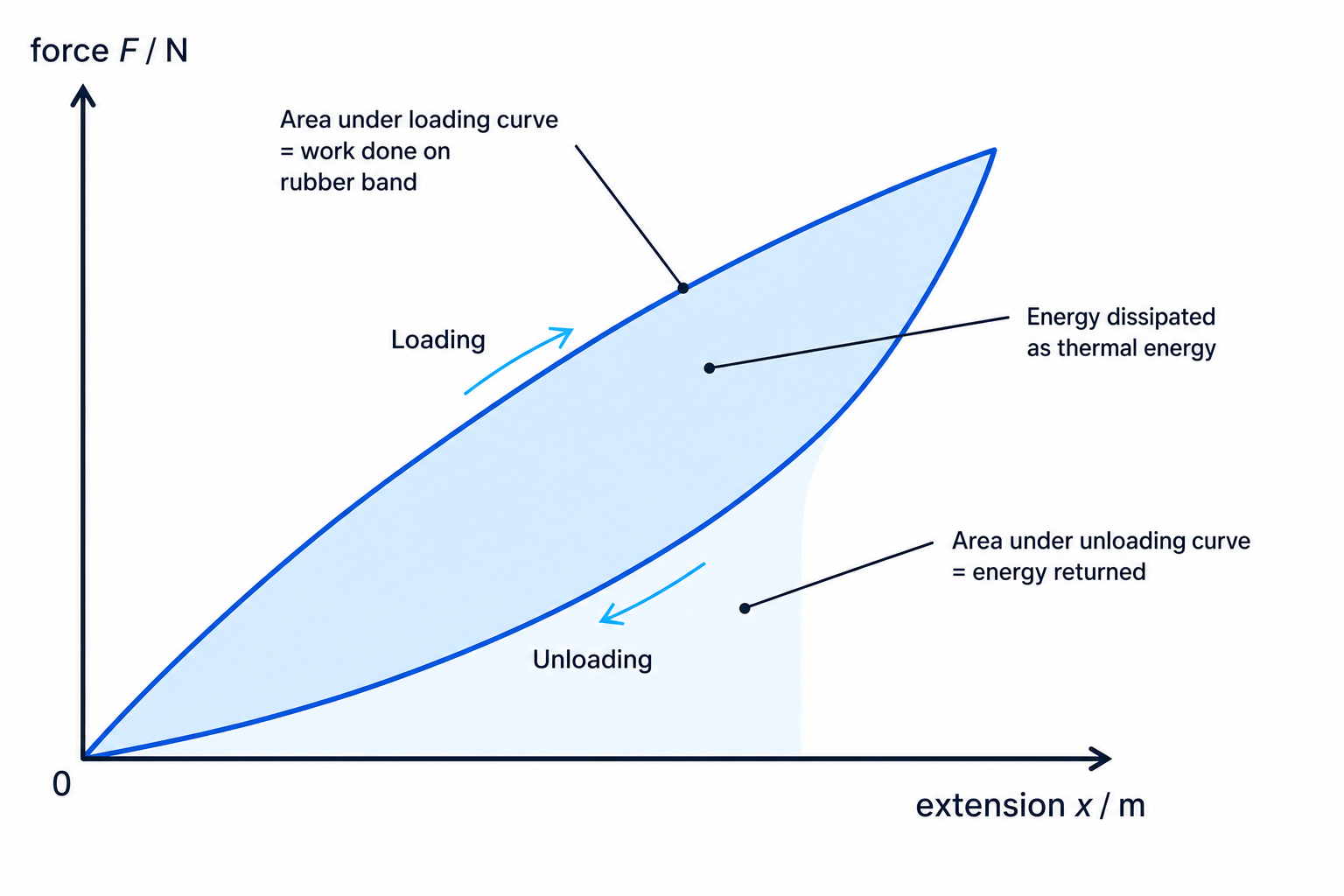
Loading means increasing the force on the material. Unloading means removing the force. For an ideal spring within its elastic limit, the unloading graph follows the same line back to the origin, so the stored energy is returned.
Rubber bands often behave differently: the unloading curve is below the loading curve. This means less energy is returned than was put in.
Definition
Hysteresis
Hysteresis is when the loading and unloading curves are different. The area between the curves is the energy dissipated, usually transferred to thermal energy in the material and surroundings.
Example
Finding energy dissipated in a loading cycle
A rubber band is stretched and released. The area under the loading curve is 1.20 J. The area under the unloading curve is 0.75 J. Find the energy dissipated.
-
Interpret the loading area as the work done on the rubber band: Ein=1.20 JE_{\text{in}}=1.20\ \text{J}Ein=1.20 J.
-
Interpret the unloading area as the energy returned by the rubber band: Ereturned=0.75 JE_{\text{returned}}=0.75\ \text{J}Ereturned=0.75 J.
-
Subtract the returned energy from the input energy: Edissipated=1.20 J−0.75 J=0.45 JE_{\text{dissipated}}=1.20\ \text{J}-0.75\ \text{J}=0.45\ \text{J}Edissipated=1.20 J−0.75 J=0.45 J.
Practical graph skills
In a typical lab experiment, you might hang masses from a spring or wire and measure the extension for each load. To get reliable force-extension data:
- measure the original length before adding masses
- convert mass to force using W=mgW=mgW=mg
- wait for the object to stop oscillating before reading the ruler
- use a fiducial marker or set square to reduce parallax error
- plot force on the vertical axis and extension on the horizontal axis
- draw a best-fit line or curve, not dot-to-dot lines
If each length reading has an uncertainty of about 1 mm, the extension may have a larger uncertainty because it is found by subtracting two readings.
Tip
Graph marks are often easy marks
Label axes with quantities and units, use SI units, plot points accurately, and take the gradient from a large triangle on the best-fit straight section. If the graph curves, describe the trend rather than forcing a straight line.
Energy transfers using springs
Elastic strain energy can be transferred into other forms. For example, a stretched spring might launch a trolley, so elastic strain energy becomes kinetic energy. If there are no significant losses, you can equate the energies:
12kx2=12mv2\frac{1}{2}kx^2=\frac{1}{2}mv^221kx2=21mv2In real situations, some energy is often dissipated due to friction, air resistance or internal heating.
Exam technique
In the exam
- Check whether the graph is straight through the origin before using F=kxF=kxF=kx or Ee=12FxE_e=\frac{1}{2}FxEe=21Fx.
- Convert extensions into metres and masses into kg before substituting into equations.
- For curved graphs, use the area under the graph: count squares or split the area into trapezia.
- State units clearly: spring constant in N m^-1 and energy in J.
Self review
Check yourself
- What does the gradient of a straight force-extension graph tell you?
- Why is the elastic strain energy in a Hooke’s law spring 12Fx\frac{1}{2}Fx21Fx rather than FxFxFx?
- What does the area between loading and unloading curves represent?