Revision notes for Edexcel A Level Physics Refraction and total internal reflection. Open the guide for explanations and worked examples. Written against the Edexcel A Level Physics (9PH0) specification, so the content matches what's examinable rather than general Physics background.
Refraction and total internal reflection
What you'll learn
- Why light changes direction when it crosses a boundary between materials.
- How to use refractive index and Snell’s law to calculate ray angles.
- The conditions for total internal reflection, including the critical angle.
- How refraction can be investigated experimentally using ray diagrams and graphs.
Starting point: rays, boundaries and the normal
Light is an electromagnetic wave, but for refraction problems we often use ray diagrams. A ray is a straight line with an arrow showing the direction that light energy travels.
When a ray reaches the surface between two materials, such as air and glass, that surface is called a boundary. To measure angles properly, we draw a normal: an imaginary line at right angles to the boundary.
Definition
Key ray-diagram terms
- The incident ray is the incoming ray before it reaches the boundary.
- The refracted ray is the ray after it has crossed the boundary and changed direction.
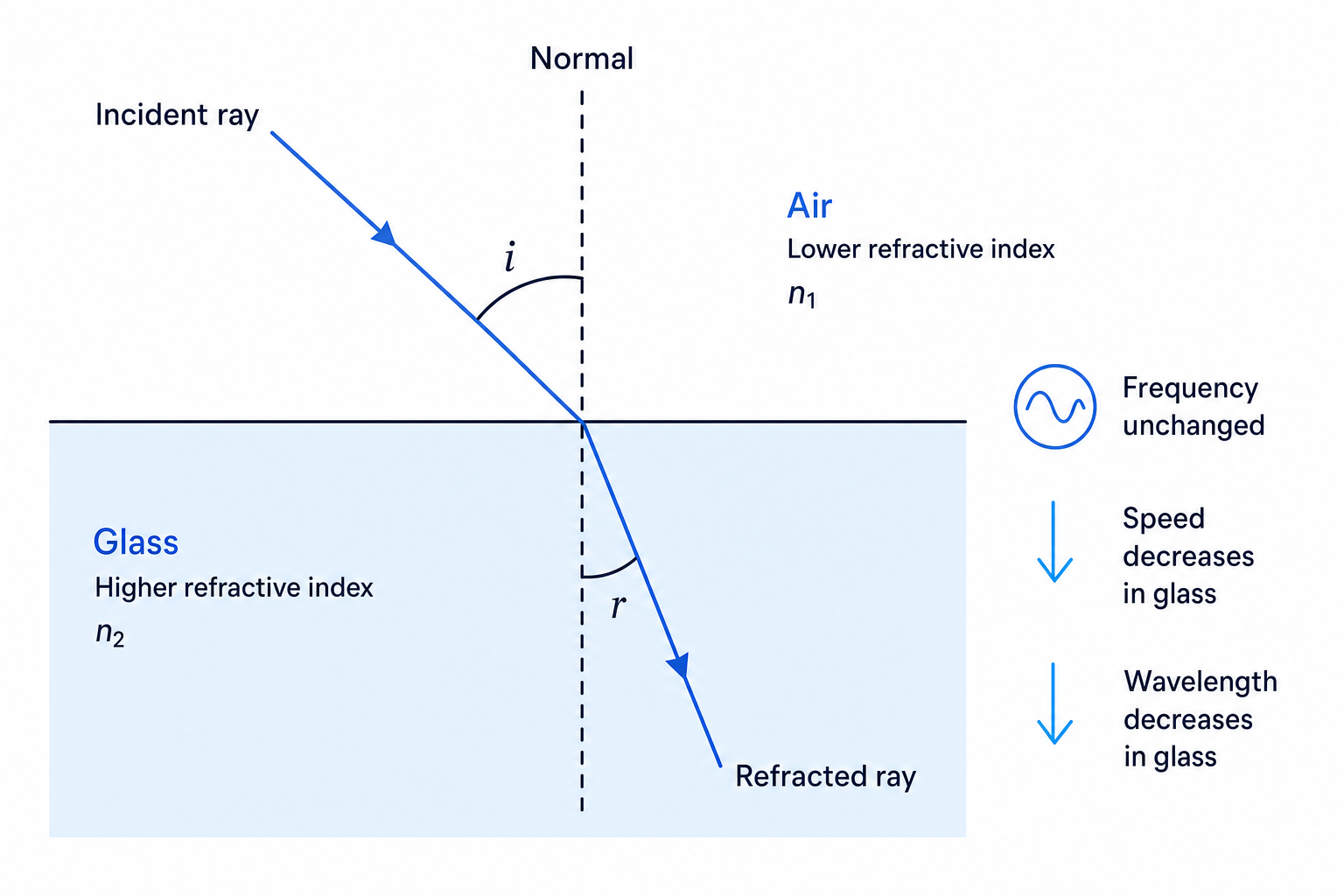
- The angle of incidence, usually iii, is measured between the incident ray and the normal.
- The angle of refraction, usually rrr, is measured between the refracted ray and the normal.
Common Mistake
Measure from the normal, not the surface
Angles in refraction are measured from the normal. If a diagram gives an angle to the surface, subtract it from 90 degrees before using Snell’s law.
Why refraction happens
Refraction is the change in direction of a wave when it crosses a boundary because its speed changes.
For light, the frequency is set by the source, so the frequency stays the same when light enters a new medium. Since wave speed is given by
v=fλv = f\lambdav=fλa change in speed means the wavelength must change.
Refractive index
The refractive index tells you how much a material slows light down compared with light in a vacuum.
Definition
Refractive index
The absolute refractive index nnn of a material is
n=cvn = \frac{c}{v}n=vcwhere ccc is the speed of light in a vacuum, approximately 3.00×10⁸ m s−13.00 \times 10^8\ \text{m s}^{-1}3.00×10⁸ m s−1, and vvv is the speed of light in the material. Refractive index has no unit.
A larger refractive index means light travels more slowly in that material. For example, glass usually has a refractive index of about 1.5, so light travels slower in glass than in air.
Example
Finding the speed and wavelength in glass
Light of frequency 5.00×10¹⁴ Hz5.00 \times 10^{14}\ \text{Hz}5.00×10¹⁴ Hz enters glass of refractive index 1.50.
-
Use the definition of refractive index:
v=cn=3.00×1081.50=2.00×10⁸ m s−1v = \frac{c}{n} = \frac{3.00 \times 10^8}{1.50} = 2.00 \times 10^8\ \text{m s}^{-1}v=nc=1.503.00×108=2.00×10⁸ m s−1 -
Use v=fλv = f\lambdav=fλ to find the wavelength in the glass:
λ=vf=2.00×1085.00×1014=4.00×10⁻⁷ m\lambda = \frac{v}{f} = \frac{2.00 \times 10^8}{5.00 \times 10^{14}} = 4.00 \times 10^{-7}\ \text{m}λ=fv=5.00×10142.00×108=4.00×10⁻⁷ m -
Compare this with the wavelength in a vacuum:
λ0=3.00×1085.00×1014=6.00×10⁻⁷ m\lambda_0 = \frac{3.00 \times 10^8}{5.00 \times 10^{14}} = 6.00 \times 10^{-7}\ \text{m}λ0=5.00×10143.00×108=6.00×10⁻⁷ mThe wavelength is smaller in glass because the speed is lower, while the frequency stays the same.
Which way does the ray bend?
When light enters a material with a higher refractive index, it slows down and bends towards the normal.
When light enters a material with a lower refractive index, it speeds up and bends away from the normal.
The diagram shows light entering glass from air. The refracted angle is smaller than the incident angle because glass has the higher refractive index.
Key Idea
Direction of bending
Into higher nnn: bends towards the normal. Into lower nnn: bends away from the normal. The frequency of the light does not change at the boundary.
Common Mistake
Normal incidence
If a ray travels along the normal, its angle of incidence is zero, so it does not bend. However, its speed and wavelength still change if it enters a material with a different refractive index.
Snell’s law
To calculate the angles, use Snell’s law:
n1sinθ1=n2sinθ2n_1 \sin \theta_1 = n_2 \sin \theta_2n1sinθ1=n2sinθ2Here, n1n_1n1 and n2n_2n2 are the refractive indices of the two materials, and θ1\theta_1θ1 and θ2\theta_2θ2 are the angles measured from the normal in those materials.
For air, you can usually take n=1.00n = 1.00n=1.00 unless the question gives a more precise value.
Example
Calculating an angle of refraction
A ray of light travels from air into glass of refractive index 1.52. The angle of incidence is 40.0∘40.0^\circ40.0∘. Find the angle of refraction.
-
Identify the two media:
n1=1.00,θ1=40.0∘,n2=1.52n_1 = 1.00,\quad \theta_1 = 40.0^\circ,\quad n_2 = 1.52n1=1.00,θ1=40.0∘,n2=1.52 -
Substitute into Snell’s law and rearrange:
sinθ2=n1sinθ1n2=1.00sin40.0∘1.52=0.423\sin \theta_2 = \frac{n_1 \sin \theta_1}{n_2} = \frac{1.00 \sin 40.0^\circ}{1.52} = 0.423sinθ2=n2n1sinθ1=1.521.00sin40.0∘=0.423 -
Take the inverse sine:
θ2=sin−1(0.423)=25.0∘\theta_2 = \sin^{-1}(0.423) = 25.0^\circθ2=sin−1(0.423)=25.0∘This makes sense because the ray enters a higher refractive index, so it bends towards the normal.
Tip
Sanity check your angle
If light goes from air into glass, the refracted angle should be smaller than the incident angle. If your answer is larger, check whether you swapped the refractive indices or measured from the surface.
Parallel-sided glass blocks
In a rectangular glass block, the ray bends towards the normal as it enters, then away from the normal as it leaves.
If the material on both sides is the same, such as air on both sides of a glass block, the emergent ray is parallel to the incident ray. It may be shifted sideways; this is called lateral displacement.
Total internal reflection
Sometimes light does not refract out of a material at all. Instead, all the light reflects back inside the original material. This is called total internal reflection, often shortened to TIR.
Definition
Total internal reflection
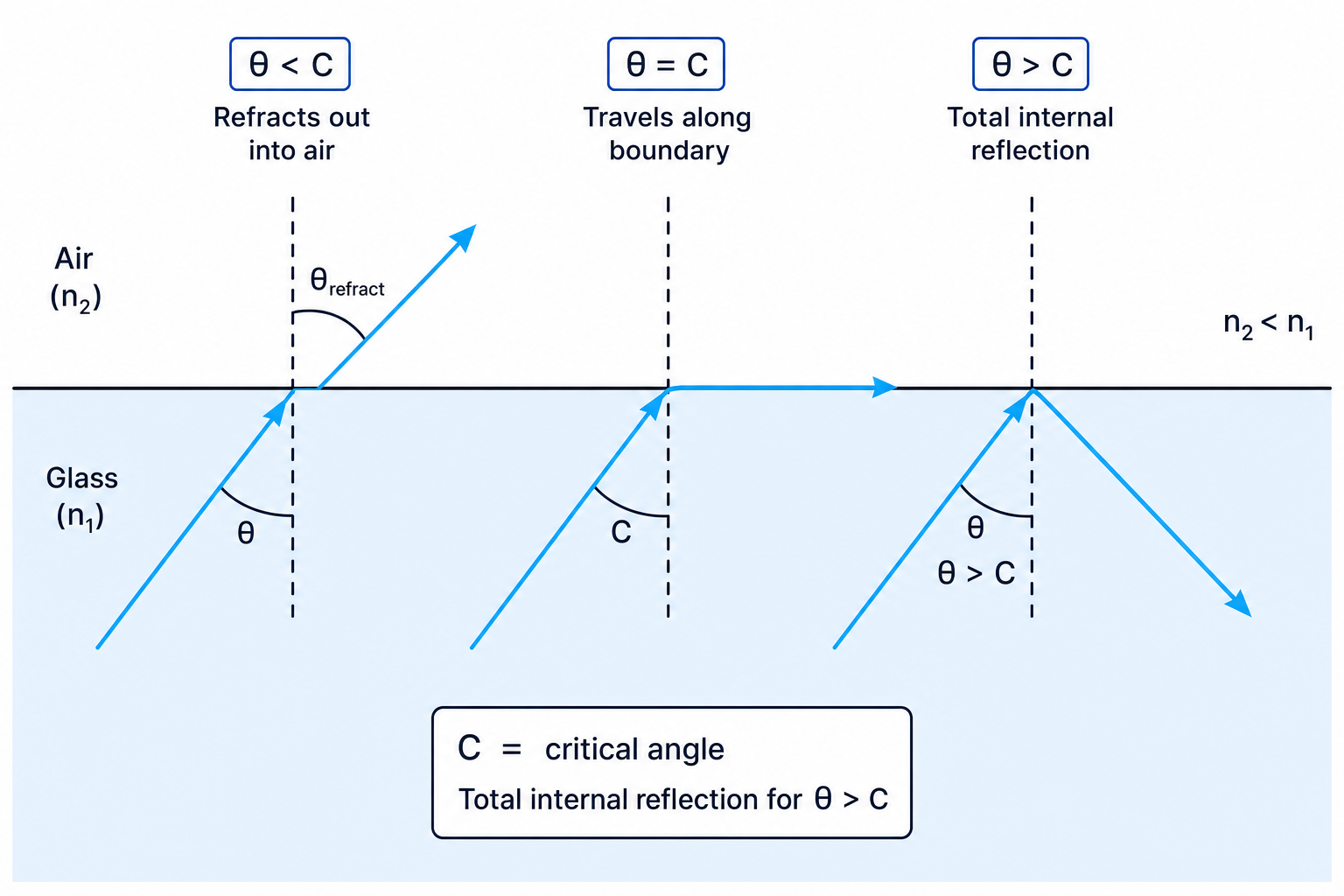
Total internal reflection happens when a ray travelling from a higher refractive index material to a lower refractive index material hits the boundary at an angle greater than the critical angle.
There are two conditions for total internal reflection:
- The ray must travel from higher refractive index to lower refractive index.
- The angle of incidence must be greater than the critical angle.
The diagram shows what happens as the angle of incidence increases at a glass-air boundary.
Critical angle
The critical angle, CCC, is the angle of incidence in the higher refractive index material that makes the refracted ray travel along the boundary.
At the critical angle, the angle of refraction is 90∘90^\circ90∘.
Starting with Snell’s law:
n1sinC=n2sin90∘n_1 \sin C = n_2 \sin 90^\circn1sinC=n2sin90∘Since sin90∘=1\sin 90^\circ = 1sin90∘=1:
sinC=n2n1\sin C = \frac{n_2}{n_1}sinC=n1n2where n1n_1n1 is the higher refractive index and n2n_2n2 is the lower refractive index.
For a material to air, this is often written as:
sinC=1n\sin C = \frac{1}{n}sinC=n1Example
Calculating a critical angle
Light travels inside glass of refractive index 1.50 towards a glass-air boundary. Find the critical angle and decide whether an incident angle of 45.0∘45.0^\circ45.0∘ produces total internal reflection.
-
Identify the direction of travel and the refractive indices:
n1=1.50,n2=1.00n_1 = 1.50,\quad n_2 = 1.00n1=1.50,n2=1.00 -
Use the critical angle equation:
sinC=n2n1=1.001.50=0.667\sin C = \frac{n_2}{n_1} = \frac{1.00}{1.50} = 0.667sinC=n1n2=1.501.00=0.667 -
Find CCC:
C=sin−1(0.667)=41.8∘C = \sin^{-1}(0.667) = 41.8^\circC=sin−1(0.667)=41.8∘ -
Compare the actual angle with the critical angle:
45.0∘>41.8∘45.0^\circ > 41.8^\circ45.0∘>41.8∘So total internal reflection occurs.
Common Mistake
When a critical angle exists
A critical angle only exists when light is travelling from higher refractive index to lower refractive index. If light travels from air into glass, total internal reflection cannot happen at that boundary.
Common Mistake
At the critical angle is not TIR
At exactly the critical angle, the refracted ray travels along the boundary. Total internal reflection happens only when the angle of incidence is greater than the critical angle.
Applications of total internal reflection
Total internal reflection is used in optical fibres. The fibre has a core with a higher refractive index than the surrounding cladding. Light repeatedly reflects at the core-cladding boundary, allowing signals to travel along the fibre.
This is useful in medical endoscopes and telecommunications. The cladding also helps stop light leaking out and prevents signals from crossing into neighbouring fibres.
TIR is also used in prisms, such as in binoculars, where it can reflect light more efficiently than a mirror.
Measuring refractive index experimentally
A common practical method uses a ray box, a rectangular glass or Perspex block, paper, a pencil and a protractor.
You trace the block, shine a narrow ray into it, mark the incident and emergent rays, then remove the block and draw the path through the material. Measure iii and rrr from the normal, repeat for several angles, and use Snell’s law.
For light going from air into a block:
1.00sini=nsinr1.00 \sin i = n \sin r1.00sini=nsinrSo:
sini=nsinr\sin i = n \sin rsini=nsinrIf you plot sini\sin isini on the vertical axis against sinr\sin rsinr on the horizontal axis, the gradient is the refractive index of the block.
Example
Finding refractive index from a graph
A graph of sini\sin isini against sinr\sin rsinr has a best-fit line passing through the points (0.200, 0.294)(0.200,\ 0.294)(0.200, 0.294) and (0.600, 0.882)(0.600,\ 0.882)(0.600, 0.882). Find the refractive index.
-
Calculate the gradient using two well-separated points on the best-fit line:
gradient=0.882−0.2940.600−0.200=0.5880.400=1.47\text{gradient} = \frac{0.882 - 0.294}{0.600 - 0.200} = \frac{0.588}{0.400} = 1.47gradient=0.600−0.2000.882−0.294=0.4000.588=1.47 -
Match the graph to Snell’s law:
sini=nsinr\sin i = n \sin rsini=nsinr -
Since sini\sin isini is on the vertical axis and sinr\sin rsinr is on the horizontal axis, the gradient equals nnn:
n=1.47n = 1.47n=1.47
Tip
Check the axes before using the gradient
If the graph is sinr\sin rsinr against sini\sin isini, the gradient is 1n\frac{1}{n}n1 instead. Always derive the graph relationship from Snell’s law before quoting the refractive index.
For better experimental results, use a sharp ray, draw thin pencil lines, measure angles carefully from the normal, and repeat for a wide range of angles. A semicircular block can be useful for critical angle work because a ray aimed at the centre enters through the curved surface along a radius, so it does not refract at the first surface.
Exam technique
In the exam
- Always draw or imagine the normal first, then measure every angle from the normal.
- Before calculating, decide whether the ray is entering a higher or lower refractive index so you know whether the answer should be smaller or larger.
- For total internal reflection, state both conditions: higher to lower refractive index, and angle of incidence greater than the critical angle.
Self review
Check yourself
- Why does the wavelength of light change when it enters glass, but the frequency does not?
- A ray travels from glass into air. What two conditions are needed for total internal reflection?
- If a graph plots sini\sin isini against sinr\sin rsinr for air into glass, what does the gradient represent?