Revision notes for Edexcel A Level Physics Stress, strain and Young modulus. Open the guide for explanations and worked examples. Written against the Edexcel A Level Physics (9PH0) specification, so the content matches what's examinable rather than general Physics background.
Stress, strain and Young modulus
What you'll learn
- How force and extension lead to stress and strain.
- How to calculate the Young modulus of a material.
- How to interpret force-extension and stress-strain graphs.
- How the Young modulus practical is carried out and evaluated.
Starting point: stretching a material
When you pull on a wire, spring, rubber band or rod, you apply a tensile force. If the object gets longer, its increase in length is called the extension.
For a wire:
- LLL is the original length.
- xxx is the extension.
- FFF is the tensile force applied.
- AAA is the cross-sectional area of the wire.
Definition
Extension
The extension xxx of an object is the increase in its length: x=final length−original lengthx = \text{final length} - \text{original length}x=final length−original length. It is measured in metres, m.
A longer wire usually stretches more than a shorter wire under the same force. A thinner wire usually stretches more than a thicker wire. That means force and extension alone do not tell you only about the material — they also depend on the shape and size of the sample.
Hooke’s law and elastic behaviour
For many materials, if the force is not too large, extension is directly proportional to force:
F=kxF = kxF=kxwhere kkk is the spring constant or force constant, measured in newtons per metre, N m−1^{-1}−1.
Definition
Hooke’s law
An object obeys Hooke’s law if its extension is directly proportional to the force applied, provided the limit of proportionality has not been exceeded.
The limit of proportionality is the point beyond which force and extension are no longer directly proportional.
If an object returns to its original length when the force is removed, the deformation is elastic. If it does not fully return, the deformation is plastic, meaning there is a permanent change in shape.
Example
Using a force-extension graph
A spring stretches by 12.0 mm when a force of 18.0 N is applied. The spring is still in the linear region. Find the spring constant and the elastic energy stored.
-
Convert the extension into metres:
x=12.0 mm=12.0×10⁻³ mx = 12.0\ \text{mm} = 12.0 \times 10^{-3}\ \text{m}x=12.0 mm=12.0×10⁻³ m -
Use F=kxF = kxF=kx, so k=Fxk = \frac{F}{x}k=xF:
k=18.012.0×10−3=1.50×10³ N m−1k = \frac{18.0}{12.0 \times 10^{-3}} = 1.50 \times 10^{3}\ \text{N m}^{-1}k=12.0×10−318.0=1.50×10³ N m−1 -
The energy stored is the area under the force-extension graph. In the linear region this is a triangle:
E=12Fx=12(18.0)(12.0×10⁻³)=0.108 JE = \frac{1}{2}Fx = \frac{1}{2}(18.0)(12.0 \times 10^{-3}) = 0.108\ \text{J}E=21Fx=21(18.0)(12.0×10⁻³)=0.108 J
Common Mistake
Force is not mass
If slotted masses are used, the force is their weight: F=mgF = mgF=mg. Do not put the mass in kg directly into equations that need force in newtons.
Stress: force spread over area
To compare different samples fairly, we use stress rather than just force.
Definition
Tensile stress
Tensile stress σ\sigmaσ is the tensile force per unit cross-sectional area:
σ=FA\sigma = \frac{F}{A}σ=AFIt is measured in pascals, Pa, where 1 Pa=1 N m−21\ \text{Pa} = 1\ \text{N m}^{-2}1 Pa=1 N m−2.
A thin wire has a smaller cross-sectional area, so the same force produces a larger stress. This is why thin wires are more likely to snap under the same load.
For a circular wire of diameter ddd:
A=πd24A = \frac{\pi d^2}{4}A=4πd2Tip
Diameter shortcut
If you measure the diameter ddd of a circular wire, you do not need to find the radius separately. Use A=πd24A = \frac{\pi d^2}{4}A=4πd2.
Strain: fractional change in length
Stress describes the force per area. Strain describes how much the object has stretched compared with its original length.
Definition
Tensile strain
Tensile strain ε\varepsilonε is the extension divided by the original length:
ε=xL\varepsilon = \frac{x}{L}ε=LxStrain has no unit because it is a ratio of two lengths.
For example, an extension of 1 mm is more significant for a 10 cm wire than for a 2 m wire. Strain accounts for that difference.
Common Mistake
Extension is not strain
Extension is a length, measured in m. Strain is extension divided by original length, so it has no unit.
Young modulus: stiffness of a material
The Young modulus tells you how stiff a material is in tension. A material with a large Young modulus produces only a small strain for a given stress.
Definition
Young modulus
The Young modulus EEE of a material is the ratio of tensile stress to tensile strain, within the linear elastic region:
E=σεE = \frac{\sigma}{\varepsilon}E=εσUsing σ=FA\sigma = \frac{F}{A}σ=AF and ε=xL\varepsilon = \frac{x}{L}ε=Lx:
E=FLAxE = \frac{FL}{Ax}E=AxFLThe unit of Young modulus is the pascal, Pa.
Key Idea
What Young modulus really means
Young modulus measures stiffness, not strength. A stiff material has a large EEE; a strong material can withstand a large stress before breaking.
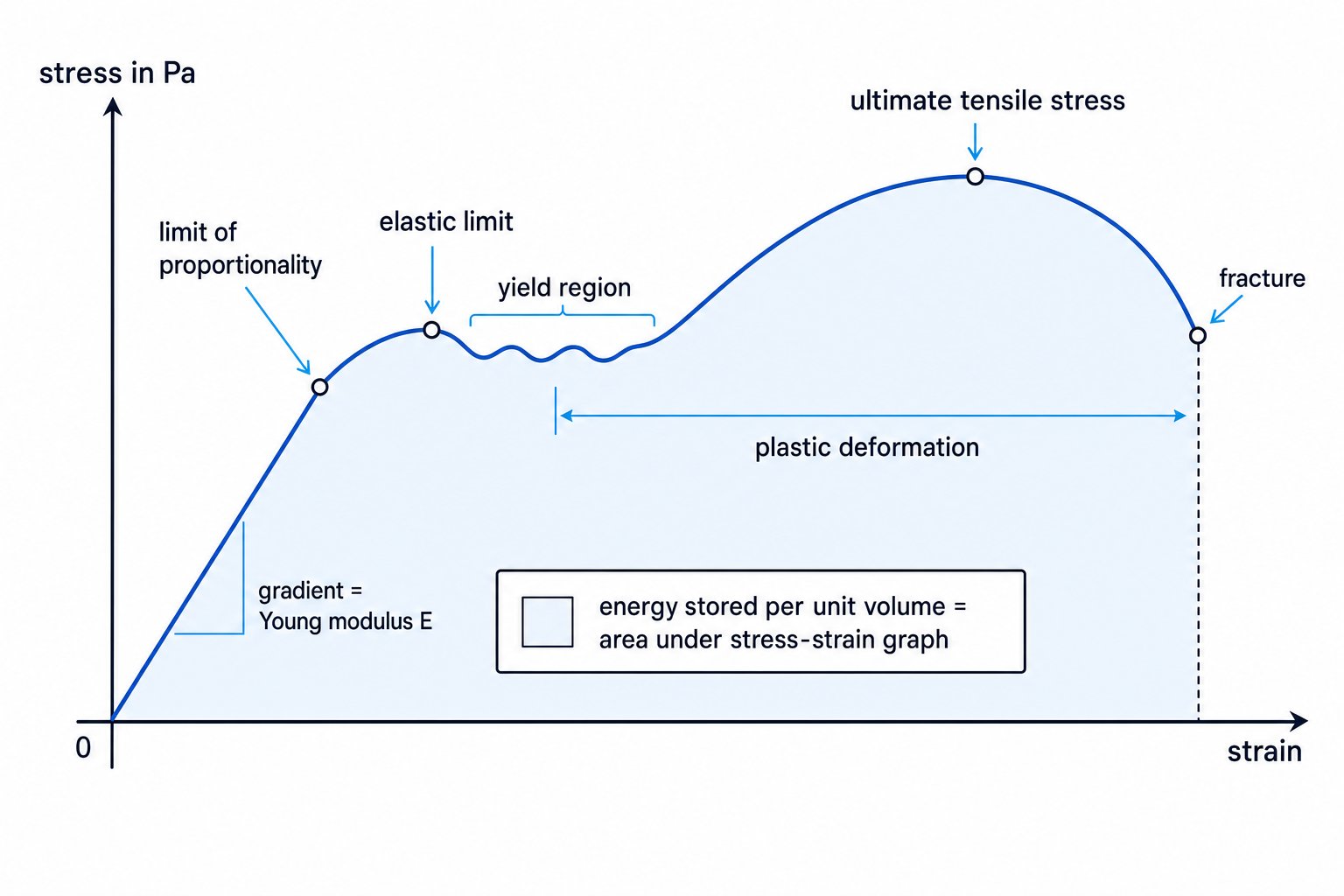
A stress-strain graph is especially useful because it removes the effect of the sample’s size. In the straight-line region, the gradient is the Young modulus.
Example
Calculating Young modulus from wire measurements
A metal wire has original length 1.80 m and diameter 0.46 mm. A mass of 2.00 kg causes an extension of 1.30 mm. Calculate the Young modulus of the metal.
-
Calculate the tensile force using F=mgF = mgF=mg:
F=2.00×9.81=19.6 NF = 2.00 \times 9.81 = 19.6\ \text{N}F=2.00×9.81=19.6 N -
Convert the diameter and calculate the cross-sectional area:
d=0.46 mm=0.46×10⁻³ md = 0.46\ \text{mm} = 0.46 \times 10^{-3}\ \text{m}d=0.46 mm=0.46×10⁻³ m A=πd24=π(0.46×10⁻³)24=1.66×10⁻⁷ m2A = \frac{\pi d^2}{4} = \frac{\pi(0.46 \times 10^{-3})^2}{4} = 1.66 \times 10^{-7}\ \text{m}^2A=4πd2=4π(0.46×10⁻³)2=1.66×10⁻⁷ m2 -
Calculate the tensile stress and tensile strain:
σ=FA=19.61.66×10−7=1.18×10⁸ Pa\sigma = \frac{F}{A} = \frac{19.6}{1.66 \times 10^{-7}} = 1.18 \times 10^{8}\ \text{Pa}σ=AF=1.66×10−719.6=1.18×10⁸ Pa ε=xL=1.30×10−31.80=7.22×10⁻⁴\varepsilon = \frac{x}{L} = \frac{1.30 \times 10^{-3}}{1.80} = 7.22 \times 10^{-4}ε=Lx=1.801.30×10−3=7.22×10⁻⁴ -
Use E=σεE = \frac{\sigma}{\varepsilon}E=εσ:
E=1.18×1087.22×10−4=1.63×10¹¹ PaE = \frac{1.18 \times 10^{8}}{7.22 \times 10^{-4}} = 1.63 \times 10^{11}\ \text{Pa}E=7.22×10−41.18×108=1.63×10¹¹ PaSo the Young modulus is about 1.6×10¹¹ Pa1.6 \times 10^{11}\ \text{Pa}1.6×10¹¹ Pa.
Interpreting a stress-strain graph
In the first straight section, stress is proportional to strain. The material is behaving elastically and obeying Hooke’s law.
After the limit of proportionality, the graph curves, so EEE is no longer found from the whole graph. After the elastic limit, removing the force leaves permanent deformation. In ductile metals, there may be a yield region, where the strain increases greatly without much increase in stress.
The ultimate tensile stress is the maximum stress the material can withstand. The fracture point is where the material breaks.
Common Mistake
Young modulus only comes from the linear region
Do not calculate Young modulus using points from the curved or plastic part of a stress-strain graph. Use the gradient of the initial straight-line section only.
Energy stored in stretching
Work is done when a force stretches a material. On a force-extension graph, the work done is the area under the graph.
In the linear elastic region:
Eelastic=12Fx=12kx2E_{\text{elastic}} = \frac{1}{2}Fx = \frac{1}{2}kx^2Eelastic=21Fx=21kx2On a stress-strain graph, the area under the graph gives the energy stored per unit volume, measured in joules per cubic metre, J m−3^{-3}−3.
Example
Finding energy per unit volume
A material behaves elastically up to a stress of 120 MPa120\ \text{MPa}120 MPa at a strain of 6.0×10−46.0 \times 10^{-4}6.0×10⁻⁴. Estimate the energy stored per unit volume.
-
Convert the stress into pascals:
120 MPa=120×106 Pa120\ \text{MPa} = 120 \times 10^{6}\ \text{Pa}120 MPa=120×106 Pa -
In the linear region, the area under the stress-strain graph is a triangle:
energy per unit volume=12σε\text{energy per unit volume} = \frac{1}{2} \sigma \varepsilonenergy per unit volume=21σε -
Substitute the values:
12(120×106)(6.0×10⁻⁴)=3.6×10⁴ J m−3\frac{1}{2}(120 \times 10^{6})(6.0 \times 10^{-4}) = 3.6 \times 10^{4}\ \text{J m}^{-3}21(120×106)(6.0×10⁻⁴)=3.6×10⁴ J m−3
Practical: determining Young modulus
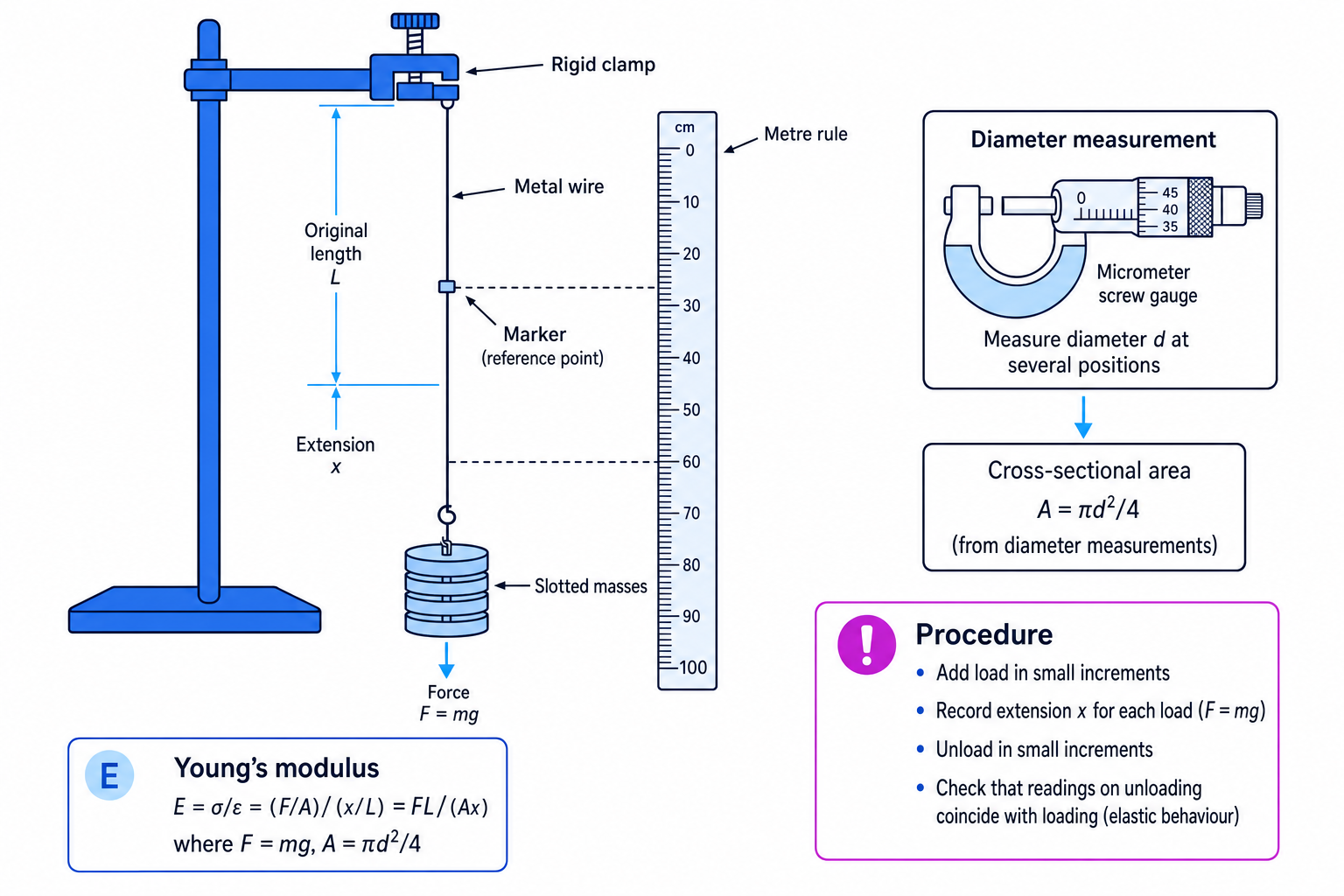
A typical Young modulus experiment uses a long, thin metal wire. A long wire is useful because the extension is larger and easier to measure accurately.
A sensible method is:
- Measure the original length LLL of the wire from the clamp to the marker.
- Measure the diameter ddd several times along the wire using a micrometer screw gauge, then calculate a mean value.
- Calculate the cross-sectional area using A=πd24A = \frac{\pi d^2}{4}A=4πd2.
- Add masses in small increments and calculate the force using F=mgF = mgF=mg.
- Measure the extension xxx for each load.
- Remove the masses gradually and check that the unloading readings match the loading readings, showing elastic behaviour.
You can plot a graph of force FFF against extension xxx. Since
F=EALxF = \frac{EA}{L}xF=LEAxthe gradient of a force-extension graph is:
gradient=EAL\text{gradient} = \frac{EA}{L}gradient=LEAso:
E=gradient×LAE = \frac{\text{gradient} \times L}{A}E=Agradient×LAlternatively, plot stress against strain directly. Then the gradient is simply EEE.
Tip
Improving accuracy
Use a long wire, a marker close to a fixed scale to reduce parallax, repeat diameter measurements in different positions, and stay within the elastic region so the graph remains linear.
Common Mistake
Diameter uncertainty matters a lot
Because A=πd24A = \frac{\pi d^2}{4}A=4πd2, a percentage uncertainty in diameter is doubled when it affects area. Measuring the diameter carefully is one of the most important parts of the practical.
Exam technique
In the exam
- Always convert mm to m and MPa to Pa before substituting into equations.
- If masses are given, calculate the force using F=mgF = mgF=mg before finding stress or Young modulus.
- For Young modulus from a graph, use the gradient of the initial straight-line section only.
Self review
Check yourself
- Why does strain have no unit, while stress is measured in pascals?
- How would you calculate the Young modulus from a force-extension graph?
- What is the difference between the limit of proportionality and the elastic limit?