Revision notes for Edexcel A Level Physics Hooke's law and stiffness. Open the guide for explanations and worked examples. Written against the Edexcel A Level Physics (9PH0) specification, so the content matches what's examinable rather than general Physics background.
Hooke's law and stiffness
What you'll learn
- How force, extension and stiffness are linked for springs and wires.
- How to use Hooke’s law: F=kxF = kxF=kx.
- How to find stiffness from a force-extension graph.
- How elastic behaviour, plastic deformation and energy storage appear in this topic.
Starting point: forces and stretching
When you pull on a spring, wire or elastic material, you apply a force. Force is measured in newtons, N.
A force that stretches an object is called a tensile force. A force that squashes it is a compressive force. In this topic, we mainly talk about tensile forces because we are often measuring how much a spring or wire gets longer.
A load is the force applied to an object. In a school experiment, the load is usually the weight of hanging masses.
Weight is calculated using:
W=mgW = mgW=mgwhere WWW is weight in newtons, mmm is mass in kilograms, and ggg is gravitational field strength, usually taken as 9.81 N kg−19.81\ \text{N kg}^{-1}9.81 N kg−1.
Example
Converting hanging mass to force
A mass hanger and slotted masses have a total mass of 250 g. Find the force they apply.
-
Convert the mass into kilograms because W=mgW = mgW=mg needs SI units: 250 g = 0.250 kg.
-
Substitute into the weight equation:
W=0.250×9.81W = 0.250 \times 9.81W=0.250×9.81 -
Calculate the load:
W=2.45 NW = 2.45\ \text{N}W=2.45 N
So the spring is being pulled down by about 2.45 N.
Common Mistake
Mass is not force
If you hang 200 g from a spring, the force is not 200 N. Convert mass to kilograms, then use W=mgW = mgW=mg.
Length, original length and extension
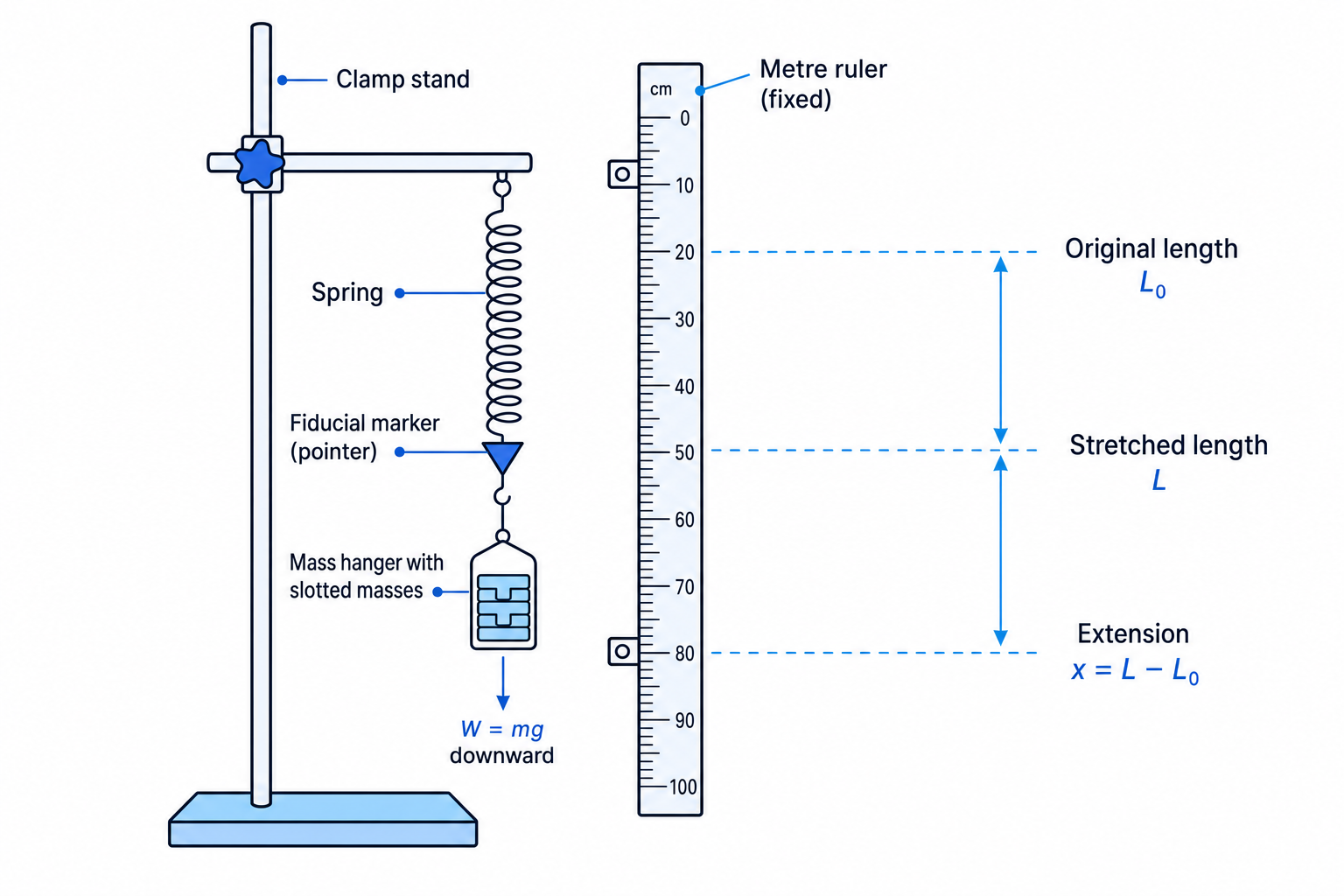
The original length of an object is its length before the stretching force is applied. It is often written as L0L_0L0.
The stretched length is the length while the force is acting. It is often written as LLL.
Definition
Extension
The extension is the increase in length caused by the applied force:
x=L−L0x = L - L_0x=L−L0Extension is measured in metres, m.
A typical practical setup uses a clamp stand, spring, ruler and hanging masses. A pointer helps you read the scale without parallax error.
Tip
Use extension, not total length
Hooke’s law uses extension xxx, not the total stretched length LLL. Always subtract the original length first.
Hooke’s law
Many springs and wires behave very simply when the force is not too large: doubling the force doubles the extension, tripling the force triples the extension, and so on.
This is called direct proportionality. A directly proportional relationship gives a straight-line graph through the origin.
Key Idea
Hooke's law
Hooke’s law states that the force applied to an object is directly proportional to its extension, provided the limit of proportionality is not exceeded:
F=kxF = kxF=kxHere:
- FFF is the applied force in newtons, N
- xxx is the extension in metres, m
- kkk is the spring constant, also called the stiffness, in newtons per metre, N m^-1
Definition
Stiffness
The stiffness of an object tells you how much force is needed to produce each metre of extension. A larger value of kkk means a stiffer object.
A spring with a large stiffness does not stretch much for a given force. A spring with a small stiffness stretches more easily.
Example
Calculating extension
A spring has stiffness k=150 N m−1k = 150\ \text{N m}^{-1}k=150 N m−1. A force of 12.0 N is applied. Find the extension.
-
Start from Hooke’s law:
F=kxF = kxF=kx -
Rearrange for extension:
x=Fkx = \frac{F}{k}x=kF -
Substitute the values:
x=12.0150x = \frac{12.0}{150}x=15012.0 -
Calculate the extension:
x=0.0800 mx = 0.0800\ \text{m}x=0.0800 m
The extension is 0.0800 m, which is 8.00 cm.
Force-extension graphs
A force-extension graph shows how the applied force changes with extension.
If force is on the vertical axis and extension is on the horizontal axis, the gradient of the straight-line section is the stiffness:
k=ΔFΔxk = \frac{\Delta F}{\Delta x}k=ΔxΔFThe straight-line section is the region where Hooke’s law is obeyed.
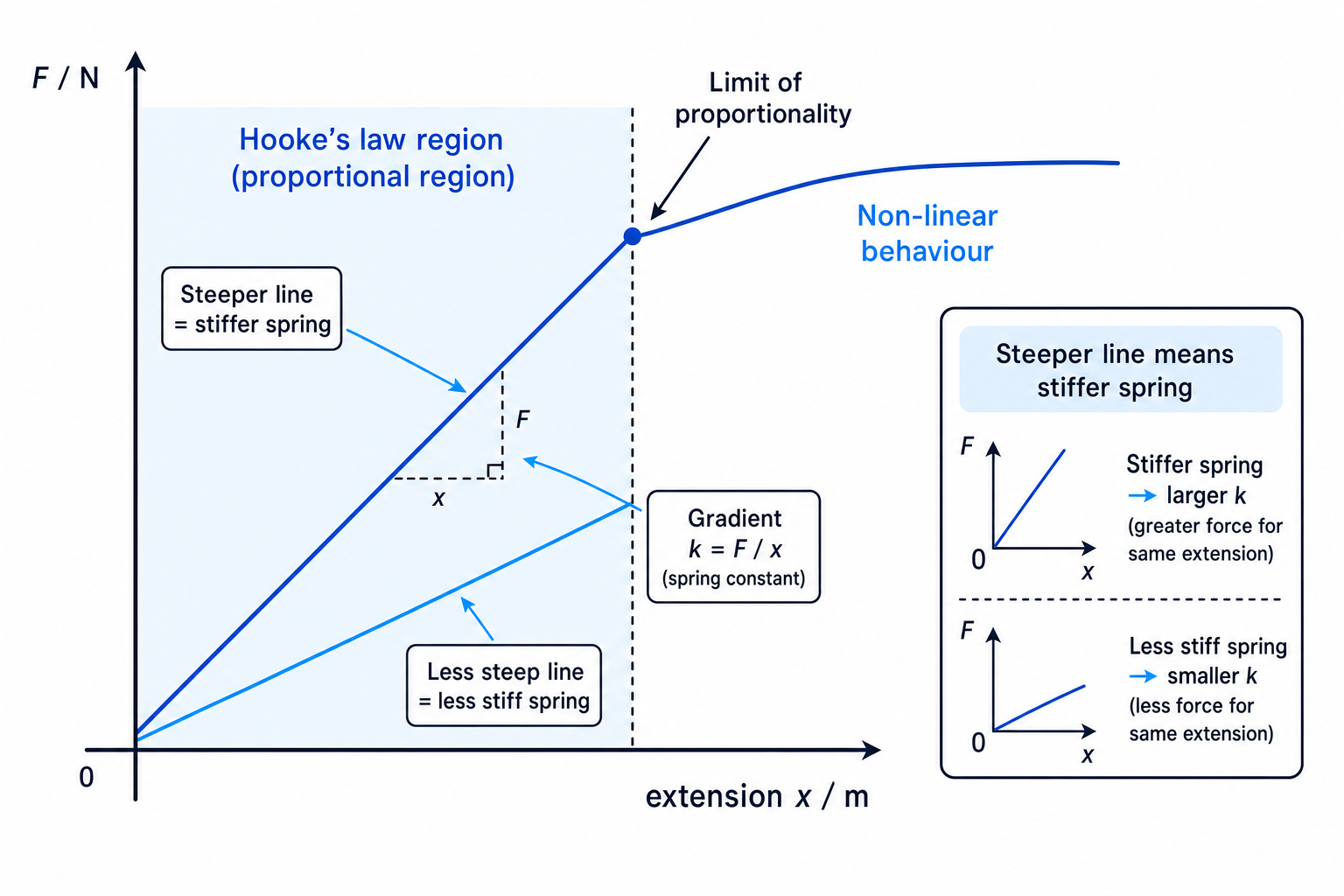
The limit of proportionality is the point beyond which force is no longer directly proportional to extension. After this point, the graph is no longer a straight line through the origin.
Example
Finding stiffness from a graph
A force-extension graph has a straight-line section. Two points on the best-fit line are 2.0 cm, 3.2 N and 8.0 cm, 12.8 N. Find the stiffness.
-
Convert the extensions into metres:
2.0 cm=0.020 m2.0\ \text{cm} = 0.020\ \text{m}2.0 cm=0.020 m 8.0 cm=0.080 m8.0\ \text{cm} = 0.080\ \text{m}8.0 cm=0.080 m -
Find the changes in force and extension:
ΔF=12.8−3.2=9.6 N\Delta F = 12.8 - 3.2 = 9.6\ \text{N}ΔF=12.8−3.2=9.6 N Δx=0.080−0.020=0.060 m\Delta x = 0.080 - 0.020 = 0.060\ \text{m}Δx=0.080−0.020=0.060 m -
Use gradient = stiffness:
k=ΔFΔx=9.60.060k = \frac{\Delta F}{\Delta x} = \frac{9.6}{0.060}k=ΔxΔF=0.0609.6 -
Calculate the stiffness:
k=160 N m−1k = 160\ \text{N m}^{-1}k=160 N m−1
Common Mistake
Wrong graph gradient
The gradient is kkk only when force is on the y-axis and extension is on the x-axis. If the axes are swapped, the gradient is 1k\frac{1}{k}k1.
Elastic and plastic deformation
An object shows elastic deformation if it returns to its original shape and length when the force is removed.
An object shows plastic deformation if it has been permanently changed and does not return to its original length after unloading.
The elastic limit is the maximum force or extension an object can experience and still return to its original length afterwards.
Common Mistake
Limit of proportionality is not always the elastic limit
The limit of proportionality is where the graph stops being straight. The elastic limit is where permanent deformation begins. These are often close, but they are not exactly the same idea.
Example
Deciding whether deformation is elastic
A wire has original length 0.500 m. It is stretched to 0.535 m. When the force is removed, its length becomes 0.503 m. Decide whether the deformation was elastic or plastic.
-
Compare the final length after unloading with the original length.
-
The wire ends at 0.503 m, not 0.500 m, so it has not returned to its original length.
-
The permanent extension is:
0.503−0.500=0.003 m0.503 - 0.500 = 0.003\ \text{m}0.503−0.500=0.003 m
The deformation is plastic, with a permanent extension of 0.003 m.
Energy stored in a stretched spring
When you stretch a spring, you do work on it. That work is transferred into elastic strain energy, which is energy stored because the object has been deformed.
For any force-extension graph:
Key Idea
Energy from a graph
The work done stretching an object is the area under the force-extension graph.
For a Hooke’s law spring, the graph is a straight line through the origin, so the area is a triangle:
E=12FxE = \frac{1}{2}FxE=21FxSince F=kxF = kxF=kx, you can also write:
E=12kx2E = \frac{1}{2}kx^2E=21kx2Energy is measured in joules, J.
Example
Calculating elastic energy
A spring with stiffness k=200 N m−1k = 200\ \text{N m}^{-1}k=200 N m−1 is stretched by 0.050 m. Find the elastic strain energy stored.
-
Use the Hooke’s law energy equation because the spring is assumed to be in the proportional region:
E=12kx2E = \frac{1}{2}kx^2E=21kx2 -
Substitute the values:
E=12×200×(0.050)2E = \frac{1}{2} \times 200 \times (0.050)^2E=21×200×(0.050)2 -
Calculate:
E=0.250 JE = 0.250\ \text{J}E=0.250 J
So the spring stores 0.250 J of elastic strain energy.
Common Mistake
Do not use triangle area for every material
The equation E=12FxE = \frac{1}{2}FxE=21Fx only applies when the force-extension graph is a straight line through the origin. For a curved graph, find the area under the curve instead.
Practical notes: measuring stiffness
To determine stiffness experimentally, you usually:
- Measure the original length of the spring or wire.
- Add known masses one at a time.
- Convert each total mass into force using W=mgW = mgW=mg.
- Measure the new length each time.
- Calculate extension using x=L−L0x = L - L_0x=L−L0.
- Plot force against extension.
- Find the gradient of the straight-line section.
Good practical technique matters. Keep the ruler fixed, read at eye level, and use a fiducial marker or pointer to reduce parallax. Add masses gently so the spring does not oscillate too much.
For uncertainty, remember that extension comes from two length readings. If each ruler reading has an uncertainty of about ±1 mm, the uncertainty in extension is roughly ±2 mm.
Tip
Graph strategy
Use a large triangle on the best-fit straight line to calculate the gradient. Do not use a single plotted point unless the question specifically tells you to.
Stiffness is about the object, not just the material
A steel wire and a steel spring can have very different stiffness values, even though they may be made from the same material. Stiffness depends on the material and also on the object’s shape and dimensions.
In later materials work, you will meet Young modulus, which is a property of the material itself. For now, treat kkk as the stiffness of a particular spring, wire or object.
Exam technique
In the exam
- Check whether the question gives force or mass. If it gives mass, convert using W=mgW = mgW=mg.
- Check the graph axes before using the gradient. Force against extension gives gradient kkk.
- Use metres for extension, not cm or mm, when calculating stiffness in N m^-1.
- Only apply F=kxF = kxF=kx in the straight-line Hooke’s law region.
- For energy, use the area under the force-extension graph; use 12Fx\frac{1}{2}Fx21Fx only for a straight line through the origin.
Self review
Check yourself
- What is the difference between length and extension?
- How would you find stiffness from a force-extension graph?
- Why does Hooke’s law stop working after the limit of proportionality?