Revision notes for Edexcel A Level Physics Impulse and two-dimensional momentum. Open the guide for explanations and worked examples. Written against the Edexcel A Level Physics (9PH0) specification, so the content matches what's examinable rather than general Physics background.
Impulse and two-dimensional momentum
What you'll learn
- How momentum depends on mass and velocity, and why it is a vector.
- How impulse links force, contact time, and change in momentum.
- How to use force-time graphs to find impulse.
- How to solve two-dimensional collision problems by resolving momentum into components.
Prerequisites: vectors and components
A scalar has size only, such as mass or time. A vector has size and direction, such as velocity, force, and momentum.
When motion is not all in one straight line, you split a vector into perpendicular components. Usually you choose an x-direction horizontally and a y-direction vertically.
Definition
Component of a vector
A component is the part of a vector acting in a chosen direction. If a vector of magnitude AAA makes an angle θ\thetaθ above the positive x-axis, then Ax=AcosθA_x = A\cos\thetaAx=Acosθ and Ay=AsinθA_y = A\sin\thetaAy=Asinθ.
Tip
Choose axes early
In momentum questions, draw axes before writing equations. A good choice of axes often makes one component zero, which simplifies the algebra.
Example
Resolving a momentum vector
A 0.40 kg puck moves at 8.0 m s⁻¹ at 35° above the horizontal. Find its horizontal and vertical momentum components.
- Calculate the momentum magnitude using p=mvp = mvp=mv:
- Resolve the momentum into components because the angle is measured from the horizontal:
- Find the vertical component using sine:
- State the directions: the puck has momentum 2.6 kg m s⁻¹ horizontally and 1.8 kg m s⁻¹ upwards.
Momentum
Definition
Momentum
The momentum ppp of an object is the product of its mass and velocity:
p=mv p = mv p=mvMomentum is a vector. Its unit is kg m s⁻¹.
Momentum points in the same direction as velocity. A more massive object, or a faster object, has more momentum.
The change in momentum is always:
Δp=pfinal−pinitial \Delta p = p_{\text{final}} - p_{\text{initial}} Δp=pfinal−pinitialThat subtraction matters because momentum has direction.
Impulse
Definition
Impulse
Impulse JJJ is the change in momentum of an object:
J=Δp J = \Delta p J=ΔpIt is also equal to the resultant force multiplied by the time for which it acts, if the force is constant or averaged:
J=FavgΔt J = F_{\text{avg}}\Delta t J=FavgΔtImpulse is a vector. Its unit is N s, equivalent to kg m s⁻¹.
From Newton’s second law in momentum form:
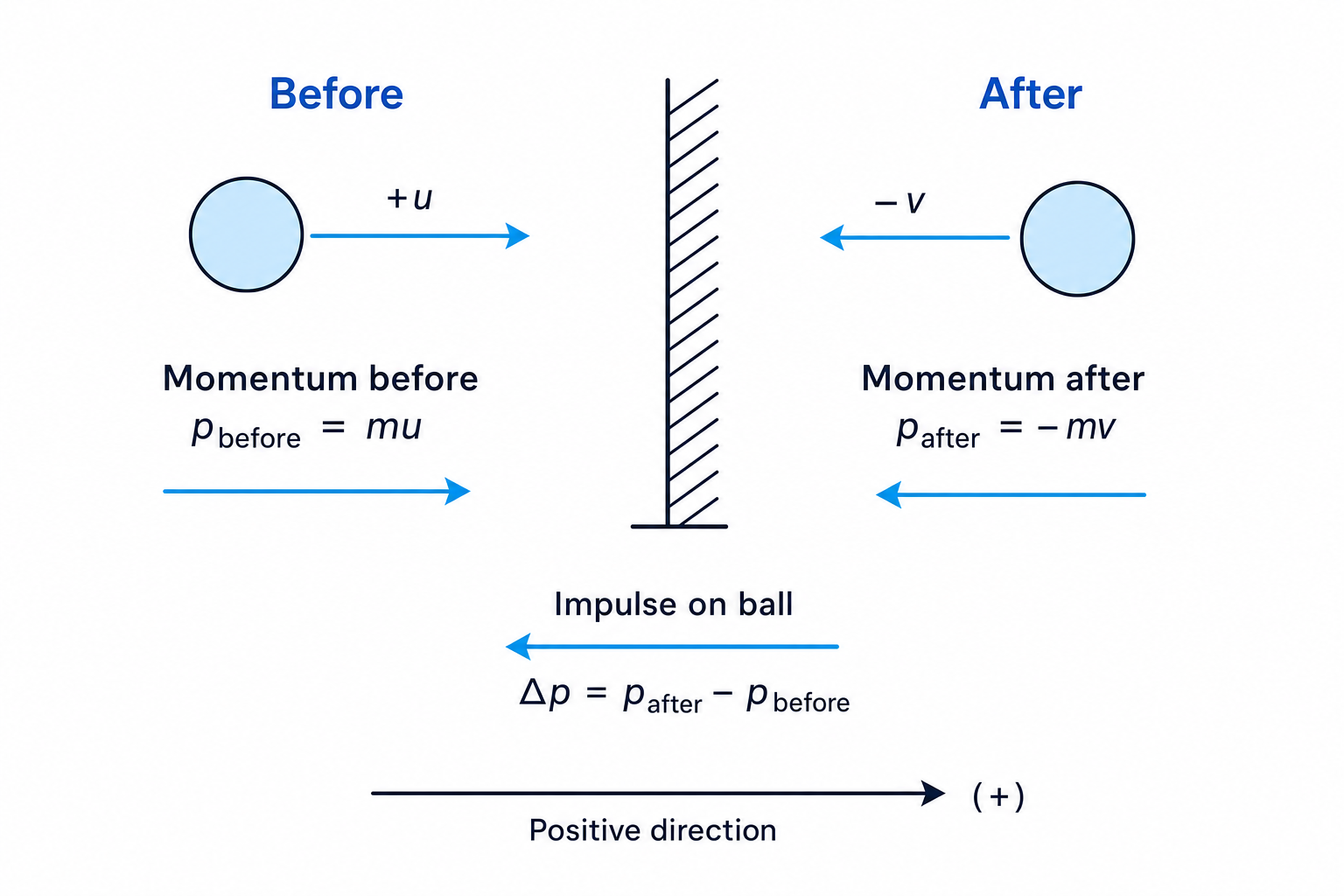
Fresultant=ΔpΔt F_{\text{resultant}} = \frac{\Delta p}{\Delta t} Fresultant=ΔtΔpso a given change in momentum can happen with a large force for a short time, or a smaller force for a longer time. This is why helmets, mats, crumple zones, and follow-through in sport matter: they increase the time over which momentum changes, reducing the average force.
Common Mistake
Forgetting the sign when an object rebounds
If an object reverses direction, its final velocity has the opposite sign. Do not just subtract speeds; use pfinal−pinitialp_{\text{final}} - p_{\text{initial}}pfinal−pinitial with a clear positive direction.
Example
Finding impulse and average force
A 0.060 kg ball hits a wall travelling at 20 m s⁻¹ to the right. It rebounds at 15 m s⁻¹ to the left. The contact time is 0.010 s. Find the impulse on the ball and the average force.
-
Choose right as positive, so the initial and final velocities are +20 m s−1+20\ \text{m s}^{-1}+20 m s−1 and −15 m s−1-15\ \text{m s}^{-1}−15 m s−1.
-
Calculate the initial and final momenta:
- Find the change in momentum, which is the impulse:
- Use J=FavgΔtJ = F_{\text{avg}}\Delta tJ=FavgΔt to find the average force:
- Interpret the sign: the impulse is 2.1 N s to the left, and the average force on the ball is 210 N to the left.
Force-time graphs
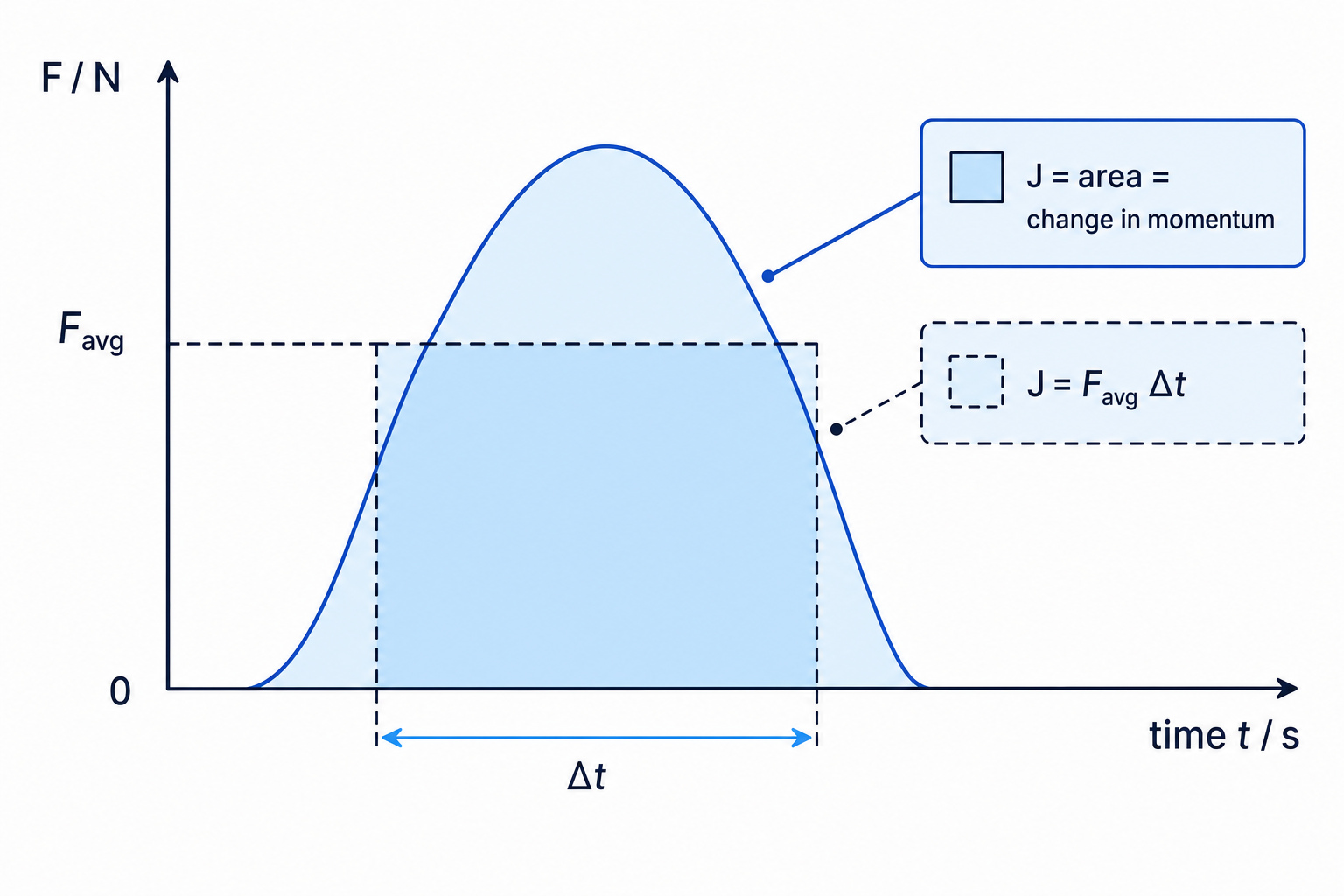
During a collision, the force is usually not constant. It rises, reaches a peak, then falls again. The impulse is the area under the force-time graph.
Key Idea
Area gives impulse
On a force-time graph, area has units N s, so the area under the graph gives impulse and therefore change in momentum.
Example
Using area under a force-time graph
A force-time graph for a collision is approximately triangular. The force rises from zero to 800 N, then returns to zero over a total time of 0.020 s. Find the impulse.
-
Identify the graph shape: a triangle with base 0.020 s and height 800 N.
-
Calculate the area under the graph:
- Link this to momentum: the object’s momentum changes by 8.0 kg m s⁻¹ in the direction of the resultant force.
Conservation of momentum
Definition
Conservation of momentum
The principle of conservation of momentum says that the total momentum of a system remains constant, provided no resultant external force acts on the system.
A system is the set of objects you are considering. In a collision, the forces between the objects are internal forces. They are equal and opposite, so they produce equal and opposite impulses within the system.
For a short collision, external forces such as weight and friction are often negligible compared with the collision forces, so momentum can be treated as conserved during the impact.
Common Mistake
Momentum and kinetic energy are different
Momentum is conserved in an isolated collision. Kinetic energy is only conserved in an elastic collision. In an inelastic collision, some kinetic energy is transferred to thermal energy, sound, or deformation.
Two-dimensional momentum
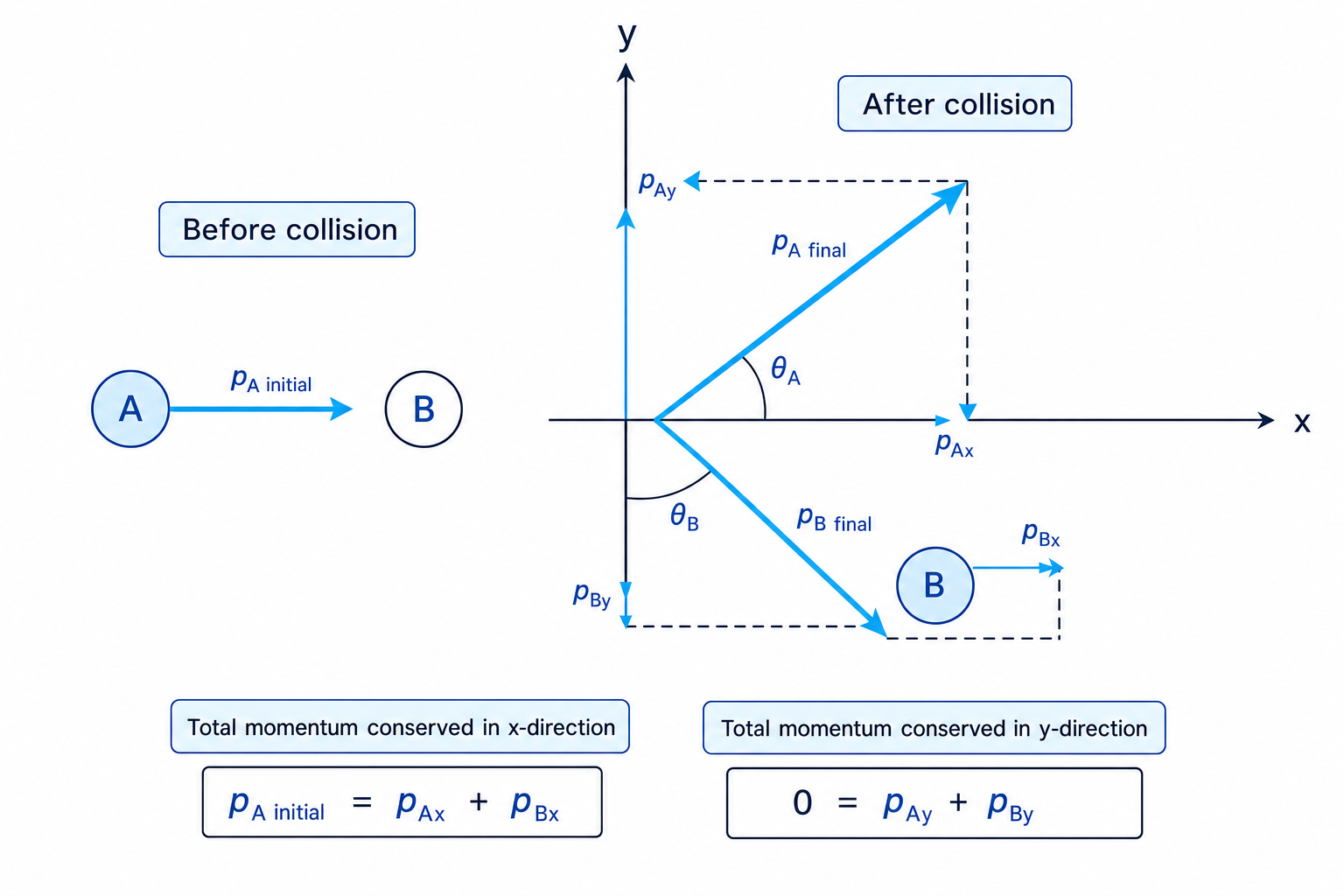
In two-dimensional collisions, momentum is still conserved — but because momentum is a vector, you must conserve components separately.
For an isolated system:
∑px,before=∑px,after \sum p_{x,\text{before}} = \sum p_{x,\text{after}} ∑px,before=∑px,afterand
∑py,before=∑py,after \sum p_{y,\text{before}} = \sum p_{y,\text{after}} ∑py,before=∑py,afterThis is the main technique for glancing collisions, explosions, and objects moving off at angles.
Key Idea
Conserve components separately
You do not conserve “horizontal momentum” and “vertical momentum” because they are different laws. You conserve total vector momentum, and resolving into x and y components is the practical way to do it.
Example
Solving a glancing collision
A 0.200 kg ball A moves at 5.0 m s⁻¹ along the positive x-direction and collides with an identical stationary ball B. After the collision, A moves at 3.0 m s⁻¹ at 40° above the x-axis. Find the velocity of B after the collision.
- Calculate the initial momentum. Only A is moving before the collision:
- Resolve A’s final momentum. Its final momentum magnitude is:
So its components are:
pAx=0.600cos40∘=0.460 kg m s−1 p_{Ax} = 0.600\cos 40^\circ = 0.460\ \text{kg m s}^{-1} pAx=0.600cos40∘=0.460 kg m s−1 pAy=0.600sin40∘=0.386 kg m s−1 p_{Ay} = 0.600\sin 40^\circ = 0.386\ \text{kg m s}^{-1} pAy=0.600sin40∘=0.386 kg m s−1- Use conservation of x-momentum to find B’s x-momentum:
- Use conservation of y-momentum to find B’s y-momentum:
- Convert B’s momentum components into velocity components by dividing by the mass:
- Find B’s speed and direction:
So B moves at 3.3 m s⁻¹, 36° below the positive x-axis.
A reliable problem-solving routine
For most impulse and two-dimensional momentum questions, use this order:
- Draw a diagram showing before and after.
- Choose positive directions or axes.
- Write momentum expressions using p=mvp = mvp=mv.
- For impulse, use J=ΔpJ = \Delta pJ=Δp or area under a force-time graph.
- For collisions, apply conservation separately in x and y.
- Only use kinetic energy conservation if the collision is stated to be elastic.
Exam technique
In the exam
- Always include signs or directions with impulse and momentum; a correct magnitude with the wrong direction can lose marks.
- In two-dimensional collisions, write two separate equations: one for x-components and one for y-components.
- Check whether kinetic energy is mentioned. If the question only says momentum is conserved, do not assume the collision is elastic.
Self review
Check yourself
- A ball reverses direction after hitting a wall. Why is its change in momentum larger than you might get by subtracting the two speeds?
- What condition must be true for total momentum of a system to be conserved?
- In a glancing collision, why can the y-momentum before be zero but the objects still move with vertical components afterwards?