Revision notes for Edexcel A Level Physics Elastic and inelastic collisions. Open the guide for explanations and worked examples. Written against the Edexcel A Level Physics (9PH0) specification, so the content matches what's examinable rather than general Physics background.
Elastic and inelastic collisions
What you'll learn
- How to use conservation of momentum in one-dimensional collisions.
- The difference between elastic, inelastic, and perfectly inelastic collisions.
- How to track signs for velocity and momentum.
- How impulse links collision time, force, and change in momentum.
The essential prerequisite: momentum
Momentum describes how much “motion” an object has. It depends on both mass and velocity, so a heavy slow object can have the same momentum as a light fast object.
Definition
Linear momentum
The linear momentum of an object is
p=mvp = mvp=mvwhere ppp is momentum in kilogram metres per second, mmm is mass in kilograms, and vvv is velocity in metres per second. Momentum is a vector, so direction matters.
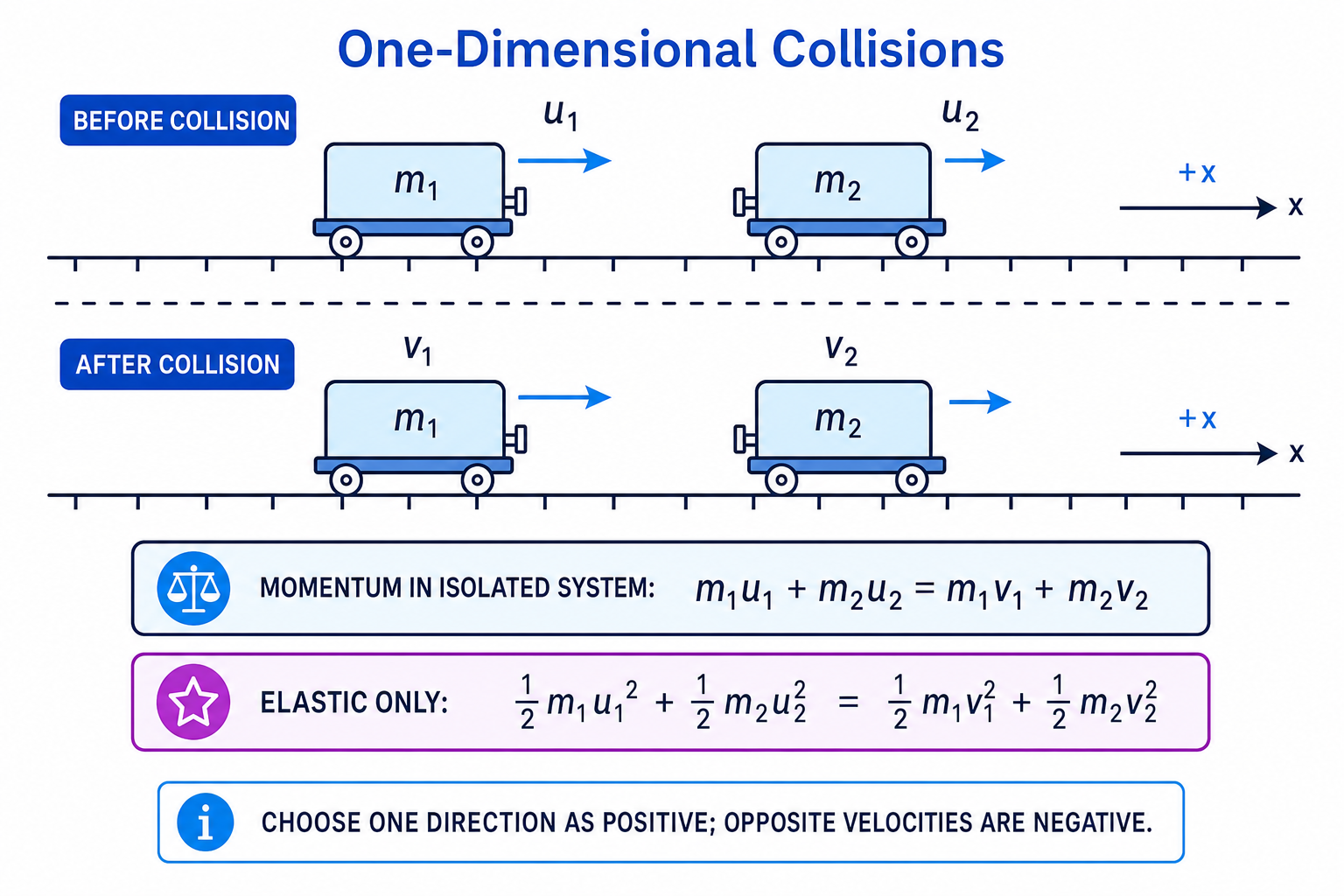
Because momentum is a vector, you must choose a positive direction before doing a collision calculation. In one-dimensional problems, velocities in the opposite direction are negative.
Common Mistake
Forgetting the sign of velocity
Speed is always positive, but velocity can be positive or negative. In collision questions, using all speeds as positive usually gives the wrong momentum.
Conservation of momentum
A system is the group of objects you are considering. For a collision, the system is usually the two objects that collide.
Definition
Conservation of momentum
In an isolated system, with no resultant external force, the total momentum before an interaction equals the total momentum after the interaction.
total momentum before=total momentum after\text{total momentum before} = \text{total momentum after}total momentum before=total momentum afterDuring a collision, the objects exert equal and opposite forces on each other. These internal forces can change each object’s momentum, but the total momentum of the system stays constant if external forces are negligible.
For two objects moving in one dimension:
m1u1+m2u2=m1v1+m2v2m_1u_1 + m_2u_2 = m_1v_1 + m_2v_2m1u1+m2u2=m1v1+m2v2where uuu means velocity before the collision and vvv means velocity after the collision.
Key Idea
Momentum is always your first equation
For A-Level collision problems, start with conservation of momentum. Then decide whether you are also allowed to conserve kinetic energy.
Inelastic collisions
An inelastic collision is a collision where total momentum is conserved, but total kinetic energy is not conserved.
Definition
Inelastic collision
In an inelastic collision, total momentum is conserved, but some kinetic energy is transferred to other forms, such as internal energy, sound, deformation, or thermal energy.
This does not mean energy has disappeared. Total energy is still conserved overall; it is just no longer all kinetic energy.
A special case is a perfectly inelastic collision, where the objects stick together and move off with a shared final velocity.
Example
Finding the speed after two trolleys stick together
A 0.60 kg trolley moving at 2.5 m s−1^{-1}−1 to the right collides with a stationary 0.40 kg trolley. They stick together. Find their final velocity and the kinetic energy lost.
-
Choose right as positive and use conservation of momentum. Since the trolleys stick together, they have one final velocity vvv:
m1u1+m2u2=(m1+m2)vm_1u_1 + m_2u_2 = (m_1 + m_2)vm1u1+m2u2=(m1+m2)v -
Substitute the values:
(0.60)(2.5)+(0.40)(0)=(0.60+0.40)v(0.60)(2.5) + (0.40)(0) = (0.60 + 0.40)v(0.60)(2.5)+(0.40)(0)=(0.60+0.40)v 1.5=1.00v1.5 = 1.00v1.5=1.00vSo
v=1.5 m s−1v = 1.5\ \text{m s}^{-1}v=1.5 m s−1The trolleys move to the right.
-
Calculate the kinetic energy before:
Ek,before=12(0.60)(2.5)2+12(0.40)(0)2E_{k,\text{before}} = \frac{1}{2}(0.60)(2.5)^2 + \frac{1}{2}(0.40)(0)^2Ek,before=21(0.60)(2.5)2+21(0.40)(0)2 Ek,before=1.875 JE_{k,\text{before}} = 1.875\ \text{J}Ek,before=1.875 J -
Calculate the kinetic energy after:
Ek,after=12(1.00)(1.5)2=1.125 JE_{k,\text{after}} = \frac{1}{2}(1.00)(1.5)^2 = 1.125\ \text{J}Ek,after=21(1.00)(1.5)2=1.125 J -
Compare the two kinetic energies:
ΔEk=1.875−1.125=0.750 J\Delta E_k = 1.875 - 1.125 = 0.750\ \text{J}ΔEk=1.875−1.125=0.750 JThe collision is inelastic, and 0.750 J of kinetic energy has been transferred to other forms.
Elastic collisions
An elastic collision is a collision where total momentum and total kinetic energy are both conserved.
Definition
Elastic collision
In an elastic collision:
m1u1+m2u2=m1v1+m2v2m_1u_1 + m_2u_2 = m_1v_1 + m_2v_2m1u1+m2u2=m1v1+m2v2and
12m1u12+12m2u22=12m1v12+12m2v22\frac{1}{2}m_1u_1^2 + \frac{1}{2}m_2u_2^2 = \frac{1}{2}m_1v_1^2 + \frac{1}{2}m_2v_2^221m1u12+21m2u22=21m1v12+21m2v22At A-Level, “elastic” does not mean the objects are stretchy. It means no kinetic energy is lost from the system. Ideal gas molecules are often modelled as making elastic collisions.
For a one-dimensional elastic collision, you can also use the result:
relative speed of approach=relative speed of separation\text{relative speed of approach} = \text{relative speed of separation}relative speed of approach=relative speed of separationFor two objects, if object 1 is catching object 2 before the collision:
u1−u2=v2−v1u_1 - u_2 = v_2 - v_1u1−u2=v2−v1This is often simpler than solving the kinetic energy equation directly.
Tip
A useful elastic-collision shortcut
For one-dimensional elastic collisions, use conservation of momentum plus the relative-speed equation. It avoids expanding lots of squared terms.
Example
Solving a one-dimensional elastic collision
A 0.20 kg ball moves right at 5.0 m s−1^{-1}−1. It collides elastically with a 0.30 kg ball moving left at 1.0 m s−1^{-1}−1. Find both velocities after the collision.
-
Choose right as positive. The initial velocities are u1=5.0 m s−1u_1 = 5.0\ \text{m s}^{-1}u1=5.0 m s−1 and u2=−1.0 m s−1u_2 = -1.0\ \text{m s}^{-1}u2=−1.0 m s−1.
-
Apply conservation of momentum:
(0.20)(5.0)+(0.30)(−1.0)=0.20v1+0.30v2(0.20)(5.0) + (0.30)(-1.0) = 0.20v_1 + 0.30v_2(0.20)(5.0)+(0.30)(−1.0)=0.20v1+0.30v2 0.70=0.20v1+0.30v20.70 = 0.20v_1 + 0.30v_20.70=0.20v1+0.30v2 -
Use the elastic-collision relative-speed equation:
u1−u2=v2−v1u_1 - u_2 = v_2 - v_1u1−u2=v2−v1 5.0−(−1.0)=v2−v15.0 - (-1.0) = v_2 - v_15.0−(−1.0)=v2−v1 v2=v1+6.0v_2 = v_1 + 6.0v2=v1+6.0 -
Substitute v2=v1+6.0v_2 = v_1 + 6.0v2=v1+6.0 into the momentum equation:
0.70=0.20v1+0.30(v1+6.0)0.70 = 0.20v_1 + 0.30(v_1 + 6.0)0.70=0.20v1+0.30(v1+6.0) 0.70=0.50v1+1.800.70 = 0.50v_1 + 1.800.70=0.50v1+1.80 v1=−2.2 m s−1v_1 = -2.2\ \text{m s}^{-1}v1=−2.2 m s−1 -
Find v2v_2v2:
v2=−2.2+6.0=3.8 m s−1v_2 = -2.2 + 6.0 = 3.8\ \text{m s}^{-1}v2=−2.2+6.0=3.8 m s−1The 0.20 kg ball rebounds to the left, and the 0.30 kg ball moves to the right.
Impulse during a collision
A collision usually involves a large force acting for a short time. The effect of this force is described by impulse.
Definition
Impulse
Impulse is the change in momentum of an object:
J=ΔpJ = \Delta pJ=ΔpFor a constant force, or an average force during contact,
J=FΔtJ = F\Delta tJ=FΔtSo
FΔt=m(v−u)F\Delta t = m(v - u)FΔt=m(v−u)Impulse has units of newton seconds, equivalent to kilogram metres per second.
This is why crumple zones, airbags, helmets, and padded surfaces reduce injury. They increase the collision time Δt\Delta tΔt, so for the same change in momentum the average force is smaller.
Example
Calculating an average collision force
A 0.15 kg ball moving left at 20 m s−1^{-1}−1 rebounds right at 25 m s−1^{-1}−1. The contact time is 5.0 ms. Find the average force on the ball.
-
Choose right as positive. The initial velocity is u=−20 m s−1u = -20\ \text{m s}^{-1}u=−20 m s−1 and the final velocity is v=25 m s−1v = 25\ \text{m s}^{-1}v=25 m s−1.
-
Calculate the change in momentum:
Δp=m(v−u)\Delta p = m(v - u)Δp=m(v−u) Δp=0.15(25−(−20))=6.75 kg m s−1\Delta p = 0.15(25 - (-20)) = 6.75\ \text{kg m s}^{-1}Δp=0.15(25−(−20))=6.75 kg m s−1 -
Convert the time to seconds and use F=ΔpΔtF = \frac{\Delta p}{\Delta t}F=ΔtΔp:
Δt=5.0 ms=5.0×10⁻³ s\Delta t = 5.0\ \text{ms} = 5.0 \times 10^{-3}\ \text{s}Δt=5.0 ms=5.0×10⁻³ s F=6.755.0×10−3=1.35×10³ NF = \frac{6.75}{5.0 \times 10^{-3}} = 1.35 \times 10^3\ \text{N}F=5.0×10−36.75=1.35×10³ NThe average force on the ball is 1.4×10³ N1.4 \times 10^3\ \text{N}1.4×10³ N to two significant figures, to the right.
How to decide which equations to use
For every collision:
- Use conservation of momentum if the system is isolated, or if external forces are negligible during the short collision time.
- Use conservation of kinetic energy only if the question says the collision is elastic.
- If the objects stick together, use a common final velocity.
- If the collision is inelastic, do not assume kinetic energy is conserved.
Common Mistake
External forces can break momentum conservation
Momentum is conserved only for the chosen system if there is no resultant external force. In many short collision problems, forces such as friction are small enough to ignore during the impact, but that assumption should be reasonable.
Practical note: investigating collisions
In a school lab, collisions can be investigated using dynamics trolleys, a low-friction track, light gates, and data loggers. The light gates measure velocities before and after impact.
You can then calculate total momentum and total kinetic energy before and after. Differences may be caused by friction, uncertainty in velocity measurements, slight rotation, sound, or deformation.
Tip
Checking experimental data
Momentum is directional, so include signs when processing trolley data. Kinetic energy is scalar, so each term uses v2v^2v2 and is never negative.
Exam technique
In the exam
- Define your positive direction before substituting velocities, especially if objects move towards each other.
- Use momentum conservation for all isolated collisions, then use kinetic energy conservation only when the collision is elastic.
- Check your answer physically: a negative velocity means the object has reversed direction, not that the answer is wrong.
Self review
Check yourself
- What is conserved in every isolated collision, whether elastic or inelastic?
- In a perfectly inelastic collision, what is special about the final velocities of the objects?
- Why does increasing collision time reduce the average force for the same change in momentum?