Revision notes for Edexcel A Level Physics Photons, photoelectric effect and line spectra. Open the guide for explanations and worked examples. Written against the Edexcel A Level Physics (9PH0) specification, so the content matches what's examinable rather than general Physics background.
Photons, photoelectric effect and line spectra
What you'll learn
- How the photon model links light frequency to energy using E=hfE=hfE=hf.
- Why the photoelectric effect is strong evidence that light can behave like particles.
- How to use hf=ϕ+Ek,maxhf=\phi+E_{k,\max}hf=ϕ+Ek,max and stopping potential graphs.
- Why atoms produce line spectra rather than a continuous spread of colours.
Before we start: waves, energy and charge
You already know that electromagnetic waves include radio waves, microwaves, infrared, visible light, ultraviolet, X-rays and gamma rays. In a vacuum, they all travel at the same speed:
c=3.00×10⁸ m s−1c = 3.00 \times 10^8\ \text{m s}^{-1}c=3.00×10⁸ m s−1For any wave,
v=fλv=f\lambdav=fλso for light in a vacuum,
c=fλc=f\lambdac=fλwhere fff is frequency in hertz, and λ\lambdaλ is wavelength in metres. Higher frequency means shorter wavelength.
Definition
Electronvolt
An electronvolt, eV, is a unit of energy. One electronvolt is the energy transferred when an electron moves through a potential difference of 1 volt: 1 eV=1.60×10⁻¹⁹ J1\ \text{eV}=1.60\times10^{-19}\ \text{J}1 eV=1.60×10⁻¹⁹ J.
The electronvolt is useful in atomic physics because photon energies and electron energy-level changes are often very small in joules.
Photons: light as packets of energy
The photon model says that electromagnetic radiation is emitted, absorbed and transferred in discrete packets called photons.
Definition
Photon
A photon is a discrete packet, or quantum, of electromagnetic radiation. The energy of one photon is E=hfE=hfE=hf, where hhh is the Planck constant.
The Planck constant is:
h=6.63×10⁻³⁴ J sh = 6.63 \times 10^{-34}\ \text{J s}h=6.63×10⁻³⁴ J sA photon’s energy depends on its frequency:
E=hfE=hfE=hfUsing c=fλc=f\lambdac=fλ, you can also write:
E=hcλE=\frac{hc}{\lambda}E=λhcSo high-frequency ultraviolet photons have more energy per photon than visible light photons. Increasing the intensity of light at a fixed frequency means more photons arrive each second, not that each photon has more energy.
Key Idea
Frequency decides photon energy
For one photon, energy depends on frequency only: E=hfE=hfE=hf. Intensity affects the number of photons arriving per second.
Example
Finding the energy of an ultraviolet photon
An ultraviolet photon has wavelength 250 nm. Calculate its energy in joules and electronvolts.
-
Use E=hcλE=\frac{hc}{\lambda}E=λhc because the wavelength is given, and convert the wavelength: 250 nm=250×10−9 m250\ \text{nm}=250\times10^{-9}\ \text{m}250 nm=250×10−9 m.
-
Substitute the constants:
E=(6.63×10⁻³⁴)(3.00×10⁸)250×10−9E=\frac{(6.63\times10^{-34})(3.00\times10^8)}{250\times10^{-9}}E=250×10−9(6.63×10⁻³⁴)(3.00×10⁸) E=7.96×10⁻¹⁹ JE=7.96\times10^{-19}\ \text{J}E=7.96×10⁻¹⁹ J -
Convert to electronvolts by dividing by 1.60×10⁻¹⁹ J eV−11.60\times10^{-19}\ \text{J eV}^{-1}1.60×10⁻¹⁹ J eV−1:
E=7.96×10−191.60×10−19=4.98 eVE=\frac{7.96\times10^{-19}}{1.60\times10^{-19}}=4.98\ \text{eV}E=1.60×10−197.96×10−19=4.98 eV
The photoelectric effect
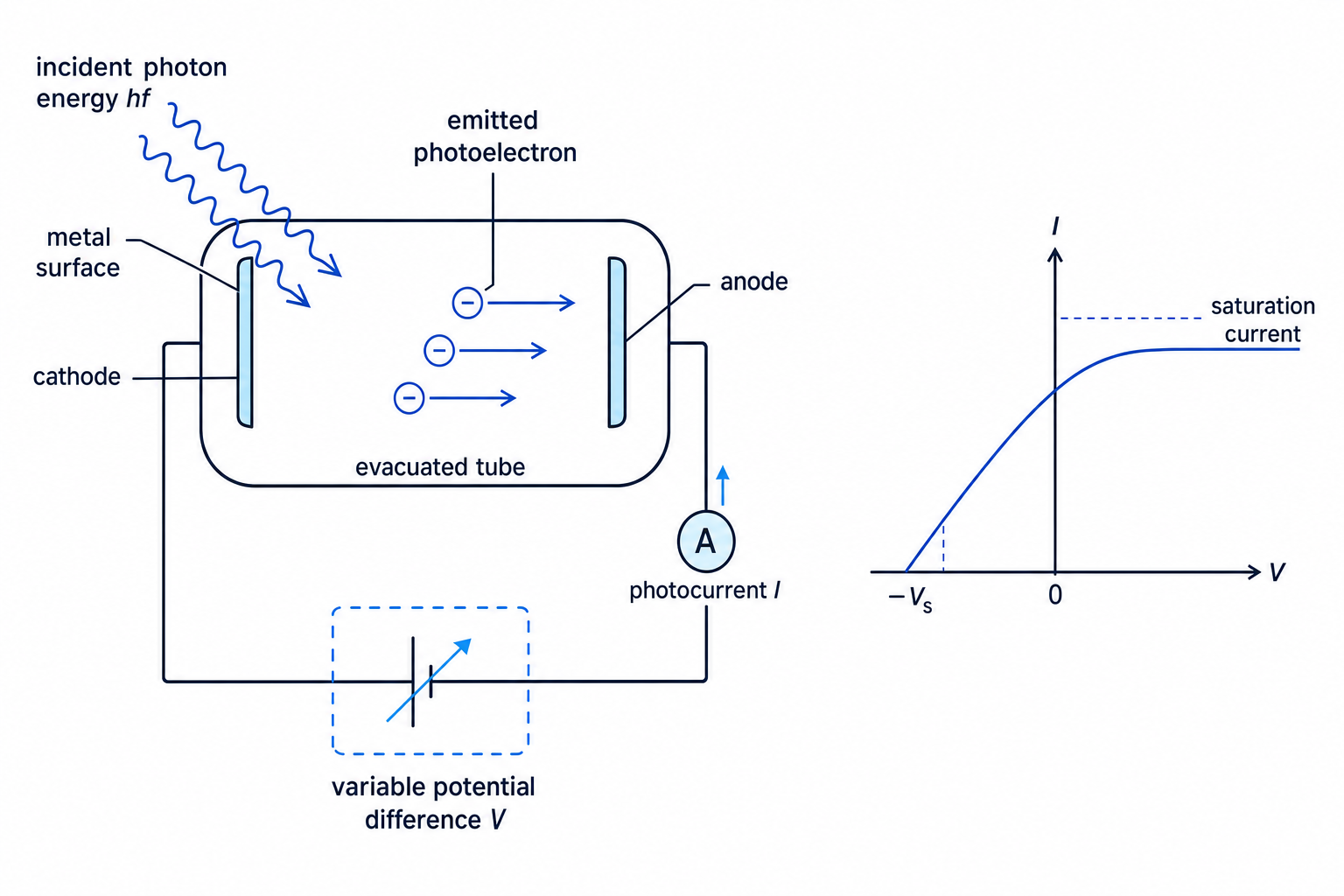
The photoelectric effect is the emission of electrons from a metal surface when electromagnetic radiation of sufficiently high frequency is incident on the metal.
Definition
Photoelectron
A photoelectron is an electron emitted from a material by the photoelectric effect.
The key observations are:
- Below a certain frequency, no electrons are emitted, no matter how intense the light is.
- Above that frequency, emission starts almost immediately.
- Increasing intensity increases the number of emitted electrons per second.
- Increasing frequency increases the maximum kinetic energy of the emitted electrons.
The minimum frequency needed to release electrons from a particular metal is called the threshold frequency, f0f_0f0.
Definition
Threshold frequency
The threshold frequency, f0f_0f0, is the minimum frequency of incident radiation needed to emit photoelectrons from a metal surface.
These observations are difficult to explain using a simple wave model of light, because a wave model suggests energy could build up gradually. The photon model explains them neatly: one photon transfers its energy to one electron.
Key Idea
One photon, one electron
For photoemission, a single electron absorbs energy from a single photon. If the photon energy is too small, increasing intensity cannot make that individual photon release an electron.
Example
Explaining threshold frequency and intensity
A metal is illuminated with bright red light and no photoelectrons are emitted. The intensity of the red light is then doubled.
-
Compare photon energy with the energy needed to release an electron. Red light has a relatively low frequency, so each photon has energy E=hfE=hfE=hf.
-
If the red light frequency is below the threshold frequency, then hf<ϕhf<\phihf<ϕ, where ϕ\phiϕ is the work function. Each photon has insufficient energy to remove one electron.
-
Doubling intensity doubles the number of photons arriving per second, but it does not change fff or E=hfE=hfE=hf. So no photoelectrons are emitted.
Work function and the photoelectric equation
The work function is the minimum energy needed to remove an electron from the surface of a metal.
Definition
Work function
The work function, ϕ\phiϕ, is the minimum energy required for an electron to escape from the surface of a material.
If a photon gives energy hfhfhf to an electron, some energy is used to overcome the work function. Any remaining energy becomes kinetic energy of the emitted electron.
hf=ϕ+Ek,maxhf=\phi+E_{k,\max}hf=ϕ+Ek,maxRearranging:
Ek,max=hf−ϕE_{k,\max}=hf-\phiEk,max=hf−ϕAt the threshold frequency, emitted electrons have zero maximum kinetic energy, so:
ϕ=hf0\phi=hf_0ϕ=hf0and therefore:
Ek,max=h(f−f0)E_{k,\max}=h(f-f_0)Ek,max=h(f−f0)Common Mistake
Using intensity in the photoelectric equation
Intensity does not appear in hf=ϕ+Ek,maxhf=\phi+E_{k,\max}hf=ϕ+Ek,max. Increasing intensity increases the emission rate, but it does not increase the maximum kinetic energy of the photoelectrons.
Example
Calculating maximum kinetic energy and speed
Light of frequency 8.00×10¹⁴ Hz8.00\times10^{14}\ \text{Hz}8.00×10¹⁴ Hz is incident on a metal with work function 2.30 eV. Calculate the maximum speed of the emitted photoelectrons. Use electron mass me=9.11×10⁻³¹ kgm_e=9.11\times10^{-31}\ \text{kg}me=9.11×10⁻³¹ kg.
-
Convert the work function into joules:
ϕ=2.30×(1.60×10−19)=3.68×10⁻¹⁹ J\phi=2.30\times(1.60\times10^{-19})=3.68\times10^{-19}\ \text{J}ϕ=2.30×(1.60×10−19)=3.68×10⁻¹⁹ J -
Calculate the photon energy:
E=hf=(6.63×10⁻³⁴)(8.00×10¹⁴)E=hf=(6.63\times10^{-34})(8.00\times10^{14})E=hf=(6.63×10⁻³⁴)(8.00×10¹⁴) E=5.30×10⁻¹⁹ JE=5.30\times10^{-19}\ \text{J}E=5.30×10⁻¹⁹ J -
Find the maximum kinetic energy:
Ek,max=hf−ϕ=5.30×10⁻¹⁹−3.68×10⁻¹⁹E_{k,\max}=hf-\phi=5.30\times10^{-19}-3.68\times10^{-19}Ek,max=hf−ϕ=5.30×10⁻¹⁹−3.68×10⁻¹⁹ Ek,max=1.62×10⁻¹⁹ JE_{k,\max}=1.62\times10^{-19}\ \text{J}Ek,max=1.62×10⁻¹⁹ J -
Use Ek=12mv2E_k=\frac{1}{2}mv^2Ek=21mv2 and rearrange:
v=2Ekmv=\sqrt{\frac{2E_k}{m}}v=m2Ek v=2(1.62×10⁻¹⁹)9.11×10⁻³¹v=\sqrt{\frac{2(1.62\times10^{-19})}{9.11\times10^{-31}}}v=9.11×10−312(1.62×10⁻¹⁹) v=5.96×10⁵ m s−1v=5.96\times10^5\ \text{m s}^{-1}v=5.96×10⁵ m s−1
Stopping potential
In photoelectric experiments, a potential difference can be applied to oppose the motion of the photoelectrons.
The stopping potential is the potential difference needed to reduce the photocurrent to zero. It stops even the fastest photoelectrons from reaching the collecting electrode.
Definition
Stopping potential
The stopping potential, VsV_sVs, is the magnitude of the potential difference needed to stop the most energetic photoelectrons from reaching the anode.
The electrical work done per electron is eVseV_seVs, where eee is the elementary charge. At the stopping potential:
Ek,max=eVsE_{k,\max}=eV_sEk,max=eVsCombining this with the photoelectric equation:
eVs=hf−ϕeV_s=hf-\phieVs=hf−ϕor
Vs=hef−ϕeV_s=\frac{h}{e}f-\frac{\phi}{e}Vs=ehf−eϕThis is a straight-line relationship between stopping potential and frequency.
Tip
Photoelectric graph clues
For a graph of Ek,maxE_{k,\max}Ek,max against fff, the gradient is hhh, the y-intercept is −ϕ-\phi−ϕ, and the x-intercept is f0f_0f0.
Example
Finding Planck’s constant from stopping potential data
In an experiment, the stopping potential is 0.40 V at frequency 6.00×10¹⁴ Hz6.00\times10^{14}\ \text{Hz}6.00×10¹⁴ Hz and 1.23 V at 8.00×10¹⁴ Hz8.00\times10^{14}\ \text{Hz}8.00×10¹⁴ Hz. Estimate hhh.
-
Use the straight-line relationship Vs=hef−ϕeV_s=\frac{h}{e}f-\frac{\phi}{e}Vs=ehf−eϕ, so the gradient of a VsV_sVs against fff graph is he\frac{h}{e}eh.
-
Calculate the gradient:
gradient=1.23−0.408.00×1014−6.00×10¹⁴\text{gradient}=\frac{1.23-0.40}{8.00\times10^{14}-6.00\times10^{14}}gradient=8.00×10¹⁴−6.00×10141.23−0.40 gradient=4.15×10⁻¹⁵ V s\text{gradient}=4.15\times10^{-15}\ \text{V s}gradient=4.15×10⁻¹⁵ V s -
Multiply by the elementary charge to find hhh:
h=e×gradienth=e\times\text{gradient}h=e×gradient h=(1.60×10⁻¹⁹)(4.15×10⁻¹⁵)h=(1.60\times10^{-19})(4.15\times10^{-15})h=(1.60×10⁻¹⁹)(4.15×10⁻¹⁵) h=6.64×10⁻³⁴ J sh=6.64\times10^{-34}\ \text{J s}h=6.64×10⁻³⁴ J s
Common Mistake
Sign of stopping potential
The graph may show the current reaching zero at a negative potential, such as −Vs-V_s−Vs. In calculations, VsV_sVs is usually used as a positive magnitude.
Line spectra and energy levels
A line spectrum is a set of separate, sharp lines at specific wavelengths or frequencies. It is not a continuous spectrum.
Definition
Line spectrum
A line spectrum is a spectrum containing discrete lines at particular frequencies or wavelengths, caused by transitions between quantised energy levels.
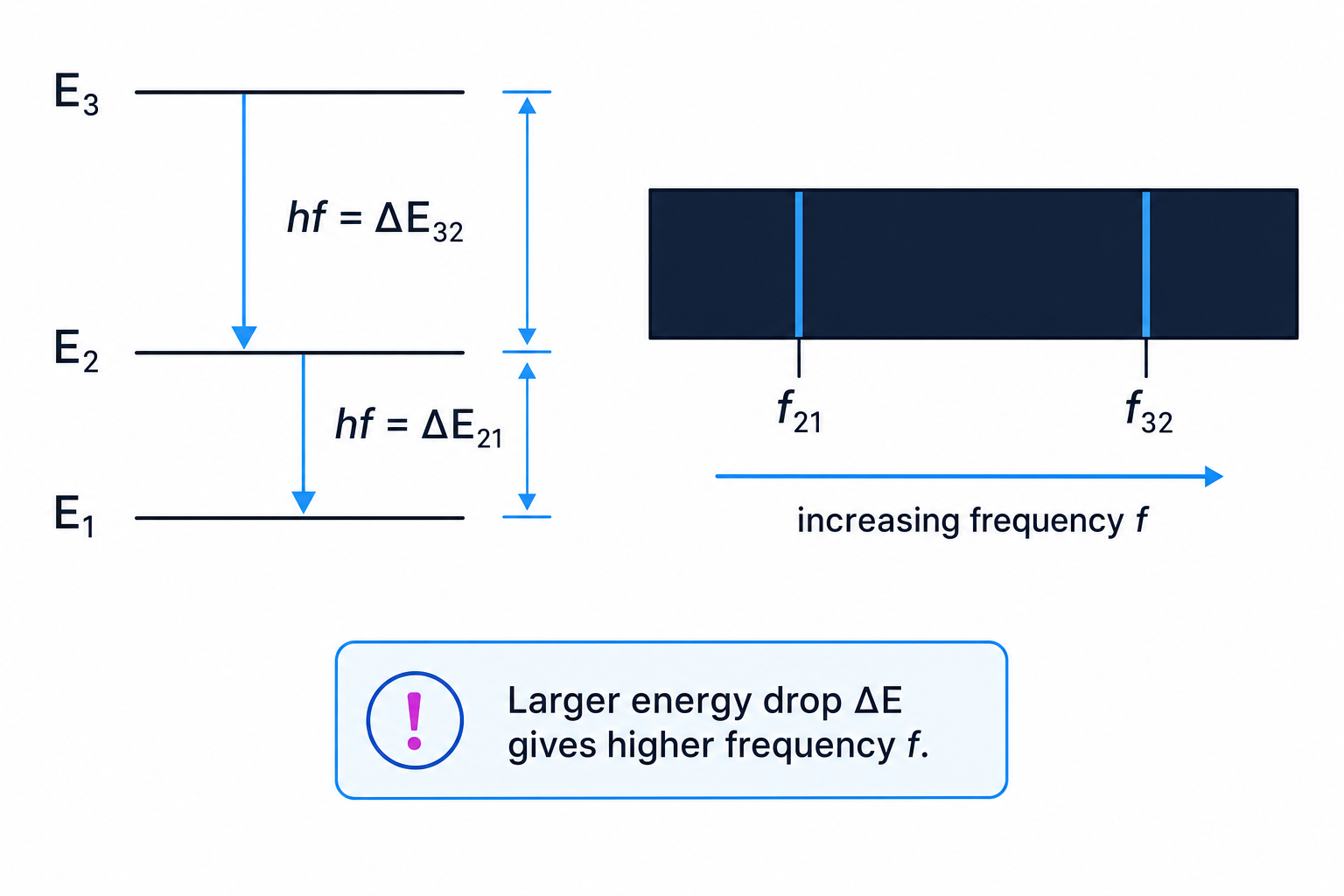
Atoms have quantised energy levels, meaning electrons in atoms can only have certain allowed energies. When an electron moves from a higher energy level to a lower energy level, it emits a photon. The photon energy equals the energy difference between the levels.
So:
f=ΔEhf=\frac{\Delta E}{h}f=hΔEand:
λ=hcΔE\lambda=\frac{hc}{\Delta E}λ=ΔEhcBecause each element has its own unique set of energy levels, each element produces a unique line spectrum. This is why line spectra can be used to identify elements in stars and gas lamps.
Key Idea
Atoms only make certain photon energies
Line spectra show that atomic energy levels are quantised. Only photons with energies matching differences between allowed levels can be emitted or absorbed.
Emission spectra are produced when excited electrons fall to lower levels and emit photons. Absorption spectra are produced when electrons absorb photons of exactly the right energy to jump to higher levels.
Example
Calculating wavelength from an energy-level transition
An electron in an atom drops between two energy levels separated by 2.55 eV. Calculate the wavelength of the emitted photon.
-
Convert the energy difference into joules:
ΔE=2.55×(1.60×10−19)\Delta E=2.55\times(1.60\times10^{-19})ΔE=2.55×(1.60×10−19) ΔE=4.08×10⁻¹⁹ J\Delta E=4.08\times10^{-19}\ \text{J}ΔE=4.08×10⁻¹⁹ J -
Use f=ΔEhf=\frac{\Delta E}{h}f=hΔE:
f=4.08×10−196.63×10⁻³⁴f=\frac{4.08\times10^{-19}}{6.63\times10^{-34}}f=6.63×10−344.08×10⁻¹⁹ f=6.15×10¹⁴ Hzf=6.15\times10^{14}\ \text{Hz}f=6.15×10¹⁴ Hz -
Use c=fλc=f\lambdac=fλ, so λ=cf\lambda=\frac{c}{f}λ=fc:
λ=3.00×1086.15×1014\lambda=\frac{3.00\times10^8}{6.15\times10^{14}}λ=6.15×10143.00×108 λ=4.88×10⁻⁷ m\lambda=4.88\times10^{-7}\ \text{m}λ=4.88×10⁻⁷ mThis is 488 nm, which is in the visible region.
Bringing the ideas together
Photons explain both the photoelectric effect and line spectra.
In the photoelectric effect, a photon transfers energy to an electron in a metal. If hfhfhf is greater than the work function, the electron can escape.
In line spectra, photons are emitted or absorbed when electrons in atoms move between allowed energy levels. The photon energy is exactly equal to the energy change.
Exam technique
In the exam
-
Always check whether an energy is given in joules or electronvolts before substituting into equations.
-
For photoelectric questions, separate the effects of frequency and intensity: frequency affects photon energy; intensity affects photon number per second.
-
On graphs, identify the gradient and intercept carefully: Ek,maxE_{k,\max}Ek,max against fff gives gradient hhh, while VsV_sVs against fff gives gradient he\frac{h}{e}eh.
Self review
Check yourself
- Why can increasing the intensity of light below the threshold frequency not release photoelectrons?
- What does the work function represent in the equation hf=ϕ+Ek,maxhf=\phi+E_{k,\max}hf=ϕ+Ek,max?
- How does an energy-level diagram explain the sharp lines in an emission spectrum?
You've reached the end
Test yourself on this topic, or move on to the next guide.
How was this guide?