Revision notes for Edexcel A Level Physics I-V characteristics and resistivity. Open the guide for explanations and worked examples. Written against the Edexcel A Level Physics (9PH0) specification, so the content matches what's examinable rather than general Physics background.
I-V characteristics and resistivity
What you'll learn
- How current, potential difference and resistance are connected.
- How to interpret I-V characteristic graphs for resistors, filament lamps and diodes.
- Why a wire’s resistance depends on length, area and material.
- How to measure resistivity experimentally using a graph.
The basic circuit quantities
Current
Electric current is about how much charge flows each second.
Definition
Current
Current is the rate of flow of electric charge:
I=ΔQΔtI = \frac{\Delta Q}{\Delta t}I=ΔtΔQwhere III is current in amperes, ΔQ\Delta QΔQ is charge in coulombs, and Δt\Delta tΔt is time in seconds.
A current of 1 A means 1 C of charge passes a point in the circuit every second.
Potential difference
Potential difference tells you how much energy is transferred by each coulomb of charge moving between two points.
Definition
Potential difference
Potential difference is energy transferred per unit charge:
V=WQV = \frac{W}{Q}V=QWwhere VVV is potential difference in volts, WWW is energy transferred in joules, and QQQ is charge in coulombs.
So if a component has a potential difference of 6 V across it, each coulomb of charge transfers 6 J of energy in that component.
Resistance
Resistance describes how difficult it is for charge to flow through a component.
Definition
Resistance
Resistance is defined by:
R=VIR = \frac{V}{I}R=IVwhere RRR is resistance in ohms, VVV is potential difference in volts, and III is current in amperes.
Example
Calculating resistance
A resistor has a potential difference of 12.0 V across it and a current of 0.40 A through it. Find its resistance.
- Choose the definition of resistance because both potential difference and current are given: R=VIR = \frac{V}{I}R=IV.
- Substitute the values with units: R=12.0 V0.40 AR = \frac{12.0\ \text{V}}{0.40\ \text{A}}R=0.40 A12.0 V.
- Calculate the resistance: R=30 ΩR = 30\ \OmegaR=30 Ω.
What is an I-V characteristic?
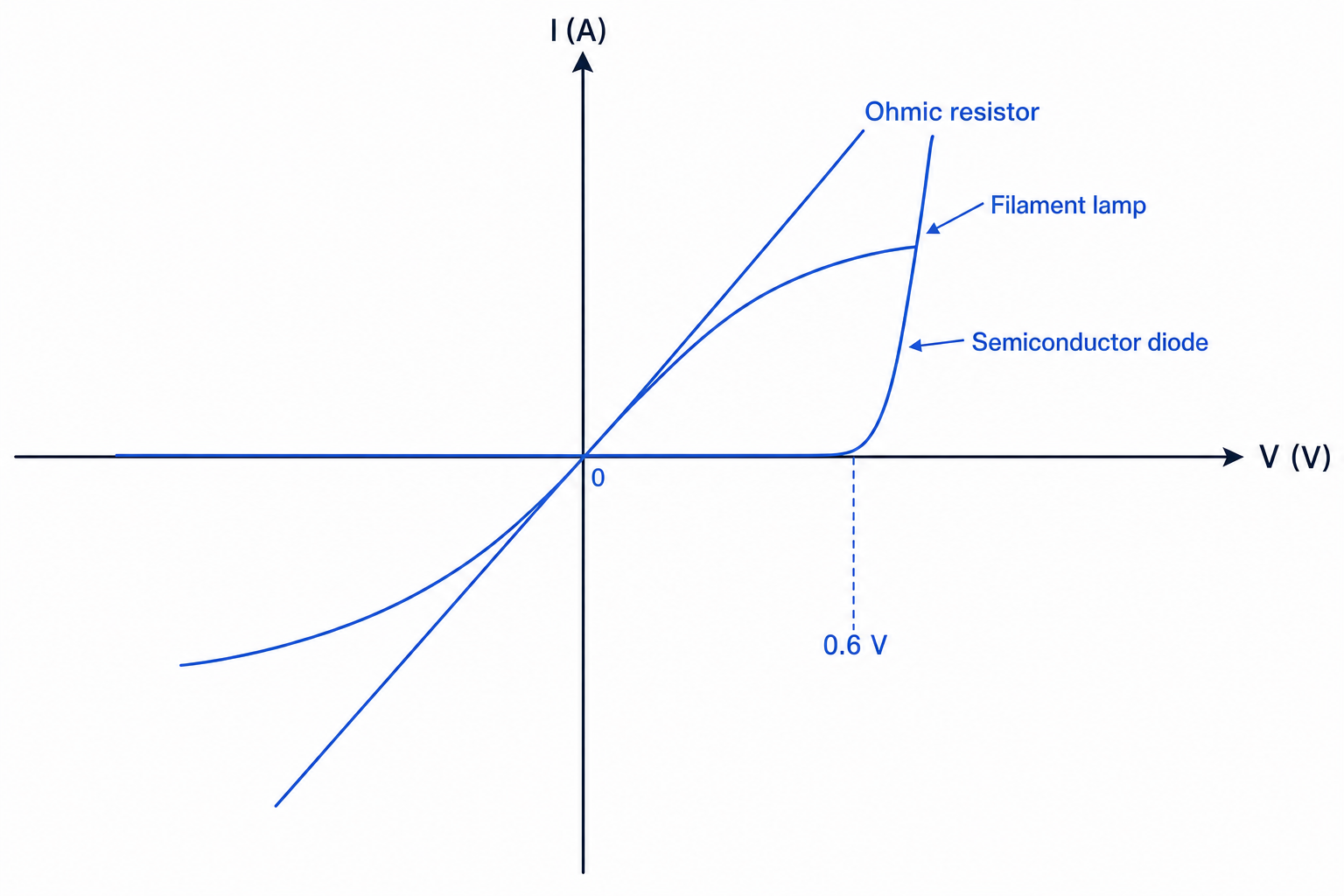
An I-V characteristic is a graph showing how the current through a component varies with the potential difference across it.
Definition
I-V characteristic
An I-V characteristic is a graph of current III against potential difference VVV for a component.
For Pearson Edexcel A-Level Physics, you should be comfortable recognising and explaining the shapes for:
- an ohmic conductor or fixed resistor
- a filament lamp
- a semiconductor diode
The graph is usually plotted with current on the vertical axis and potential difference on the horizontal axis.
Common Mistake
Mixing up the graph gradient
On a graph of current against potential difference, the gradient is IV\frac{I}{V}VI, so for an ohmic resistor it equals 1R\frac{1}{R}R1. If the graph is potential difference against current instead, the gradient is RRR.
Ohmic conductors
An ohmic conductor is a component that obeys Ohm’s law.
Definition
Ohm’s law
For a metallic conductor at constant temperature, current is directly proportional to potential difference:
I∝VI \propto VI∝VThis means the resistance is constant.
The key phrase is at constant temperature. If the temperature changes, the resistance may change too.
For an ohmic conductor:
- the I-V graph is a straight line through the origin
- doubling the potential difference doubles the current
- the resistance stays constant
Key Idea
Ohmic behaviour
A straight-line I-V graph through the origin means current is proportional to potential difference and resistance is constant.
Example
Finding resistance from an I-V graph
An ohmic resistor has a straight-line I-V graph. When the potential difference is 4.0 V, the current is 0.20 A. Find the resistance.
- Use a point on the straight line and apply R=VIR = \frac{V}{I}R=IV.
- Substitute the graph values: R=4.0 V0.20 AR = \frac{4.0\ \text{V}}{0.20\ \text{A}}R=0.20 A4.0 V.
- Calculate: R=20 ΩR = 20\ \OmegaR=20 Ω.
Filament lamps
A filament lamp contains a thin metal wire that gets very hot when current passes through it.
At low potential difference, the filament is relatively cool, so its resistance is lower. As the current increases, the filament heats up. The metal ions vibrate more, making it harder for electrons to pass through. This increases the resistance.
So the I-V graph for a filament lamp:
- starts steep near the origin
- becomes less steep as current increases
- is roughly symmetrical for positive and negative potential difference
Key Idea
Heating increases resistance
For a filament lamp, increasing current heats the filament, so resistance increases and the I-V graph curves.
The curve becoming less steep on an I-V graph means that for each extra volt, the increase in current gets smaller. Since the gradient is roughly related to 1R\frac{1}{R}R1, a smaller gradient means a larger resistance.
Example
Comparing filament lamp resistance
A filament lamp has a current of 0.10 A at 1.0 V and a current of 0.30 A at 6.0 V. Compare its resistance at these two operating points.
- Calculate the resistance at 1.0 V using R=VIR = \frac{V}{I}R=IV:
R=1.0 V0.10 A=10 ΩR = \frac{1.0\ \text{V}}{0.10\ \text{A}} = 10\ \OmegaR=0.10 A1.0 V=10 Ω. - Calculate the resistance at 6.0 V:
R=6.0 V0.30 A=20 ΩR = \frac{6.0\ \text{V}}{0.30\ \text{A}} = 20\ \OmegaR=0.30 A6.0 V=20 Ω. - Compare the two values: the resistance has doubled because the filament is hotter at the higher current.
Semiconductor diodes
A diode is a component that allows current to flow much more easily in one direction than the other.
Definition
Diode
A diode is a semiconductor component that has very low resistance in the forward direction above a threshold potential difference, and very high resistance in the reverse direction.
For a typical silicon diode:
- in reverse bias, almost no current flows
- in forward bias, almost no current flows until about 0.6 V
- above this threshold, the current increases rapidly
Tip
Remembering diode direction
Think of a diode as a one-way valve for charge: it strongly favours current in one direction, but blocks current in the reverse direction under normal conditions.
Common Mistake
Reverse breakdown
At a sufficiently large reverse potential difference, a diode can suddenly conduct in reverse. This is called breakdown. Standard I-V characteristic questions often ignore this unless it is shown or stated.
Resistivity
Resistance does not only depend on the material. It also depends on the dimensions of the conductor.
A long thin wire has a larger resistance than a short thick wire of the same material. Resistivity separates out the effect of the material itself.
Definition
Resistivity
Resistivity is a property of a material defined by:
ρ=RAL\rho = \frac{RA}{L}ρ=LRAwhere ρ\rhoρ is resistivity in ohm metres, RRR is resistance in ohms, AAA is cross-sectional area in square metres, and LLL is length in metres.
This can also be rearranged as:
R=ρLAR = \frac{\rho L}{A}R=AρLSo:
- resistance is proportional to length: R∝LR \propto LR∝L
- resistance is inversely proportional to cross-sectional area: R∝1AR \propto \frac{1}{A}R∝A1
- a material with larger resistivity gives a larger resistance for the same shape
Key Idea
What resistivity tells you
Resistivity tells you how strongly a material opposes current, independent of the wire’s length and thickness.
For a circular wire, the cross-sectional area is found from its diameter:
A=π(d2)2A = \pi\left(\frac{d}{2}\right)^2A=π(2d)2where ddd is the diameter of the wire.
Example
Calculating resistivity of a wire
A metal wire has length 0.800 m, diameter 0.32 mm, and resistance 2.1 Ω. Calculate its resistivity.
- Convert the diameter into metres:
d=0.32 mm=0.32×10⁻³ md = 0.32\ \text{mm} = 0.32 \times 10^{-3}\ \text{m}d=0.32 mm=0.32×10⁻³ m. - Calculate the cross-sectional area:
A=π(0.32×10⁻³ m2)2=8.04×10⁻⁸ m2A = \pi\left(\frac{0.32 \times 10^{-3}\ \text{m}}{2}\right)^2 = 8.04 \times 10^{-8}\ \text{m}^2A=π(20.32×10⁻³ m)2=8.04×10⁻⁸ m2. - Use the resistivity equation:
ρ=RAL\rho = \frac{RA}{L}ρ=LRA. - Substitute the values:
ρ=2.1 Ω×8.04×10−8 m20.800 m\rho = \frac{2.1\ \Omega \times 8.04 \times 10^{-8}\ \text{m}^2}{0.800\ \text{m}}ρ=0.800 m2.1 Ω×8.04×10−8 m2. - Calculate and quote sensibly:
ρ=2.1×10⁻⁷ Ω m\rho = 2.1 \times 10^{-7}\ \Omega\ \text{m}ρ=2.1×10⁻⁷ Ω m.
Measuring resistivity in the lab
This is a core practical idea: determine the resistivity of a material, usually a metal wire.
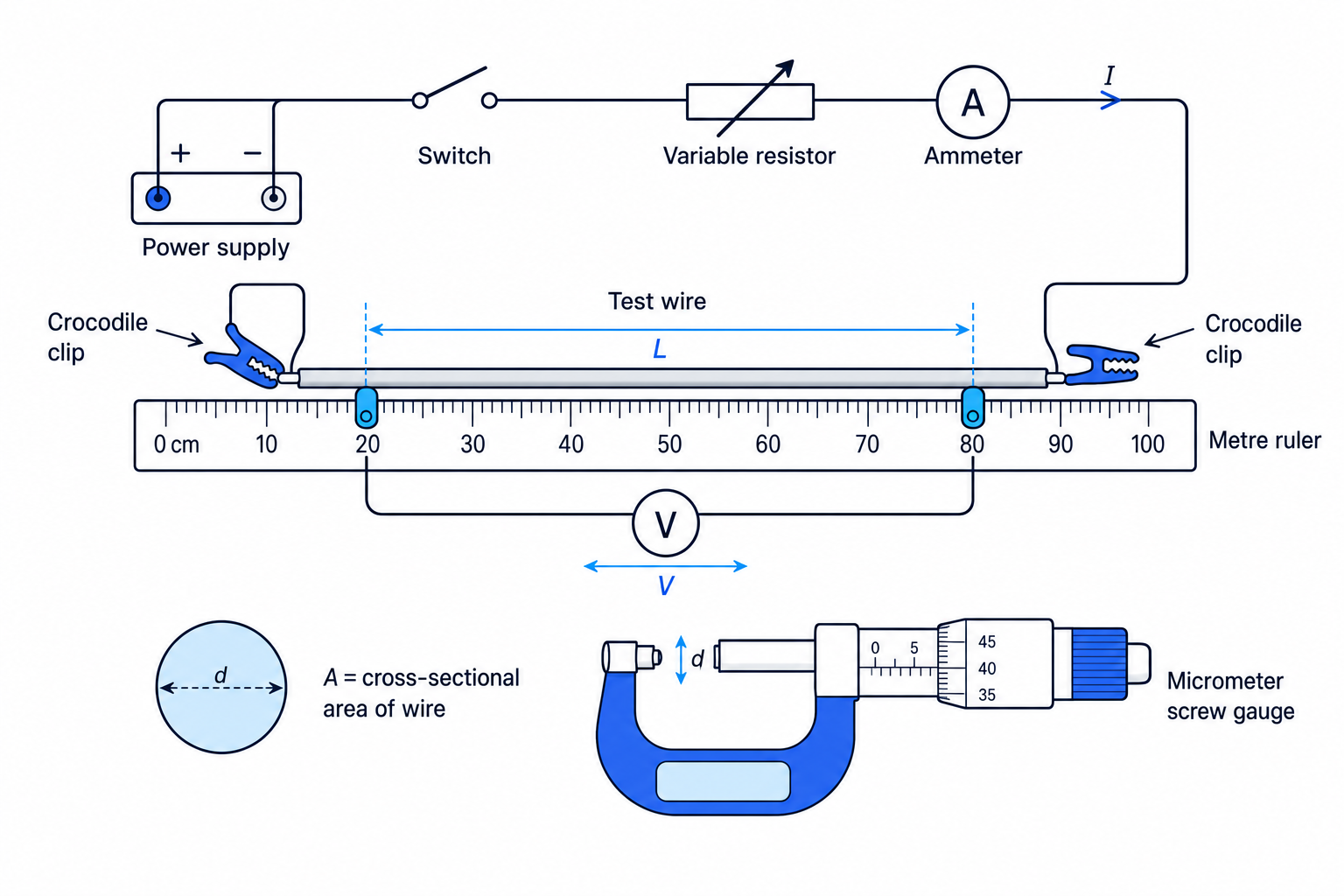
You measure:
- the current through the wire using an ammeter in series
- the potential difference across a measured length using a voltmeter in parallel
- the length of wire using a metre ruler
- the diameter using a micrometer screw gauge
Method outline
A good method is:
- Measure the diameter of the wire at several points and in different orientations using a micrometer.
- Calculate the mean diameter, then calculate the cross-sectional area.
- Set a length LLL of wire using crocodile clips.
- Measure the potential difference VVV across that length and the current III through it.
- Calculate resistance using R=VIR = \frac{V}{I}R=IV.
- Repeat for several lengths.
A better graph method is to plot resistance against length. Since
R=ρLAR = \frac{\rho L}{A}R=AρLa graph of RRR against LLL should be a straight line through the origin, with gradient:
gradient=ρA\text{gradient} = \frac{\rho}{A}gradient=AρTherefore:
ρ=gradient×A\rho = \text{gradient} \times Aρ=gradient×AExample
Using a resistance-length graph
A student plots resistance against length for a wire. The gradient of the graph is 4.5 Ω m−1^{-1}−1. The wire has cross-sectional area 1.3×10⁻⁷ m21.3 \times 10^{-7}\ \text{m}^21.3×10⁻⁷ m2. Find the resistivity.
- Link the graph gradient to the equation R=ρLAR = \frac{\rho L}{A}R=AρL. For a graph of RRR against LLL, the gradient is ρA\frac{\rho}{A}Aρ.
- Rearrange for resistivity: ρ=gradient×A\rho = \text{gradient} \times Aρ=gradient×A.
- Substitute the values:
ρ=4.5 Ω m−1×1.3×10−7 m2\rho = 4.5\ \Omega\ \text{m}^{-1} \times 1.3 \times 10^{-7}\ \text{m}^2ρ=4.5 Ω m−1×1.3×10−7 m2. - Calculate:
ρ=5.9×10⁻⁷ Ω m\rho = 5.9 \times 10^{-7}\ \Omega\ \text{m}ρ=5.9×10⁻⁷ Ω m.
Common Mistake
Forgetting to square the diameter conversion
When calculating area, convert the diameter into metres before squaring it. A millimetre-to-metre error becomes much worse after squaring.
Practical uncertainties and good technique
The diameter measurement is often the biggest source of percentage uncertainty because the wire is thin.
To improve reliability:
- take several diameter measurements along the wire
- avoid overheating the wire, because resistance changes with temperature
- use a small current or switch off between readings
- ensure crocodile clips make firm contact
- read analogue meters at eye level to avoid parallax error
- use a graph and a best-fit line rather than relying on one pair of readings
Tip
Sanity check for resistivity
Typical metal resistivities are often around 10−810^{-8}10−8 to 10−6 Ω m10^{-6}\ \Omega\ \text{m}10−6 Ω m. If your answer is many powers of ten away, check unit conversions, especially mm to m and area.
Exam technique
In the exam
- Check which way round the I-V graph is plotted before using the gradient; current against potential difference gives gradient 1R\frac{1}{R}R1 for an ohmic resistor.
- For resistivity calculations, convert all lengths to metres and calculate area using A=π(d2)2A = \pi\left(\frac{d}{2}\right)^2A=π(2d)2.
- When explaining curved I-V graphs, link the shape to a physical change: temperature increase for a filament lamp, or threshold behaviour for a diode.
Self review
Check yourself
- Why must temperature be constant for a conductor to obey Ohm’s law?
- On a graph of resistance against length, how would you find the resistivity of the wire?
- Why does the I-V graph of a filament lamp become less steep as current increases?