Revision notes for Edexcel A Level Physics Electric potential and energy. Open the guide for explanations and worked examples. Written against the Edexcel A Level Physics (9PH0) specification, so the content matches what's examinable rather than general Physics background.
Electric potential and energy
What you'll learn
- What electric potential means and how it links to work done and energy.
- How to use ΔEp=qΔV\Delta E_p = q\Delta VΔEp=qΔV for charges moving through potential differences.
- How potential behaves in uniform fields and around point charges.
- How to handle signs, electronvolts, equipotentials and superposition.
The starting point: fields, work and charge
An electric field is a region where a charge experiences a force. Electric field strength, symbol EEE, is force per unit positive charge:
E=FqE = \frac{F}{q}E=qFIts units are newtons per coulomb, N C^-1. Later in this topic you will also meet the equivalent unit volts per metre, V m^-1.
A test charge is a very small charge used to investigate a field without noticeably changing the field itself. By convention, field direction is the direction of the force on a positive test charge.
Work done is energy transferred by a force. In electric fields, the important idea is not just “how large is the force?”, but “how much energy is transferred per coulomb of charge?”.
Key Idea
Potential is an energy idea
Electric potential lets you solve many electric-field problems using energy per charge instead of force and distance.
Electric potential
Definition
Electric potential
The electric potential at a point, symbol VVV, is the work done per unit positive charge in bringing a small positive test charge from infinity to that point, without changing its kinetic energy.
In equation form:
V=WqV = \frac{W}{q}V=qWThe unit is the volt, V. One volt is one joule per coulomb, J C^-1.
For isolated point charges, we usually choose the electric potential to be zero at infinity. This is similar to gravitational potential being defined relative to infinity in fields around planets and stars.
Potential is scalar
Electric potential is a scalar quantity. This means it has magnitude and sign, but no direction.
That is different from electric field strength, which is a vector. Electric field strength has both magnitude and direction.
Potential difference and energy changes
Definition
Potential difference
The potential difference between two points is the work done per unit charge in moving a charge between those points.
If a charge qqq moves through a potential difference ΔV\Delta VΔV, its change in electric potential energy is:
ΔEp=qΔV\Delta E_p = q\Delta VΔEp=qΔVThis is one of the most important equations in this topic.
The work done by the electric field is the negative of the change in potential energy:
Wfield=−qΔVW_{\text{field}} = -q\Delta VWfield=−qΔVSo if electric potential energy decreases, kinetic energy can increase.
Example
Energy change across a potential difference
An ion with charge +3.0×10⁻⁶+3.0 \times 10^{-6}+3.0×10⁻⁶ C moves from a point at 12 V to a point at 45 V. Find the change in electric potential energy and the work done by the electric field.
-
Calculate the potential difference: ΔV=VB−VA=45−12=33\Delta V = V_B - V_A = 45 - 12 = 33ΔV=VB−VA=45−12=33 V.
-
Use ΔEp=qΔV\Delta E_p = q\Delta VΔEp=qΔV: ΔEp=(3.0×10⁻⁶)(33)=9.9×10⁻⁵\Delta E_p = (3.0 \times 10^{-6})(33) = 9.9 \times 10^{-5}ΔEp=(3.0×10⁻⁶)(33)=9.9×10⁻⁵ J. The positive sign means the ion’s electric potential energy increases.
-
The work done by the field is Wfield=−ΔEp=−9.9×10⁻⁵W_{\text{field}} = -\Delta E_p = -9.9 \times 10^{-5}Wfield=−ΔEp=−9.9×10⁻⁵ J. The electric field does negative work, so an external force would need to supply energy.
Common Mistake
Dropping the sign of the charge
Always include the sign of qqq when using ΔEp=qΔV\Delta E_p = q\Delta VΔEp=qΔV. A negative charge, such as an electron, has the opposite potential energy change to a positive charge moving through the same potential difference.
Electrons, accelerating potential differences and electronvolts
A charged particle accelerated through a potential difference can gain kinetic energy. If it starts from rest and electrical energy is converted into kinetic energy, then:
ΔEk=qΔV\Delta E_k = q\Delta VΔEk=qΔVFor many particle problems, you use the magnitude of the charge and the magnitude of the potential difference to find the energy gained.
The elementary charge, symbol eee, is the magnitude of the charge on a proton or electron:
e=1.60×10⁻¹⁹ Ce = 1.60 \times 10^{-19}\ \text{C}e=1.60×10⁻¹⁹ CAn electronvolt is a unit of energy. One electronvolt is the energy gained by an electron when it is accelerated through a potential difference of 1 V:
1 eV=1.60×10⁻¹⁹ J1\ \text{eV} = 1.60 \times 10^{-19}\ \text{J}1 eV=1.60×10⁻¹⁹ JExample
Energy gained by an electron
An electron is accelerated from rest through a potential difference of 2.0 kV. Find its kinetic energy in joules and in electronvolts.
-
Use the magnitude of the charge because the question asks for energy gained: ΔEk=eΔV\Delta E_k = e\Delta VΔEk=eΔV.
-
Substitute the values: ΔEk=(1.60×10⁻¹⁹)(2.0×10³)=3.2×10⁻¹⁶\Delta E_k = (1.60 \times 10^{-19})(2.0 \times 10^3) = 3.2 \times 10^{-16}ΔEk=(1.60×10⁻¹⁹)(2.0×10³)=3.2×10⁻¹⁶ J.
-
Since one electronvolt is 1.60×10−191.60 \times 10^{-19}1.60×10⁻¹⁹ J, the energy is 2.0 keV.
Uniform electric fields between parallel plates
A uniform electric field has the same field strength at every point. A good approximation is the field between two large, oppositely charged parallel plates, away from the edges.
The electric field points from the positive plate to the negative plate. The potential decreases in the direction of the electric field.
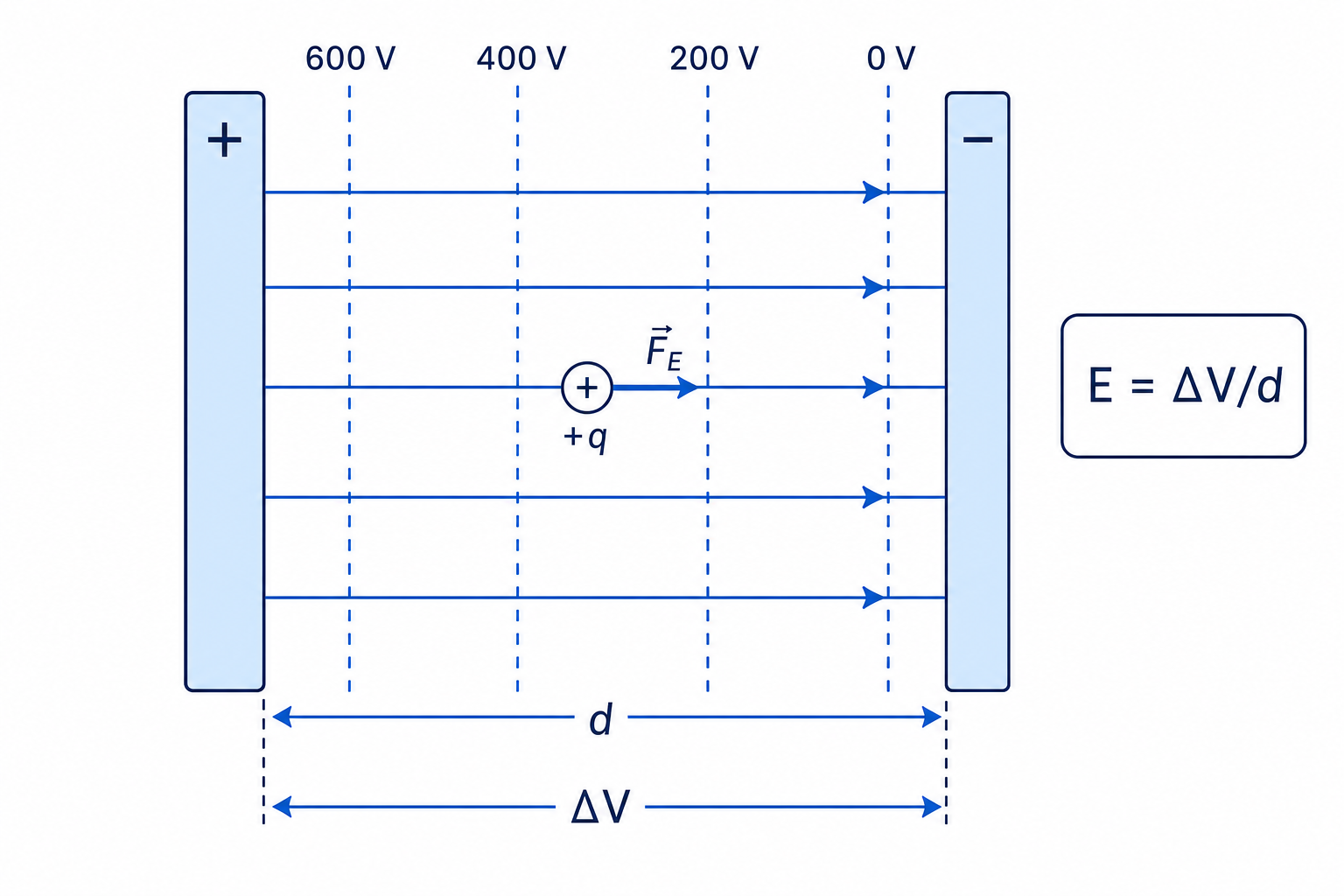
For parallel plates separated by distance ddd with potential difference ΔV\Delta VΔV, the field strength magnitude is:
E=ΔVdE = \frac{\Delta V}{d}E=dΔVThis shows why volts per metre, V m^-1, is equivalent to newtons per coulomb, N C^-1.
Definition
Equipotential
An equipotential is a line or surface where every point has the same electric potential. Moving a charge along an equipotential requires no work, because ΔV=0\Delta V = 0ΔV=0.
Equipotential lines are always at right angles to electric field lines.
Example
Field strength between parallel plates
Two parallel plates have a potential difference of 600 V and are separated by 12 mm. Find the electric field strength and the force on a proton between the plates.
-
Convert the separation to metres and use E=ΔV/dE = \Delta V/dE=ΔV/d: d=1.2×10⁻²d = 1.2 \times 10^{-2}d=1.2×10⁻² m, so E=600/(1.2×10−2)=5.0×104E = 600/(1.2 \times 10^{-2}) = 5.0 \times 10^4E=600/(1.2×10−2)=5.0×104 V m^-1.
-
Use F=qEF = qEF=qE for a proton: F=(1.60×10⁻¹⁹)(5.0×10⁴)=8.0×10⁻¹⁵F = (1.60 \times 10^{-19})(5.0 \times 10^4) = 8.0 \times 10^{-15}F=(1.60×10⁻¹⁹)(5.0×10⁴)=8.0×10⁻¹⁵ N.
-
The force is in the direction of the electric field, from the positive plate towards the negative plate.
Tip
Potential gradient
On a graph of potential against distance, the electric field strength is the negative gradient: E≈−ΔV/ΔxE \approx -\Delta V/\Delta xE≈−ΔV/Δx. In many A-Level calculations you only need the magnitude, so use E=ΔV/dE = \Delta V/dE=ΔV/d.
Common Mistake
Using E = V/d everywhere
The equation E=ΔV/dE = \Delta V/dE=ΔV/d is for a uniform field, such as between parallel plates. Around a point charge, the field is not uniform, so you need the point-charge equations.
Potential around a point charge
A point charge is a charge treated as if it is concentrated at one point. This is a good model when the distance from the charge is much larger than the size of the charged object.
The electric potential at distance rrr from a point charge QQQ is:
V=Q4πϵ0rV = \frac{Q}{4\pi\epsilon_0 r}V=4πϵ0rQHere, ϵ0\epsilon_0ϵ0 is the permittivity of free space. In practice, air is usually close enough to vacuum for A-Level calculations.
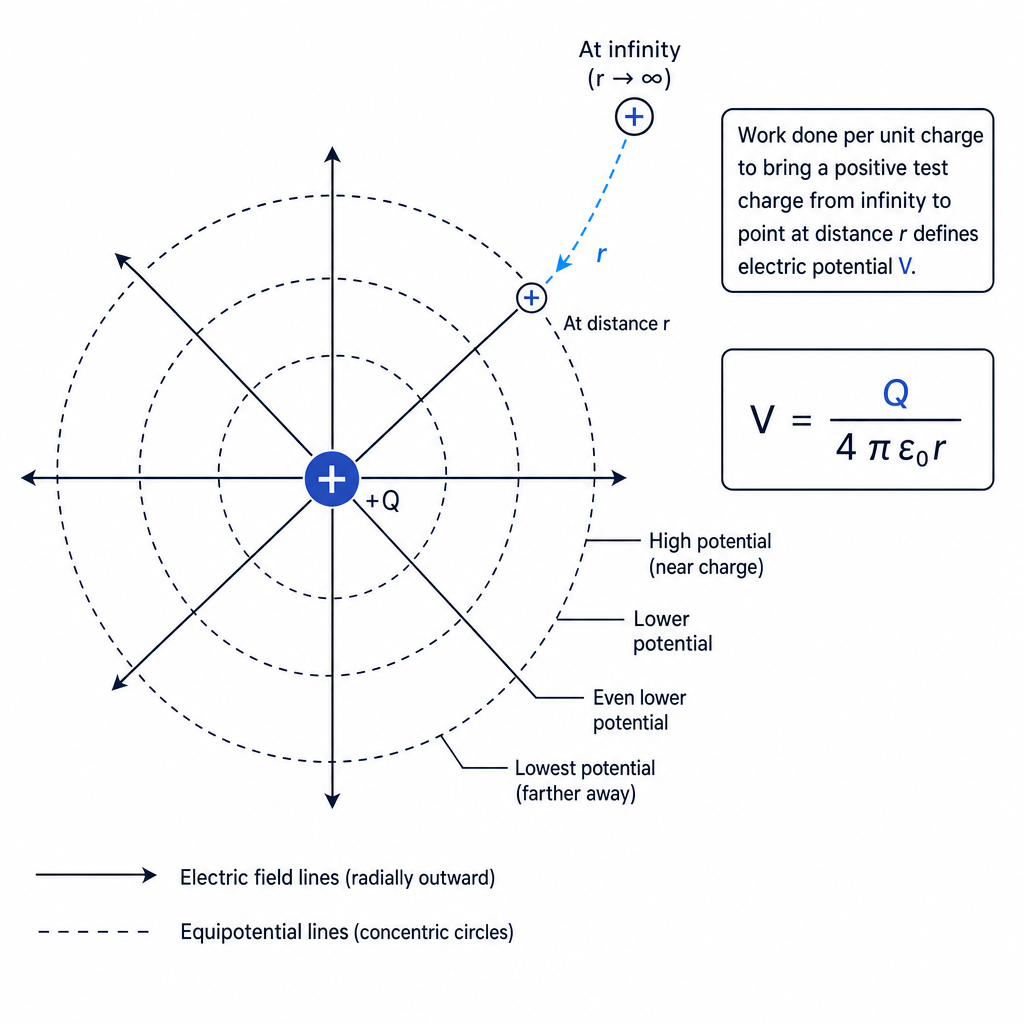
Important features:
- Potential is positive around a positive charge.
- Potential is negative around a negative charge.
- Potential gets closer to zero as rrr increases.
- Potential follows a 1/r1/r1/r relationship, whereas field strength follows a 1/r21/r^21/r2 relationship.
The electric potential energy of a charge qqq placed at a point where the potential is VVV is:
Ep=qVE_p = qVEp=qVSo for two point charges:
Ep=Qq4πϵ0rE_p = \frac{Qq}{4\pi\epsilon_0 r}Ep=4πϵ0rQqExample
Potential energy near a point charge
A charge of +3.0×10⁻⁶+3.0 \times 10^{-6}+3.0×10⁻⁶ C produces an electric potential. Find the potential 0.20 m from it, then find the electric potential energy of a charge of −2.0×10⁻⁶-2.0 \times 10^{-6}−2.0×10⁻⁶ C placed there.
-
Use V=kQ/rV = kQ/rV=kQ/r, where k=8.99×10⁹k = 8.99 \times 10^9k=8.99×10⁹ N m^2 C^-2: V=(8.99×10⁹)(3.0×10⁻⁶)/0.20=1.35×105V = (8.99 \times 10^9)(3.0 \times 10^{-6})/0.20 = 1.35 \times 10^5V=(8.99×10⁹)(3.0×10⁻⁶)/0.20=1.35×105 V.
-
Use Ep=qVE_p = qVEp=qV: Ep=(−2.0×10⁻⁶)(1.35×10⁵)=−0.270E_p = (-2.0 \times 10^{-6})(1.35 \times 10^5) = -0.270Ep=(−2.0×10⁻⁶)(1.35×10⁵)=−0.270 J.
-
The negative value means the unlike charges have lower potential energy than when infinitely separated. You would need to supply 0.270 J to move the negative charge away to infinity slowly.
Adding potentials from more than one charge
Because electric potential is scalar, potentials from several charges add algebraically. That means you include signs, but you do not resolve components.
Vtotal=∑Q4πϵ0rV_{\text{total}} = \sum \frac{Q}{4\pi\epsilon_0 r}Vtotal=∑4πϵ0rQThis is much simpler than adding electric field strengths, which are vectors and require directions.
Example
Adding potentials from two charges
Two charges, +4.0×10⁻⁹+4.0 \times 10^{-9}+4.0×10⁻⁹ C and −1.0×10⁻⁹-1.0 \times 10^{-9}−1.0×10⁻⁹ C, are separated by 10 cm. Find the electric potential at the midpoint.
-
The midpoint is 0.050 m from each charge, so both contributions use the same distance but keep their signs.
-
Add the potentials algebraically: Vtotal=(8.99×10⁹)((4.0×10⁻⁹)/0.050+(−1.0×10−9)/0.050)=5.4×102V_{\text{total}} = (8.99 \times 10^9)((4.0 \times 10^{-9})/0.050 + (-1.0 \times 10^{-9})/0.050) = 5.4 \times 10^2Vtotal=(8.99×10⁹)((4.0×10⁻⁹)/0.050+(−1.0×10−9)/0.050)=5.4×102 V.
-
The answer is positive because the positive charge’s contribution is larger in magnitude than the negative charge’s contribution.
Linking potential, energy and motion
When a charged particle moves freely in an electric field:
- A positive charge accelerates from higher potential to lower potential.
- A negative charge accelerates from lower potential to higher potential.
- Electric potential energy lost becomes kinetic energy gained, if no other forces do work.
This is just conservation of energy:
ΔEk=−ΔEp\Delta E_k = -\Delta E_pΔEk=−ΔEpSo if ΔEp\Delta E_pΔEp is negative, ΔEk\Delta E_kΔEk is positive.
Exam technique
In the exam
-
Decide whether the field is uniform or radial: use E=ΔV/dE = \Delta V/dE=ΔV/d for parallel plates, but V=Q/(4πϵ0r)V = Q/(4\pi\epsilon_0 r)V=Q/(4πϵ0r) for point charges.
-
Keep signs for potential and potential energy calculations, especially when the moving charge is negative.
-
For multiple charges, add potentials as scalars; only use vector components when adding electric field strengths.
Self review
Check yourself
- Why is electric potential a scalar, but electric field strength a vector?
- A proton and an electron move through the same potential difference. How do their potential energy changes compare?
- Why is no work done when a charge moves along an equipotential line?