Revision notes for Edexcel A Level Physics Electric fields and Coulomb's law. Open the guide for explanations and worked examples. Written against the Edexcel A Level Physics (9PH0) specification, so the content matches what's examinable rather than general Physics background.
Electric fields and Coulomb's law
What you'll learn
- What an electric field is and how to represent it with field lines.
- How to use electric field strength to link force and charge.
- How to calculate electric forces using Coulomb’s law.
- How to handle direction, signs, and vector addition in electric field questions.
The starting point: electric charge
Electric charge is a property of particles and objects that allows them to exert electrical forces. Charge can be positive or negative. Like charges repel; unlike charges attract.
The SI unit of charge is the coulomb, symbol C. A proton has charge +e+e+e and an electron has charge −e-e−e, where:
e=1.60×10⁻¹⁹ Ce = 1.60 \times 10^{-19}\ \text{C}e=1.60×10⁻¹⁹ CDefinition
Electric charge
Electric charge is a property of matter that causes electrical forces. It is measured in coulombs, C, and can be positive or negative.
Electrical forces are non-contact forces: charged objects can exert forces on each other even when they are separated by empty space.
Electric fields
An electric field is a region where a charged object experiences a force. A charged object creates a field around itself, and another charge placed in that field feels a force.
A test charge is a small positive charge imagined to be placed at a point to find the field there. We choose it to be small so it does not significantly alter the field being measured.
Definition
Electric field strength
Electric field strength, EEE, is the force per unit positive charge at a point in an electric field:
E=FqE = \frac{F}{q}E=qFIts unit is newtons per coulomb, N C⁻¹. Its direction is the direction of the force on a positive test charge.
Because E=F/qE = F/qE=F/q, you can also rearrange to find the force on a charge in a field:
F=qEF = qEF=qEIf the charge is positive, the force is in the same direction as the field. If the charge is negative, the force is in the opposite direction.
Example
Finding electric field strength from a force
A positive test charge of 6.0×10⁻⁹ C6.0 \times 10^{-9}\ \text{C}6.0×10⁻⁹ C experiences a force of 2.4×10⁻³ N2.4 \times 10^{-3}\ \text{N}2.4×10⁻³ N to the right. Find the electric field strength.
- Use the definition of electric field strength: E=F/qE = F/qE=F/q.
- Substitute the values: E=(2.4×10⁻³)÷(6.0×10⁻⁹)=4.0×10⁵ N C−1E = \left(2.4 \times 10^{-3}\right) \div \left(6.0 \times 10^{-9}\right) = 4.0 \times 10^{5}\ \text{N}\ \text{C}^{-1}E=(2.4×10⁻³)÷(6.0×10⁻⁹)=4.0×10⁵ N C−1.
- The test charge is positive, so the field direction is the same as the force: to the right.
Electric field lines
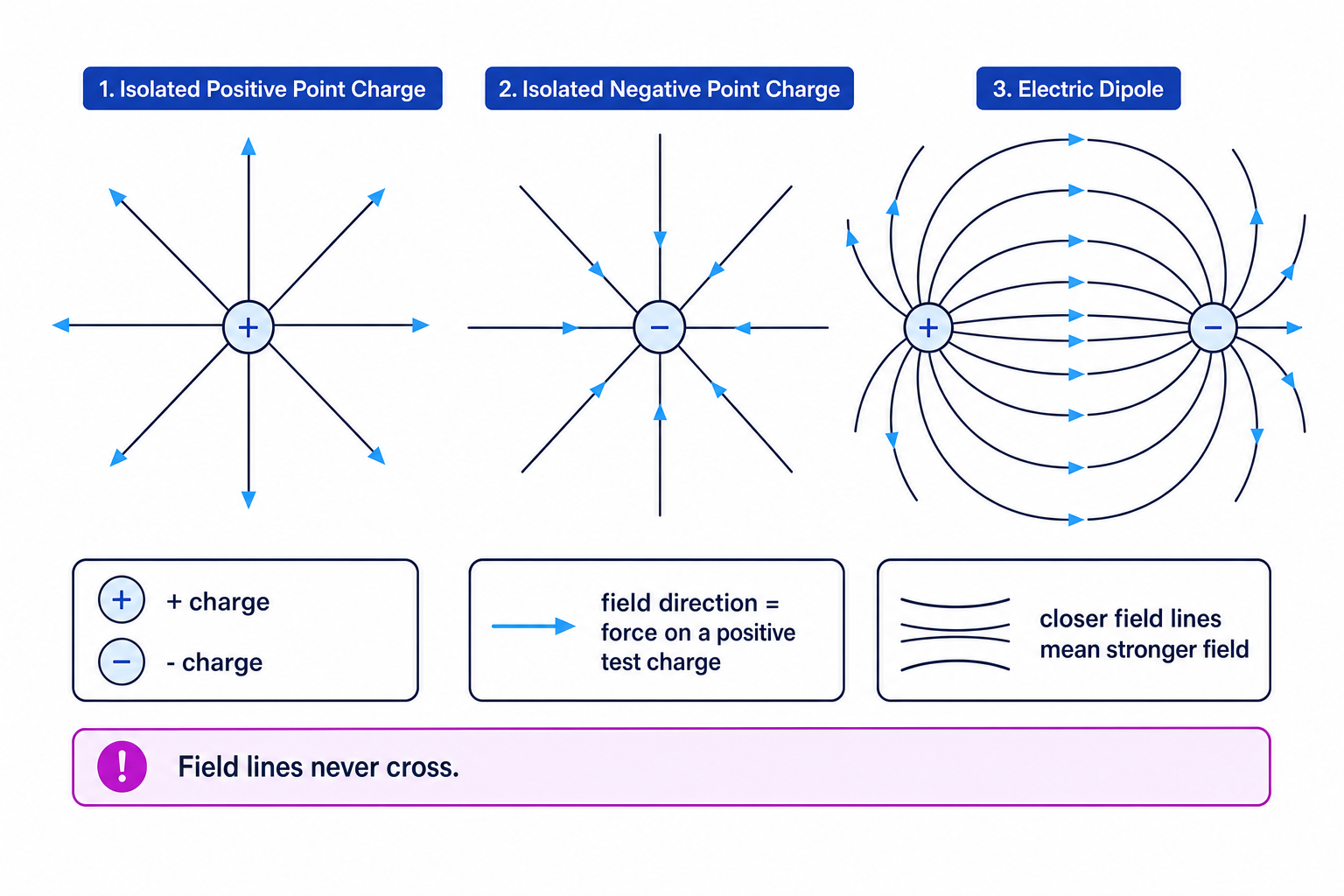
An electric field line is a line drawn to show the direction of the electric field. The arrow on the line shows the direction of the force on a positive test charge.
Field lines follow these rules:
- They point away from positive charges.
- They point towards negative charges.
- Where field lines are closer together, the field is stronger.
- Field lines never cross, because the field cannot have two directions at the same point.
Common Mistake
Forgetting the positive-test-charge convention
The electric field direction is defined using a positive test charge. An electron, being negative, experiences a force in the opposite direction to the field.
Coulomb’s law
For small charged objects, or for charged spheres viewed from far away, we often model each charge as a point charge.
Definition
Point charge
A point charge is a charge treated as if all its charge is concentrated at a single point. This is a good model when the separation between objects is much larger than their sizes.
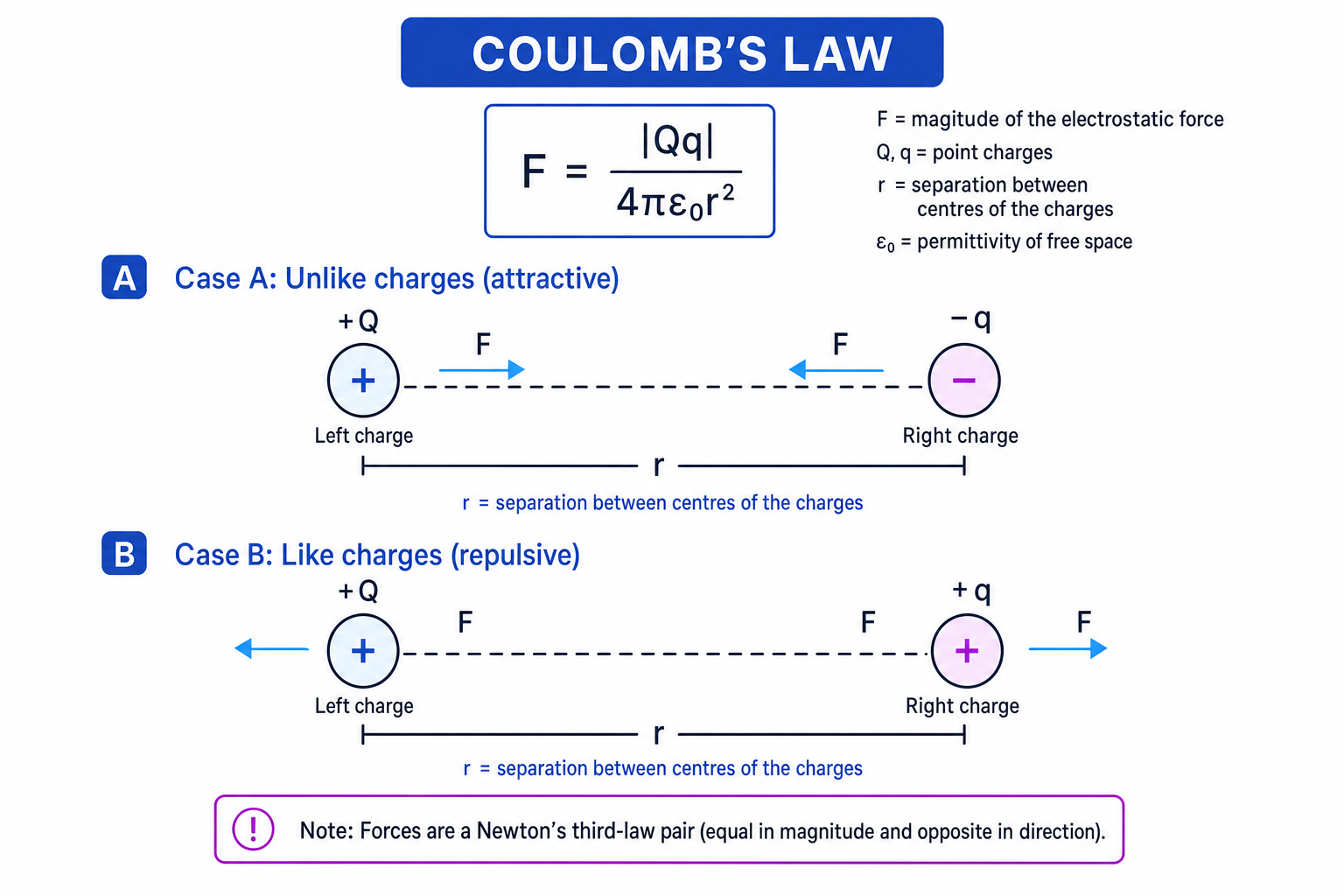
Coulomb’s law gives the magnitude of the electrostatic force between two point charges.
Definition
Coulomb’s law
For two point charges QQQ and qqq separated by distance rrr in a vacuum or air:
F=∣Qq∣4πε0r2=k∣Qq∣r2F = \frac{|Qq|}{4\pi \varepsilon_0 r^2} = k\frac{|Qq|}{r^2}F=4πε0r2∣Qq∣=kr2∣Qq∣where ε0\varepsilon_0ε0 is the permittivity of free space and k=8.99×10⁹ N m2 C−2k = 8.99 \times 10^{9}\ \text{N}\ \text{m}^{2}\ \text{C}^{-2}k=8.99×10⁹ N m2 C−2.
The force acts along the line joining the two charges. Like charges repel; unlike charges attract. The forces on the two charges are equal in magnitude and opposite in direction, forming a Newton’s third-law pair.
Example
Calculating the force between two charges
Two point charges, +4.0 μC+4.0\ \mu\text{C}+4.0 μC and −2.0 μC-2.0\ \mu\text{C}−2.0 μC, are separated by 0.15 m0.15\ \text{m}0.15 m. Calculate the force between them.
- Convert the charges into coulombs: Q=4.0×10⁻⁶ CQ = 4.0 \times 10^{-6}\ \text{C}Q=4.0×10⁻⁶ C and q=2.0×10⁻⁶ Cq = 2.0 \times 10^{-6}\ \text{C}q=2.0×10⁻⁶ C. Use the magnitudes for the size of the force.
- Substitute into Coulomb’s law: F=(8.99×10⁹)(4.0×10⁻⁶)(2.0×10⁻⁶)÷(0.15)2=3.2 NF = \left(8.99 \times 10^{9}\right)\left(4.0 \times 10^{-6}\right)\left(2.0 \times 10^{-6}\right) \div \left(0.15\right)^2 = 3.2\ \text{N}F=(8.99×10⁹)(4.0×10⁻⁶)(2.0×10⁻⁶)÷(0.15)2=3.2 N.
- The charges have opposite signs, so the force is attractive. Each charge experiences a force of 3.2 N towards the other charge.
Tip
Inverse-square check
Coulomb’s law is an inverse-square law. If the separation doubles, the force becomes one quarter as large; if the separation halves, the force becomes four times as large.
Electric field due to a point charge
A point charge creates a radial field, meaning the field lines spread out from the charge or converge towards it.
The electric field strength at distance rrr from a point charge QQQ is:
E=k∣Q∣r2E = k\frac{|Q|}{r^2}E=kr2∣Q∣For a positive source charge, the field points away from the charge. For a negative source charge, it points towards the charge.
Key Idea
Field first, force second
A source charge creates the electric field. A second charge placed in that field experiences a force. Often the cleanest method is to calculate EEE first, then use F=qEF = qEF=qE.
Example
Using a point-charge field to find a force
A charge of +3.0 μC+3.0\ \mu\text{C}+3.0 μC creates an electric field. A charge of −5.0 nC-5.0\ \text{nC}−5.0 nC is placed 0.20 m0.20\ \text{m}0.20 m away. Find the force on the negative charge.
- Find the field strength due to the source charge: E=(8.99×10⁹)(3.0×10⁻⁶)÷(0.20)2=6.7×10⁵ N C−1E = \left(8.99 \times 10^{9}\right)\left(3.0 \times 10^{-6}\right) \div \left(0.20\right)^2 = 6.7 \times 10^{5}\ \text{N}\ \text{C}^{-1}E=(8.99×10⁹)(3.0×10⁻⁶)÷(0.20)2=6.7×10⁵ N C−1.
- Use F=∣q∣EF = |q|EF=∣q∣E for the force magnitude: F=(5.0×10⁻⁹)(6.7×10⁵)=3.4×10⁻³ NF = \left(5.0 \times 10^{-9}\right)\left(6.7 \times 10^{5}\right) = 3.4 \times 10^{-3}\ \text{N}F=(5.0×10⁻⁹)(6.7×10⁵)=3.4×10⁻³ N.
- The field from the positive charge points away from it, but the placed charge is negative, so the force is in the opposite direction: towards the positive charge.
Combining fields: superposition
The principle of superposition means that when more than one charge creates a field at a point, the resultant field is the vector sum of the individual fields.
A vector has both magnitude and direction. So you must not just add field strengths as numbers unless they point in the same direction.
Example
Adding electric fields at a midpoint
A charge +2.0 μC+2.0\ \mu\text{C}+2.0 μC is on the left and a charge −2.0 μC-2.0\ \mu\text{C}−2.0 μC is on the right. They are separated by 0.20 m0.20\ \text{m}0.20 m. Find the electric field at the midpoint.
- The midpoint is 0.10 m0.10\ \text{m}0.10 m from each charge, so the field strength due to either charge is E=(8.99×10⁹)(2.0×10⁻⁶)÷(0.10)2=1.8×10⁶ N C−1E = \left(8.99 \times 10^{9}\right)\left(2.0 \times 10^{-6}\right) \div \left(0.10\right)^2 = 1.8 \times 10^{6}\ \text{N}\ \text{C}^{-1}E=(8.99×10⁹)(2.0×10⁻⁶)÷(0.10)2=1.8×10⁶ N C−1.
- At the midpoint, the field due to the positive charge points away from the positive charge, so it points to the right. The field due to the negative charge points towards the negative charge, also to the right.
- The two fields act in the same direction, so add them: Eresultant=3.6×10⁶ N C−1E_{\text{resultant}} = 3.6 \times 10^{6}\ \text{N}\ \text{C}^{-1}Eresultant=3.6×10⁶ N C−1 to the right.
Common Mistake
Adding magnitudes without directions
For resultant field questions, always draw arrows first. Fields in opposite directions subtract; fields at right angles need Pythagoras and trigonometry.
Uniform electric fields
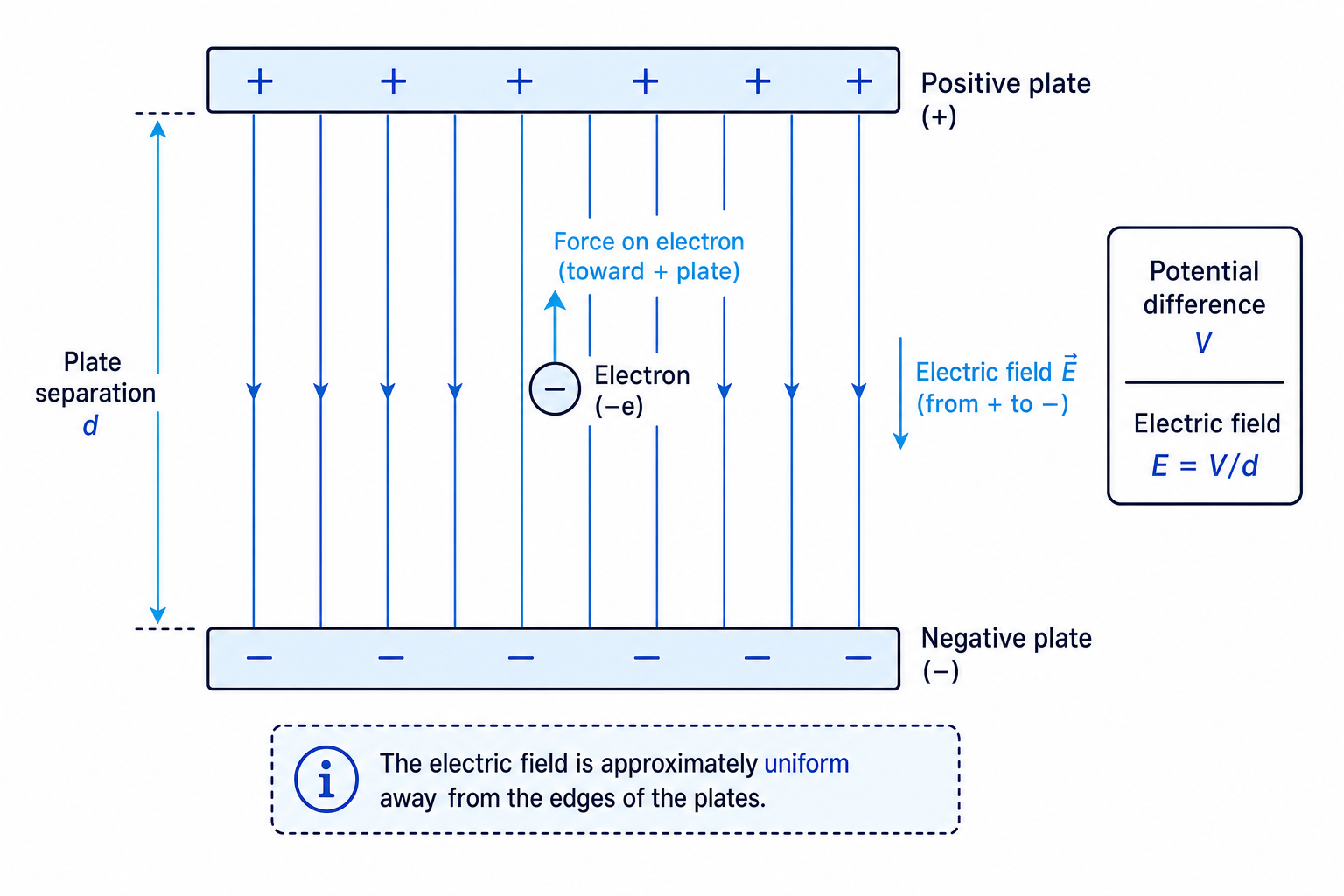
A uniform electric field has the same magnitude and direction at every point. A good approximation is the field between two large parallel plates, away from the edges.
If the plates have potential difference VVV and separation ddd, the field strength is:
E=VdE = \frac{V}{d}E=dVHere, potential difference means energy transferred per unit charge, and is measured in volts, V. The unit V m⁻¹ is equivalent to N C⁻¹.
Example
Calculating the field between parallel plates
Two parallel plates have a potential difference of 1.2×10³ V1.2 \times 10^{3}\ \text{V}1.2×10³ V and are separated by 4.0 cm4.0\ \text{cm}4.0 cm. Find the electric field strength and the force on an electron.
- Convert the separation: 4.0 cm=0.040 m4.0\ \text{cm} = 0.040\ \text{m}4.0 cm=0.040 m.
- Use E=V/dE = V/dE=V/d: E=(1.2×10³)÷0.040=3.0×10⁴ V m−1E = \left(1.2 \times 10^{3}\right) \div 0.040 = 3.0 \times 10^{4}\ \text{V}\ \text{m}^{-1}E=(1.2×10³)÷0.040=3.0×10⁴ V m−1.
- Use F=eEF = eEF=eE: F=(1.60×10⁻¹⁹)(3.0×10⁴)=4.8×10⁻¹⁵ NF = \left(1.60 \times 10^{-19}\right)\left(3.0 \times 10^{4}\right) = 4.8 \times 10^{-15}\ \text{N}F=(1.60×10⁻¹⁹)(3.0×10⁴)=4.8×10⁻¹⁵ N. The electron is negative, so the force is towards the positive plate.
Common Mistake
When the simple formula may not apply
Coulomb’s law in this form is for point charges in a vacuum or air. For extended charged objects, very close separations, or materials with significant permittivity effects, the field may need a different model.
Exam technique
In the exam
- Convert charge into coulombs and distance into metres before substituting into any field or force equation.
- Calculate the magnitude first, then use charge signs and field directions to state whether the force is attractive, repulsive, with the field, or against the field.
- For multiple charges, draw field arrows at the point of interest before adding; same direction adds, opposite direction subtracts, angled fields need vector methods.
Self review
Check yourself
- If a negative charge is placed in an electric field pointing east, which way is the force on it?
- Two equal point charges are moved twice as far apart. How does the force between them change?
- At the midpoint between a positive charge and an equal negative charge, which way does the resultant electric field point?