Revision notes for Edexcel A Level Physics Current, potential difference and resistance. Open the guide for explanations and worked examples. Written against the Edexcel A Level Physics (9PH0) specification, so the content matches what's examinable rather than general Physics background.
Current, potential difference and resistance
What you'll learn
- How electric current is linked to the flow of charge.
- What potential difference means in terms of energy transferred per unit charge.
- How resistance connects current and potential difference.
- How to measure and interpret circuit quantities using meters and I-V graphs.
The big picture: charges carry energy around a circuit
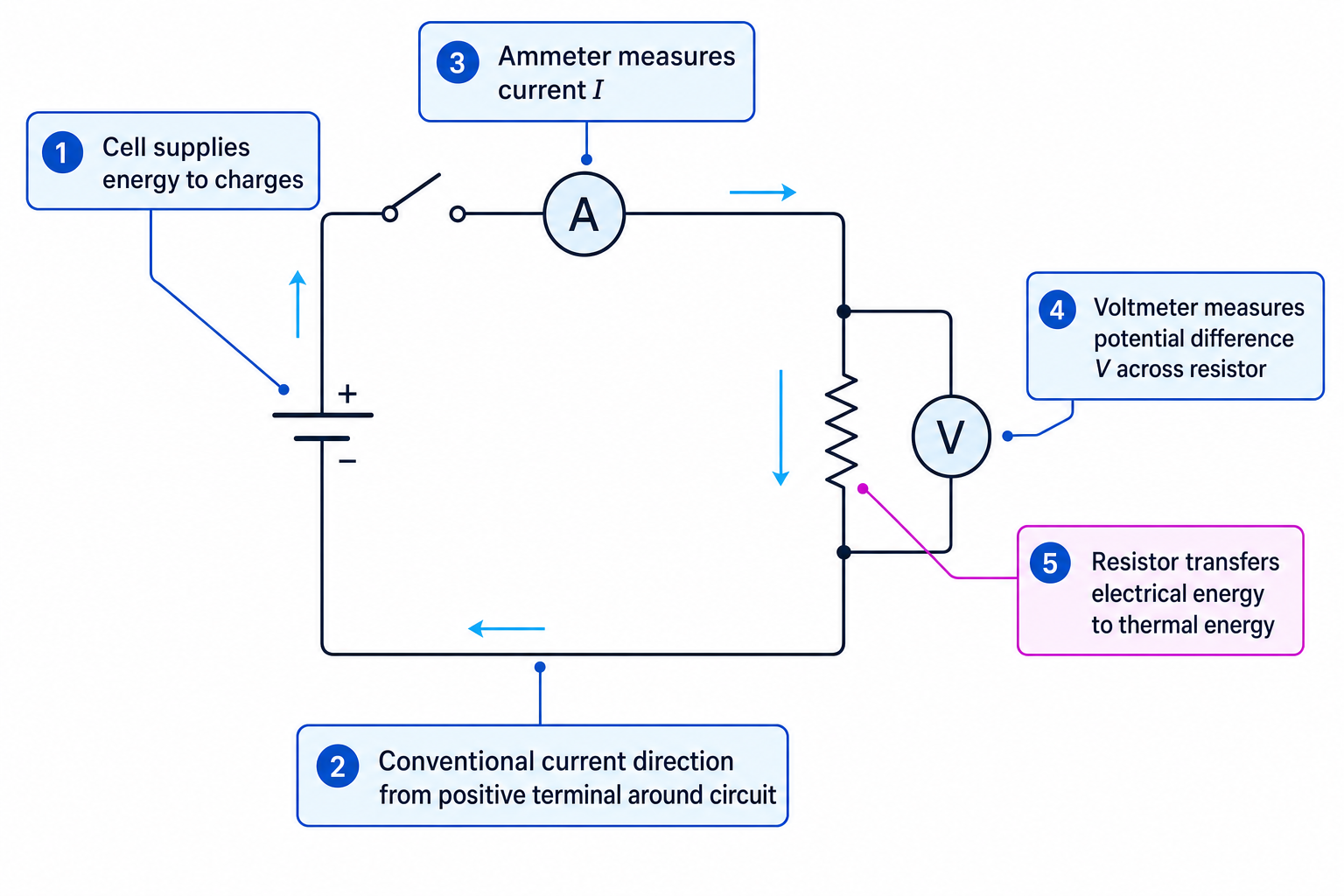
An electric circuit is a closed conducting loop containing a source of energy, such as a cell or power supply, and components such as resistors, lamps or motors.
In metal wires, the moving charged particles are electrons. However, in circuit diagrams and equations we usually use conventional current, which is defined as the direction positive charge would flow: from the positive terminal of the supply around the circuit to the negative terminal.
Common Mistake
Current is not used up
Current is the rate of flow of charge. In a steady series circuit, the current is the same at every point in the loop. Energy is transferred in components, but charge itself is not “used up”.
Electric charge
Electric charge is a property of particles that causes them to experience electrical forces. Charge is measured in coulombs, C.
The symbol for charge is usually QQQ. A single electron has a negative charge of about −1.60×10⁻¹⁹ C-1.60 \times 10^{-19}\ \text{C}−1.60×10⁻¹⁹ C, but in circuit calculations you usually deal with the total charge passing a point, not individual electrons.
Current: rate of flow of charge
Current tells you how quickly charge is moving past a point in a circuit.
Definition
Current
Electric current is the rate of flow of electric charge:
I=ΔQΔtI = \frac{\Delta Q}{\Delta t}I=ΔtΔQwhere III is current in amperes, A, ΔQ\Delta QΔQ is charge in coulombs, C, and Δt\Delta tΔt is time in seconds, s.
One ampere means one coulomb of charge passes a point every second.
Example
Calculating current from charge flow
A charge of 3.6 C3.6\ \text{C}3.6 C passes through a wire in 12 s12\ \text{s}12 s. Calculate the current.
-
Choose the current equation because charge and time are given:
I=ΔQΔtI = \frac{\Delta Q}{\Delta t}I=ΔtΔQ -
Substitute the values, keeping the units in the calculation:
I=3.6 C12 sI = \frac{3.6\ \text{C}}{12\ \text{s}}I=12 s3.6 C -
Calculate the current:
I=0.30 AI = 0.30\ \text{A}I=0.30 A
Potential difference: energy transferred per charge
A cell or power supply gives energy to charges. Components then transfer that energy into other forms, such as thermal energy in a resistor or light and thermal energy in a lamp.
Potential difference is about energy transfer. It tells you how much energy is transferred by each coulomb of charge as it moves between two points.
Definition
Potential difference
Potential difference is the work done, or energy transferred, per unit charge:
V=WQV = \frac{W}{Q}V=QWwhere VVV is potential difference in volts, V, WWW is work done or energy transferred in joules, J, and QQQ is charge in coulombs, C.
One volt means one joule of energy is transferred per coulomb of charge.
A related term is electromotive force, usually shortened to emf. The emf of a source is the energy transferred from the source to each coulomb of charge. For an ideal cell, the emf is equal to the terminal potential difference, but real cells can lose some energy internally.
Example
Calculating energy transferred by charge
A lamp has a potential difference of 6.0 V6.0\ \text{V}6.0 V across it. A charge of 25 C25\ \text{C}25 C passes through the lamp. Calculate the energy transferred in the lamp.
-
Start from the definition of potential difference and rearrange:
V=WQ⇒W=VQV = \frac{W}{Q} \Rightarrow W = VQV=QW⇒W=VQ -
Substitute the values:
W=6.0 V×25 CW = 6.0\ \text{V} \times 25\ \text{C}W=6.0 V×25 C -
Use the unit link 1 V=1 J C−11\ \text{V} = 1\ \text{J C}^{-1}1 V=1 J C−1, so volt times coulomb gives joules:
W=150 JW = 150\ \text{J}W=150 J
Key Idea
Current and potential difference are different ideas
Current tells you how much charge flows per second. Potential difference tells you how much energy is transferred per coulomb.
Resistance: how a component opposes current
A component with high resistance allows less current for the same potential difference. In a metal resistor, electrons collide with ions in the lattice, transferring energy to the lattice. This increases the internal energy of the resistor, so it gets hotter.
Definition
Resistance
Resistance is defined as the ratio of potential difference to current:
R=VIR = \frac{V}{I}R=IVwhere RRR is resistance in ohms, Ω, VVV is potential difference in volts, V, and III is current in amperes, A.
One ohm means a potential difference of one volt produces a current of one ampere.
Example
Finding resistance and power
A resistor has a potential difference of 12.0 V12.0\ \text{V}12.0 V across it and a current of 0.30 A0.30\ \text{A}0.30 A through it. Calculate its resistance and the electrical power transferred.
-
Use the resistance definition:
R=VIR = \frac{V}{I}R=IV -
Substitute the measured values:
R=12.0 V0.30 A=40 ΩR = \frac{12.0\ \text{V}}{0.30\ \text{A}} = 40\ \OmegaR=0.30 A12.0 V=40 Ω -
Use the electrical power equation:
P=VIP = VIP=VI -
Substitute to find the rate of energy transfer:
P=12.0 V×0.30 A=3.6 WP = 12.0\ \text{V} \times 0.30\ \text{A} = 3.6\ \text{W}P=12.0 V×0.30 A=3.6 W
Because R=VIR = \frac{V}{I}R=IV and P=VIP = VIP=VI, you can also combine equations for a resistor:
P=I2RP = I^2RP=I2Rand
P=V2RP = \frac{V^2}{R}P=RV2These are especially useful when you know resistance but only one of current or potential difference.
Ohm’s law
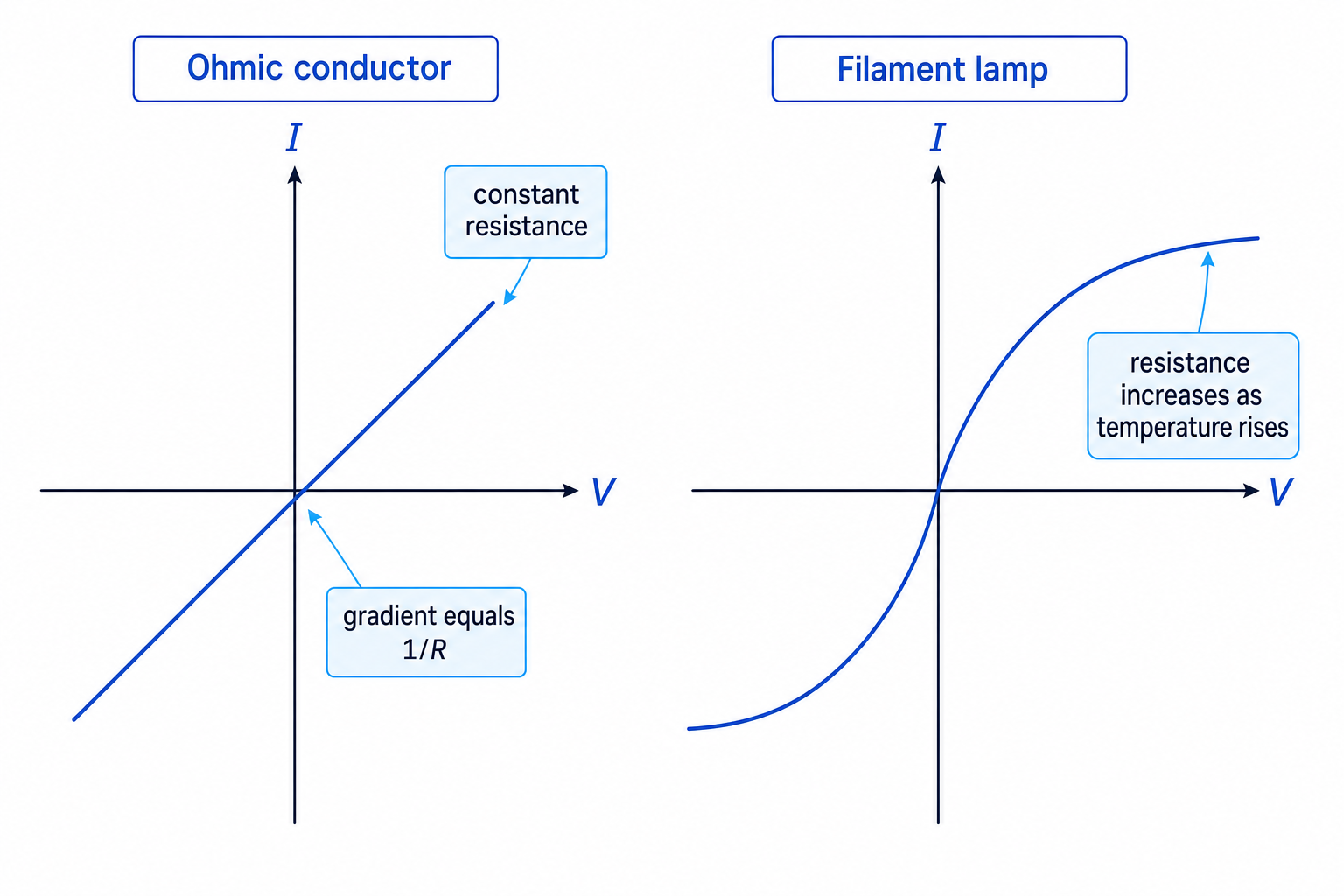
For some conductors, the current is directly proportional to the potential difference, provided the temperature stays constant. These are called ohmic conductors.
Definition
Ohm’s law
For an ohmic conductor at constant temperature, current is directly proportional to potential difference:
I∝VI \propto VI∝Vso the resistance remains constant.
The phrase constant temperature matters. If the component heats up, its resistance may change, so the current may no longer be directly proportional to potential difference.
I-V characteristics
An I-V characteristic is a graph showing how the current through a component changes as the potential difference across it changes.
For an ohmic conductor, the graph of current against potential difference is a straight line through the origin. For a filament lamp, the graph curves because the filament heats up; as temperature rises, its resistance increases.
Tip
Check the axes before using the gradient
If the graph is current against potential difference, the gradient is IV=1R\frac{I}{V} = \frac{1}{R}VI=R1. If the graph is potential difference against current, the gradient is VI=R\frac{V}{I} = RIV=R.
Example
Finding resistance from an I-V graph
An I-V graph for a resistor has current on the vertical axis and potential difference on the horizontal axis. A straight line through the origin passes through V=4.0 VV = 4.0\ \text{V}V=4.0 V and I=0.20 AI = 0.20\ \text{A}I=0.20 A. Find the resistance.
-
Since current is plotted against potential difference, calculate the graph gradient as ΔIΔV\frac{\Delta I}{\Delta V}ΔVΔI:
gradient=0.20 A4.0 V=0.050 A V−1\text{gradient} = \frac{0.20\ \text{A}}{4.0\ \text{V}} = 0.050\ \text{A V}^{-1}gradient=4.0 V0.20 A=0.050 A V−1 -
For an I against V graph, the gradient equals 1R\frac{1}{R}R1:
1R=0.050 A V−1\frac{1}{R} = 0.050\ \text{A V}^{-1}R1=0.050 A V−1 -
Take the reciprocal to find the resistance:
R=10.050=20 ΩR = \frac{1}{0.050} = 20\ \OmegaR=0.0501=20 Ω
Measuring current and potential difference
An ammeter measures current. It is placed in series with the component so the same charge flow passes through the ammeter and the component.
A voltmeter measures potential difference. It is placed in parallel across the component because potential difference is measured between two points.
In an ideal model, an ammeter has zero resistance and a voltmeter has infinite resistance. Real meters are not perfect, but they are designed to disturb the circuit as little as possible.
Common Mistake
Putting the meters in the wrong places
An ammeter goes in series. A voltmeter goes in parallel across the component being tested. If you connect an ammeter in parallel with a component, you may create a very low-resistance path and damage the meter.
Practical skill: measuring resistance
A typical method to investigate a resistor is:
- Connect the resistor in series with an ammeter and a variable resistor or variable power supply.
- Connect a voltmeter in parallel across the resistor.
- Record pairs of current and potential difference readings.
- Change the potential difference and repeat.
- Plot a graph, then use the gradient carefully depending on which way round the axes are.
To reduce uncertainty, use a sensible range of readings, avoid parallax errors on analogue meters, and take repeat readings where possible. For a metal wire or resistor, keep the current low or switch off between readings to reduce heating, because heating can change the resistance.
Exam technique
In the exam
- Write down the defining equation first: I=ΔQΔtI = \frac{\Delta Q}{\Delta t}I=ΔtΔQ, V=WQV = \frac{W}{Q}V=QW or R=VIR = \frac{V}{I}R=IV.
- Check units before substituting: time must be in seconds, charge in coulombs, current in amperes and potential difference in volts.
- For graph questions, inspect the axes before using the gradient; do not automatically assume the gradient is resistance.
Self review
Check yourself
- What is the difference between current and potential difference?
- Why must a voltmeter be connected in parallel across a component?
- On an I against V graph, how would you find the resistance of an ohmic conductor?