Revision notes for Edexcel A Level Physics Work, energy and power. Open the guide for explanations and worked examples. Written against the Edexcel A Level Physics (9PH0) specification, so the content matches what's examinable rather than general Physics background.
Work, energy and power
What you'll learn
- What work done means and how it links forces to energy transfer.
- How to use Ek=12mv2E_k = \frac{1}{2}mv^2Ek=21mv2 and Ep=mgΔhE_p = mg\Delta hEp=mgΔh in mechanics problems.
- How to calculate work from a force-displacement graph.
- How power and efficiency describe energy transfer in real systems.
The starting point: forces, displacement and energy
A force is a push or pull on an object, measured in newtons (N). A displacement is a change in position in a stated direction, measured in metres (m).
In mechanics, forces can change an object’s motion, but they can also transfer energy. This is where the idea of work done comes in.
Definition
Energy
Energy is a conserved quantity measured in joules (J). It can be stored in different ways, such as in a moving object, a raised object, or a stretched spring, and transferred between stores.
Work done by a force
When a force moves an object through a distance, energy is transferred. That energy transfer is called work done.
Definition
Work done
Work done is the energy transferred by a force when its point of application moves through a displacement. For a constant force acting in the direction of motion:
W=FsW = FsW=Fswhere WWW is work done in joules (J), FFF is force in newtons (N), and sss is displacement in metres (m).
One joule is the work done when a force of 1 N moves an object 1 m in the direction of the force. So:
1 J=1 N m1 \text{ J} = 1 \text{ N m}1 J=1 N mIf the force is at an angle to the displacement, only the component of the force parallel to the displacement does work:
W=FscosθW = Fs\cos\thetaW=Fscosθ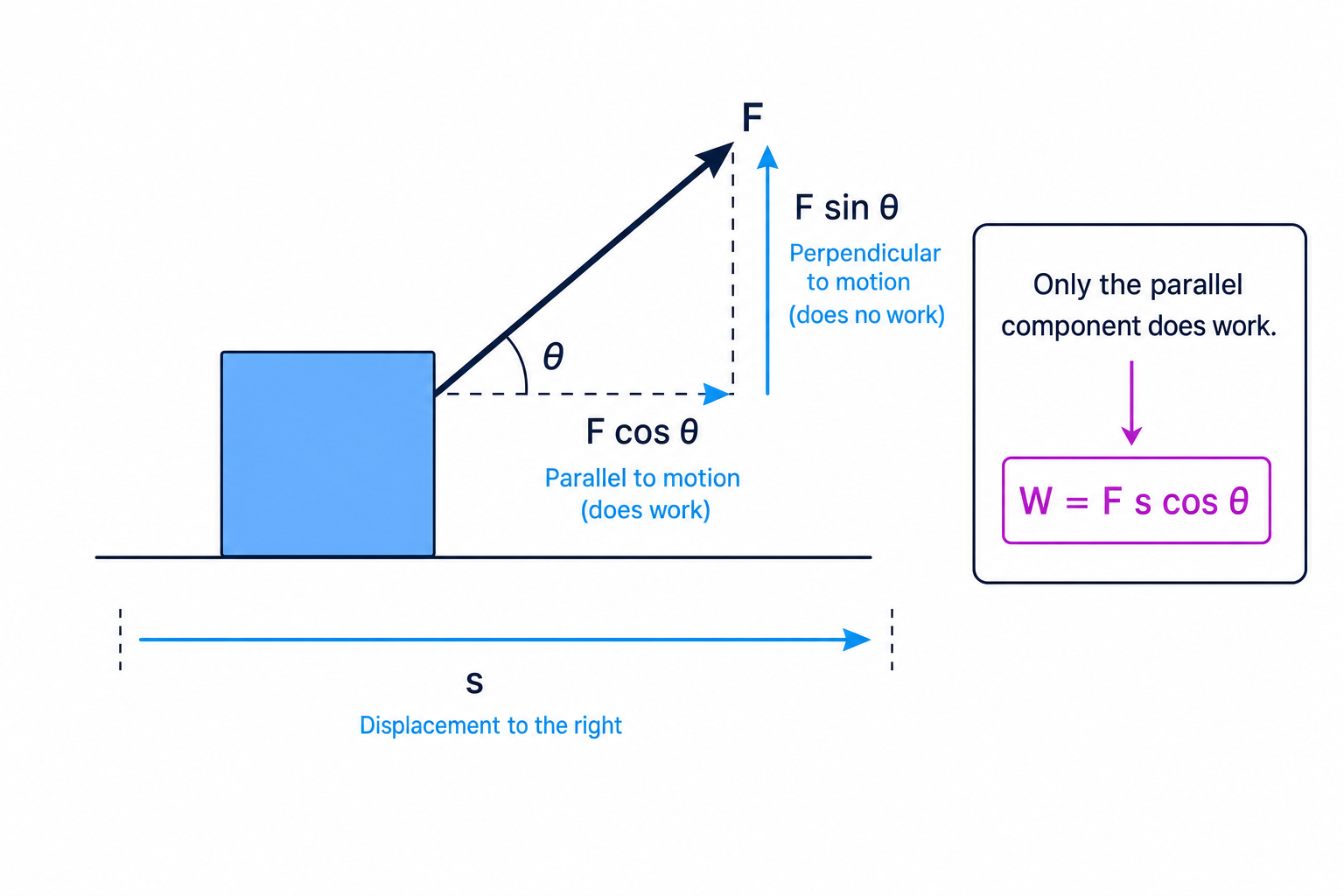
Key Idea
Only the parallel component matters
A force does positive work if it has a component in the direction of motion, negative work if it opposes the motion, and no work if it is perpendicular to the motion.
Example
Work done by an angled pull
A student pulls a sledge with a force of 45 N at 30∘30^\circ30∘ above the horizontal for 12 m. Calculate the work done by the pulling force.
- Resolve the force in the direction of motion: F∥=Fcosθ=45cos30∘=39 NF_{\parallel}=F\cos\theta=45\cos30^\circ=39 \text{ N}F∥=Fcosθ=45cos30∘=39 N.
- Multiply the parallel component by the displacement: W=F∥s=39×12=4.7×10² JW=F_{\parallel}s=39 \times 12 = 4.7 \times 10^2 \text{ J}W=F∥s=39×12=4.7×10² J.
- Compare with the maximum possible value: it is less than 45×1245 \times 1245×12 because not all of the force acts horizontally.
Common Mistake
Using the whole force
If the force is not parallel to the displacement, do not use W=FsW=FsW=Fs with the full force. Use the parallel component, or use W=FscosθW=Fs\cos\thetaW=Fscosθ.
Work done from a force-displacement graph
The equation W=FsW=FsW=Fs works when the force is constant. If the force changes during the motion, the work done is found from the area under a force-displacement graph.
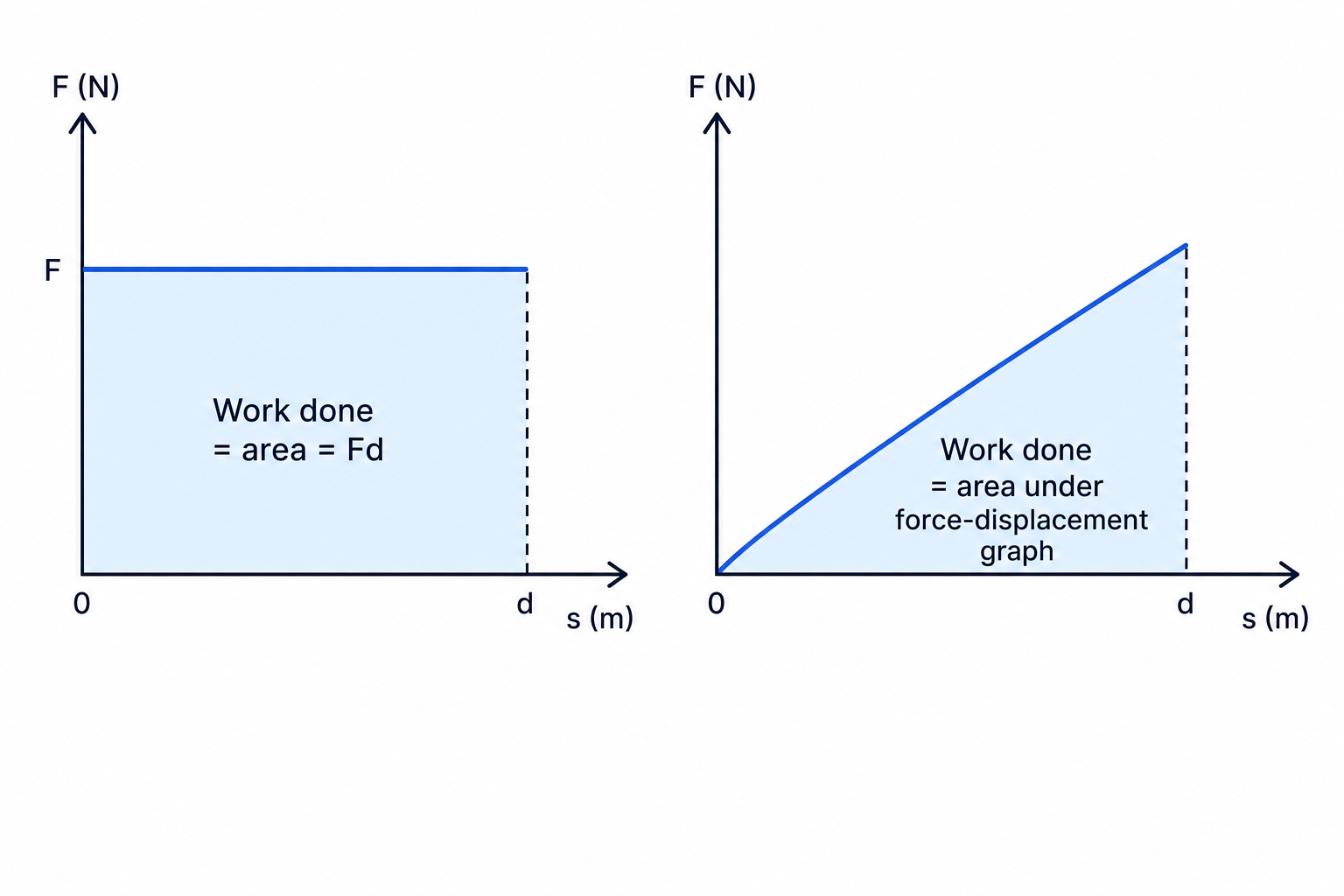
The area has units of N m, which are the same as joules. This is especially useful for springs, where the force often increases as the extension increases.
Definition
Elastic potential energy
Elastic potential energy is energy stored when an object is stretched or compressed and can return to its original shape.
Example
Using the area under a force-displacement graph
A spring is stretched from 0 to 6.0 cm. The force rises uniformly from 0 to 18 N. Calculate the elastic energy stored.
- Convert the extension into SI units: 6.0 cm = 0.060 m.
- Use the area of the triangular force-extension graph: W=12×0.060×18=0.54 JW=\frac{1}{2} \times 0.060 \times 18 = 0.54 \text{ J}W=21×0.060×18=0.54 J.
- Interpret the energy transfer: assuming no energy is dissipated, 0.54 J is stored as elastic potential energy.
Common Mistake
When the force changes
Use the area under a force-displacement graph when the force is not constant. The simple equation W=FsW=FsW=Fs only applies to a constant force component.
Kinetic energy and gravitational potential energy
A moving object has kinetic energy.
Definition
Kinetic energy
Kinetic energy is the energy stored by an object because it is moving:
Ek=12mv2E_k = \frac{1}{2}mv^2Ek=21mv2where mmm is mass in kg and vvv is speed in m s−1^{-1}−1.
An object in a gravitational field can have gravitational potential energy because of its height.
Definition
Gravitational potential energy
The change in gravitational potential energy near Earth’s surface is:
ΔEp=mgΔh\Delta E_p = mg\Delta hΔEp=mgΔhwhere mmm is mass in kg, ggg is gravitational field strength, usually 9.81 N kg−1^{-1}−1, and Δh\Delta hΔh is the change in height in m.
The zero level for gravitational potential energy is chosen by you or the question. Usually, only the change in height matters.
Example
Comparing kinetic and gravitational potential energy
A 1.2 kg ball is moving at 4.0 m s^-1. It is then lifted by 0.80 m. Compare its kinetic energy with the increase in gravitational potential energy.
- Calculate the kinetic energy: Ek=12mv2=12×1.2×4.02=9.6 JE_k=\frac{1}{2}mv^2=\frac{1}{2}\times1.2\times4.0^2=9.6 \text{ J}Ek=21mv2=21×1.2×4.02=9.6 J.
- Calculate the increase in gravitational potential energy: ΔEp=mgΔh=1.2×9.81×0.80=9.4 J\Delta E_p=mg\Delta h=1.2\times9.81\times0.80=9.4 \text{ J}ΔEp=mgΔh=1.2×9.81×0.80=9.4 J.
- Compare the values: the two energy changes are very similar, so lifting the ball by 0.80 m stores about the same energy as its motion at 4.0 m s^-1.
Tip
Watch the symbol W
The symbol WWW can mean work done, but weight is also often written as W=mgW=mgW=mg. Use the units to separate them: work done is in joules (J), weight is in newtons (N).
Conservation of energy
The principle of conservation of energy says energy cannot be created or destroyed. It can only be transferred from one store to another.
In ideal mechanics problems, energy transfers may be treated as perfectly useful. For example, if air resistance is ignored, gravitational potential energy lost can become kinetic energy gained.
In real systems, some energy is usually dissipated. Dissipated energy is transferred to less useful stores, often heating the surroundings.
Key Idea
Energy accounting
A useful way to write many mechanics problems is:
initial energy=final useful energy+energy dissipated\text{initial energy} = \text{final useful energy} + \text{energy dissipated}initial energy=final useful energy+energy dissipatedThe work-energy principle connects forces directly to energy:
work done by the resultant force=ΔEk\text{work done by the resultant force} = \Delta E_kwork done by the resultant force=ΔEkFor a constant resultant force, this also links back to dynamics. Using F=maF=maF=ma and v2=u2+2asv^2=u^2+2asv2=u2+2as:
Fs=mas=12m(v2−u2)Fs = mas = \frac{1}{2}m(v^2-u^2)Fs=mas=21m(v2−u2)So the work done by the resultant force changes the kinetic energy.
Example
Finding speed with energy losses
A 0.60 kg trolley starts from rest and rolls down a ramp, dropping vertically by 0.75 m. Work done against resistive forces is 1.3 J. Calculate its final speed.
- Set up the energy account: mgΔh=Ek+Edissipatedmg\Delta h = E_k + E_{\text{dissipated}}mgΔh=Ek+Edissipated, so Ek=mgΔh−EdissipatedE_k = mg\Delta h - E_{\text{dissipated}}Ek=mgΔh−Edissipated.
- Substitute the values: Ek=0.60×9.81×0.75−1.3=3.1 JE_k = 0.60\times9.81\times0.75 - 1.3 = 3.1 \text{ J}Ek=0.60×9.81×0.75−1.3=3.1 J.
- Use kinetic energy to find the speed: v=2Ekm=2×3.10.60=3.2 m s−1v=\sqrt{\frac{2E_k}{m}}=\sqrt{\frac{2\times3.1}{0.60}}=3.2 \text{ m s}^{-1}v=m2Ek=0.602×3.1=3.2 m s−1.
Common Mistake
Forgetting dissipated energy
If the question mentions friction, air resistance, braking, or work done against resistive forces, do not assume all gravitational potential energy becomes kinetic energy.
Power
Power tells you how quickly energy is transferred or work is done.
Definition
Power
Power is the rate of energy transfer:
P=EtP = \frac{E}{t}P=tEor, for work done:
P=WtP = \frac{W}{t}P=tWPower is measured in watts (W), where 1 W = 1 J s−1^{-1}−1.
If a constant force acts in the direction of motion, then:
P=FstP = \frac{Fs}{t}P=tFsSince speed is displacement per unit time, v=stv=\frac{s}{t}v=ts, this becomes:
P=FvP = FvP=FvThis is very useful for motors, lifts, vehicles and athletes.
Definition
Efficiency
Efficiency compares useful output energy or power with total input energy or power:
η=useful outputtotal input\eta = \frac{\text{useful output}}{\text{total input}}η=total inputuseful outputTo give efficiency as a percentage, multiply by 100%100\%100%.
Example
Calculating power and efficiency
A motor takes in 600 W of electrical power and lifts a 50 kg mass vertically at a steady speed of 0.80 m s^-1. Calculate the useful output power and the efficiency.
- Use steady speed to identify the lifting force: the upward force balances the weight, so F=mg=50×9.81=4.9×10² NF=mg=50\times9.81=4.9\times10^2 \text{ N}F=mg=50×9.81=4.9×10² N.
- Calculate the useful output power: Pout=Fv=490.5×0.80=3.9×10² WP_{\text{out}}=Fv=490.5\times0.80=3.9\times10^2 \text{ W}Pout=Fv=490.5×0.80=3.9×10² W.
- Compare output power with input power: η=PoutPin×100%=392600×100%=65%\eta=\frac{P_{\text{out}}}{P_{\text{in}}}\times100\%=\frac{392}{600}\times100\%=65\%η=PinPout×100%=600392×100%=65%.
Tip
Average or instantaneous power
Use P=EtP=\frac{E}{t}P=tE for average power over a time interval. Use P=FvP=FvP=Fv when you know the force and speed at that moment, or for steady motion.
Exam technique
In the exam
- Start by deciding the energy transfer: work done, kinetic energy, gravitational potential energy, elastic energy, or dissipated energy.
- Convert all distances, extensions and heights into metres before calculating energy.
- For force-displacement graphs, find the area under the graph and remember that N m = J.
- If resistive forces are mentioned, include energy dissipated instead of assuming perfect energy transfer.
- For efficiency, compare useful output with total input using either energies or powers, but do not mix mismatched time intervals.
Self review
Check yourself
- Why does a force perpendicular to the motion do no work?
- When would you use the area under a force-displacement graph instead of W=FsW=FsW=Fs?
- A motor lifts a mass at constant speed. Why can you use P=FvP=FvP=Fv with F=mgF=mgF=mg?

Recap questions
Test yourself with 15 quick questions on this guide. Answer them all correctly to complete it.