What you'll learn
- How the linear concepts of work and power translate into rotational dynamics.
- How to calculate the work done by a constant torque using W=TθW = T\thetaW=Tθ.
- How to calculate the power of rotating machinery using P=TωP = T\omegaP=Tω.
- Why you must account for frictional torque in real-world engineering systems.
From straight lines to circles
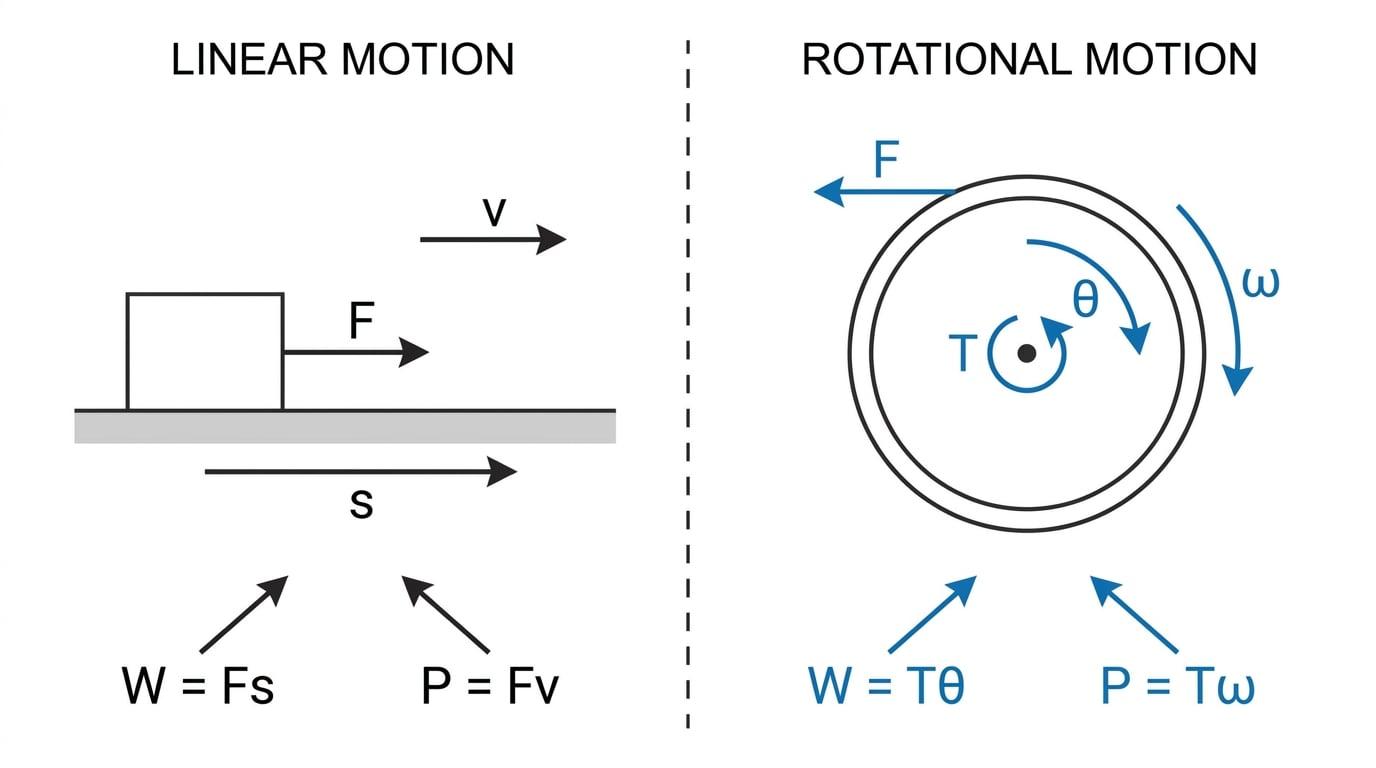
You already know that to make something move in a straight line, you have to do work on it by applying a force. The equations for linear work and power are some of the most fundamental in physics:
- Linear work: W=FsW = FsW=Fs (Force ×\times× displacement)
- Linear power: P=FvP = FvP=Fv (Force ×\times× velocity)
In the Engineering Physics option, you need to apply these exact same principles to objects that are spinning, like motors, winches, and car wheels. Instead of applying a linear force, we apply a torque. Instead of linear displacement and velocity, we use angular displacement and angular velocity.
Let's look at how the formulas transform.
Work done by a torque
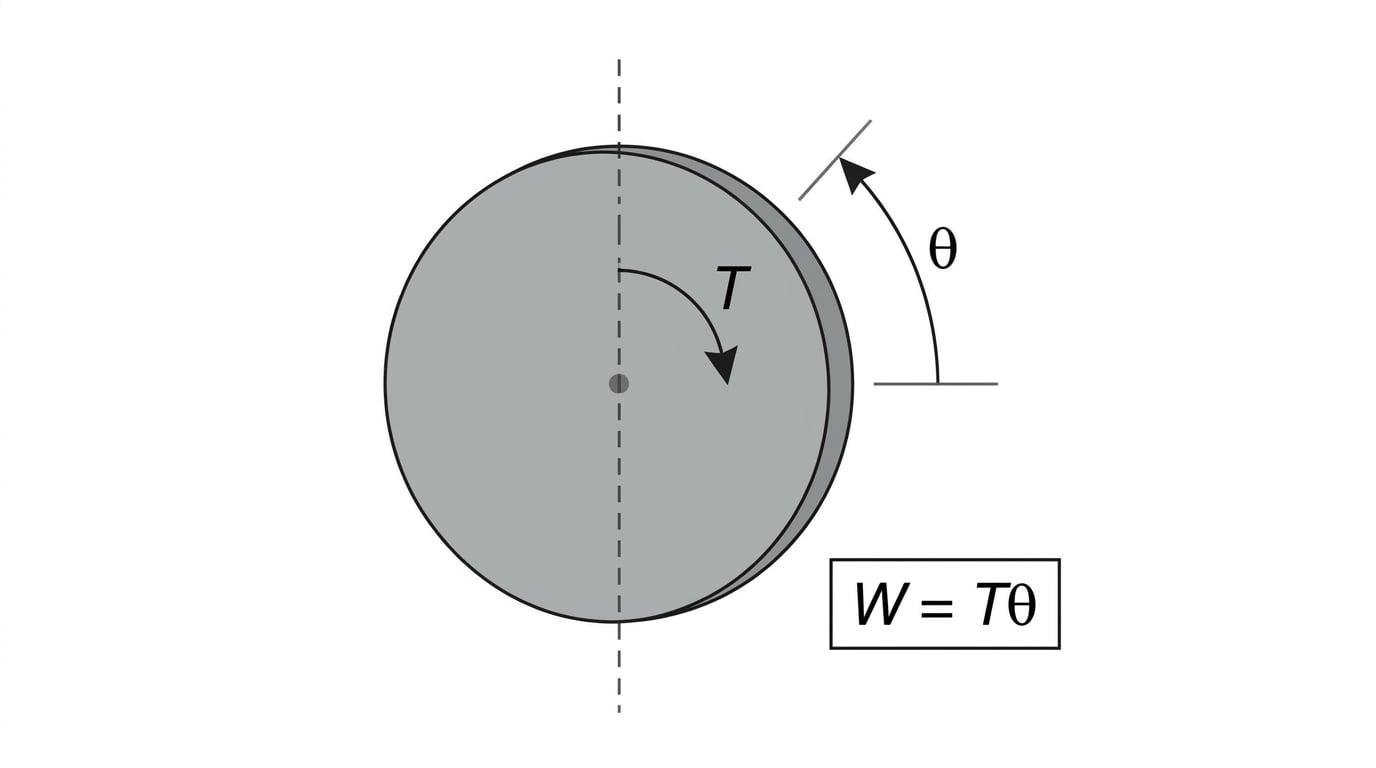
If you apply a torque to a wheel and it turns through a certain angle, you have transferred energy to that wheel. You have done work.
Rotational Work Done
The work done WWW by a constant torque TTT turning an object through an angle θ\thetaθ is:
W=Tθ W = T\theta W=TθWhere:
- WWW is the work done in joules (J\text{J}J)
- TTT is the torque in newton-metres (N m\text{N m}N m)
- θ\thetaθ is the angular displacement in radians (rad\text{rad}rad)
Forgetting to convert to radians
The equation W=TθW = T\thetaW=Tθ only works if the angle θ\thetaθ is measured in radians. AQA questions will frequently give you the displacement in degrees or "revolutions". You must convert this first! Remember that 1 revolution=2π radians1 \text{ revolution} = 2\pi \text{ radians}1 revolution=2π radians.
Calculating rotational work done
A mechanic uses a spanner to tighten a large bolt, applying a constant torque of 45 N m45 \text{ N m}45 N m. The bolt rotates through 3.5 revolutions3.5 \text{ revolutions}3.5 revolutions. Calculate the work done by the mechanic.
-
Identify the given values: Torque T=45 N mT = 45 \text{ N m}T=45 N m Angular displacement θ=3.5 revolutions\theta = 3.5 \text{ revolutions}θ=3.5 revolutions
-
Convert revolutions to radians: Since one revolution is 2π rad2\pi \text{ rad}2π rad:
θ=3.5×2π=7π rad\begin{aligned} \theta &= 3.5 \times 2\pi \\ &= 7\pi \text{ rad} \end{aligned}θ=3.5×2π=7π rad -
Apply the rotational work formula:
W=Tθ=45×7π=315π≈990 J (to 2 s.f.)\begin{aligned} W &= T\theta \\ &= 45 \times 7\pi \\ &= 315\pi \\ &\approx 990 \text{ J} \text{ (to 2 s.f.)} \end{aligned}W=Tθ=45×7π=315π≈990 J (to 2 s.f.)
Power in rotating machinery
Power is the rate at which work is done. For a motor spinning a shaft, we usually want to know how much energy it can output per second (its power).
We can derive the rotational power equation directly from the work equation. If power is work done divided by time (P=W/tP = W / tP=W/t), then:
P=Tθt P = \frac{T\theta}{t} P=tTθSince angular velocity ω\omegaω is defined as the rate of change of angular displacement (ω=θ/t\omega = \theta / tω=θ/t), we can substitute ω\omegaω into the equation.
Rotational Power
The power PPP generated or consumed by a rotating system is:
P=Tω P = T\omega P=TωWhere:
- PPP is the power in watts (W\text{W}W)
- TTT is the torque in newton-metres (N m\text{N m}N m)
- ω\omegaω is the angular velocity in radians per second (rad s−1\text{rad s}^{-1}rad s−1)
rpm to rad s⁻¹
Motors are almost universally rated in "rpm" (revolutions per minute). To convert rpm to rad s−1\text{rad s}^{-1}rad s−1, multiply by 2π2\pi2π (to get radians) and divide by 606060 (to get per second):
ω=rpm×2π60 \omega = \frac{\text{rpm} \times 2\pi}{60} ω=60rpm×2πCalculating motor power
An electric motor in an industrial fan rotates at 1200 rpm1200 \text{ rpm}1200 rpm and exerts a constant driving torque of 18 N m18 \text{ N m}18 N m. Calculate the power output of the motor.
-
Convert the angular velocity from rpm to rad s⁻¹:
ω=1200×2π60=40π rad s−1≈125.7 rad s−1\begin{aligned} \omega &= \frac{1200 \times 2\pi}{60} \\ &= 40\pi \text{ rad s}^{-1} \\ &\approx 125.7 \text{ rad s}^{-1} \end{aligned}ω=601200×2π=40π rad s−1≈125.7 rad s−1 -
Apply the rotational power formula:
P=Tω=18×125.7≈2260 W\begin{aligned} P &= T\omega \\ &= 18 \times 125.7 \\ &\approx 2260 \text{ W} \end{aligned}P=Tω=18×125.7≈2260 W -
State the final answer with units: The power output is 2.3 kW2.3 \text{ kW}2.3 kW (to 2 s.f.).
The reality check: Frictional torque
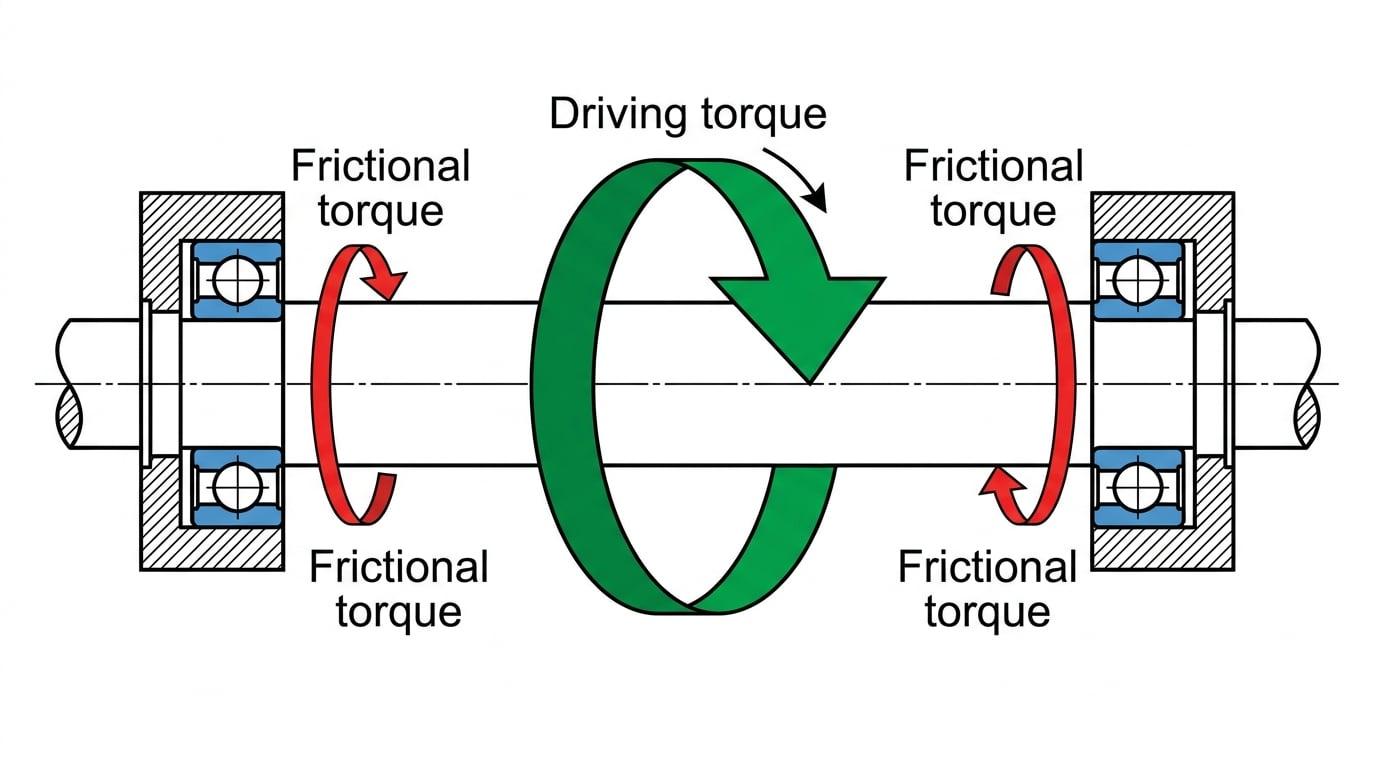
In pure theory, an axle spins freely forever. In reality, moving parts are in contact with bearings, gears, and the air. These interactions create friction.
Just as linear friction opposes linear motion, frictional torque opposes rotational motion.
Balancing torques at constant speed
If a machine is rotating at a constant angular velocity, the net torque must be zero. This means the driving torque provided by the engine must perfectly balance the sum of the useful load torque and the wasted frictional torque:
Tdriving=Tload+Tfriction T_{\text{driving}} = T_{\text{load}} + T_{\text{friction}} Tdriving=Tload+TfrictionThis concept is crucial for efficiency calculations. The total power generated by the engine (TdrivingωT_{\text{driving}}\omegaTdrivingω) is split into two parts:
- Useful power: TloadωT_{\text{load}}\omegaTloadω (doing the job you want it to do)
- Wasted power: TfrictionωT_{\text{friction}}\omegaTfrictionω (heating up the bearings due to friction)
Accounting for frictional torque
A winch motor provides a driving torque of 150 N m150 \text{ N m}150 N m to a drum, winding up a load at a constant angular velocity of 4.0 rad s−14.0 \text{ rad s}^{-1}4.0 rad s−1. The bearings in the drum exert a constant frictional torque of 12 N m12 \text{ N m}12 N m.
Calculate the useful power output of the winch.
-
Calculate the useful torque: The motor must overcome both the load and the friction.
Tdriving=Tload+Tfriction150=Tload+12Tload=138 N m\begin{aligned} T_{\text{driving}} &= T_{\text{load}} + T_{\text{friction}} \\ 150 &= T_{\text{load}} + 12 \\ T_{\text{load}} &= 138 \text{ N m} \end{aligned}Tdriving150Tload=Tload+Tfriction=Tload+12=138 N m -
Calculate the useful power: Use the power formula with the useful (load) torque.
Puseful=Tloadω=138×4.0=552 W\begin{aligned} P_{\text{useful}} &= T_{\text{load}}\omega \\ &= 138 \times 4.0 \\ &= 552 \text{ W} \end{aligned}Puseful=Tloadω=138×4.0=552 W -
Check the total power (optional, as a sanity check): Total motor power = 150×4.0=600 W150 \times 4.0 = 600 \text{ W}150×4.0=600 W. Power wasted to friction = 12×4.0=48 W12 \times 4.0 = 48 \text{ W}12×4.0=48 W. 600 W−48 W=552 W600 \text{ W} - 48 \text{ W} = 552 \text{ W}600 W−48 W=552 W. The math holds up!
Accelerating machinery
If the machine is accelerating (spinning up or slowing down), the driving torque does NOT equal the load plus friction. The difference between them provides a net torque, which causes angular acceleration according to Tnet=IαT_{\text{net}} = I\alphaTnet=Iα. We cover this in the moment of inertia topic!
In the exam
- Scan for units immediately. Highlight any angular values in rpm or revolutions. Convert them to rad s−1\text{rad s}^{-1}rad s−1 and rad\text{rad}rad before you write down a single formula.
- Watch for "constant speed" keywords. If the question states the machinery is operating at a constant speed, you immediately know Tdriving=Tload+TfrictionT_{\text{driving}} = T_{\text{load}} + T_{\text{friction}}Tdriving=Tload+Tfriction.
- Be careful with "power of the motor" vs "useful power". Make sure you are substituting the correct torque into P=TωP = T\omegaP=Tω. Driving torque gives total power; load torque gives useful power; frictional torque gives power wasted as heat.
- Efficiency. AQA might ask you for the efficiency of the rotational system. Simply use Efficiency=Useful PowerTotal Input Power×100%\text{Efficiency} = \frac{\text{Useful Power}}{\text{Total Input Power}} \times 100\%Efficiency=Total Input PowerUseful Power×100%.
Check yourself
- What is the difference between linear work (W=FsW = FsW=Fs) and rotational work (W=TθW = T\thetaW=Tθ)?
- If a motor's speed in rpm is doubled, what happens to its power output, assuming torque remains constant?
- Why does a motor running with no load connected still draw power?
- Can you write down the formula linking driving torque, load torque, and frictional torque for a system spinning at constant angular velocity?