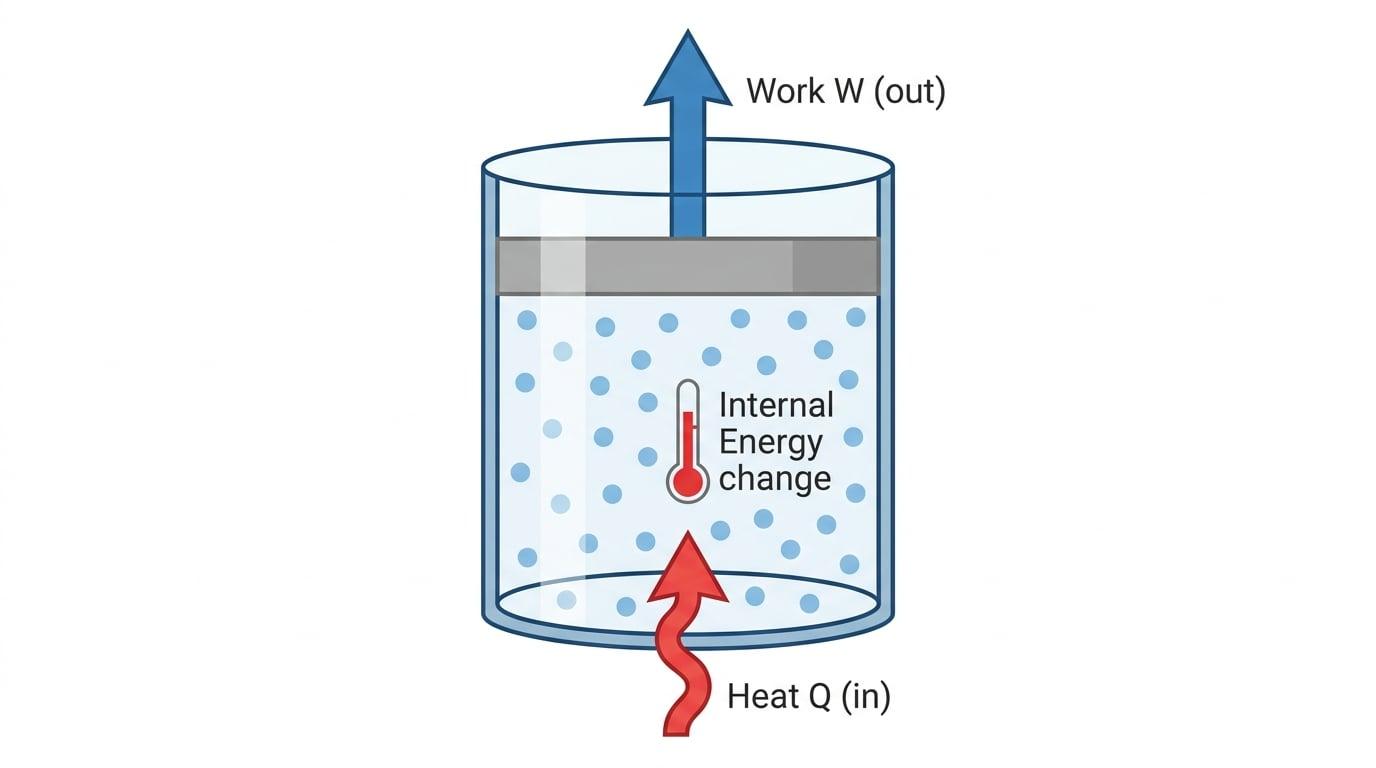
Unpacking the terms and sign conventions
The single biggest place students lose marks in this topic is using the wrong positive or negative sign. Let's look at exactly what AQA expects.
1. Heating (QQQ)
QQQ is the thermal energy transferred due to a temperature difference.
- Positive (+Q+Q+Q): Heat is transferred into the gas (e.g., you put a Bunsen burner under the cylinder).
- Negative (−Q-Q−Q): Heat is transferred out of the gas (e.g., the cylinder is placed in an ice bath).
2. Internal Energy (ΔU\Delta UΔU)
Internal energy is the sum of the randomly distributed kinetic and potential energies of the gas molecules. For an ideal gas, it is directly proportional to its absolute temperature.
- Positive (+ΔU+\Delta U+ΔU): The internal energy increases. This means the gas is getting hotter.
- Negative (−ΔU-\Delta U−ΔU): The internal energy decreases. This means the gas is getting cooler.
3. Work Done (WWW)
Work is done when a force moves through a distance. For a gas, this happens when the volume changes (the piston moves).
- Positive (+W+W+W): Work is done by the gas. The gas pushes the piston outwards. It is expanding.
- Negative (−W-W−W): Work is done on the gas. An external force pushes the piston inwards. The gas is being compressed.
AQA Sign Convention Summary
Remember the standard AQA perspective: You are the gas.
- If someone gives you heat, QQQ is positive.
- If your internal temperature goes up, ΔU\Delta UΔU is positive.
- If you push out and do work on the world, WWW is positive.
Physics vs Chemistry Equations
If you study A-Level Chemistry, you might have learned the first law as ΔU=Q+W\Delta U = Q + WΔU=Q+W. Do not use this in your Physics exam!
In chemistry, WWW is usually defined as work done on the system. In AQA Physics, WWW is strictly defined as work done by the system. Always stick to Q=ΔU+WQ = \Delta U + WQ=ΔU+W for your physics papers.
The Bank Account Analogy
Think of the gas as your bank account:
- QQQ is your salary (money coming in).
- WWW is the bills you pay (money going out to do useful things).
- ΔU\Delta UΔU is the change in your savings balance.
If your salary is £2000 (Q=+2000Q = +2000Q=+2000) and you pay £1500 in bills (W=+1500W = +1500W=+1500), your savings balance increases by £500 (ΔU=+500\Delta U = +500ΔU=+500). Equation: 2000=500+15002000 = 500 + 15002000=500+1500. It balances perfectly!
Applying the First Law
Let's see how this works in a standard exam-style calculation.
Example 1: Expanding gas
A gas is heated by a burner, absorbing 850 J850 \text{ J}850 J of thermal energy. As it is heated, it expands, pushing a piston outwards and doing 300 J300 \text{ J}300 J of work against the atmosphere. Calculate the change in internal energy of the gas and state what happens to its temperature.
- Assign signs to the given values: The gas absorbs heat, so Q=+850 JQ = +850 \text{ J}Q=+850 J. The gas expands and does work, so W=+300 JW = +300 \text{ J}W=+300 J.
- State the First Law equation: Q=ΔU+WQ = \Delta U + WQ=ΔU+W
- Substitute and rearrange: 850=ΔU+300850 = \Delta U + 300850=ΔU+300 ΔU=850−300\Delta U = 850 - 300ΔU=850−300 ΔU=+550 J\Delta U = +550 \text{ J}ΔU=+550 J
- Interpret the result: The change in internal energy is positive (+550 J+550 \text{ J}+550 J), which means the temperature of the gas increases.
Dealing with Compressions and Cooling
Things get a little trickier when the gas is being squashed or cooled down. You must be very careful with negative signs in your algebra.
Example 2: Compressing a cooling gas
A mechanic rapidly compresses the gas in a cylinder, doing 420 J420 \text{ J}420 J of work on the gas. During this process, 150 J150 \text{ J}150 J of thermal energy is lost to the cold surroundings. Calculate the change in internal energy.
- Assign signs to the given values: Work is done on the gas (it is compressed), so WWW is negative: W=−420 JW = -420 \text{ J}W=−420 J. Thermal energy is lost to the surroundings, so QQQ is negative: Q=−150 JQ = -150 \text{ J}Q=−150 J.
- State the First Law equation: Q=ΔU+WQ = \Delta U + WQ=ΔU+W
- Substitute the values carefully: −150=ΔU+(−420)-150 = \Delta U + (-420)−150=ΔU+(−420)
- Rearrange for ΔU\Delta UΔU: ΔU=−150−(−420)\Delta U = -150 - (-420)ΔU=−150−(−420) ΔU=−150+420\Delta U = -150 + 420ΔU=−150+420 ΔU=+270 J\Delta U = +270 \text{ J}ΔU=+270 J
- Interpret the result: Even though the gas lost heat, the huge amount of work done on it caused its overall internal energy to increase. Its temperature goes up!
Special Cases
Sometimes, the exam question describes a scenario where one of the three terms is zero.
- "Constant volume" (Isochoric): If the volume cannot change, the piston cannot move. No work is done, so W=0W = 0W=0. The equation becomes Q=ΔUQ = \Delta UQ=ΔU. All heat added goes directly into raising the temperature.
- "Thermally insulated" / "No heat transfer" (Adiabatic): If the cylinder is perfectly insulated, or the process happens so fast there is no time for heat to enter or leave, then Q=0Q = 0Q=0. The equation becomes 0=ΔU+W0 = \Delta U + W0=ΔU+W, meaning ΔU=−W\Delta U = -WΔU=−W. If the gas does work (expands), it must use its own internal energy to do so, causing it to cool down rapidly.
Connecting topics
In upcoming topics, you will learn how to calculate the work done (WWW) yourself using the equation W=pΔVW = p \Delta VW=pΔV (pressure ×\times× change in volume), and how to calculate ΔU\Delta UΔU using the specific heat capacity of a gas. You will then plug those values right back into Q=ΔU+WQ = \Delta U + WQ=ΔU+W.
In the exam
- Read carefully for direction words. Highlight words like "expands", "compressed", "absorbs", "loses", "heats up", and "cools".
- Write out the variables with signs first. Before you do any math, write down Q=...Q = \text{...}Q=..., W=...W = \text{...}W=..., ΔU=...\Delta U = \text{...}ΔU=... with a +++ or −-− next to every number.
- Trust the algebra. When rearranging an equation with negative numbers, take it one step at a time to avoid dropping a minus sign.
- Check your final answer makes physical sense. If you squeezed a gas really hard (work done on it) and it didn't lose much heat, the temperature must go up. Check that your final ΔU\Delta UΔU is positive.
Check yourself
- What does the symbol QQQ represent in the first law of thermodynamics?
- If a gas is compressed by an external force, is WWW positive or negative in AQA Physics?
- A gas is kept at a constant volume while being heated. Which term in the equation Q=ΔU+WQ = \Delta U + WQ=ΔU+W must be exactly zero?
- If ΔU\Delta UΔU is negative at the end of your calculation, what does that tell you about the temperature of the ideal gas?