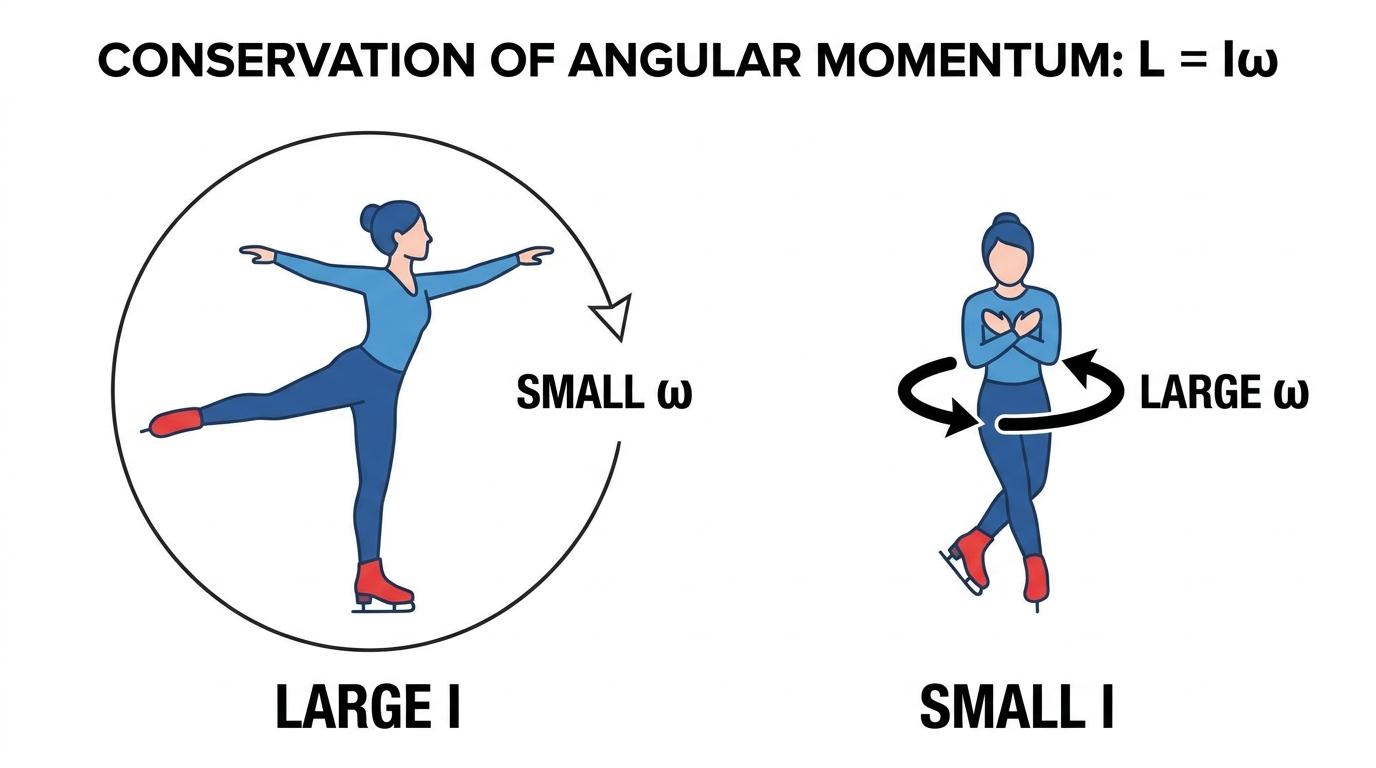
You see exactly the same physics in diving and gymnastics. A diver leaps from the board and pulls their body into a tight "tuck" position. This drastically reduces their moment of inertia, allowing them to spin rapidly and complete multiple somersaults before opening out again (which increases their moment of inertia and slows their spin) to enter the water cleanly.
Confusing mass and moment of inertia
Students often write "the skater's mass decreases when they pull their arms in". Their mass does not change! It is the distribution of that mass that changes, meaning the moment of inertia decreases. Always use the correct term in your written answers.
The Ice Skater
An ice skater spins with her arms outstretched at an angular velocity of 3.0 rad s−13.0 \text{ rad s}^{-1}3.0 rad s−1. Her moment of inertia in this position is 2.8 kg m22.8 \text{ kg m}^22.8 kg m2. She pulls her arms tight against her body, reducing her moment of inertia to 1.2 kg m21.2 \text{ kg m}^21.2 kg m2. Assuming ice friction is negligible, calculate her new angular velocity.
- State the principle of conservation of angular momentum for this situation:
- Substitute the initial values into the left side of the equation:
- Set this equal to the final state (I2ω2I_2\omega_2I2ω2) and rearrange for the new angular velocity, ω2\omega_2ω2:
Angular Impulse
What happens if an external torque does act on a system? The angular momentum changes.
In linear mechanics, Impulse = Force ×\times× time = change in momentum (FΔt=ΔpF \Delta t = \Delta pFΔt=Δp). In rotational mechanics, Angular Impulse = Torque ×\times× time = change in angular momentum.
Angular Impulse
The angular impulse on an object is the product of the applied torque and the time over which it acts. It is equal to the change in the object's angular momentum.
TΔt=Δ(Iω) T \Delta t = \Delta (I\omega) TΔt=Δ(Iω)Where:
- TTT is a constant torque in N m\text{N m}N m
- Δt\Delta tΔt is the time interval in seconds (s\text{s}s)
- Δ(Iω)\Delta (I\omega)Δ(Iω) is the change in angular momentum in kg m2 s−1\text{kg m}^2 \text{ s}^{-1}kg m2 s−1
Notice that the units for angular impulse can be written as N m s\text{N m s}N m s. Because angular impulse equals a change in angular momentum, N m s\text{N m s}N m s and kg m2 s−1\text{kg m}^2 \text{ s}^{-1}kg m2 s−1 are equivalent units!
Often, the moment of inertia (III) of the spinning object remains constant (e.g. a rigid wheel). If III is constant, the change in angular momentum is simply IΔωI \Delta \omegaIΔω. The equation then becomes:
TΔt=IΔω T \Delta t = I \Delta \omega TΔt=IΔωBraking a flywheel
A rigid flywheel has a moment of inertia of 15 kg m215 \text{ kg m}^215 kg m2 and is spinning at 40 rad s−140 \text{ rad s}^{-1}40 rad s−1. A constant frictional braking torque of 25 N m25 \text{ N m}25 N m is applied to the flywheel. Calculate the time it takes for the flywheel to come to a complete stop.
- Identify that the flywheel is rigid, so its moment of inertia III is constant. Write down the angular impulse equation:
- Calculate the change in angular velocity (Δω\Delta \omegaΔω). It goes from 40 rad s−140 \text{ rad s}^{-1}40 rad s−1 to 0 rad s−10 \text{ rad s}^{-1}0 rad s−1, so the magnitude of the change is 40 rad s−140 \text{ rad s}^{-1}40 rad s−1.
- Substitute the values into the equation (ignoring negative signs as we are dealing with magnitudes):
- Solve for Δt\Delta tΔt:
Sign conventions
If a torque acts to slow down an object, the torque and the angular velocity are in opposite directions. You can treat the initial angular velocity as positive and the torque as negative, which ensures your final answer makes sense. In simple cases (like the example above), just thinking in terms of magnitudes of the change is perfectly fine.
In the exam
- Watch out for units: Exam questions love to give angular velocity in rev min−1\text{rev min}^{-1}rev min−1 (revolutions per minute) or rev s−1\text{rev s}^{-1}rev s−1 rather than rad s−1\text{rad s}^{-1}rad s−1. Always convert to rad s−1\text{rad s}^{-1}rad s−1 by multiplying by 2π2\pi2π (and dividing by 60 if it's per minute) before doing any angular momentum calculations.
- "Explain why" questions: If asked to explain a spinning sportsperson, hit three specific marking points: (a) No external torques act, so (b) angular momentum is conserved. (c) Moment of inertia decreases/increases, so angular velocity must increase/decrease to compensate.
- Rigid vs Non-Rigid: Check if III is constant. For flywheels and wheels, III is usually constant so Δ(Iω)=IΔω\Delta(I\omega) = I\Delta\omegaΔ(Iω)=IΔω. For skaters and collapsing stars, III changes, so use I1ω1=I2ω2I_1\omega_1 = I_2\omega_2I1ω1=I2ω2.
Check yourself
- What is the rotational equivalent of mass in the equation for momentum?
- Why must an ice skater pull their arms inwards, rather than push them outwards, if they want to increase their spin speed?
- What are the SI units of angular impulse, and how do they relate to the units of angular momentum?
- If the moment of inertia of a spinning satellite is doubled while in space (with no external torques acting), what happens to its angular velocity?