Wave-particle duality
What you'll learn
- How the photoelectric effect and electron diffraction together prove "wave-particle duality".
- How to calculate the de Broglie wavelength of a moving particle.
- How the size of an electron diffraction pattern changes when the electron's momentum changes.
- How the scientific community uses peer review to validate paradigm-shifting ideas.
The Two Faces of Physics
Throughout much of physics history, the universe seemed neatly divided into two categories: particles and waves. Particles (like billiard balls or electrons) have mass and momentum, and they bounce off things. Waves (like sound or light) have wavelengths and frequencies, and they diffract and interfere.
However, the discovery of the photoelectric effect shattered this neat division. It showed that electromagnetic radiation (light), which everyone knew was a wave, can sometimes behave as a stream of discrete, particle-like packets of energy called photons.
If waves can act like particles, could particles act like waves? In 1924, a physicist named Louis de Broglie proposed exactly that. He suggested that all matter has both particle and wave properties.
The core of wave-particle duality
- The photoelectric effect provides evidence that electromagnetic waves can behave like particles.
- Electron diffraction provides evidence that particles with mass can behave like waves.
Electron Diffraction in Action
To prove that something is a wave, you have to prove that it diffracts and interferes. Diffraction is the spreading out of a wave when it passes through a gap or around an obstacle. Crucially, significant diffraction only occurs when the size of the gap is similar to the wavelength of the wave.
If electrons have a wave nature, their wavelength is incredibly tiny. A standard laboratory diffraction grating (used for light) has gaps that are far too wide. Instead, physicists use a thin slice of polycrystalline graphite. The gaps between the carbon atoms in graphite are roughly 1×10⁻¹⁰ m1 \times 10^{-10}\text{ m}1×10⁻¹⁰ m, which is perfectly sized to diffract electrons.
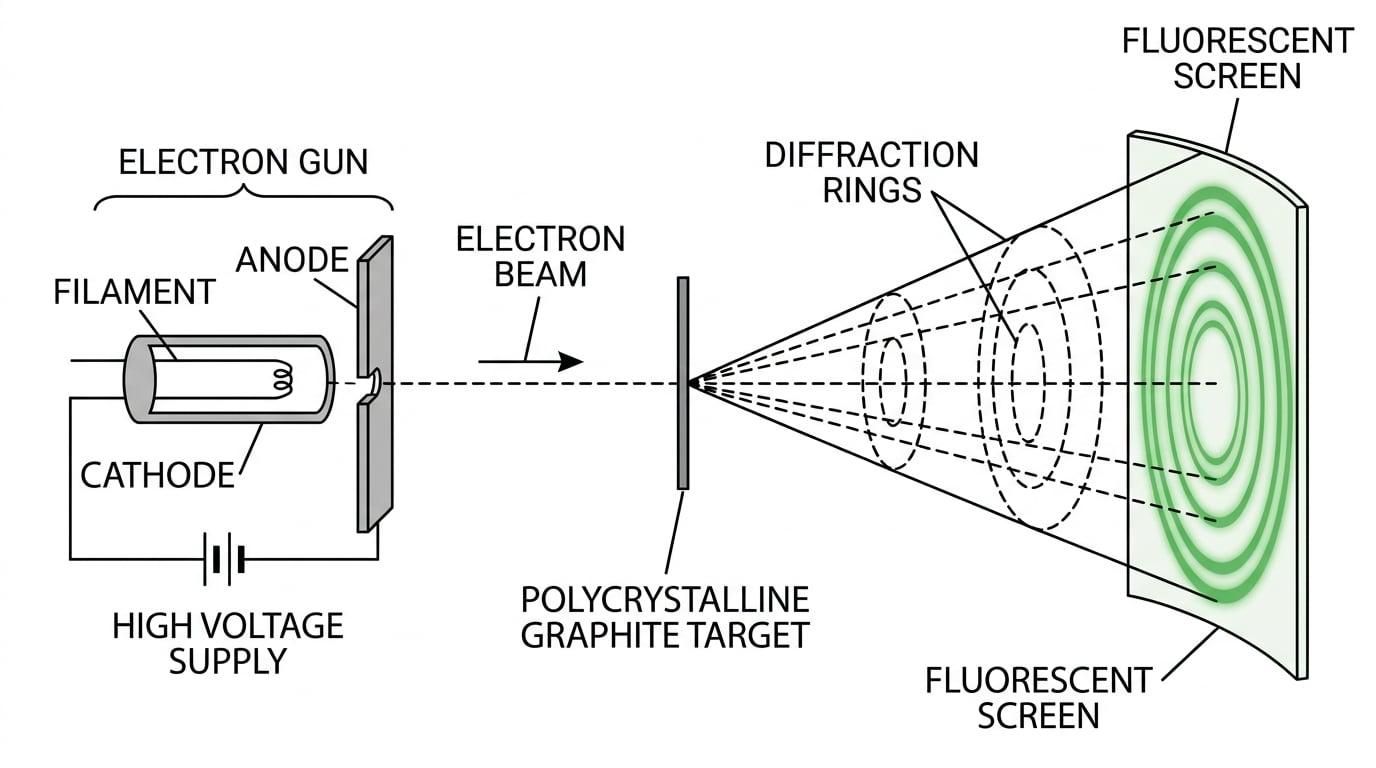
In an electron diffraction tube, an electron gun accelerates a beam of electrons towards the graphite target. When the electrons pass through the atomic gaps, they diffract.
Because the graphite crystals are arranged randomly in all directions, the diffracted electron waves overlap and interfere, forming a circular interference pattern on a fluorescent screen at the end of the tube.
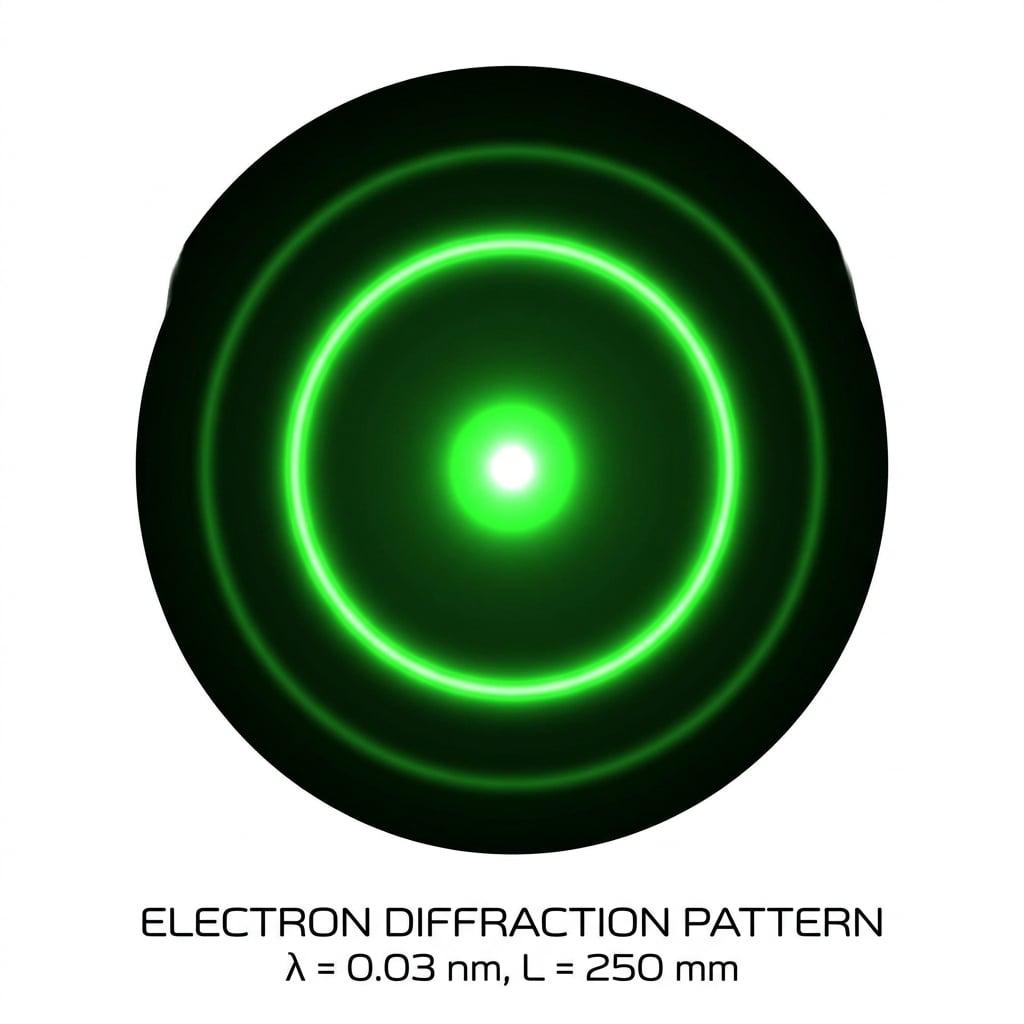
Instead of a single bright spot where the beam hits, we see a bright central spot surrounded by distinct, concentric bright and dark rings. The bright rings show where the electron waves have constructively interfered. This pattern is absolute, physical proof of the wave nature of matter.
The de Broglie Wavelength
De Broglie gave us a simple equation to calculate the wavelength of any moving particle. It directly links a wave property (wavelength) to a particle property (momentum).
The de Broglie equation
Where:
- λ\lambdaλ is the de Broglie wavelength in metres (m\text{m}m).
- hhh is the Planck constant, 6.63×10⁻³⁴ J s6.63 \times 10^{-34}\text{ J s}6.63×10⁻³⁴ J s.
- mmm is the mass of the particle in kilograms (kg\text{kg}kg).
- vvv is the velocity of the particle in metres per second (m s−1\text{m s}^{-1}m s−1).
- The product mvmvmv is the particle's momentum (ppp).
Calculating the wavelength of an electron
An electron is travelling at a velocity of 4.5×10⁶ m s−14.5 \times 10^{6}\text{ m s}^{-1}4.5×10⁶ m s−1. Calculate its de Broglie wavelength. (The mass of an electron is 9.11×10⁻³¹ kg9.11 \times 10^{-31}\text{ kg}9.11×10⁻³¹ kg)
- Identify the given values from the question and the data sheet:
- State the de Broglie equation:
- Substitute the values into the equation:
- Calculate the final answer:
Prefixes are common here
Because de Broglie wavelengths are extremely small, questions will often give or ask for the answer in nanometres (nm\text{nm}nm, 10−9 m10^{-9}\text{ m}10−9 m) or picometres (pm\text{pm}pm, 10−12 m10^{-12}\text{ m}10−12 m). Always convert back to standard metres before putting numbers into the equation!
Changing the Momentum
A common exam question asks you to explain what happens to the diffraction pattern if you increase the accelerating voltage of the electron gun.
Increasing the voltage gives the electrons more kinetic energy, which means they travel faster (their velocity vvv increases). Because mass mmm is constant, an increase in velocity means an increase in momentum (mvmvmv).
Looking at λ=hmv\lambda = \frac{h}{mv}λ=mvh, we can see that wavelength is inversely proportional to momentum.
- Higher momentum means a smaller wavelength.
- Smaller wavelength means less diffraction occurs as the electrons pass through the graphite.
- Because they spread out less, the concentric rings on the fluorescent screen squash closer together (the diameter of the rings decreases).
Explaining changes in the diffraction pattern
The accelerating voltage in an electron diffraction tube is decreased. Explain how and why the appearance of the diffraction pattern on the screen changes.
- State the effect on velocity: Decreasing the voltage reduces the kinetic energy of the electrons, so their velocity vvv decreases.
- Relate this to momentum: A lower velocity means the electrons have less momentum (mvmvmv).
- Relate momentum to wavelength: According to the de Broglie equation (λ=hmv\lambda = \frac{h}{mv}λ=mvh), a decrease in momentum causes an increase in the de Broglie wavelength.
- Conclude the effect on the pattern: A longer wavelength means the electrons diffract more. Therefore, the concentric rings will spread further apart (their diameter will increase).
Confusing the direction of change
A very common error is stating that faster electrons cause more diffraction. It's the opposite! Faster electrons →\rightarrow→ higher momentum →\rightarrow→ shorter wavelength →\rightarrow→ less diffraction →\rightarrow→ smaller rings.
How Scientific Knowledge Changes
When de Broglie first proposed his equation, it was purely theoretical. It was an elegant idea, but in physics, an idea is only as good as the evidence supporting it.
A few years later, scientists like Davisson and Germer in the US, and G.P. Thomson in the UK, successfully carried out the first electron diffraction experiments. Their results perfectly matched the wavelengths predicted by de Broglie's equation.
However, one successful experiment does not instantly change the whole of physics. When these scientists wrote up their findings, they submitted them to academic journals. Before publication, their work underwent peer review.
- Other independent experts evaluated the experiments to check for errors, bias, or poor methodology.
- Once published, scientists in other laboratories across the globe repeated the experiments to validate the findings.
Only after being rigorously tested, peer-reviewed, and validated by the wider scientific community did wave-particle duality become accepted as a cornerstone of modern quantum mechanics. This is how all scientific knowledge evolves over time.
In the exam
- Be specific with your evidence: If asked what proves the wave nature of light, say "diffraction" or "interference". If asked what proves the particle nature of light, say "the photoelectric effect".
- Watch your mass: If a question asks about the de Broglie wavelength of a proton or an entire atom, make sure you use the correct mass for that specific particle, not the electron mass you are so used to plugging in.
- Linking energy and momentum: You will often need to combine the kinetic energy equation (Ek=12mv2E_k = \frac{1}{2}mv^2Ek=21mv2) with the de Broglie equation to find the velocity first.
Check yourself
- Which specific phenomenon proves that electromagnetic radiation can behave as particles?
- Which specific phenomenon proves that moving particles can behave as waves?
- If the velocity of an electron is doubled, what happens to its de Broglie wavelength?
- Why is it important that new scientific models undergo peer review?