

Welcome to the study of waves! Whether it's light travelling from a distant star or ripples across a pond, waves are fundamental to how energy moves around the universe.
What you'll learn in this topic:
- What a progressive wave actually is and how it transfers energy.
- The precise definitions of key wave properties like amplitude, wavelength, and frequency.
- How to confidently use the wave equation c=fλc = f\lambdac=fλ.
- How to calculate phase difference between two points using fractions of a cycle, degrees, or radians.
What is a Progressive Wave?
A progressive wave is an oscillation that travels through matter (or space), transferring energy from one place to another.
The crucial point here is that a progressive wave transfers energy, but it does not transfer matter. For example, when a sound wave travels across a room, the air particles don't travel all the way from the speaker to your ear. Instead, each air particle simply oscillates (wobbles) back and forth around its resting position. It is the wave itself—and the energy it carries—that moves forward.
Energy, not matter
All progressive waves transfer energy from one point to another without permanently moving the material of the medium itself.
The Anatomy of a Wave
To describe waves mathematically, we need to define their geometry. Imagine taking a "snapshot" of a wave frozen in time. If we plot the position of all the particles along the wave against their resting positions, we get a displacement-distance graph.
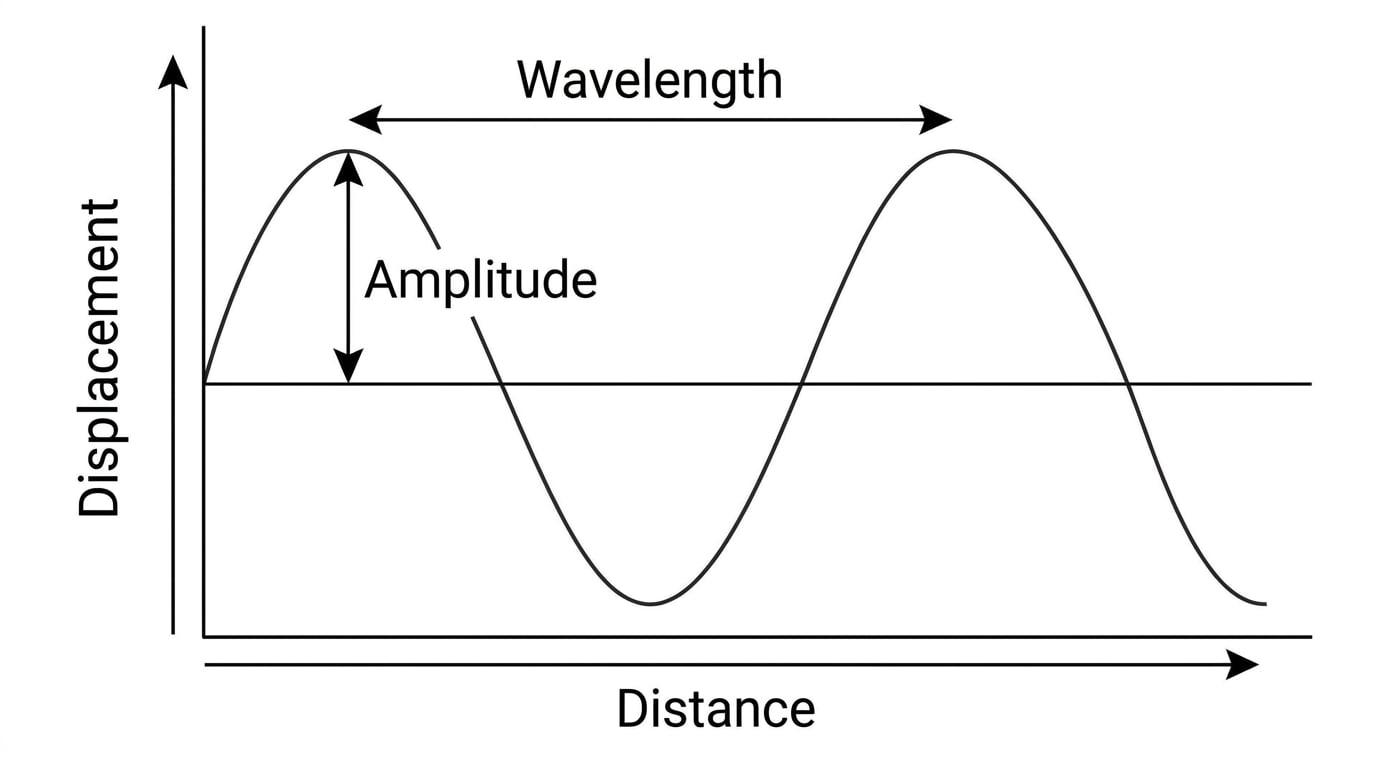
Displacement and Amplitude
- Displacement: The distance and direction of a particle from its equilibrium (rest) position.
- Amplitude (AAA): The maximum displacement of a particle from its equilibrium position.
Wavelength
Wavelength (λ\lambdaλ) is the least distance between two adjacent particles that are oscillating exactly in step (for example, the shortest distance between two consecutive peaks or two consecutive troughs). It is measured in metres (m\text{m}m).
If we change our perspective and track just one single particle over a period of time, we get a displacement-time graph. This allows us to define the wave's timing properties.
Time Period and Frequency
- Time period (TTT): The time taken for one complete wave to pass a fixed point, measured in seconds (s\text{s}s).
- Frequency (fff): The number of complete waves passing a fixed point per second, measured in hertz (Hz\text{Hz}Hz).
Mixing up graph axes
AQA examiners frequently try to catch students out by providing a displacement-time graph and asking for the wavelength. You cannot read wavelength from a time axis! A displacement-time graph only gives you the time period (TTT). To find wavelength directly from a graph, the horizontal axis must be distance.
The Wave Equations
Frequency and time period are inversely related. If one wave takes 0.5 s0.5 \text{ s}0.5 s to pass, then 2 waves will pass in one second. Mathematically:
f=1T f = \frac{1}{T} f=T1We can also figure out how fast the wave is travelling. The speed of the wave, ccc, is the distance it travels per second. Since one whole wave (which has a length of λ\lambdaλ) passes a fixed point in one time period (TTT), the speed must be c=λTc = \frac{\lambda}{T}c=Tλ.
If we substitute f=1Tf = \frac{1}{T}f=T1 into that logic, we get the fundamental wave equation:
c=fλ c = f\lambda c=fλWhere:
- ccc is the wave speed in m s−1\text{m s}^{-1}m s−1
- fff is the frequency in Hz\text{Hz}Hz
- λ\lambdaλ is the wavelength in m\text{m}m
Using the wave equation
A water wave has a time period of 0.40 s0.40 \text{ s}0.40 s and adjacent peaks are separated by 1.2 m1.2 \text{ m}1.2 m. Calculate the speed of the wave.
- First, find the frequency using the time period:
- Identify the wavelength. The physical distance between adjacent peaks is the wavelength:
- Use the wave equation to calculate the speed: c=fλc=2.5×1.2c=3.0 m s−1\begin{aligned} c &= f\lambda \\ c &= 2.5 \times 1.2 \\ c &= 3.0 \text{ m s}^{-1} \end{aligned}ccc=fλ=2.5×1.2=3.0 m s−1
Phase and Phase Difference
Phase describes what fraction of a full cycle a single particle has completed at a given moment.
Phase difference tells us how far out of step two different particles are on the same wave, or how far out of step two different waves are at the same location.
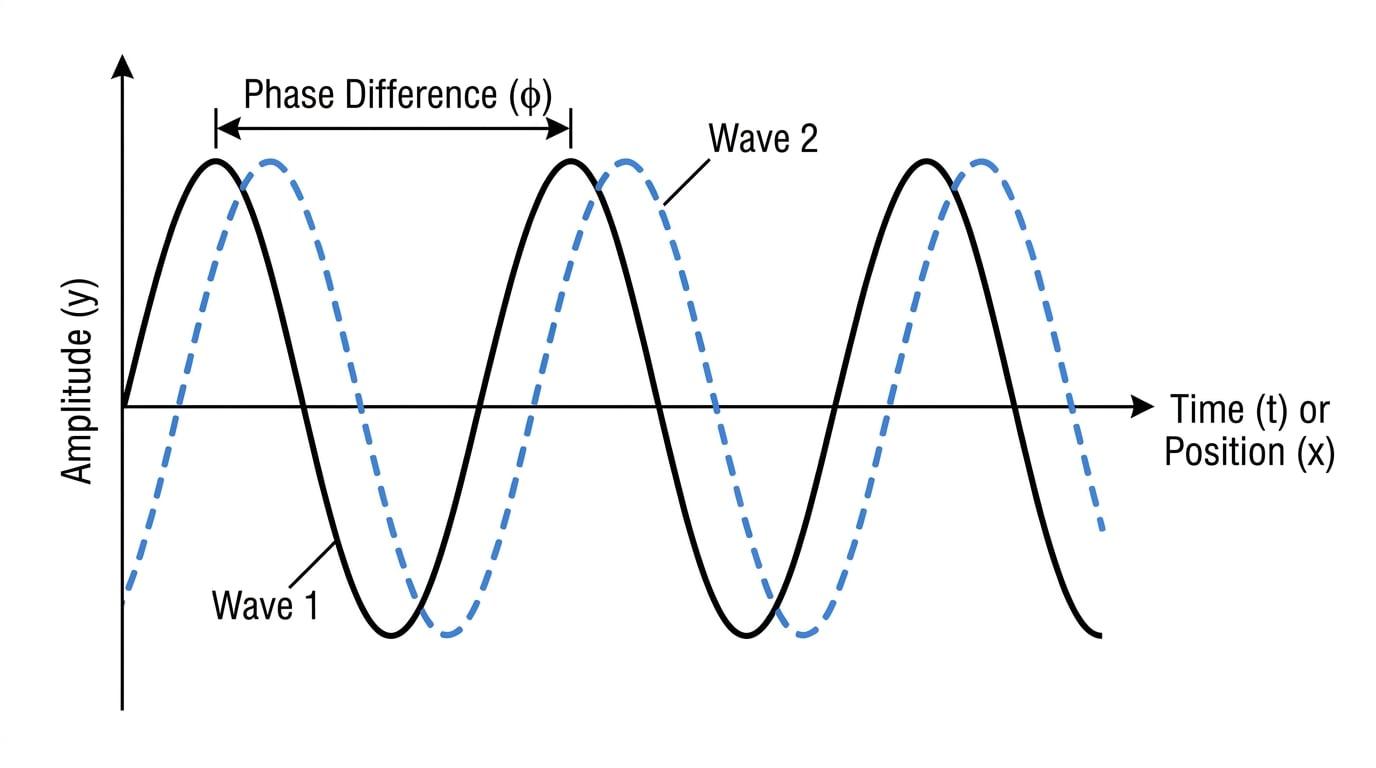
Phase difference can be measured in three distinct ways:
- Fractions of a cycle: e.g., 14\frac{1}{4}41 of a cycle out of step.
- Degrees: One full cycle is 360∘360^\circ360∘. So, 14\frac{1}{4}41 of a cycle is 90∘90^\circ90∘.
- Radians: One full cycle is 2π2\pi2π radians. So, 14\frac{1}{4}41 of a cycle is π2\frac{\pi}{2}2π radians.
Radians are the standard
In A-Level Physics, you are strongly expected to use radians for phase difference unless a question explicitly asks for degrees. Always remember the core conversion: 1 full cycle=360∘=2π rad1 \text{ full cycle} = 360^\circ = 2\pi \text{ rad}1 full cycle=360∘=2π rad.
In Phase vs Anti-Phase
When comparing two oscillating particles, we often describe their relationship using specific terms:
- In phase: The particles are oscillating exactly in step with each other. They reach their maximum positive displacement at the exact same time. Their phase difference is 000, 2π2\pi2π, 4π4\pi4π radians. On a single wave, points in phase are separated by a whole number of wavelengths (1λ,2λ1\lambda, 2\lambda1λ,2λ, etc.).
- Anti-phase: The particles are oscillating exactly out of step. When one is at its maximum positive displacement, the other is at its maximum negative displacement. Their phase difference is π\piπ, 3π3\pi3π, 5π5\pi5π radians. On a single wave, points in anti-phase are separated by (n+0.5)λ(n + 0.5)\lambda(n+0.5)λ.
Calculating Phase Difference
To calculate the phase difference (Δϕ\Delta \phiΔϕ) between two points on the same wave separated by a physical distance (Δx\Delta xΔx), you work out what fraction of a wavelength they are separated by, and then multiply by a full cycle (2π2\pi2π radians):
Δϕ=2πΔxλ \Delta \phi = \frac{2\pi \Delta x}{\lambda} Δϕ=λ2πΔxCalculating phase difference in radians
A progressive sound wave has a frequency of 170 Hz170 \text{ Hz}170 Hz and travels at 340 m s−1340 \text{ m s}^{-1}340 m s−1. Calculate the phase difference, in radians, between two points on the wave that are 0.50 m0.50 \text{ m}0.50 m apart.
- First, calculate the wavelength using c=fλc = f\lambdac=fλ:
- Identify the physical separation distance (Δx\Delta xΔx) between the two points:
- Calculate the phase difference by substituting your values into the phase difference formula: Δϕ=2πΔxλΔϕ=2π×0.502.0Δϕ=π2 rad\begin{aligned} \Delta \phi &= \frac{2\pi \Delta x}{\lambda} \\ \Delta \phi &= \frac{2\pi \times 0.50}{2.0} \\ \Delta \phi &= \frac{\pi}{2} \text{ rad} \end{aligned}ΔϕΔϕΔϕ=λ2πΔx=2.02π×0.50=2π rad
In the exam
- Check the axes: Whenever you are presented with a wave graph, immediately check the xxx-axis. Is it distance (m\text{m}m) or time (s\text{s}s)? This dictates whether you are reading wavelength (λ\lambdaλ) or time period (TTT).
- Watch your prefixes: Wave speeds are often large, and wavelengths/frequencies can span huge extremes (e.g., gigahertz for microwaves, nanometres for light). Always convert prefixes like k\text{k}k, M\text{M}M, G\text{G}G and n\text{n}n, \mu\text{\mu}\mu, m\text{m}m to standard powers of ten before plugging them into c=fλc = f\lambdac=fλ.
- Use fractions of π\piπ: When giving an answer for phase difference in radians, leave π\piπ in your answer (e.g., π3 rad\frac{\pi}{3} \text{ rad}3π rad) rather than writing out long decimals like 1.05 rad1.05 \text{ rad}1.05 rad.
Check yourself
- Can you explain the difference between a displacement-distance graph and a displacement-time graph?
- If the time period of a wave is halved, what happens to its frequency?
- If two points on a progressive wave are separated by a distance of 1.5λ1.5\lambda1.5λ, are they in phase, in anti-phase, or neither?
- Can you write down the formula linking phase difference, particle separation, and wavelength?
