What you'll learn
- Why electrons in atoms can only exist at specific, fixed energy levels.
- How an atom emits a photon when an electron transitions between these levels.
- How to use the equation hf=E1−E2hf = E_1 - E_2hf=E1−E2 to calculate the frequency or wavelength of emitted light.
- How to convert confidently between electronvolts (eV) and joules (J).
- Why atomic line spectra provide vital evidence for quantum mechanics.
The Quantum Ladder
In classical physics, an object can have any amount of energy. If you push a ball up a hill, it can rest at any height. But inside an atom, the rules of quantum mechanics take over.
Electrons bound to an atom cannot just have any amount of energy. They are restricted to very specific, fixed energy states.
Discrete Energy Levels
The specific, fixed amounts of energy that an electron in an atom is allowed to possess. Because these levels are separated by forbidden gaps, they are described as "discrete" (meaning individually distinct).
The rung of a ladder
Think of energy levels like the rungs of a ladder. You can stand on the first rung, or the second rung, but you cannot hover in the empty air between them. An electron must be exactly on an energy level.
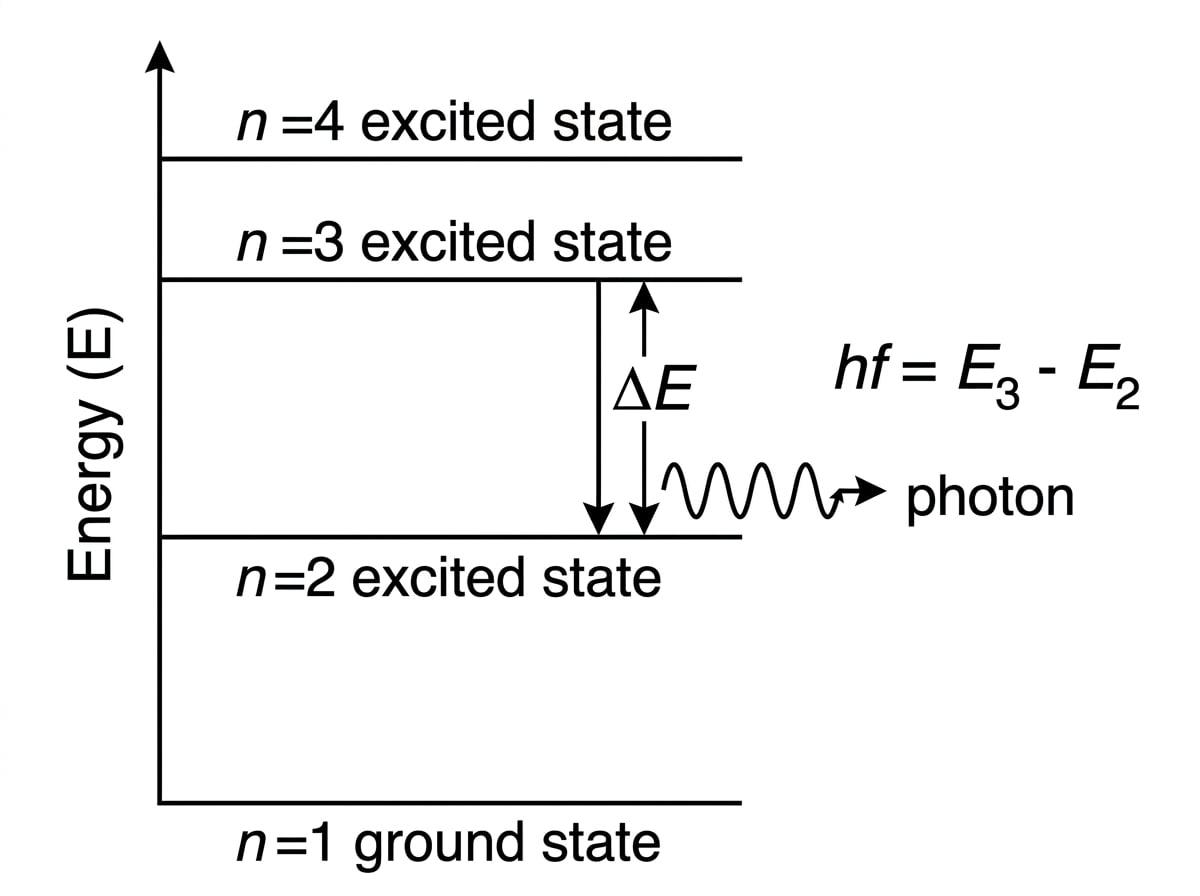
The lowest energy level an electron can occupy is called the ground state. In energy level diagrams, we often label the energy levels with a principal quantum number nnn. The ground state is n=1n = 1n=1. Levels above the ground state (n=2n = 2n=2, n=3n = 3n=3, and so on) are called excited states.
If an electron is given exactly the right amount of energy (for example, by colliding with another particle or absorbing a photon), it can jump up to a higher energy level. We say the atom is now "excited".
Emitting a Photon
Electrons generally do not like being in excited states; they are unstable. An electron will quickly fall back down to a lower energy level, closer to the ground state.
Because the electron is moving from a higher energy state to a lower energy state, it must lose energy. The law of conservation of energy demands that this missing energy goes somewhere. The atom releases it by emitting a single packet of electromagnetic radiation: a photon.
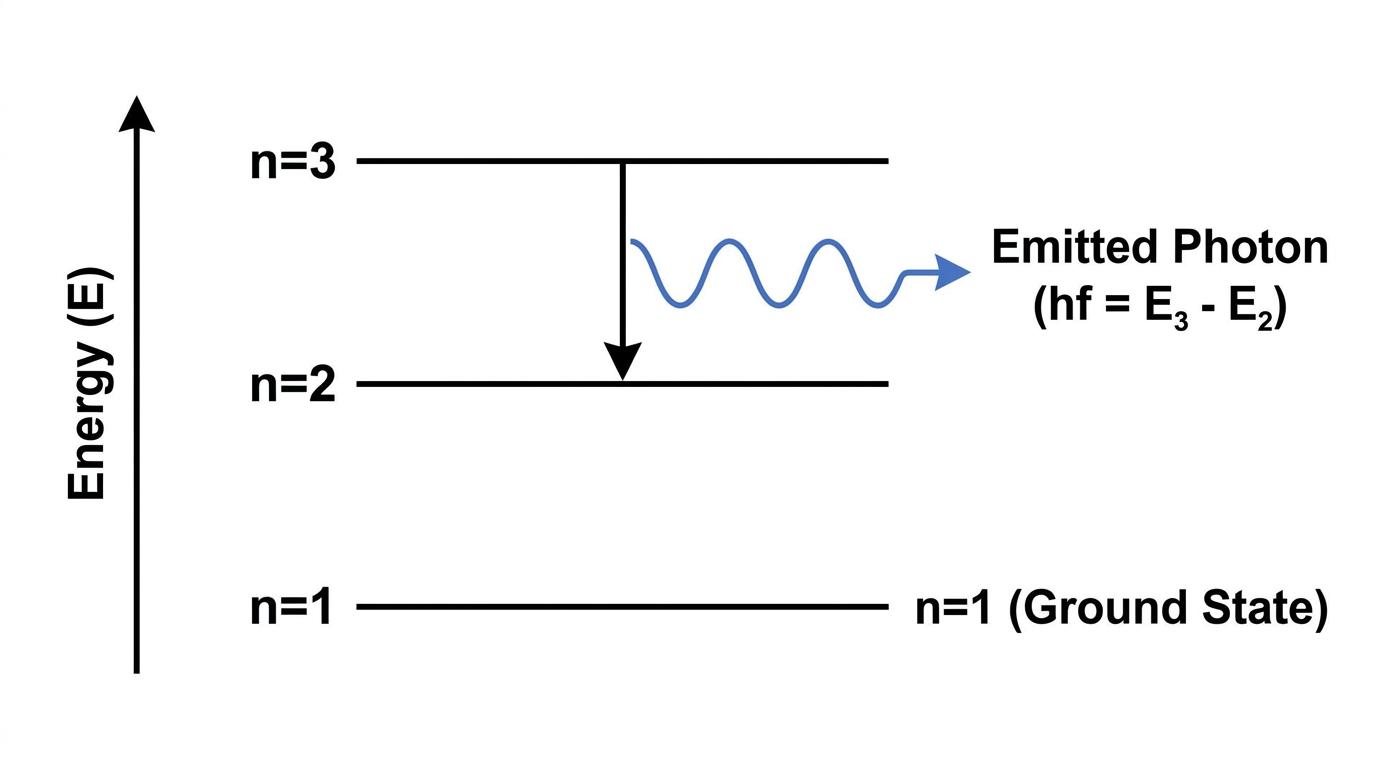
The energy of this emitted photon is exactly equal to the difference in energy between the two levels.
If an electron drops from a higher initial energy level E1E_1E1 to a lower final energy level E2E_2E2, the energy of the emitted photon is given by:
hf=E1−E2 hf = E_1 - E_2 hf=E1−E2Where:
- hhh is the Planck constant (6.63×10⁻³⁴ J s6.63 \times 10^{-34} \text{ J s}6.63×10⁻³⁴ J s)
- fff is the frequency of the emitted photon in hertz (Hz)
- E1E_1E1 is the initial, higher energy level
- E2E_2E2 is the final, lower energy level
Energy difference defines the photon
An atom can only emit photons with energies that exactly match the energy gaps between its specific discrete levels.
Energy Units: Joules and Electronvolts
Because atomic energies are so incredibly small, using joules (J) usually results in cumbersome standard form numbers like 3.0×10⁻¹⁹ J3.0 \times 10^{-19} \text{ J}3.0×10⁻¹⁹ J.
To make the numbers easier to handle, physicists use the electronvolt (eV). You will often see energy level diagrams labeled entirely in eV.
The Electronvolt (eV)
One electronvolt is the kinetic energy gained by a single electron when it is accelerated through a potential difference of 1 volt. Since work done W=QVW = QVW=QV, and the charge of an electron is 1.60×10⁻¹⁹ C1.60 \times 10^{-19} \text{ C}1.60×10⁻¹⁹ C: 1 eV=1.60×10⁻¹⁹ J1 \text{ eV} = 1.60 \times 10^{-19} \text{ J}1 eV=1.60×10⁻¹⁹ J
Watch your units!
The equation hf=E1−E2hf = E_1 - E_2hf=E1−E2 only works if the energies are in joules. If an exam question gives you energy levels in eV, you must convert the difference into joules before you try to calculate the frequency or wavelength!
Let's look at exactly how a classic AQA calculation plays out. Notice how we handle the negative values typically given for energy levels. (Energy levels are often written as negative numbers because we define the zero-energy point as the moment the electron is completely removed from the atom — known as ionization).
Calculating photon wavelength from an energy transition
A hydrogen atom has an energy level n=3n=3n=3 at −1.51 eV-1.51 \text{ eV}−1.51 eV and an energy level n=2n=2n=2 at −3.40 eV-3.40 \text{ eV}−3.40 eV. Calculate the wavelength, in nanometres, of the photon emitted when an electron transitions from n=3n=3n=3 down to n=2n=2n=2.
- Find the energy difference in eV. The photon energy is the difference between the initial and final states:
- Convert the energy from eV to Joules. Multiply by the conversion factor 1.60×10−191.60 \times 10^{-19}1.60×10⁻¹⁹:
- Calculate the frequency of the photon. Rearrange the photon energy equation E=hfE = hfE=hf:
- Calculate the wavelength. Use the wave equation c=fλc = f \lambdac=fλ, rearranged for wavelength λ\lambdaλ. Remember that the speed of electromagnetic waves ccc in a vacuum is 3.00×10⁸ m s−13.00 \times 10^8 \text{ m s}^{-1}3.00×10⁸ m s−1:
- Convert to nanometres. A nanometre is 10−9 m10^{-9} \text{ m}10−9 m. To convert our answer into nm, divide by 10−910^{-9}10−9:
(This wavelength corresponds to the distinctive red line in the hydrogen emission spectrum!)
Line Spectra: The Evidence
How do we actually know that these discrete energy levels exist? The answer lies in emission line spectra.
If you take a tube of a specific gas (like hydrogen) and pass a high voltage through it, the atoms become excited and emit light. If you pass this light through a prism or a diffraction grating, you do not get a continuous rainbow of colors.
Instead, you see a completely black background with a few sharp, distinct vertical colored lines.
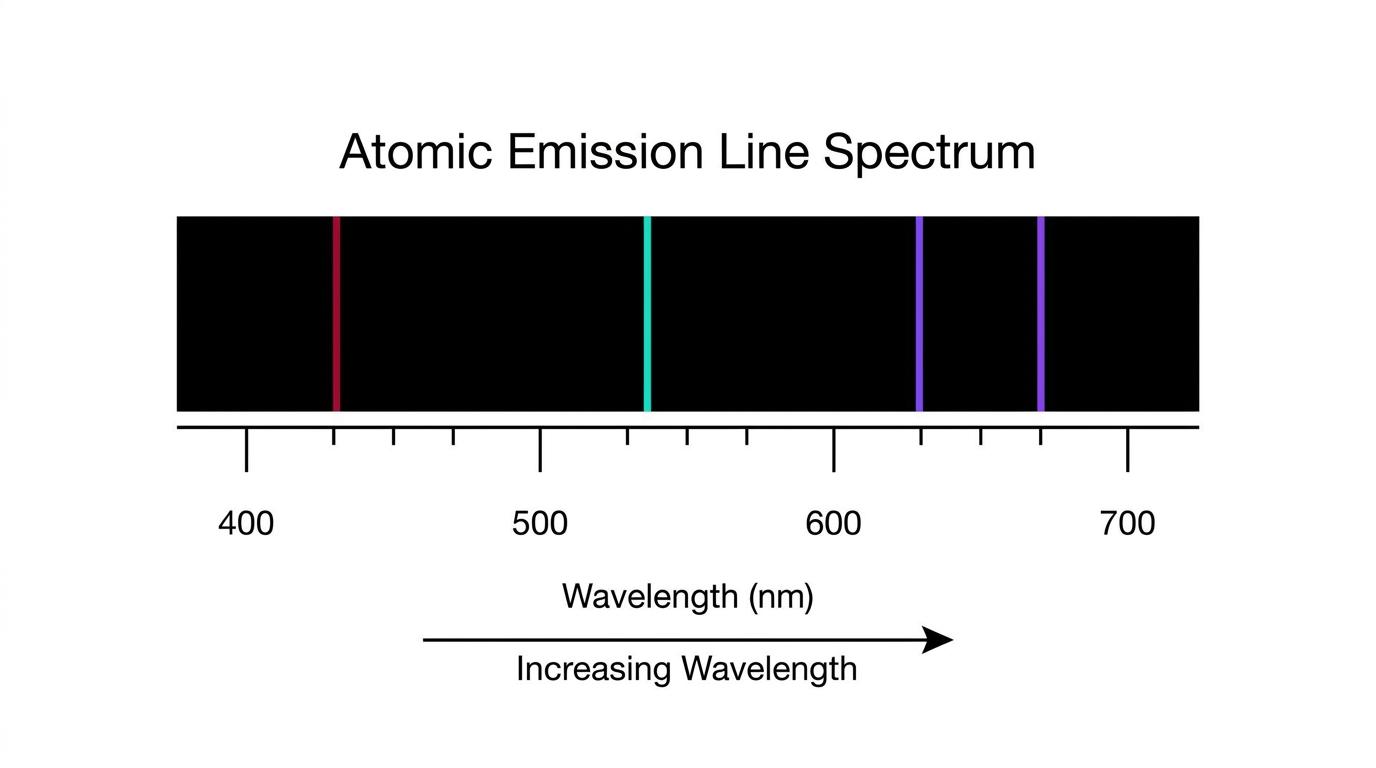
Each distinct colored line corresponds to a photon of a specific wavelength (and therefore a specific frequency and energy).
Because the energy of the emitted photon exactly matches the energy difference between two levels (hf=E1−E2hf = E_1 - E_2hf=E1−E2), the fact that we only see specific colors proves that only specific energy gaps exist within the atom.
Confusing continuous and line spectra
A hot glowing solid (like a filament bulb) produces a continuous spectrum (a full rainbow) because its atoms are packed closely together, blurring their energy levels. Only hot, low-pressure gases produce line emission spectra, because their atoms are isolated and the distinct energy levels are preserved.
If an atom could have any amount of energy, it would be able to emit photons of any energy, and we would see a continuous smear of colors. The line spectrum is the ultimate visual proof of the quantum ladder. Every element has its own unique set of energy levels, meaning every element has its own unique "fingerprint" line spectrum.
In the exam
- Check the units immediately. If the y-axis of an energy level diagram is in eV, multiply the gaps by 1.60×10−191.60 \times 10^{-19}1.60×10⁻¹⁹ before using E=hfE = hfE=hf or E=hcλE = \frac{hc}{\lambda}E=λhc.
- Don't be thrown by negative energy values. The energy of a photon must be positive. Just subtract the more negative number from the less negative number to find the gap size.
- If an AQA question asks you to "explain how the emission line spectrum provides evidence for discrete energy levels", your logical flow should be: specific lines →\rightarrow→ specific wavelengths/frequencies →\rightarrow→ specific photon energies (E=hfE=hfE=hf) →\rightarrow→ specific energy gaps (E1−E2E_1 - E_2E1−E2) →\rightarrow→ discrete energy levels.
Check yourself
- What is the difference between an atom in its ground state and an atom in an excited state?
- Why does a transition from n=4n=4n=4 to n=2n=2n=2 emit a photon with a higher frequency than a transition from n=3n=3n=3 to n=2n=2n=2?
- By what number do you multiply an energy value in eV to convert it into J?