Welcome to the final piece of the medical physics puzzle: radioactive implants. By now, you know how radiation can be used externally to image the body or destroy tumours. But what if we could bring the treatment inside the patient?
In this topic, what you'll learn:
- What "brachytherapy" is and how it delivers internal radiotherapy.
- Why beta emitters are the ideal choice of radiation for these implants.
- How to apply the radioactive decay equations to calculate treatment times and doses.
Bringing the Treatment Inside
External beam radiotherapy is highly effective, but it has a major drawback: the radiation must pass through healthy tissue to reach the tumour. Even when beams are rotated around the patient to spread out the collateral damage, healthy cells are still irradiated.
Medical physicists solve this by using brachytherapy (from the Greek brachy, meaning "short distance").
Brachytherapy
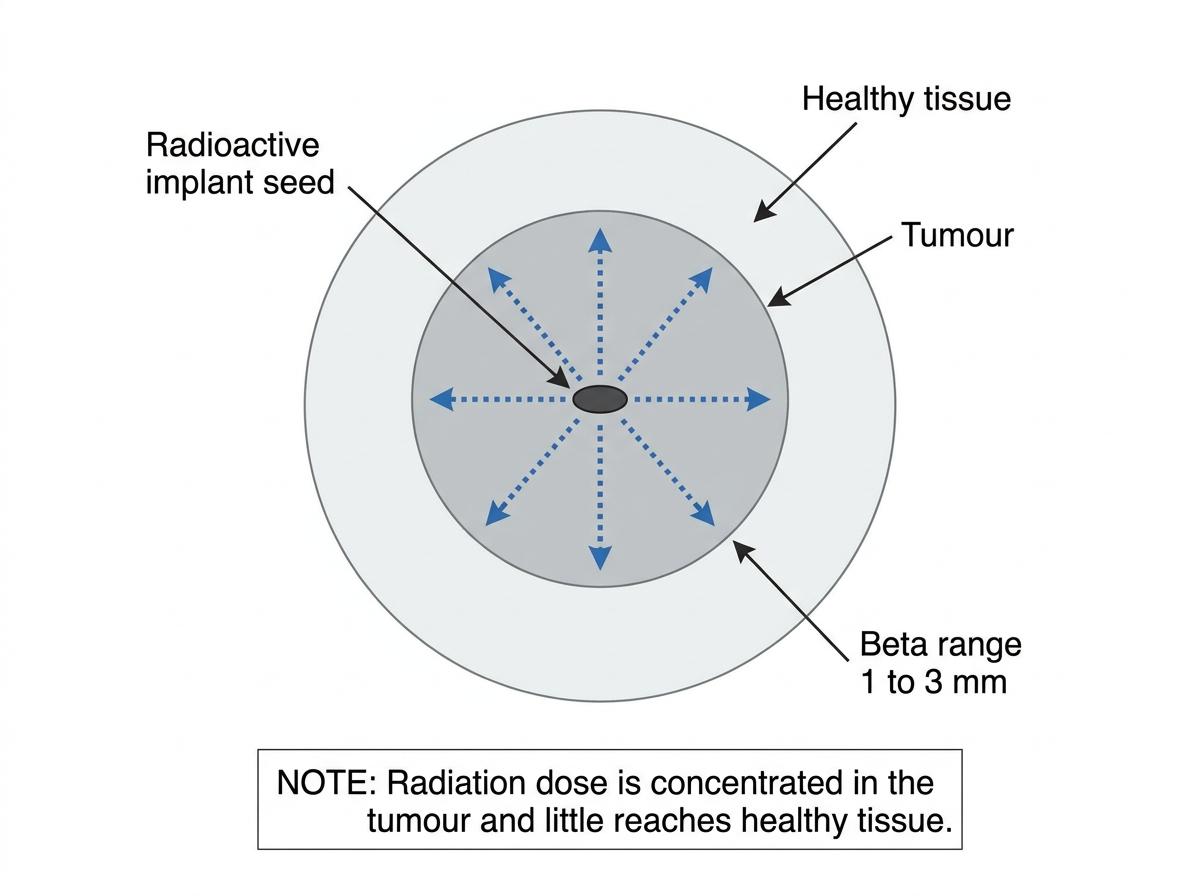
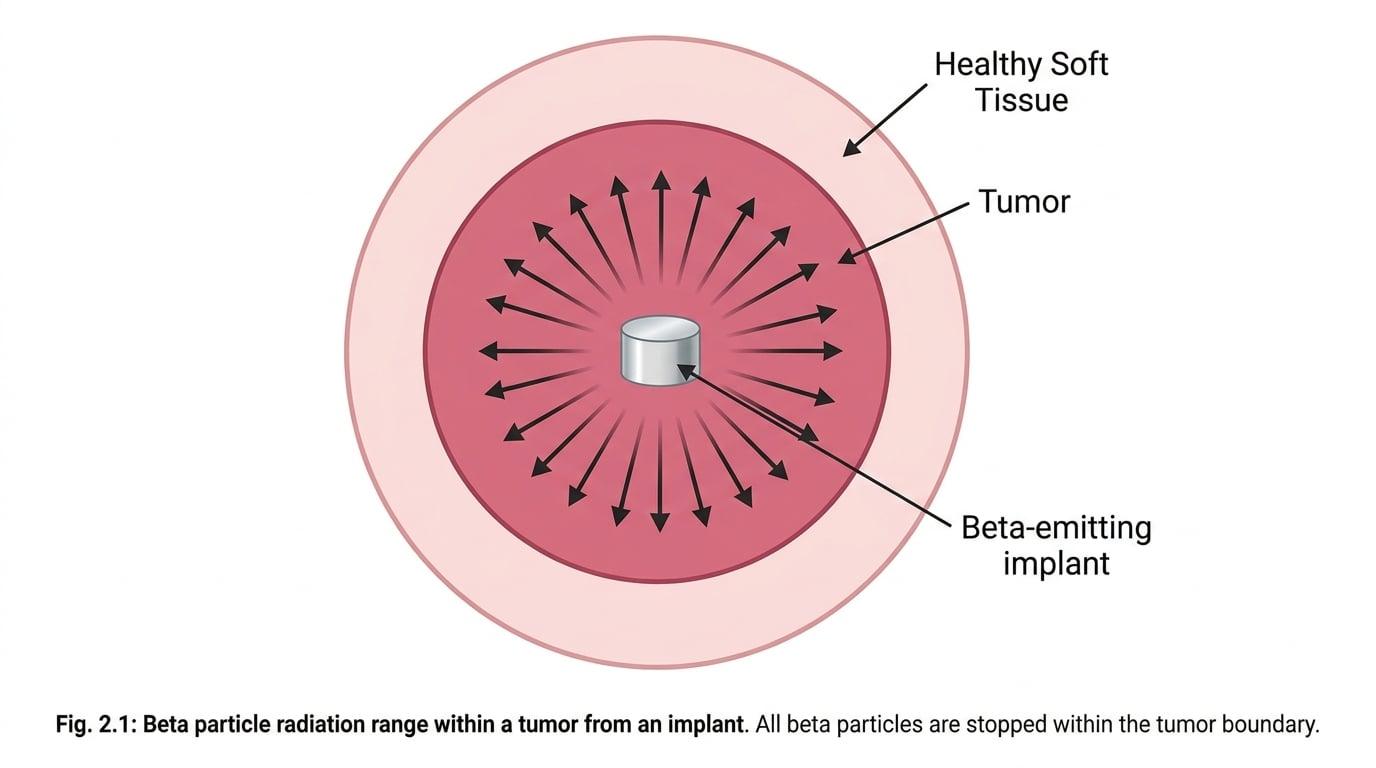
Brachytherapy is a form of internal radiotherapy where sealed radioactive sources (often called "seeds" or "implants") are placed directly inside or immediately next to a tumour.
These implants are tiny—often the size of a grain of rice. They consist of a radioactive isotope sealed inside a biologically inert casing, such as titanium. The casing prevents the radioactive material from leaking into the bloodstream while allowing the emitted radiation to pass through and irradiate the surrounding cancer cells.
Why Beta Emitters?
The AQA specification specifically requires you to understand the use of beta-emitting implants. To understand why beta particles (β−\beta^{-}β− or β+\beta^{+}β+) are chosen, we have to compare their properties against alpha (α\alphaα) and gamma (γ\gammaγ) radiation.
The primary goal of any cancer treatment is to maximize damage to the tumour while minimizing damage to healthy tissue.
The Goldilocks Radiation
Beta particles are the "Goldilocks" choice for implants because of their range:
- Moderately ionising: They have enough ionising power to effectively damage the DNA of cancer cells, causing them to die.
- Short range in tissue: They can only travel a few millimetres (typically 1 mm1 \text{ mm}1 mm to 3 mm3 \text{ mm}3 mm) through soft tissue. This means all their kinetic energy is deposited directly into the tumour, and healthy cells just outside the tumour are spared.
Let's quickly look at why we don't usually use the other types of radiation for sealed implants:
- Why not Alpha? Alpha particles are highly ionising but have a microscopic range in tissue (fractions of a millimetre). They would either be completely absorbed by the metal casing of the implant itself, or they would only kill the single layer of cells touching the implant, leaving the rest of the tumour untouched.
- Why not Gamma? Gamma rays are highly penetrating. If you put a gamma emitter inside a tumour, most of the high-energy photons would pass straight through the tumour, out through the healthy tissue, and even out of the patient's body entirely. This would irradiate healthy organs and pose a radiation hazard to medical staff and family members.
Confusing ionising power with suitability
Students often write "alpha is not used because it is too dangerous/too ionising". This is technically incorrect for an exam. The main reason alpha is unsuitable for sealed implants is its lack of penetrating power—it cannot treat the whole volume of the tumour because its range is too short.
Choosing the Right Half-life
The isotope used inside the implant must be carefully chosen based on its half-life (T1/2T_{1/2}T1/2).
When an implant is left in the body permanently (as is common for prostate cancer treatments), the isotope needs a half-life that balances two factors:
- It must be long enough so that the implant doesn't lose all its activity before it can be manufactured, transported to the hospital, and surgically inserted.
- It must be short enough so that the radiation dose is delivered reasonably quickly, and the patient doesn't remain significantly radioactive for the rest of their life.
Commonly used isotopes include Yttrium-90 (a pure beta emitter with a half-life of 64 hours64 \text{ hours}64 hours). Because the half-life is relatively short, the activity drops to safe background levels after a few weeks, meaning the inactive titanium seeds can safely be left inside the patient permanently.
Working with the Decay Equation
Because brachytherapy relies on the natural decay of an isotope over days or weeks, you are frequently asked to use the radioactive decay equations:
A=A0e−λt A = A_0 e^{-\lambda t} A=A0e−λt T1/2=ln2λ T_{1/2} = \frac{\ln 2}{\lambda} T1/2=λln2Let's look at how AQA might test this in a written paper.
Calculating treatment time
An implant containing Yttrium-90 is placed inside a solid tumour. Yttrium-90 is a beta emitter with a half-life of 64 hours64 \text{ hours}64 hours. The initial activity of the implant is 4.5×10⁶ Bq4.5 \times 10^6 \text{ Bq}4.5×10⁶ Bq.
Calculate the time taken, in days, for the activity of the implant to fall to a safe level of 1.0×10⁵ Bq1.0 \times 10^5 \text{ Bq}1.0×10⁵ Bq.
- First, calculate the decay constant λ\lambdaλ. We can keep the time unit in hours for now:
- Next, write down the exponential decay equation and rearrange it to make time (ttt) the subject:
- Substitute the values for activity to find the time in hours:
- Finally, convert the time from hours into days (by dividing by 242424):
Unit matching
In the decay equation A=A0e−λtA = A_0 e^{-\lambda t}A=A0e−λt, the units of λ\lambdaλ and ttt must always match. If λ\lambdaλ is in h−1\text{h}^{-1}h−1, then ttt will come out in hours. You don't always have to convert to seconds, provided you are careful to convert to the requested unit (like days) at the very end.
In the exam
When answering long-form written questions comparing internal beta implants to external beam therapies:
- Always state the physical properties of the radiation: "Beta particles have a short range in soft tissue (1–3 mm)."
- Link the property to the clinical outcome: "...meaning the radiation energy is entirely absorbed by the tumour."
- State the benefit to the patient: "...which prevents damage to the surrounding healthy tissue."
- If comparing to gamma, explicitly state that gamma is highly penetrating and would pass out of the tumour, reducing the targeted dose and exposing healthy tissue.
Check yourself
- Why are alpha sources unsuitable for use in sealed radioactive implants?
- What is the typical range of a beta particle in human soft tissue?
- If a radioactive seed has a half-life of 5 days, what fraction of its original activity remains after 15 days?