A historical physics group is recreating classic 17th and 19th-century optical experiments to compare Isaac Newton's corpuscular model against Christiaan Huygens' wave model of light.
Initially, in Setup A, the group projects a parallel beam of red light towards a screen containing two relatively wide, widely spaced vertical slits, as shown in the diagram.
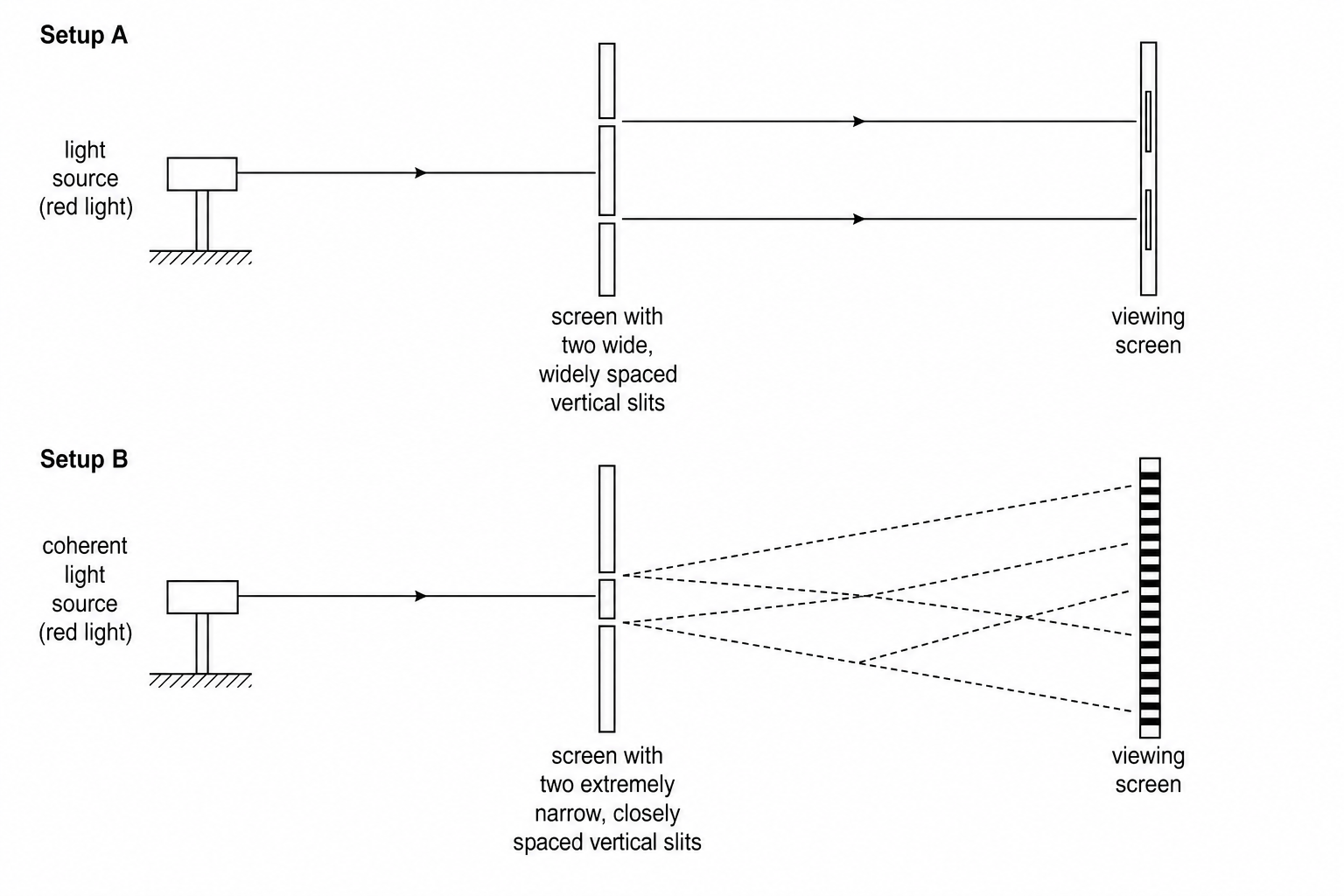
Describe the pattern observed on the viewing screen in Setup A, and explain how this observation supports Newton's corpuscular theory of light.
The group then modifies the apparatus as shown in Setup B, resulting in an interference pattern consisting of alternating red and dark fringes of equal width.
Explain the modifications required to transition from Setup A to Setup B, and explain how the wave theory of Huygens accounts for this pattern.
In your answer, you should:

