Transmission media (A-level only)
Welcome to the physics of getting a message from point A to point B. Whether you are downloading a video on your phone or sending an email across the Atlantic, the data has to travel through a physical medium.
What you'll learn in this topic:
- The three main types of transmission media: metal wires, optic fibres, and electromagnetic waves.
- How radio waves travel around the Earth using ground waves, sky waves, and space waves.
- Why satellite systems use different frequencies for uploading and downloading data.
- How to compare different media based on data rate, cost, and security.
The Three Main Transmission Paths
In data communications, a "transmission medium" is the physical pathway that carries the signal. We can split these into three broad categories:
- Metal wire: such as copper twisted-pair cables or coaxial cables. They transmit data as pulses of electrical voltage or alternating currents.
- Optic fibre: thin strands of glass that transmit data as pulses of light or infrared radiation.
- Electromagnetic (wireless): using radio waves or microwaves to broadcast signals through the air or the vacuum of space without any physical cables.
While cables are fairly straightforward—the signal follows the physical path you lay down—wireless transmission is much more complex. How do radio waves travel between continents if the Earth is curved and electromagnetic waves normally travel in straight lines?
Electromagnetic Wave Propagation
When we transmit an electromagnetic wave from an antenna, the path it takes depends heavily on its frequency (and therefore its wavelength). There are three primary ways these waves propagate over long distances.
1. Ground Waves
Ground waves are electromagnetic waves with very long wavelengths (typically radio frequencies below 3 MHz3 \text{ MHz}3 MHz).
Because their wavelength is so large—often hundreds of metres—they experience significant diffraction when they encounter large objects. This diffraction allows ground waves to bend around hills, buildings, and, crucially, the curvature of the Earth itself. They literally "hug" the ground, making them excellent for local and regional broadcasting (like AM radio), though they are absorbed by the Earth's surface over very long distances.
2. Sky Waves
If you increase the frequency to between 3 MHz3 \text{ MHz}3 MHz and 30 MHz30 \text{ MHz}30 MHz (known as short-wave radio), the wavelength becomes too short to diffract effectively around the Earth. Instead, these waves travel upwards into the sky.
High above the Earth is the ionosphere, a layer of the atmosphere ionized by solar radiation. When sky waves enter the ionosphere, they are refracted. Because the refractive index of the ionosphere changes with altitude and electron density, the wave bends so much that it undergoes total internal reflection and bounces back down to Earth. This reflection and refraction allow sky waves to bounce between the ionosphere and the ground, enabling over-the-horizon, global communication.
3. Space Waves (Line of sight)
For frequencies above 30 MHz30 \text{ MHz}30 MHz (like microwaves used for Wi-Fi, mobile phones, and satellite TV), the wavelength is too short for both diffraction around the Earth and reflection by the ionosphere.
These waves pass straight through the atmosphere and into space. Therefore, the transmitter and receiver must have a direct line of sight. If there is a mountain or the curve of the Earth in the way, the signal is blocked. To communicate over long distances using microwaves, we must use tall masts or beam the signals up to satellites.
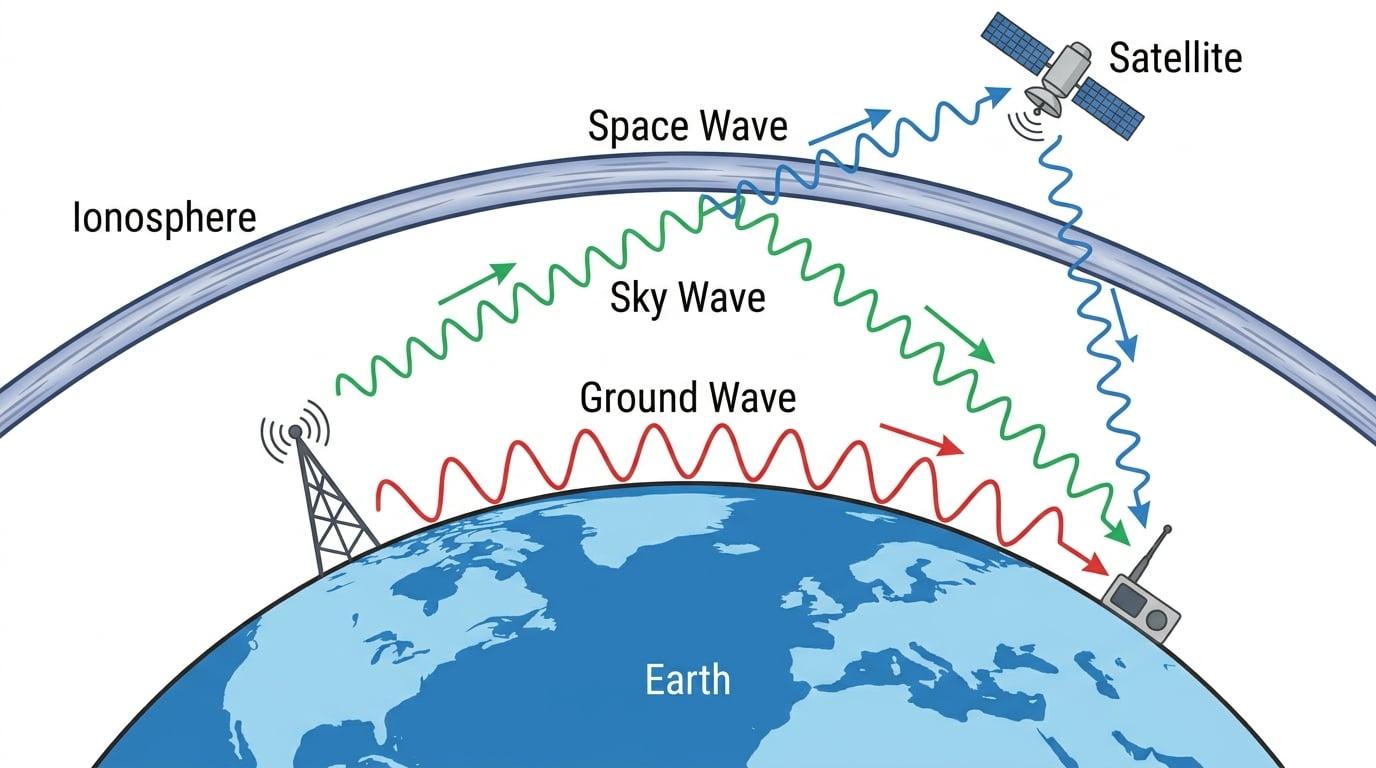
Wavelength determines the path
The path an electromagnetic wave takes depends on its physics:
- Long wavelength: Diffracts around the Earth's surface (Ground wave).
- Medium wavelength: Refracts and reflects off the ionosphere (Sky wave).
- Short wavelength: Passes straight through into space (Space wave).
Satellite Systems and Frequencies
Because microwaves pass straight through the ionosphere, they are perfectly suited for satellite communications. Typical transmission frequencies for satellites are in the gigahertz range (e.g., 1 GHz1 \text{ GHz}1 GHz to 300 GHz300 \text{ GHz}300 GHz).
When communicating with a satellite, the earth station beams a signal up, and the satellite beams a signal back down.
- The uplink is the signal sent from Earth to the satellite.
- The downlink is the signal sent from the satellite back to Earth.
De-sensing
De-sensing (or desensitisation) occurs when a very strong transmitted signal swamps a nearby receiver, making it unable to detect a much weaker incoming signal.
Satellites have to receive a tiny, weak signal from Earth while simultaneously transmitting a powerful signal back down. If the uplink and downlink used the same frequency, the satellite's own transmission would completely overwhelm its sensitive receiver—it would deafen itself.
To prevent this, the uplink and downlink must require different frequencies.
Often, the uplink uses a higher frequency than the downlink. Higher frequencies suffer more attenuation (energy loss) as they pass through the atmosphere, but an earth station has access to grid electricity and can transmit at very high power. The satellite, relying on solar panels, has limited power, so it uses a lower frequency for the downlink to minimise signal loss on the way back.
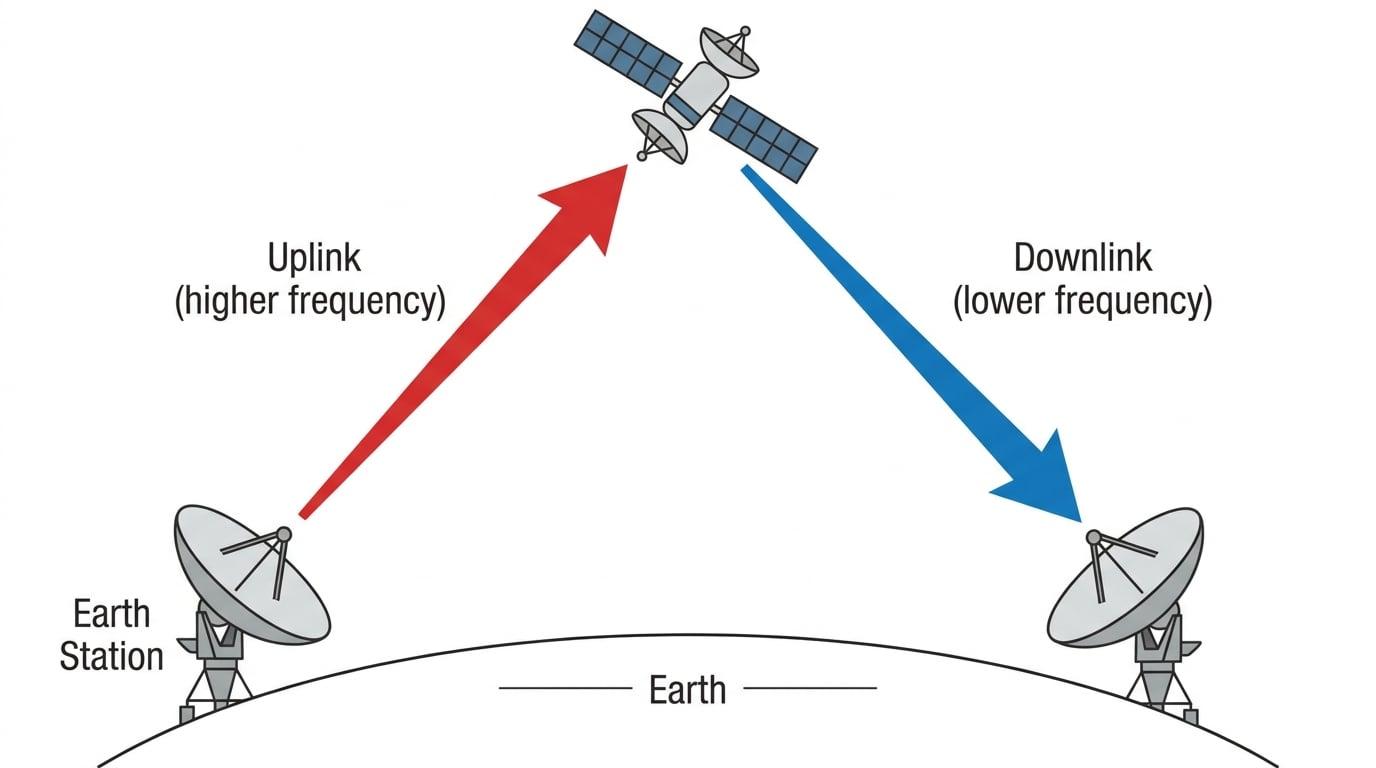
Explaining satellite frequency choices
An exam question might ask: "A geostationary satellite receives a microwave signal from an Earth station and transmits it to a different location. Explain why the transmitting and receiving aerials on the satellite must operate at different frequencies."
- The satellite must transmit and receive signals simultaneously.
- The transmitted signal is very powerful, while the received signal from Earth is very weak.
- If they operated at the same frequency, the powerful transmitted signal would overwhelm the receiver.
- Using different frequencies prevents the receiver from being de-sensed.
Advantages and Disadvantages of Transmission Media
When designing a communication system, engineers must choose between metal wires, optic fibres, and electromagnetic wireless links. You need to be able to compare them based on three specific criteria: data transmission rate, cost, and security.
1. Data Transmission Rate (Bandwidth)
The maximum rate at which data can be sent is proportional to the frequency of the carrier wave.
- Optic fibres: Use visible/infrared light, which has an incredibly high frequency (around 1014 Hz10^{14} \text{ Hz}1014 Hz). Therefore, optic fibres offer the highest data transmission rates and can carry many thousands of channels simultaneously.
- Metal wires: Have a much lower bandwidth. Twisted-pair cables (like old telephone lines) are the slowest. Coaxial cables are better but still fall far short of optic fibre.
- Electromagnetic: Varies. Microwaves offer high data rates, while lower-frequency radio waves offer very low data rates.
2. Cost
- Metal wires: Very cheap to manufacture and easy to install over short distances.
- Optic fibres: The cables themselves have become cheaper, but the equipment required to send, receive, and splice the light signals is expensive. Installing long-distance underground cables requires major infrastructure investment.
- Electromagnetic: Extremely cost-effective for difficult terrain (like mountains or oceans) because you do not need to lay a physical cable across the entire distance—you only need to build a transmitter and a receiver.
3. Security
- Optic fibres: The most secure. The signal is completely contained within the glass core by total internal reflection. Tapping the cable requires physically cutting into it, which immediately drops the light level and alerts the operators.
- Metal wires: Less secure. Electrical signals traveling through copper create tiny electromagnetic fields around the wire, which can be detected and "tapped" without physically cutting the wire.
- Electromagnetic: The least secure. The signal is broadcast openly into the air or space. Anyone with a receiver tuned to the correct frequency can intercept the transmission, meaning the data must be heavily encrypted.
Selecting a transmission medium
A hospital wants to securely link its main server to a new research building 2 km2 \text{ km}2 km away. They need to transfer huge amounts of high-resolution MRI image data quickly. Evaluate whether they should use a microwave link or an optic fibre cable.
- Data rate: Both can provide high data rates, but an optic fibre offers the maximum possible transmission rate, which is ideal for large image files.
- Security: Medical data requires strict confidentiality. An optic fibre is highly secure as it cannot be easily tapped without detection. A microwave link is broadcast through the air and could be intercepted, requiring complex encryption.
- Cost: An underground optic fibre will be expensive to install (digging trenches over 2 km2 \text{ km}2 km). A microwave link would be cheaper as it only requires a dish on each building.
- Conclusion: Given the strict security requirements and the need for massive data transfer, optic fibre is the better choice despite the higher installation cost.
In the exam
- When asked about radio propagation, explicitly link the physical phenomenon to the wave: state that ground waves diffract and sky waves refract (or undergo total internal reflection in the ionosphere).
- The term "de-sensed" is specifically named in the AQA specification. If an exam question asks why satellite uplinks and downlinks use different frequencies, using the word "de-sensing" (or explaining that the receiver would be swamped) will earn you the mark.
- When comparing media, avoid vague words like "better" or "faster". Be specific: use terms like "higher data transmission rate", "more expensive infrastructure", or "easier to intercept".
Check yourself
- Which type of radio wave relies on diffraction to travel over long distances?
- Why do sky waves bounce back down to Earth, and what layer of the atmosphere makes this possible?
- If a satellite used the same frequency to receive and transmit, what problem would occur?
- Why is an optic fibre considered more secure than a copper wire?