Time dilation (A-level only)
What you'll learn:
- The difference between proper time and dilated time.
- How to use the time dilation equation to calculate time intervals for moving observers.
- How the decay of cosmic ray muons provides real-world experimental evidence for special relativity.
Classical physics, heavily influenced by Isaac Newton, taught us that time is an absolute, universal ticking clock. A second for you is a second for me, regardless of what we are doing. Special relativity shatters this idea. According to Einstein, time is relative: it passes at different rates depending on how fast you are moving.
Proper Time vs. Dilated Time
To understand relativity, we must define exactly who is measuring a time interval. The key is to look at the events that start and stop the "clock".
Proper time ()
Proper time is the time interval between two events measured by an observer who is at rest relative to those events.
Crucially, in the proper time frame, the two events occur at the exact same location in space. Think of it as the time measured by a clock that is present at both the start and end of the event.
If you watch someone else moving at a very high speed (close to the speed of light, ccc), and you measure a time interval between two events happening in their spaceship, you will measure a different, longer time.
Dilated time ()
Dilated time is the time interval between two events measured by an observer who is moving relative to the events.
In this frame of reference, the two events occur at different locations in space.
Moving clocks run slow
If you observe a clock moving past you at high speed, you will measure it ticking more slowly than your own stationary clock. This effect is called time dilation.
Visualising time dilation: The Light Clock
To understand why time dilates, physicists use a thought experiment called a light clock. Imagine a clock made of two parallel mirrors with a photon of light bouncing up and down between them. One full up-and-down bounce is one "tick".
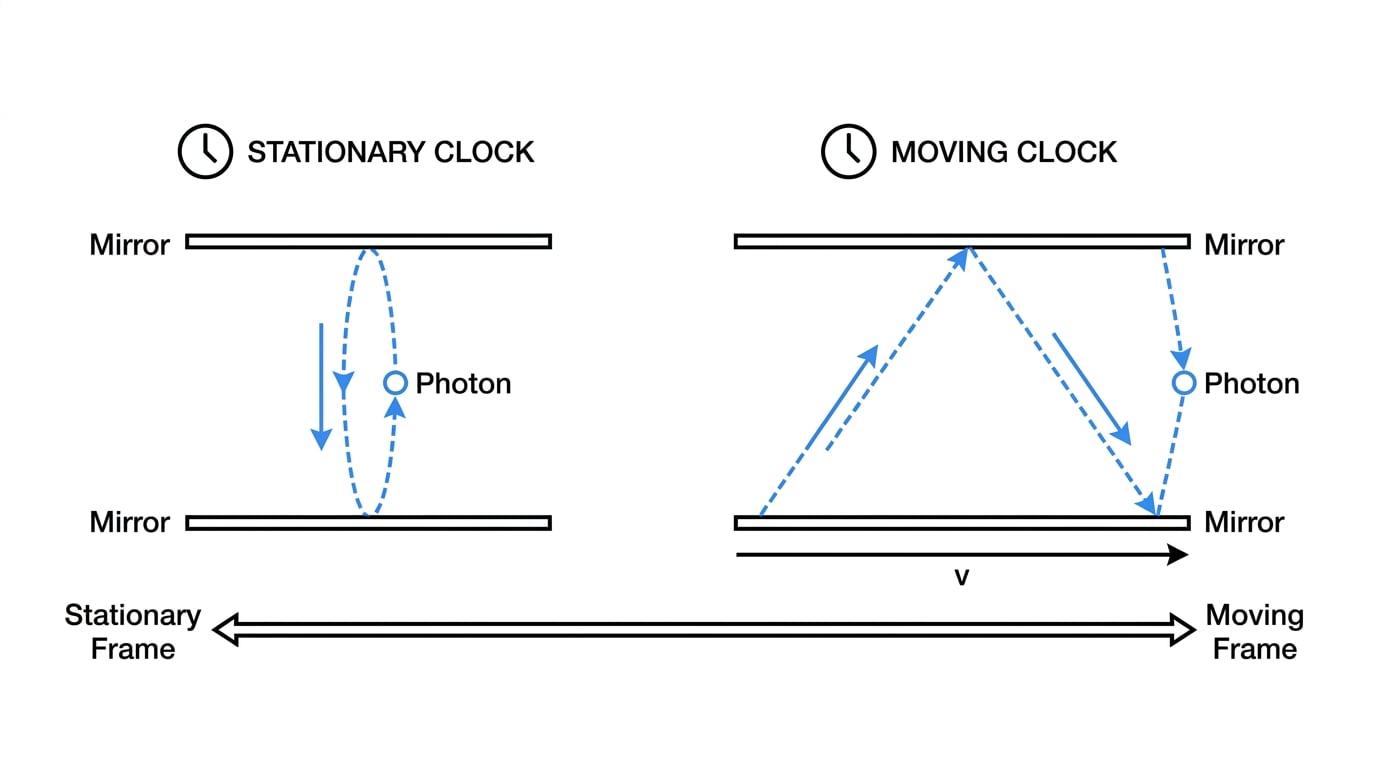
If the clock is stationary relative to you, the light travels straight up and straight down. This measures the proper time, t0t_0t0.
If the clock is moving to the right at velocity vvv, the light must travel in a diagonal zig-zag path to hit the mirrors. The diagonal path is longer than the straight up-and-down path.
Because one of Einstein's postulates states that the speed of light, ccc, is absolutely constant for all observers, the light moving on the longer diagonal path must take more time to complete one tick. Therefore, the moving clock ticks slower!
The Time Dilation Equation
The geometry of the light clock's diagonal path gives us the mathematical formula for time dilation. You don't need to derive it for the exam, but you do need to be able to use it flawlessly:
t=t01−v2c2 t = \frac{t_0}{\sqrt{1 - \frac{v^2}{c^2}}} t=1−c2v2t0Where:
- ttt is the dilated time (in seconds, s\text{s}s)
- t0t_0t0 is the proper time (in seconds, s\text{s}s)
- vvv is the velocity of the moving object relative to the observer (in m s−1\text{m s}^{-1}m s−1)
- ccc is the speed of light in a vacuum (3.00×10⁸ m s−13.00 \times 10^8 \text{ m s}^{-1}3.00×10⁸ m s−1)
Because vvv is always less than ccc, the fraction v2c2\frac{v^2}{c^2}c2v2 is always between 000 and 111. This means the denominator 1−v2c2\sqrt{1 - \frac{v^2}{c^2}}1−c2v2 is always less than 111. Dividing by a number smaller than 111 means that ttt is always greater than t0t_0t0.
Swapping t and t₀
The single most common error in relativity exams is plugging the given time into the wrong side of the equation. Always ask yourself: "In whose frame of reference do the start and end events happen at the same place?" That person measures proper time, t0t_0t0.
Calculating time dilation for a fast spaceship
A spaceship passes Earth at a constant velocity of 0.85c0.85c0.85c. An astronaut on the ship measures exactly 12.0 s12.0 \text{ s}12.0 s for a computer process to complete. Calculate the time taken for this process as measured by an observer on Earth.
- Identify proper and dilated time: The computer process starts and stops inside the spaceship. To the astronaut, the computer isn't moving—the events happen in the same place. So, the astronaut measures the proper time: t0=12.0 st_0 = 12.0 \text{ s}t0=12.0 s. The Earth observer is moving relative to the computer, so they measure the dilated time, ttt.
- State the values:
- t0=12.0 st_0 = 12.0 \text{ s}t0=12.0 s
- v=0.85cv = 0.85cv=0.85c (Notice we can leave ccc in the expression, it will cancel out!)
- Substitute into the time dilation equation:
- Cancel ccc and calculate:
- Sanity check: 22.8 s>12.0 s22.8 \text{ s} > 12.0 \text{ s}22.8 s>12.0 s. The moving clock runs slower, so the process takes longer when observed from Earth. This makes sense.
Evidence from Muon Decay
Time dilation sounds like science fiction, but we observe it every day in particle physics. The classic piece of experimental evidence required by the AQA specification is muon decay.
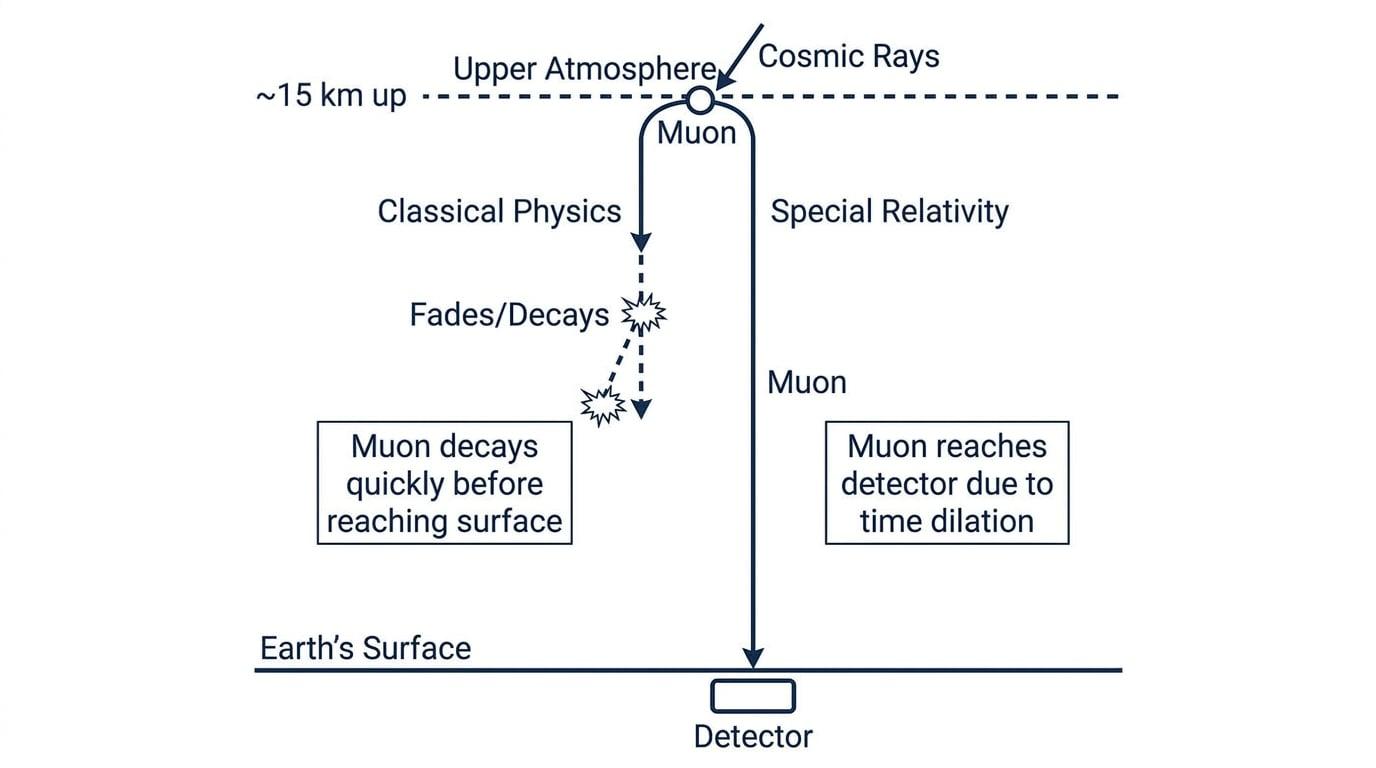
Muons are fundamental particles (like heavy, unstable electrons). They are created about 15 km15 \text{ km}15 km up in the Earth's upper atmosphere when highly energetic cosmic rays smash into air molecules. Muons travel downwards towards the surface at speeds very close to the speed of light, typically around 0.99c0.99c0.99c to 0.996c0.996c0.996c.
However, muons are unstable. When measured at rest in a laboratory, they have a very short mean lifetime of about 2.2×10⁻⁶ s2.2 \times 10^{-6} \text{ s}2.2×10⁻⁶ s (or 2.2μs2.2 \mu\text{s}2.2μs).
The Classical Prediction vs. The Relativistic Reality
If we use purely classical, non-relativistic physics, we would predict that almost no muons should reach the surface of the Earth.
If a muon travels at 0.99c0.99c0.99c for its lifetime of 2.2μs2.2 \mu\text{s}2.2μs, the distance it can cover is:
d=v×t=(0.99×3.00×108)×(2.2×10−6)≈650 m d = v \times t = (0.99 \times 3.00 \times 10^8) \times (2.2 \times 10^{-6}) \approx 650 \text{ m} d=v×t=(0.99×3.00×108)×(2.2×10−6)≈650 mSince they are created 15 000 m15\,000 \text{ m}15000 m up, they should all decay long before hitting the ground.
But detectors on the ground measure huge numbers of muons! How do they survive the trip?
The answer is time dilation.
The 2.2μs2.2 \mu\text{s}2.2μs lifetime is the muon's proper time (t0t_0t0), because in the muon's own frame of reference, it is at rest. But to an observer on Earth, the muon is hurtling downwards at 0.99c0.99c0.99c. According to relativity, the muon's internal "clock" runs incredibly slowly compared to Earth's clocks. Its dilated lifetime (ttt), as measured by us, is much longer, giving it plenty of time to reach the ground.
Proving muon survival mathematically
A muon is created in the upper atmosphere and travels straight downwards at a velocity of 0.994c0.994c0.994c. Its mean lifetime at rest is 2.20×10⁻⁶ s2.20 \times 10^{-6} \text{ s}2.20×10⁻⁶ s. Calculate the mean distance the muon travels, as measured by an observer on Earth, before it decays.
- Identify proper time: The mean lifetime at rest is the proper time. t0=2.20×10⁻⁶ st_0 = 2.20 \times 10^{-6} \text{ s}t0=2.20×10⁻⁶ s
- Calculate the dilated time (ttt) for the Earth observer:
- Calculate the distance travelled in the Earth's frame: The Earth observer sees the muon travelling at v=0.994cv = 0.994cv=0.994c for a time of t=2.01×10⁻⁵ st = 2.01 \times 10^{-5} \text{ s}t=2.01×10⁻⁵ s.
- Conclusion: Thanks to time dilation, the muon's effective lifetime is nearly 10 times longer in the Earth's frame, allowing it to travel almost 6 km6 \text{ km}6 km rather than just a few hundred metres.
Handling velocities given as fractions of c
If a question gives velocity as a fraction of ccc (e.g., v=0.9cv = 0.9cv=0.9c), you don't need to substitute 3.00×10⁸ m s−13.00 \times 10^8 \text{ m s}^{-1}3.00×10⁸ m s−1 into the time dilation equation. When you square 0.9c0.9c0.9c, you get 0.81c20.81c^20.81c2. The c2c^2c2 top and bottom will neatly cancel out, leaving just 1−0.81\sqrt{1 - 0.81}1−0.81. This drastically reduces calculator errors!
In the exam
- Be rigorous with t0t_0t0 vs ttt: Always pause before calculating and state explicitly which frame measures proper time. Remember: proper time t0t_0t0 requires the start and end events to be at the same physical location in that observer's frame.
- Watch your calculator rounding: The term 1−v2c2\sqrt{1 - \frac{v^2}{c^2}}1−c2v2 is very sensitive when vvv is close to ccc. Do not round intermediate steps. Keep the full number in your calculator memory until the final answer.
- Learn the muon story: "Evidence for time dilation from muon decay" is explicitly named in the spec. Be ready to write a 3 or 4-mark prose explanation describing how classical mechanics fails to explain the amount of muons reaching the surface, and how time dilation extends their lifetime in the Earth observer's frame.
Check yourself
- Can you define proper time and explain how it differs from dilated time?
- If a particle travels at 0.8c0.8c0.8c, what happens to the c2c^2c2 terms when calculating the denominator of the time dilation formula?
- Why do significantly more muons reach the Earth's surface than classical physics predicts?