Einstein's theory of special relativity (A-level only)
What you'll learn in this topic:
- What a "frame of reference" is, and specifically what makes a frame inertial.
- Einstein's First Postulate: why physical laws work exactly the same way in all inertial frames.
- Einstein's Second Postulate: why the speed of light in a vacuum is absolute and unchanging, regardless of how fast you are moving.
Before diving into time dilation and length contraction (the famous mathematical consequences of relativity), we must lay out the rules of the game. Einstein built his entire theory of special relativity on just two fundamental assumptions, known as postulates. To understand them, we first need to understand how we measure motion.
Frames of Reference
When you say a car is moving at 30 m s−130 \text{ m s}^{-1}30 m s−1, you are implying a background against which that motion is measured. Usually, that background is the road (the Earth). A frame of reference is simply a set of coordinates—effectively a 3D grid and a clock—that an observer uses to measure the position and time of events.
Imagine you are standing on a station platform watching a train go by. You are in the "platform frame of reference". A passenger sitting on the train is in the "train frame of reference". To you, the passenger is moving forward at velocity vvv. To the passenger, you are moving backwards at velocity vvv. Neither of you is "wrong"—motion is entirely relative.
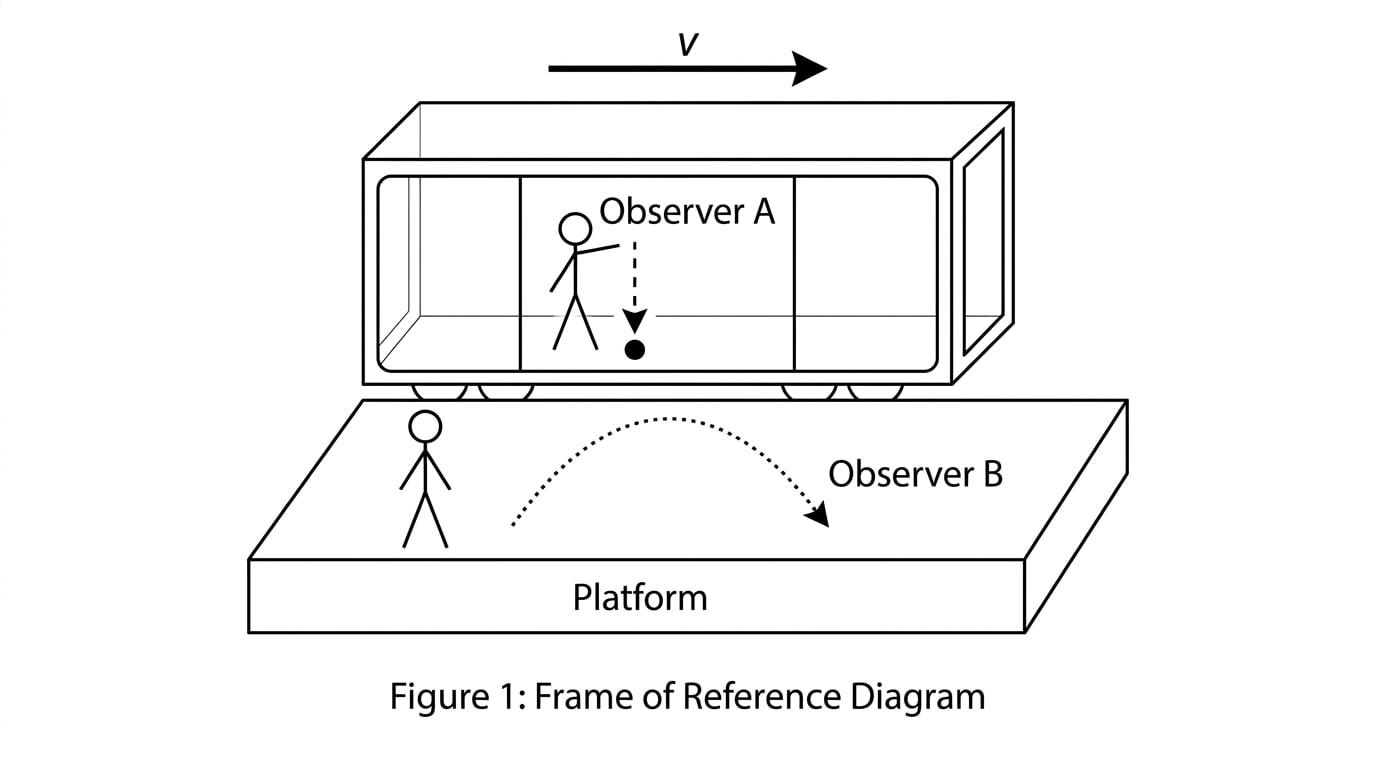
Inertial Frames of Reference
Einstein's theory of special relativity is "special" because it only applies to a specific, restricted set of reference frames: inertial frames.
An inertial frame is one that is not accelerating. If you are sitting in a train carriage moving at a perfectly constant speed in a perfectly straight line, you are in an inertial frame. If the train suddenly slams on the brakes or goes around a sharp corner, you are accelerating—your frame is now non-inertial, and special relativity no longer strictly applies.
Inertial frame of reference
An inertial frame of reference is a frame of reference that is moving at a constant velocity (or is at rest) relative to another inertial frame. In an inertial frame, Newton's first law of motion holds true: objects at rest stay at rest, and objects in motion stay in motion, unless acted upon by a resultant force.
Is the Earth an inertial frame?
Strictly speaking, the surface of the Earth is not an inertial frame of reference. Because the Earth is rotating on its axis and orbiting the Sun, an observer on the surface is constantly changing direction, and therefore accelerating. However, because this acceleration is very small, we usually approximate the Earth's surface as an inertial frame for most A-Level physics problems.
The First Postulate
In 1905, Albert Einstein published his theory based on two simple, yet profound, statements.
The first postulate extends Galileo's original ideas about relative motion to cover all of physics, not just mechanics.
The First Postulate
Physical laws have the same form in all inertial frames of reference.
What does this mean in practice? Imagine you are inside a windowless train carriage moving at a perfectly constant 200 m s−1200 \text{ m s}^{-1}200 m s−1 along a perfectly smooth track. The first postulate states that absolutely no experiment you can perform inside that carriage will tell you whether you are moving or stationary.
If you drop a ball, it accelerates straight down at 9.81 m s−29.81 \text{ m s}^{-2}9.81 m s−2, exactly as it would if the train were parked. If you measure the charge on an electron, or the resonant frequency of a circuit, you will get the exact same results as someone doing the experiment on the ground. Absolute motion does not exist; you can only ever measure your speed relative to something else.
The Second Postulate
The second postulate is where Einstein broke away from classical physics. It deals with light.
Before Einstein, physicists believed that light waves must travel through an invisible medium called the "aether", just as sound waves travel through air. If that were true, moving towards a light beam would mean you hit the waves faster, measuring a higher speed of light. Einstein argued that the aether doesn't exist, and that light behaves completely counter-intuitively.
The Second Postulate
The speed of light in free space is invariant.
Notice the word invariant. It doesn't just mean "constant" (not changing over time); it means that the speed of light, ccc, is measured to be exactly the same by all observers, regardless of their own motion or the motion of the light source.
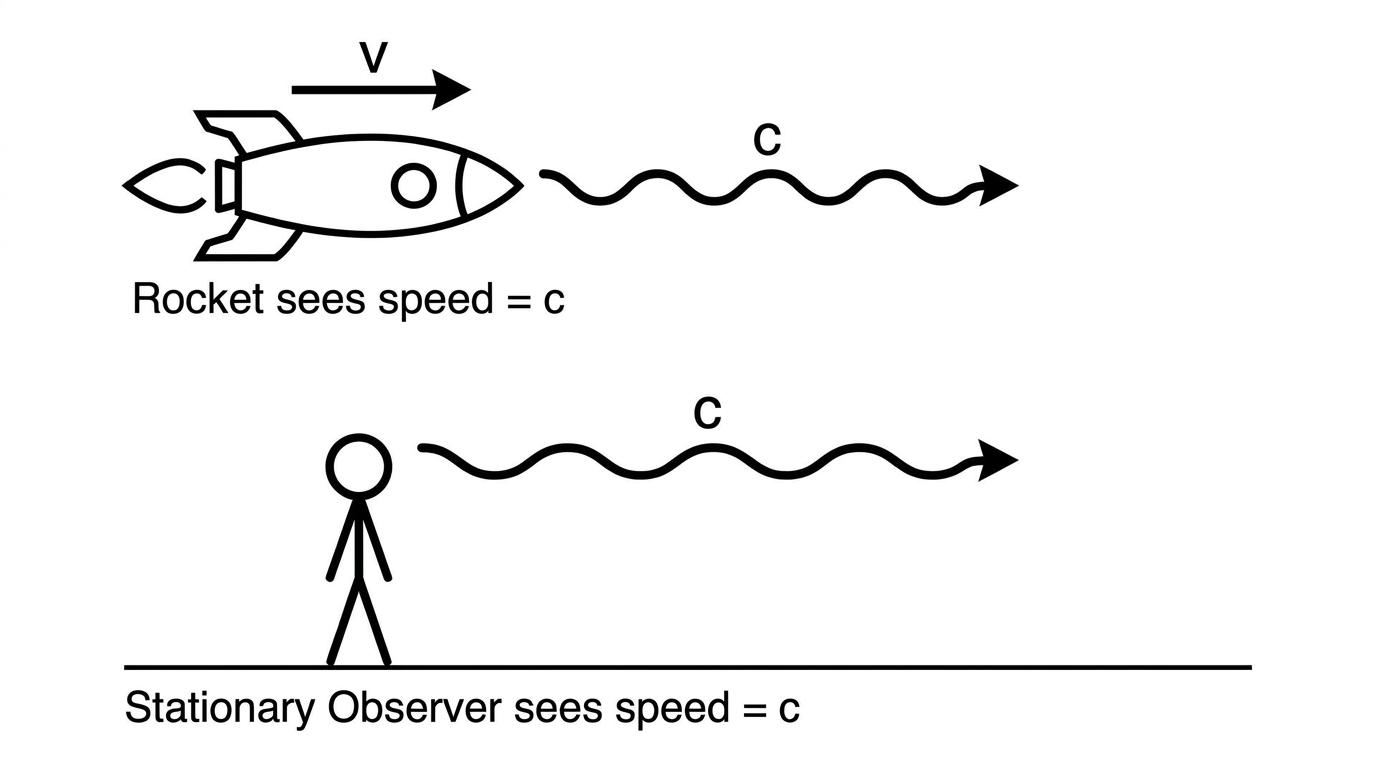
Imagine a spaceship flying towards Earth at half the speed of light (0.5c0.5c0.5c). It turns on a forward-facing headlight.
- Classical (Galilean) physics says: An observer on Earth should see the light approaching at 1.5c1.5c1.5c (the speed of the ship plus the speed of the light).
- Special Relativity says: The observer on Earth measures the light moving at exactly c≈3.00×10⁸ m s−1c \approx 3.00 \times 10^8 \text{ m s}^{-1}c≈3.00×10⁸ m s−1. The pilot of the spaceship also measures the light leaving their ship at exactly ccc.
Don't just say 'constant'
In AQA exams, defining the second postulate by saying "the speed of light is constant" will often lose you the mark. You must specify that it is invariant (or "constant for all observers") and that it applies to light in "free space" (a vacuum).
To make this bizarre rule work—where speed (distance divided by time) is identical for everyone—Einstein realised that distance and time themselves must change depending on how fast you are moving. That realisation is the foundation for the rest of this topic!
Worked Example
Applying the Postulates
Question: A distant galaxy is moving away from the Earth at a constant velocity of 0.2c0.2c0.2c. A supernova in the galaxy emits a flash of light towards Earth.
- State what is meant by an inertial frame of reference. (1 mark)
- State the two postulates of Einstein's theory of special relativity. (2 marks)
- Calculate the speed at which the light from the supernova approaches the Earth, as measured by an astronomer on Earth. Explain your answer. (2 marks)
Answer:
- An inertial frame of reference is a frame in which Newton's first law is obeyed (a frame moving at a constant velocity with no acceleration).
- The two postulates are:
- Physical laws have the same form in all inertial frames of reference.
- The speed of light in free space is invariant.
- The speed of the light approaching Earth is exactly ccc (or 3.00×10⁸ m s−13.00 \times 10^8 \text{ m s}^{-1}3.00×10⁸ m s−1).
- This is due to Einstein's second postulate, which states that the speed of light in a vacuum is independent of the motion of the source or the observer.
In the exam
- Memorise the definitions word-for-word: This sub-topic relies entirely on exact definitions. Learn the precise AQA phrasing for both postulates and the definition of an inertial frame.
- Watch out for 'free space': When stating the second postulate, remember to include the phrase "in free space" (or "in a vacuum"). Light does slow down when it enters glass or water (as you know from refraction), so the postulate specifically applies to empty space.
- Beware of simple addition: If an exam question asks you for the relative speed of a light beam from a moving source, do not fall into the trap of adding or subtracting the source's velocity from ccc. The answer is always ccc.
Check yourself
- Can you explain why a train braking at a station is not an inertial frame of reference?
- If you were inside a perfectly sealed, smoothly flying aircraft, why wouldn't you be able to tell how fast you were flying just by doing an experiment? Which postulate tells you this?
- A particle accelerator fires a proton at 0.9c0.9c0.9c. The proton emits a photon forward. What speed does a stationary scientist measure for that photon? What speed does the proton 'measure' for the photon?