Length contraction (A-level only)
What you'll learn
- How moving objects appear shorter to stationary observers.
- The definition of "proper length" and how to identify it in exam questions.
- How to use the length contraction formula to calculate relative speeds and lengths.
- Why length contraction only ever happens in the direction of motion.
When we studied time dilation, we saw that time is not absolute—it flows differently depending on how fast you are moving. Because speed is just distance divided by time, if observers disagree on time, they must also disagree on distance in order to keep the speed of light constant. This leads us to length contraction.
The Concept of Proper Length
Before we can calculate how much an object shrinks, we need to know its original length. In special relativity, we call this the proper length.
Proper Length
The proper length, denoted by the symbol l0l_0l0, is the length of an object measured by an observer who is at rest relative to the object.
If you are sitting inside a spaceship with a tape measure, you and the spaceship are in the same reference frame (you are at rest relative to each other). The length you measure is the proper length l0l_0l0.
If someone on Earth watches your spaceship fly past at a high speed, they will measure your spaceship to be shorter than l0l_0l0. This effect is called length contraction.
The Golden Rule of Length Contraction
Moving objects are always measured to be shorter than their proper length. The faster an object moves past you, the shorter it appears.
The Length Contraction Formula
To calculate exactly how much shorter an object appears, we use the length contraction formula. This is provided in your AQA formula booklet:
l=l01−v2c2l = l_0 \sqrt{1 - \frac{v^2}{c^2}}l=l01−c2v2Where:
- lll is the contracted length (the length measured by the observer watching the object move).
- l0l_0l0 is the proper length (the length measured at rest relative to the object).
- vvv is the relative velocity between the observer and the object.
- ccc is the speed of light in a vacuum (3.00×10⁸ m s−13.00 \times 10^8 \text{ m s}^{-1}3.00×10⁸ m s−1).
Let's look at the mathematics of the formula. Because no object with mass can travel at or faster than the speed of light, the term v2c2\frac{v^2}{c^2}c2v2 is always a fraction less than 1. Therefore, the square root term is always less than 1. When you multiply the proper length l0l_0l0 by a number less than 1, the result lll is always smaller.
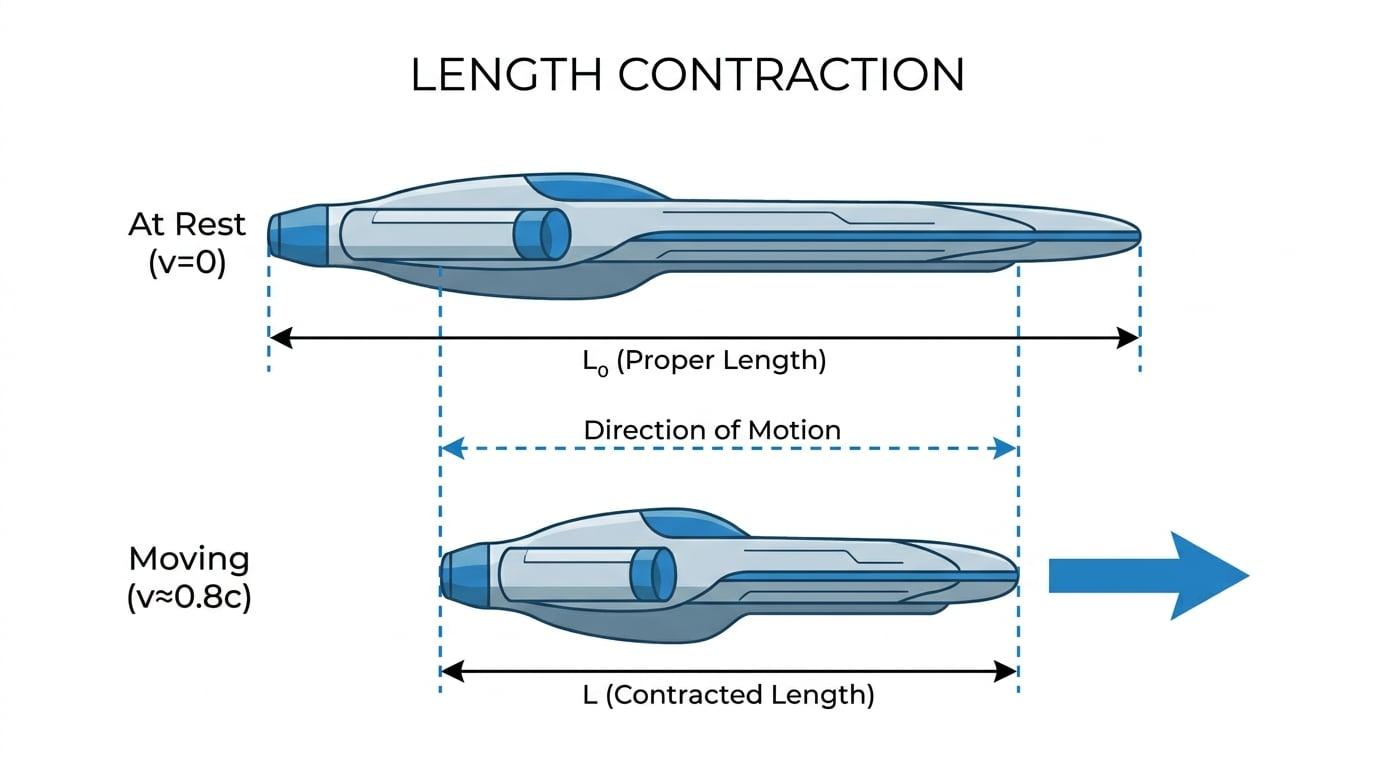
Direction matters
Length contraction is 1D. An object only contracts parallel to its direction of motion. If a rocket is travelling horizontally, it gets shorter from nose to tail, but its vertical height and width remain completely unchanged!
Calculating Contracted Length
Let's see how this works in a typical straightforward exam scenario.
Calculating the length of a moving spaceship
A futuristic racing spacecraft has a proper length of 150 metres. It flies past a space station at a speed of 0.80c0.80c0.80c. Calculate the length of the spacecraft as measured by an observer on the space station.
- Identify the variables: The proper length (measured at rest) is l0=150 ml_0 = 150 \text{ m}l0=150 m. The speed is v=0.80cv = 0.80cv=0.80c. We want to find the contracted length lll.
- Write down the formula: l=l01−v2c2l = l_0 \sqrt{1 - \frac{v^2}{c^2}}l=l01−c2v2
- Substitute the values: Because the speed is given as a multiple of ccc, the c2c^2c2 terms will cancel beautifully. l=1501−(0.80c)2c2l = 150 \sqrt{1 - \frac{(0.80c)^2}{c^2}}l=1501−c2(0.80c)2
- Square the velocity term: l=1501−0.64c2c2l = 150 \sqrt{1 - \frac{0.64c^2}{c^2}}l=1501−c20.64c2
- Cancel c2c^2c2 and simplify: l=1501−0.64l=1500.36l=150×0.60\begin{aligned} l &= 150 \sqrt{1 - 0.64} \\ l &= 150 \sqrt{0.36} \\ l &= 150 \times 0.60 \end{aligned}lll=1501−0.64=1500.36=150×0.60
- Calculate the final answer: l=90 ml = 90 \text{ m}l=90 m The observer on the space station measures the spacecraft to be 90 metres long.
Mixing up lengths
The most common error in relativistic calculations is swapping lll and l0l_0l0. Always ask yourself: "Who is moving relative to the object?" The observer who sees the object moving measures lll. The observer riding along with the object measures l0l_0l0.
Working Backwards: Finding the Speed
Often in the AQA exam, you will be given both the proper length and the contracted length, and you will be asked to calculate the speed vvv. This requires some careful algebraic rearrangement.
Calculating speed from length contraction
A student observes a passing subatomic particle. In the particle's rest frame, its path through a detector is 2.50 metres long. The student measures the path length to be only 1.25 metres due to length contraction. Calculate the speed of the particle as a fraction of ccc.
- Identify the variables: The detector is at rest relative to the student, but the particle sees the detector moving. From the particle's perspective, the path is moving, so it measures the contracted length l=1.25 ml = 1.25 \text{ m}l=1.25 m. The proper length of the path (measured by the student at rest relative to the detector) is l0=2.50 ml_0 = 2.50 \text{ m}l0=2.50 m.
- Set up the equation: l=l01−v2c2l = l_0 \sqrt{1 - \frac{v^2}{c^2}}l=l01−c2v2
- Substitute the knowns: 1.25=2.501−v2c21.25 = 2.50 \sqrt{1 - \frac{v^2}{c^2}}1.25=2.501−c2v2
- Divide both sides by l0l_0l0: 1.252.50=1−v2c20.50=1−v2c2\begin{aligned} \frac{1.25}{2.50} &= \sqrt{1 - \frac{v^2}{c^2}} \\ 0.50 &= \sqrt{1 - \frac{v^2}{c^2}} \end{aligned}2.501.250.50=1−c2v2=1−c2v2
- Square both sides to remove the square root: 0.25=1−v2c20.25 = 1 - \frac{v^2}{c^2}0.25=1−c2v2
- Rearrange to solve for v2c2\frac{v^2}{c^2}c2v2: v2c2=1−0.25v2c2=0.75\begin{aligned} \frac{v^2}{c^2} &= 1 - 0.25 \\ \frac{v^2}{c^2} &= 0.75 \end{aligned}c2v2c2v2=1−0.25=0.75
- Square root to find vvv: v=0.75c≈0.866cv = \sqrt{0.75} c \approx 0.866cv=0.75c≈0.866c The particle is travelling at approximately 0.87c0.87c0.87c.
The Muon Problem: Two Perspectives
You have likely already studied the atmospheric muon decay problem in the context of time dilation. Length contraction offers a second, equally valid way to explain the exact same phenomenon!
Muons are created in the upper atmosphere, roughly 15 km above the Earth's surface. They travel towards the ground at speeds very close to ccc (e.g., 0.99c0.99c0.99c). Their half-life is so short that, according to classical physics, almost none should reach the ground. Yet, we detect them in abundance.
- Earth Observer's Perspective (Time Dilation): We see the muons moving very fast. Therefore, we observe their "clocks" running slowly. They live long enough to cross the 15 km distance.
- Muon's Perspective (Length Contraction): In the muon's frame of reference, it is completely stationary. It sees the Earth and its atmosphere rushing upwards at 0.99c0.99c0.99c. Because the atmosphere is moving relative to the muon, the 15 km distance is length contracted to a much shorter distance (perhaps only 2 km). The muon doesn't need to live longer; it just has less distance to cross!
Both perspectives are physically valid and lead to the exact same conclusion: the muon reaches the ground.
Time goes up, length goes down
If you ever get confused about which way the relativistic effects go: Moving clocks tick slower (so the time measured ttt gets bigger compared to proper time t0t_0t0). Moving objects shrink (so the length measured lll gets smaller compared to proper length l0l_0l0).
In the exam
- Check your "fraction of ccc": When substituting speeds like 0.6c0.6c0.6c into the equation, remember that squaring it gives 0.36c20.36c^20.36c2, not 0.6c20.6c^20.6c2.
- Watch for multi-step questions: A classic 4-mark question involves using kinetic energy to find the velocity vvv, and then using that vvv to calculate the length contraction.
- Use the "sanity check": Before you move on to the next question, look at your answers. Your calculated contracted length lll must always be smaller than the proper length l0l_0l0. If it's bigger, you've divided by the square root instead of multiplying!
Check yourself
- If a perfectly spherical asteroid moves past Earth at 0.8c0.8c0.8c, what 3D shape does an Earth observer see?
- Why is it impossible for a moving object to appear longer than its proper length?
- A fast train travels through a station. Who measures the proper length of the train: a passenger on the train, or a person standing on the platform?