Thermionic emission of electrons (A-level only)
What you'll learn
- How heating a metal filament allows electrons to escape its surface.
- How an "electron gun" uses electric fields to accelerate these free electrons into a beam.
- How to calculate the final speed of an accelerated electron by equating electrical work done to kinetic energy.
You already know from the photoelectric effect that electrons can be freed from a metal surface if you give them enough energy via photons. But light isn't the only way to provide that energy. In this topic, we will look at how heat can do the exact same job, and how we can then manipulate those free electrons.
What is thermionic emission?
In a metal, conduction electrons are free to move around the atomic lattice, but they are trapped inside the metal itself. To escape the surface, an electron must overcome the attractive forces of the positive metal ions. The minimum energy required to do this is called the work function of the metal.
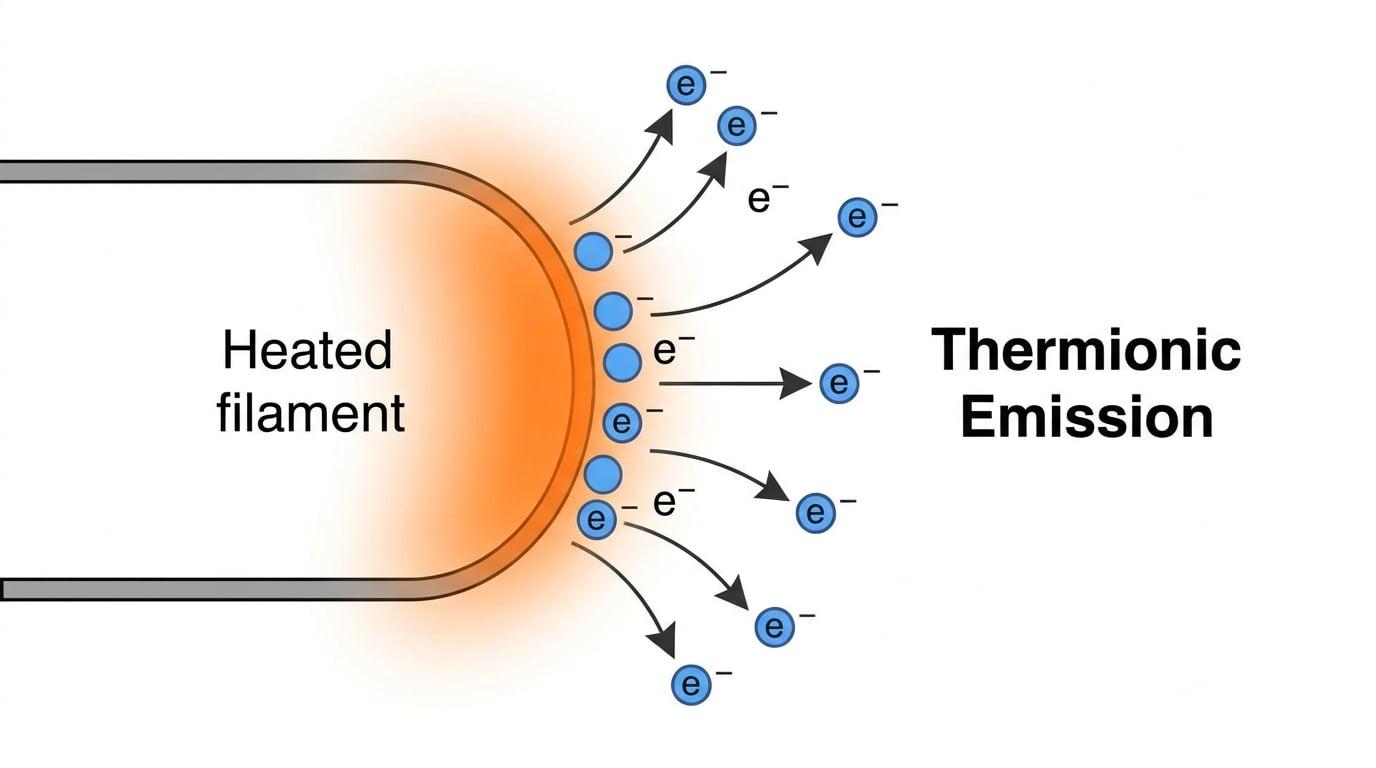
If we pass an electric current through a thin piece of metal wire (a filament), the wire gets very hot. The thermal energy increases the kinetic energy of the free electrons inside the metal. If the wire gets hot enough, some electrons near the surface will gain enough kinetic energy to overcome the work function and break free entirely.
Thermionic Emission
Thermionic emission is the release of electrons from the surface of a heated metal.
Boiling water
Think of thermionic emission like boiling a pan of water. At room temperature, the water molecules are moving around but are trapped in the liquid. When you heat the pan, the water molecules gain kinetic energy. Eventually, they gain enough energy to break the bonds holding them in the liquid, escaping as steam. Thermionic emission is "boiling off" electrons from a metal.
The Electron Gun
Once we have "boiled off" a cloud of free electrons, we want to do something useful with them. We can use an electric field to attract them, accelerate them, and fire them in a straight line. The device that does this is called an electron gun.
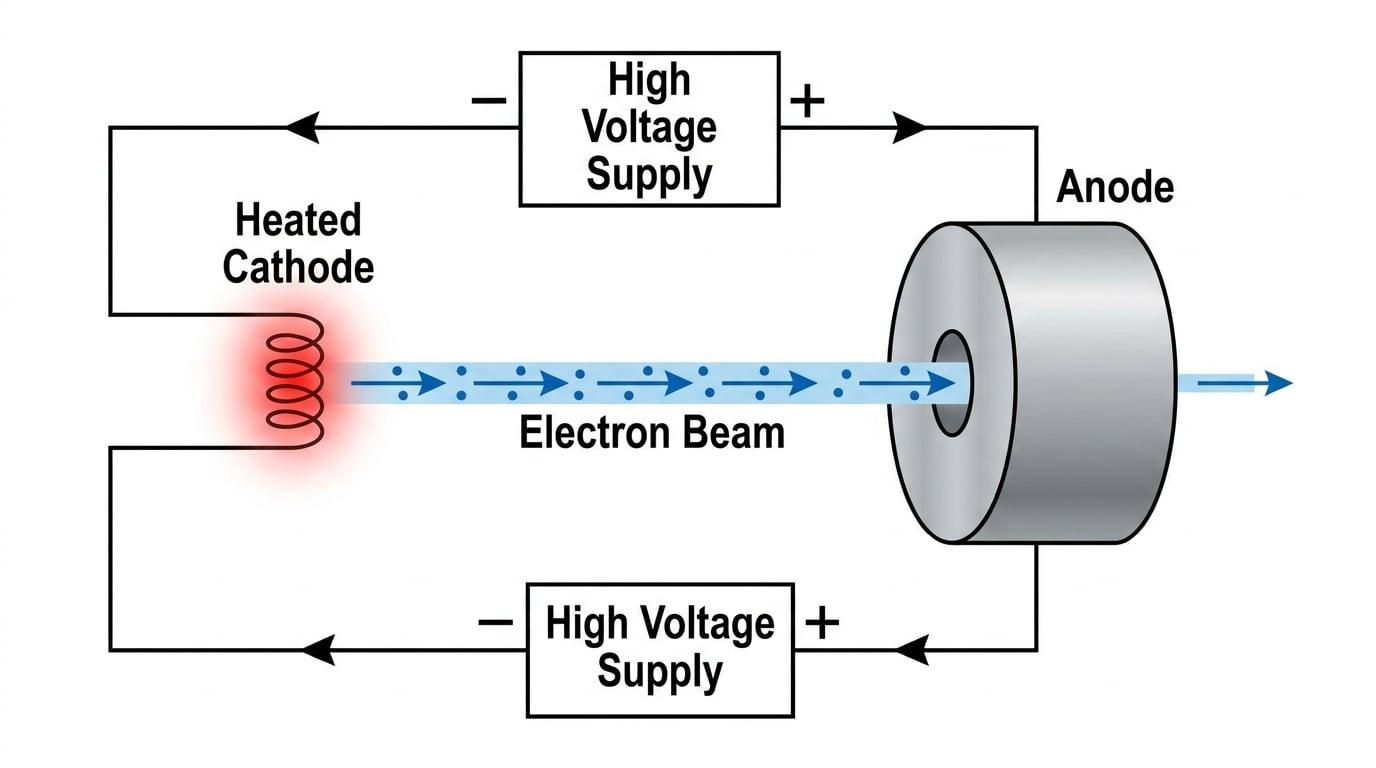
An electron gun consists of two main parts:
- A heated cathode (the negative terminal). This is the filament that gets hot and undergoes thermionic emission to provide a source of free electrons.
- An anode (the positive terminal) placed a short distance away. The anode is typically a metal cylinder or plate with a small hole in the centre.
Because the free electrons are negatively charged, they are strongly repelled by the negative cathode and strongly attracted to the positive anode. They accelerate across the gap between them. Most of the electrons hit the anode, but some shoot straight through the tiny hole in the middle, emerging as a narrow, fast-moving beam of electrons.
Accelerating the electrons
To use an electron beam in experiments (like electron diffraction) or in old cathode-ray tube (CRT) televisions, we need to know exactly how fast the electrons are travelling. We can figure this out using the principle of conservation of energy.
When an electron moves through a potential difference VVV, the electric field does work on it. From your earlier studies of electricity, you know that the work done WWW on a charged particle is:
W=QV \begin{aligned} W = Q V \end{aligned} W=QVFor an electron, the charge QQQ is the elementary charge eee. Therefore, the electrical work done on the electron is eVe VeV.
Assuming the electron starts from rest at the cathode (its initial thermal speed is negligible compared to its final speed), all of this electrical work is transferred into the electron's kinetic energy, EkE_kEk.
Ek=12mv2 \begin{aligned} E_k = \frac{1}{2} m v^2 \end{aligned} Ek=21mv2Equating energies
By equating the electrical work done to the kinetic energy gained, we get the fundamental equation for an electron accelerated from rest:
12mv2=eV \begin{aligned} \frac{1}{2} m v^2 = e V \end{aligned} 21mv2=eVWhere:
- mmm is the mass of an electron (9.11×10⁻³¹ kg9.11 \times 10^{-31} \text{ kg}9.11×10⁻³¹ kg)
- vvv is the final velocity of the electron in m s−1\text{m s}^{-1}m s−1
- eee is the elementary charge (1.60×10⁻¹⁹ C1.60 \times 10^{-19} \text{ C}1.60×10⁻¹⁹ C)
- VVV is the accelerating potential difference in volts (V\text{V}V)
Capital V vs Lowercase v
In the equation 12mv2=eV\frac{1}{2} m v^2 = e V21mv2=eV, it is incredibly easy to mix up the two vvv symbols.
- Capital VVV is Voltage (potential difference).
- Lowercase vvv is velocity.
When writing your working out in an exam, make your capital VVV large and sharp, and your lowercase vvv small and curly to avoid confusing yourself mid-calculation.
Calculating velocity
Let's look at how AQA typically tests this. They will usually give you the accelerating voltage and expect you to calculate the final speed of the electrons. You will need to recall the mass and charge of an electron from your data sheet.
Calculating electron speed
An electron gun accelerates electrons from rest through a potential difference of 3.50 kV3.50 \text{ kV}3.50 kV. Calculate the final speed of the electrons.
- Identify the known variables: The potential difference V=3500 VV = 3500 \text{ V}V=3500 V. From the data sheet, m=9.11×10⁻³¹ kgm = 9.11 \times 10^{-31} \text{ kg}m=9.11×10⁻³¹ kg and e=1.60×10⁻¹⁹ Ce = 1.60 \times 10^{-19} \text{ C}e=1.60×10⁻¹⁹ C.
- State the formula:
- Rearrange to make velocity (vvv) the subject: Multiply both sides by 2 and divide by mmm:
Take the square root:
v=2eVm \begin{aligned} v &= \sqrt{\frac{2 e V}{m}} \end{aligned} v=m2eV- Substitute the values and solve:
Sanity checking your answer
Electrons accelerated in a typical lab electron gun will travel very fast—often between 1×10⁷ m s−11 \times 10^7 \text{ m s}^{-1}1×10⁷ m s−1 and 8×10⁷ m s−18 \times 10^7 \text{ m s}^{-1}8×10⁷ m s−1. If your answer comes out as 3 m s−13 \text{ m s}^{-1}3 m s−1 (too slow) or 5×10¹⁰ m s−15 \times 10^{10} \text{ m s}^{-1}5×10¹⁰ m s−1 (faster than the speed of light!), you have made a calculation error. Go back and check your powers of 10.
What happens at extremely high voltages?
If we keep increasing the accelerating voltage VVV, the equation 12mv2=eV\frac{1}{2} m v^2 = e V21mv2=eV suggests the velocity vvv will just keep increasing without limit. However, Einstein's theory of special relativity tells us that nothing can travel faster than the speed of light in a vacuum (c=3.00×10⁸ m s−1c = 3.00 \times 10^8 \text{ m s}^{-1}c=3.00×10⁸ m s−1).
As an electron's speed approaches the speed of light (usually when vvv gets past about 10%10\%10% of ccc), its mass effectively begins to increase. Because the mass mmm is no longer constant, the simple kinetic energy formula 12mv2\frac{1}{2} m v^221mv2 breaks down.
Relativistic limits
AQA rarely asks you to do relativistic math in this specific sub-topic, but they do like to ask word questions about the limits of the equation. If an exam question asks "Explain why this equation is no longer accurate at an accelerating voltage of 1 MV1 \text{ MV}1 MV", the answer is that the electron's speed approaches the speed of light, relativistic effects become significant, and the mass of the electron increases.
In the exam
- Check the prefixes: Accelerating voltages are frequently given in kV\text{kV}kV (kilovolts) or MV\text{MV}MV (megavolts). Always convert these to plain Volts (10310^3103 or 10610^6106) before substituting into the equation.
- Data sheet dependency: Remember that eee and mem_eme are on your formula and data sheet. You do not need to memorize them, but you do need to know where to find them quickly.
- Show the rearrangement: In multi-mark calculation questions, always write down 12mv2=eV\frac{1}{2} m v^2 = e V21mv2=eV before you start rearranging. If you mess up the algebra, you will still get the first mark for the physics principle.
- Square root: The most common mathematical error in this topic is getting to v2=…v^2 = \dotsv2=… and forgetting to take the square root. Always double-check your final step.
Check yourself
- Can you describe the process of thermionic emission in terms of thermal energy and the work function?
- Why is the anode in an electron gun given a positive potential relative to the cathode?
- Can you write down the equation that links accelerating voltage to final velocity, defining all four symbols?
- If the accelerating voltage in an electron gun is doubled, by what factor does the final velocity of the electrons increase? (Hint: look at the rearranged formula!).