What you'll learn
- How to derive and calculate the specific charge of an electron using the "fine beam tube" method.
- The physical principles that allow us to trap electrons in a visible circular path.
- Why J.J. Thomson's historical measurement of the electron's specific charge was a groundbreaking moment in physics.
- How to compare the specific charge of an electron with that of a hydrogen ion.
A quick refresher on specific charge
You might remember specific charge from the very start of your A-level physics course. It is a fundamental property of any charged particle.
Specific charge
The specific charge of a particle is its ratio of charge to mass. It is calculated by dividing the particle's total charge by its total mass. The unit is coulombs per kilogram (C kg−1\text{C kg}^{-1}C kg−1).
For an electron, the charge is denoted by eee (the elementary charge) and its mass by mem_eme. Therefore, the specific charge of an electron is written as eme\frac{e}{m_e}mee.
Measuring this value experimentally is a classic A-level physics topic. The AQA specification requires you to know one method for determining it. The most common and visual method taught in schools is the fine beam tube.
The Fine Beam Tube Method
A fine beam tube is a specialized piece of equipment used to measure the specific charge of an electron.
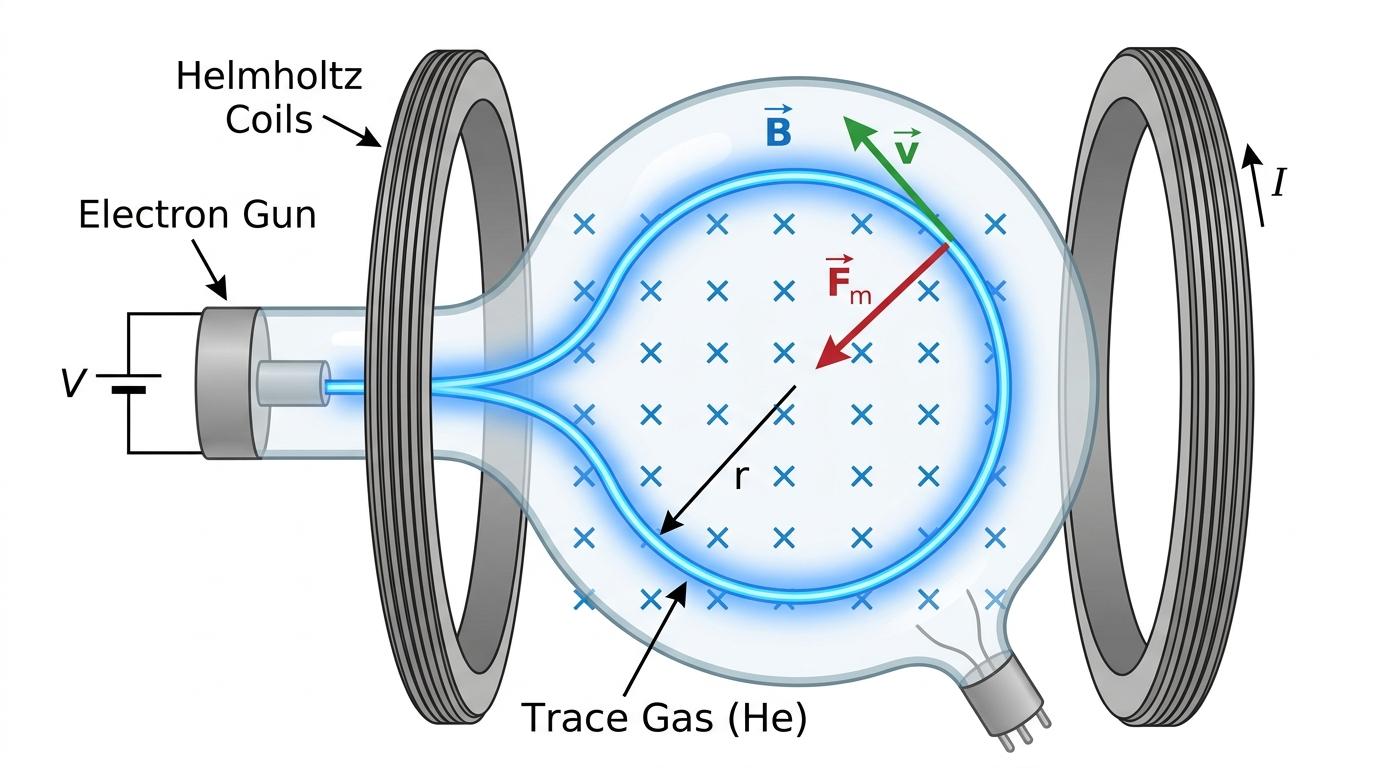
It consists of a glass bulb containing a vacuum with a tiny trace of gas (usually helium or argon) at very low pressure. Inside the bulb is an electron gun. The whole glass bulb is placed between two large magnetic coils (called Helmholtz coils) which create a uniform magnetic field across the bulb.
Here is how the experiment works:
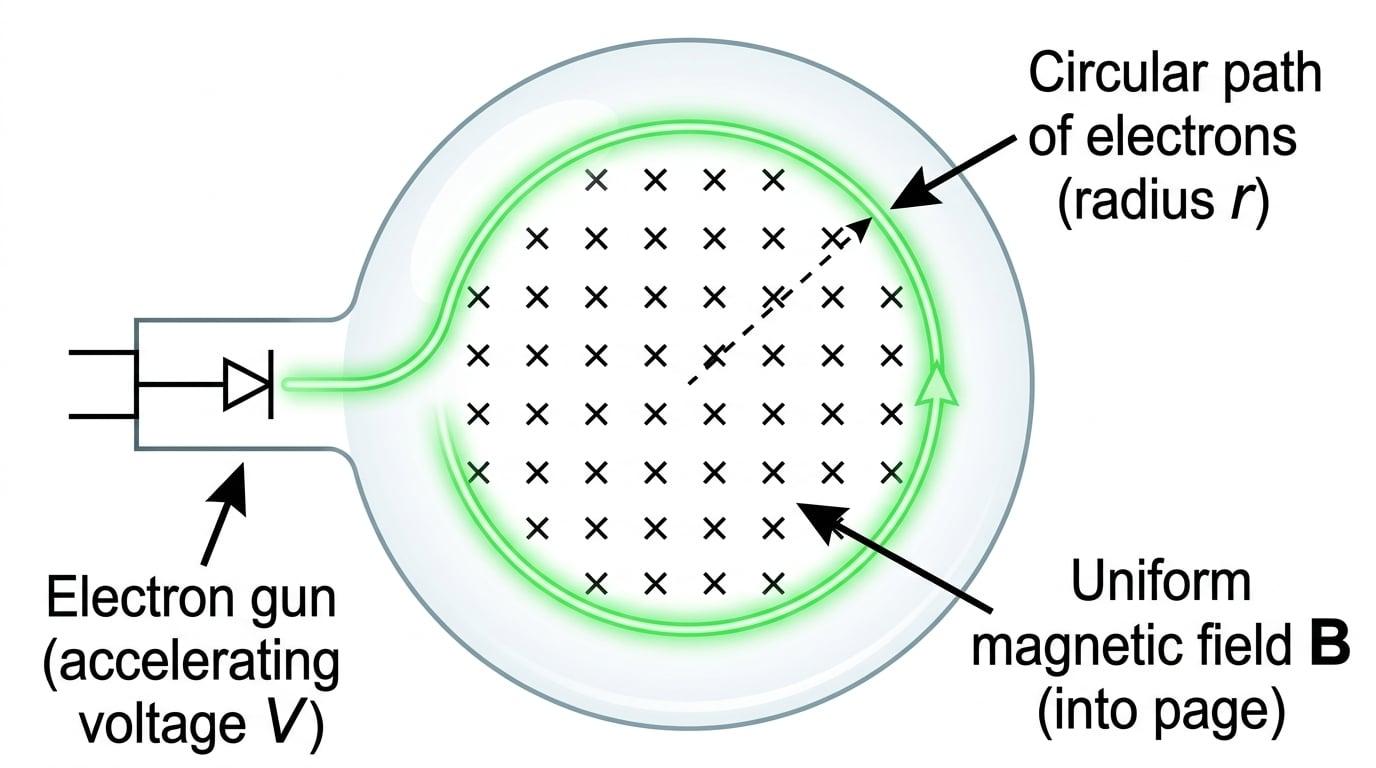
- The electron gun accelerates a beam of electrons using a high accelerating voltage, VVV.
- The beam enters the uniform magnetic field, BBB, which is directed perpendicularly to the electrons' direction of motion.
- The magnetic force acts at right angles to the electrons' velocity, acting as a centripetal force. This forces the electrons into a closed circular path of radius rrr.
Why can we see the beam?
Normally, electrons are invisible. But as the electrons travel through the tube, they collide with the trace gas atoms. These collisions transfer energy, exciting the gas atoms' electrons to higher energy levels. When the atoms de-excite, they emit photons of visible light. This is why the path glows!
Deriving the formula
To find the specific charge, we need to combine two equations: one for the electron gun, and one for the circular motion.
Part 1: The Electron Gun (Kinetic Energy) When the electron is accelerated by the voltage VVV, electrical work done is converted into kinetic energy.
Ek=Work done12mev2=eV \begin{aligned} E_k &= \text{Work done} \\ \frac{1}{2}m_e v^2 &= eV \end{aligned} Ek21mev2=Work done=eVRearranging for velocity, vvv:
v=2eVme v = \sqrt{\frac{2eV}{m_e}} v=me2eVPart 2: The Magnetic Field (Circular Motion) When the electron enters the magnetic field, the magnetic force provides the centripetal force.
Magnetic Force=Centripetal ForceBev=mev2r \begin{aligned} \text{Magnetic Force} &= \text{Centripetal Force} \\ B e v &= \frac{m_e v^2}{r} \end{aligned} Magnetic ForceBev=Centripetal Force=rmev2We can cancel one vvv from each side to get:
Be=mevr Be = \frac{m_e v}{r} Be=rmevRearranging for vvv:
v=Berme v = \frac{B e r}{m_e} v=meBerPart 3: Combining them Now we have two expressions for velocity. Since square roots can be messy, let's square the second equation:
v2=B2e2r2me2 v^2 = \frac{B^2 e^2 r^2}{m_e^2} v2=me2B2e2r2We can also rearrange our very first equation to find v2v^2v2:
v2=2eVme v^2 = \frac{2eV}{m_e} v2=me2eVEquating the two expressions for v2v^2v2:
B2e2r2me2=2eVme \frac{B^2 e^2 r^2}{m_e^2} = \frac{2eV}{m_e} me2B2e2r2=me2eVWe want to find eme\frac{e}{m_e}mee. Let's divide both sides by eee and multiply both sides by mem_eme:
B2er2me=2V \frac{B^2 e r^2}{m_e} = 2V meB2er2=2VFinally, rearrange to isolate eme\frac{e}{m_e}mee:
eme=2VB2r2 \frac{e}{m_e} = \frac{2V}{B^2 r^2} mee=B2r22VThe Fine Beam Tube Equation
The specific charge of an electron can be calculated if you know the accelerating voltage VVV, the magnetic flux density BBB, and the radius of the circular path rrr:
eme=2VB2r2 \frac{e}{m_e} = \frac{2V}{B^2 r^2} mee=B2r22VYou do not get this final equation in the AQA data sheet — you must be able to derive it from the kinetic energy and circular motion equations!
Forgetting to square the values
When students rearrange the formula in an exam, they frequently write eme=2VBr2\frac{e}{m_e} = \frac{2V}{B r^2}mee=Br22V or 2VB2r\frac{2V}{B^2 r}B2r2V. Notice that because vvv was squared, both BBB and rrr must be squared in the denominator.
Calculating specific charge from a fine beam tube
In a fine beam tube experiment, electrons are accelerated through a potential difference of 3500 V3500\text{ V}3500 V. They enter a uniform magnetic field of flux density 1.5×10⁻³ T1.5 \times 10^{-3}\text{ T}1.5×10⁻³ T and travel in a circular path of radius 0.042 m0.042\text{ m}0.042 m. Calculate the specific charge of the electron.
- State the known values: V=3500 VV = 3500\text{ V}V=3500 V B=1.5×10−3 TB = 1.5 \times 10^{-3}\text{ T}B=1.5×10⁻³ T r=0.042 mr = 0.042\text{ m}r=0.042 m
- State the derived formula for specific charge:
- Substitute the values into the formula:
- Calculate the denominator first to avoid calculator errors:
- Complete the calculation:
J.J. Thomson and the Discovery of the Electron
In 1897, the physicist J.J. Thomson measured the specific charge of "cathode rays" (which we now know are electrons). He didn't use a fine beam tube; instead, he used a device with crossed electric and magnetic fields to deflect the beam.
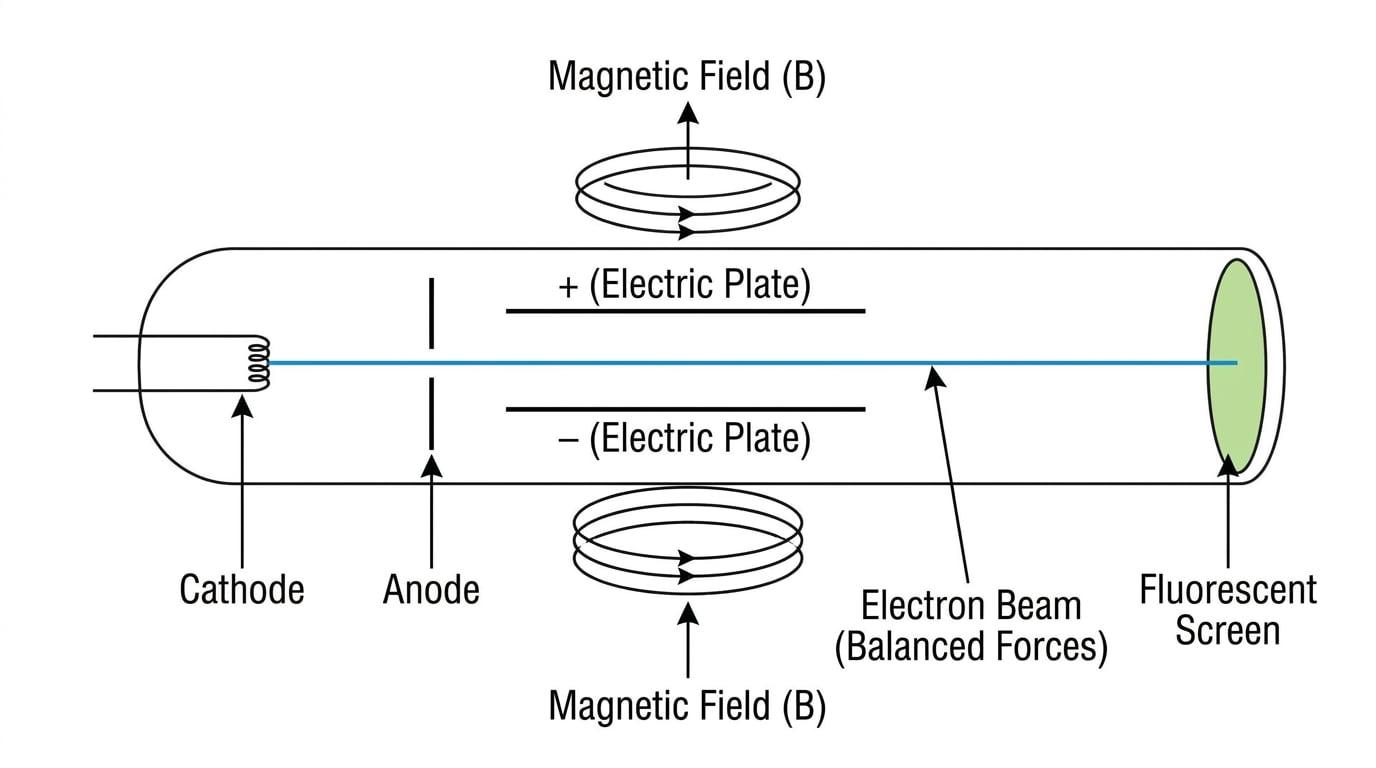
While you don't need to mathematically derive Thomson's specific crossed-field method for this section, you do need to understand the historical significance of his result.
Comparing with the Hydrogen Ion
Before Thomson's experiment, the particle with the largest known specific charge was the hydrogen ion (H+\text{H}^+H+), which is just a single proton.
Let's look at the specific charge of a hydrogen ion using modern values from the AQA data sheet:
- Charge of H+=1.60×10⁻¹⁹ C\text{H}^+ = 1.60 \times 10^{-19}\text{ C}H+=1.60×10⁻¹⁹ C
- Mass of H+=1.67×10⁻²⁷ kg\text{H}^+ = 1.67 \times 10^{-27}\text{ kg}H+=1.67×10⁻²⁷ kg
Now compare this to the specific charge of the electron we calculated earlier (1.76×10¹¹ C kg−11.76 \times 10^{11}\text{ C kg}^{-1}1.76×10¹¹ C kg−1).
Comparing the specific charges
Calculate how many times greater the specific charge of an electron is compared to a hydrogen ion.
- Divide the specific charge of the electron by the specific charge of the hydrogen ion:
- Calculate the final ratio:
The electron's specific charge is roughly 1800 times larger!
The Significance of Thomson's Result
Why was this number so shocking?
Thomson knew that cathode rays had a negative charge, and he reasonably assumed that the size of this charge was the same fundamental unit of charge as the hydrogen ion (just negative instead of positive).
If the charges are roughly the same magnitude, but the electron's specific charge (Qm\frac{Q}{m}mQ) is 1800 times larger, then the mass of the electron must be 1800 times smaller than the hydrogen ion!
Significance of Thomson's experiment
By showing that the specific charge of an electron was vastly larger than that of a hydrogen ion, Thomson proved that cathode rays were made of particles that were significantly lighter than the lightest known atom (hydrogen). This was the first experimental proof that subatomic particles existed.
This shattered the long-held scientific belief that atoms were the smallest, indivisible building blocks of matter. Thomson had discovered the electron.
In the exam
- Be ready to derive: "Show that..." questions for the fine beam tube are very common. Practice starting from 12mv2=eV\frac{1}{2}m v^2 = e V21mv2=eV and Bev=mv2rBev = \frac{m v^2}{r}Bev=rmv2 to reach the final specific charge equation.
- Explain the glow: If asked why the circular path in a fine beam tube is visible, clearly state: "Electrons collide with trace gas atoms, exciting them. The atoms emit visible light photons as they de-excite."
- Learn the significance: "State the significance of Thomson's determination of e/mee/m_ee/me" is a classic 2-mark question. Your answer should be: "It showed the specific charge of an electron is much larger than a hydrogen ion, proving the existence of particles smaller than an atom."
- Sanity check your answers: The specific charge of an electron is approximately 1.76×10¹¹ C kg−11.76 \times 10^{11}\text{ C kg}^{-1}1.76×10¹¹ C kg−1. If your calculation in an exam gives you something like 10510^5105 or 10−1110^{-11}10−11, you have likely forgotten to square a term or misread standard form.
Check yourself
- Can you write down the two starting equations required to derive the specific charge in a fine beam tube?
- In the fine beam tube equation eme=2VB2r2\frac{e}{m_e} = \frac{2V}{B^2 r^2}mee=B2r22V, what does VVV stand for, and what are its units?
- Roughly how many times larger is the specific charge of an electron compared to a hydrogen ion?
- What fundamental assumption did Thomson make about the charge of his cathode rays to conclude they had a very small mass?