Cathode rays (A-level only)
What you'll learn
- What a "cathode ray" actually is.
- The setup of a classic gas discharge tube.
- The step-by-step physical process of how cathode rays are produced.
- Why the gas inside the tube glows.
Welcome to the start of "The discovery of the electron" topic! Before physicists knew what an electron was, they observed strange glowing beams in glass tubes. They called these mysterious beams "cathode rays". To understand the experiments that led to the discovery of the electron, we first need to understand how these beams were made.
What is a cathode ray?
In the late 19th century, physicists discovered that if they trapped a gas inside a glass tube at a very low pressure and applied a massive voltage across it, the tube would light up, and an invisible "ray" would shoot from the negative electrical terminal to the positive one. Because the negative terminal is called the cathode, they named them cathode rays.
Cathode ray
A beam of fast-moving electrons emitted from the cathode (the negative electrode) of a high-vacuum or low-pressure gas tube.
At the time, scientists didn't know they were electrons—they just knew something was travelling through the tube.
The Discharge Tube Setup
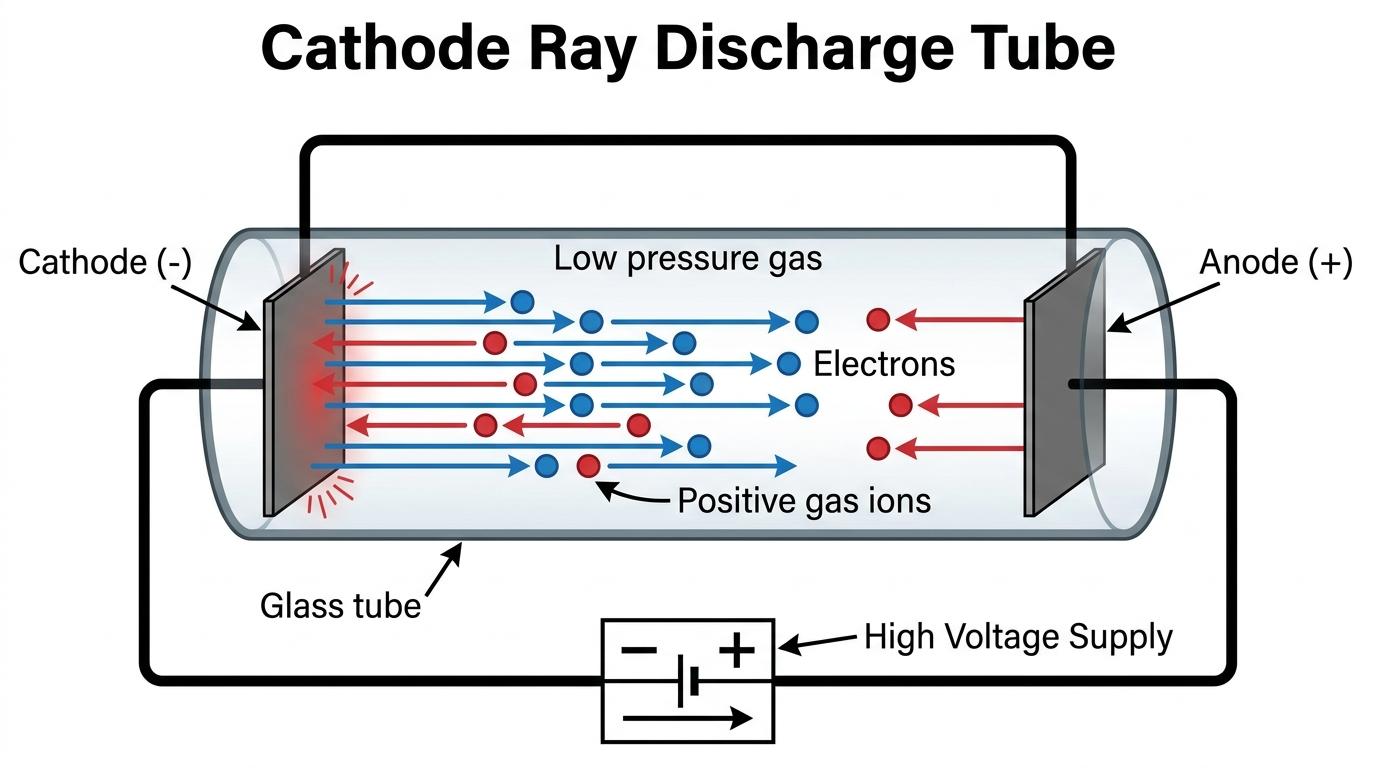
To produce cathode rays, you need a specific piece of equipment called a discharge tube. The basic setup includes:
- A sealed glass tube containing a gas (like neon or argon).
- A vacuum pump to lower the pressure of the gas to a fraction of normal atmospheric pressure.
- Two metal plates inside the tube: a cathode (connected to the negative terminal of a power supply) and an anode (connected to the positive terminal).
- A high-voltage DC power supply (often generating several thousand volts).
The Goldilocks Pressure
The pressure inside the tube must be "just right" (around 0.0010.0010.001 atmospheres).
- If the pressure is too high, the electrons collide with gas atoms too frequently and lose their kinetic energy before they can cause the necessary reactions.
- If the pressure is too low (a perfect vacuum), there are no gas atoms left to bump into, and the chain reaction that produces the rays can't start!
How are cathode rays actually produced?
The production of cathode rays in a cold discharge tube is a chain reaction. It relies on the immense electric field created by the high voltage, calculated by E=VdE = \frac{V}{d}E=dV, where VVV is the potential difference and ddd is the distance between the anode and cathode.
Here is the exact sequence of events you need to know:
- Stray electrons: Even in a normal volume of gas, background radiation (like cosmic rays) occasionally knocks an electron out of a gas atom, creating a few stray "free" electrons and positive gas ions.
- Acceleration: The extremely high potential difference creates a strong electric field. This field exerts a force (F=EqF = EqF=Eq) on those stray electrons, rapidly accelerating them towards the positive anode.
- Ionisation: Because the pressure is low, the electrons can travel far enough to gain significant kinetic energy before hitting anything. When they finally do collide with a neutral gas atom, they hit it with enough energy to knock out more electrons. This process is called ionisation.
- Positive ion acceleration: The ionisation creates heavy, positive gas ions. The electric field pulls these positive ions in the opposite direction, accelerating them forcefully towards the negative cathode.
- Emission of cathode rays: When these heavy positive ions smash into the metal surface of the cathode, the impact transfers enough energy to knock free electrons right out of the metal lattice.
- The final beam: These newly freed electrons are instantly repelled by the cathode and accelerated towards the anode. This continuous stream of fast-moving electrons is the cathode ray!
Don't confuse your emission types
AQA often tests your ability to distinguish between different ways to release electrons. A discharge tube uses a cold cathode—the electrons are released due to the physical impact of high-energy positive ions.
This is totally different from thermionic emission (which you will meet later), where a filament is heated up until electrons literally boil off it. If a question asks about a discharge tube, mention positive ion impact, not heat!
Why does the tube glow?
As well as ionising the gas, the flying electrons also cause excitation.
When an electron collides with a gas atom but doesn't have quite enough energy to completely remove an electron, it can still bump one of the atom's orbital electrons up to a higher energy level.
The atom is now unstable. Shortly afterwards, the orbital electron falls back down (de-excites) to its original energy level. As it drops, it releases the excess energy as a photon of light (ΔE=hf\Delta E = hfΔE=hf). Because millions of these collisions happen every second, the entire tube emits a continuous, visible glow.
Fluorescent colours
The specific colour of the glow depends entirely on the element used inside the tube, because each gas has its own unique set of energy levels. Neon glows a brilliant red-orange, while argon glows pale blue/purple.
Worked Example
Let's look at how AQA typically assesses this descriptive process. They love asking for clear, sequential explanations.
Explaining cathode ray production
Question: A potential difference of 4.5 kV\text{4.5 kV}4.5 kV is applied across a discharge tube containing a low-pressure gas. Explain how cathode rays are produced in this tube. (5 marks)
Step-by-step answer:
- The high potential difference creates a strong electric field across the tube, which accelerates any naturally occurring free electrons towards the anode.
- These fast-moving electrons collide with gas atoms and ionise them.
- This ionisation creates positive gas ions (and releases more free electrons).
- The positive gas ions are accelerated by the electric field towards the cathode.
- When the positive ions strike the cathode, their impact causes electrons to be emitted from the metal surface; these emitted electrons form the cathode rays.
In the exam
When asked to explain the production of cathode rays in a discharge tube, use this checklist to ensure you hit the marking points:
- Always state the initial cause: stray/free electrons being accelerated.
- Use the exact word ionisation (or "ionise") when describing the collisions with gas atoms.
- Explicitly state that positive ions are formed and travel to the cathode.
- The final mark is almost always for stating that the positive ions strike the cathode, causing it to emit electrons.
Check yourself
- Why must the gas in the discharge tube be kept at a low pressure rather than atmospheric pressure?
- What physical event actually knocks the electrons out of the cathode plate?
- Why does the gas inside the tube emit visible light during this process?