Thermal energy transfer (A-level only)
Welcome to Thermal Energy Transfer! We encounter heating and cooling every day, from boiling a kettle to sweating on a hot run. In this topic, we will look at exactly what is happening to the particles during these processes, and how to calculate the energy required to change a substance's temperature or state.
What you'll learn:
- The definition of internal energy and how the First Law of Thermodynamics applies to it.
- How to use specific heat capacity for temperature changes, including the clever "continuous flow" method.
- How to use specific latent heat for phase changes, and why temperature stays constant while melting or boiling.
1. Internal Energy
When we zoom in on any substance, we see a massive ensemble of particles (atoms or molecules) jiggling around. Each particle has kinetic energy (because it is moving) and potential energy (because of electrostatic forces between the particles).
Internal Energy
Internal energy is the sum of the randomly distributed kinetic energies and potential energies of all the particles in a body.
Notice the phrase "randomly distributed". If you throw a baseball, the whole ball gains kinetic energy, but its internal energy hasn't changed. Internal energy only cares about the chaotic, microscopic jostling of the particles inside the ball.
There are only two ways you can increase the internal energy of a system:
- Heating it: Transferring thermal energy to the system from a hotter object.
- Doing work on it: For example, compressing a gas with a piston, or vigorously stirring a liquid.
The First Law of Thermodynamics (Qualitative)
The internal energy of a system increases when energy is transferred to it by heating, or when work is done on it. (Conversely, it decreases if the system loses heat or does work on its surroundings).
2. Specific Heat Capacity (Changing Temperature)
When you heat a substance and its temperature rises, you are increasing the kinetic energy of its particles. They vibrate or move faster. However, different materials require different amounts of energy to achieve the same temperature rise.
Specific Heat Capacity, c
The specific heat capacity (ccc) is the energy required to raise the temperature of 1 kg1\text{ kg}1 kg of a substance by 1 K1\text{ K}1 K without changing its state.
Unit: J kg−1K−1\text{J kg}^{-1}\text{K}^{-1}J kg−1K−1
The equation for calculating the energy transfer for a change in temperature is:
Q=mcΔθ Q = mc\Delta\theta Q=mcΔθWhere:
- QQQ is the energy transferred by heating (in J\text{J}J)
- mmm is the mass of the substance (in kg\text{kg}kg)
- ccc is the specific heat capacity (in J kg−1K−1\text{J kg}^{-1}\text{K}^{-1}J kg−1K−1)
- Δθ\Delta\thetaΔθ is the change in temperature (in K\text{K}K or ∘C^\circ\text{C}∘C)
Kelvin vs Celsius
Because a change of 1 K1\text{ K}1 K is exactly the same size as a change of 1∘C1^\circ\text{C}1∘C, you can plug Δθ\Delta\thetaΔθ directly into the formula whether your temperatures are given in Celsius or Kelvin. Just ensure you are calculating the difference.
Example 1: Using specific heat capacity
An electrical heater supplies 48 kJ48\text{ kJ}48 kJ of energy to a 2.0 kg2.0\text{ kg}2.0 kg block of aluminium initially at 20∘C20^\circ\text{C}20∘C. The specific heat capacity of aluminium is 900 J kg−1K−1900\text{ J kg}^{-1}\text{K}^{-1}900 J kg−1K−1. Calculate the final temperature of the block, assuming no heat is lost to the surroundings.
- Extract your knowns: Q=48000 JQ = 48000\text{ J}Q=48000 J, m=2.0 kgm = 2.0\text{ kg}m=2.0 kg, c=900 J kg−1K−1c = 900\text{ J kg}^{-1}\text{K}^{-1}c=900 J kg−1K−1, initial temperature =20∘C= 20^\circ\text{C}=20∘C.
- Rearrange the formula for the temperature change:
- Substitute the values:
- Find the final temperature: Since the initial temperature was 20∘C20^\circ\text{C}20∘C, the final temperature is 20+26.67=46.7∘C20 + 26.67 = 46.7^\circ\text{C}20+26.67=46.7∘C (or 47∘C47^\circ\text{C}47∘C to 2 sig figs).
3. Continuous Flow Calorimetry
In standard heating experiments, energy escapes to the surroundings, making your calculated value for ccc inaccurate. A brilliant way around this is the continuous flow method.
Imagine a liquid flowing steadily through a tube. Inside the tube is an electrical heating coil. You measure the temperature of the liquid as it flows in, and as it flows out.
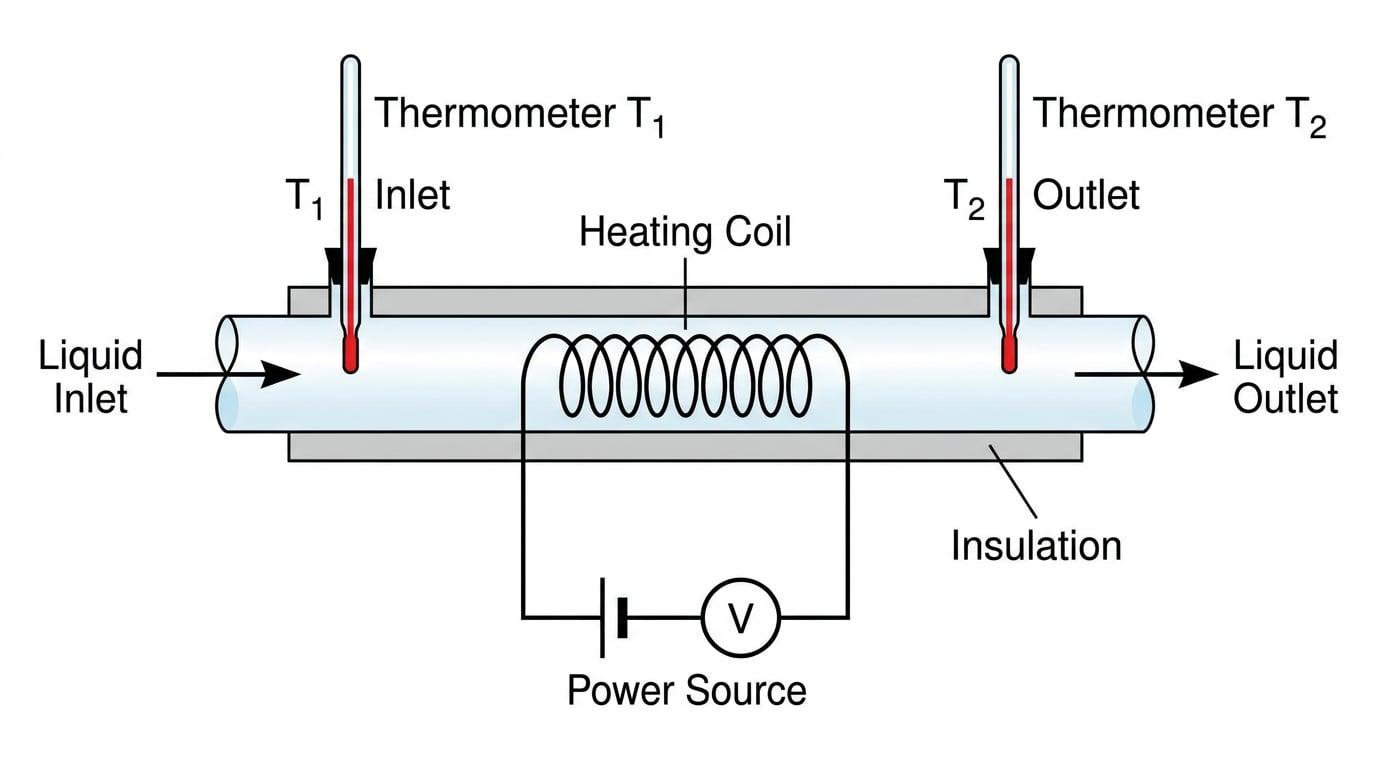
If the liquid flows at a constant rate and the heater is left on, the system reaches a steady state. The temperature difference between the inlet and outlet, Δθ\Delta\thetaΔθ, remains constant.
The electrical energy supplied by the heater in time ttt is E=VItE = VItE=VIt. This energy does two things:
- Heats the mass of water mmm that flows through.
- Gets lost to the surroundings (let's call this heat loss HHH).
So, for a first experiment:
V1I1t=m1cΔθ+H V_1 I_1 t = m_1 c \Delta\theta + H V1I1t=m1cΔθ+HNow for the clever part: we change the flow rate so a new mass m2m_2m2 flows through in time ttt. We then adjust the heater voltage and current to V2V_2V2 and I2I_2I2 until the temperature difference Δθ\Delta\thetaΔθ is exactly the same as before.
Because the apparatus is at the exact same temperatures, the heat lost to the surroundings HHH in time ttt is exactly the same!
V2I2t=m2cΔθ+H V_2 I_2 t = m_2 c \Delta\theta + H V2I2t=m2cΔθ+HIf we subtract the first equation from the second, HHH cancels out completely:
(V2I2t)−(V1I1t)=(m2−m1)cΔθ (V_2 I_2 t) - (V_1 I_1 t) = (m_2 - m_1) c \Delta\theta (V2I2t)−(V1I1t)=(m2−m1)cΔθExample 2: Continuous Flow Calculation
In a continuous flow experiment, a fluid is heated and a temperature rise of 5.0 K5.0\text{ K}5.0 K is maintained. In the first run, a voltage of 12 V12\text{ V}12 V and current of 2.0 A2.0\text{ A}2.0 A are used, and 0.040 kg0.040\text{ kg}0.040 kg of fluid flows through in 100 s100\text{ s}100 s. In the second run, a voltage of 15 V15\text{ V}15 V and current of 2.8 A2.8\text{ A}2.8 A are used, and 0.065 kg0.065\text{ kg}0.065 kg of fluid flows through in 100 s100\text{ s}100 s. Calculate the specific heat capacity of the fluid.
- Calculate the energy supplied in each run (E=VItE = VItE=VIt): Run 1: E1=12×2.0×100=2400 JE_1 = 12 \times 2.0 \times 100 = 2400\text{ J}E1=12×2.0×100=2400 J Run 2: E2=15×2.8×100=4200 JE_2 = 15 \times 2.8 \times 100 = 4200\text{ J}E2=15×2.8×100=4200 J
- Set up the two equations: 2400=(0.040×c×5.0)+H2400 = (0.040 \times c \times 5.0) + H2400=(0.040×c×5.0)+H 4200=(0.065×c×5.0)+H4200 = (0.065 \times c \times 5.0) + H4200=(0.065×c×5.0)+H
- Subtract the first equation from the second to eliminate HHH: 4200−2400=(0.065−0.040)×c×5.04200 - 2400 = (0.065 - 0.040) \times c \times 5.04200−2400=(0.065−0.040)×c×5.0 1800=0.025×c×5.01800 = 0.025 \times c \times 5.01800=0.025×c×5.0
- Solve for ccc: 1800=0.125×c1800 = 0.125 \times c1800=0.125×c
4. Change of State and Specific Latent Heat
If you keep heating a solid, eventually it melts. During this melting process, the temperature stops rising, even though you are still putting thermal energy into the system.
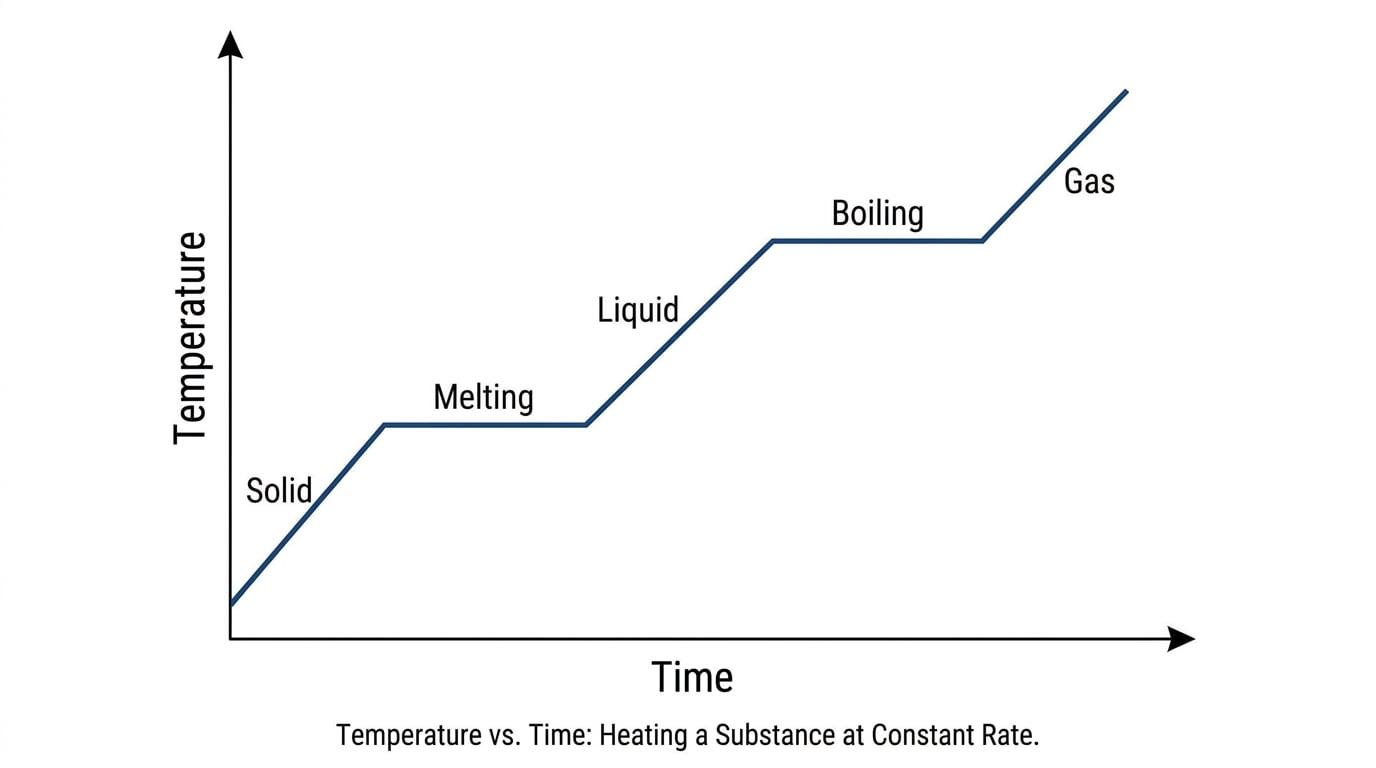
Why does the temperature plateau?
- Temperature is a measure of the average kinetic energy of the particles.
- During a phase change, the kinetic energy stays constant.
- Instead, the energy you supply is used to overcome the intermolecular forces holding the particles together. This increases the potential energy of the particle ensemble.
Bonds vs Intermolecular forces
When boiling water or melting ice, you are breaking intermolecular forces (the bonds between molecules), not the strong covalent bonds inside the water molecule itself. The molecules remain H2O\text{H}_2\text{O}H2O throughout!
Because the energy needed to change state depends heavily on the material, we use a property called Specific Latent Heat. ("Latent" means hidden, referring to the hidden energy that goes in without raising the temperature).
Specific Latent Heat, l
The specific latent heat (lll) is the energy required to change the state of 1 kg1\text{ kg}1 kg of a substance at a constant temperature.
Unit: J kg−1\text{J kg}^{-1}J kg−1
There are two types of specific latent heat you need to know:
- Specific latent heat of fusion (lfl_flf): For changing between solid and liquid (melting/freezing).
- Specific latent heat of vaporisation (lvl_vlv): For changing between liquid and gas (boiling/condensing). Vaporisation always requires much more energy than fusion, because you have to separate the molecules completely against atmospheric pressure.
The formula is wonderfully simple:
Q=ml Q = ml Q=mlWhere:
- QQQ is the energy transferred for the state change (in J\text{J}J)
- mmm is the mass changing state (in kg\text{kg}kg)
- lll is the specific latent heat (in J kg−1\text{J kg}^{-1}J kg−1)
Many exam questions will combine temperature changes (mcΔθmc\Delta\thetamcΔθ) and state changes (mlmlml). You simply add the energy for each stage together.
Example 3: Melting ice to water
Calculate the total energy required to heat 0.50 kg0.50\text{ kg}0.50 kg of ice at −10∘C-10^\circ\text{C}−10∘C until it becomes liquid water at 15∘C15^\circ\text{C}15∘C. (Specific heat capacity of ice = 2100 J kg−1K−12100\text{ J kg}^{-1}\text{K}^{-1}2100 J kg−1K−1; Specific latent heat of fusion of water = 3.3×10⁵ J kg−13.3 \times 10^5\text{ J kg}^{-1}3.3×10⁵ J kg−1; Specific heat capacity of water = 4200 J kg−1K−14200\text{ J kg}^{-1}\text{K}^{-1}4200 J kg−1K−1).
- Stage 1: Heat the ice to 0∘C0^\circ\text{C}0∘C:
- Stage 2: Melt the ice at 0∘C0^\circ\text{C}0∘C (change of state):
- Stage 3: Heat the liquid water from 0∘C0^\circ\text{C}0∘C to 15∘C15^\circ\text{C}15∘C:
- Find the total energy:
In the exam
- Watch your powers of ten: Heat capacities and latent heats are often given in kJ\text{kJ}kJ or MJ\text{MJ}MJ. Always convert to Joules (J) before using the formulas, or you will be off by a factor of 1000.
- Check the "mass": In a continuous flow calculation, ensure you divide by the correct time if the question gives you a mass flow rate (e.g. kg s−1\text{kg s}^{-1}kg s−1) instead of an absolute mass and a time.
- Explain the plateaus carefully: If asked to explain a flat line on a temperature-time graph, explicitly state that "kinetic energy remains constant while potential energy increases as intermolecular forces are overcome."
Check yourself
- Can you state the difference between internal energy, kinetic energy, and potential energy in a substance?
- Why is the continuous flow method more accurate for determining ccc than a simple beaker-and-heater experiment?
- If a substance is melting at a constant rate, what is happening to the kinetic and potential energies of its particles?
- What is the difference between specific latent heat of fusion and specific latent heat of vaporisation?