Forced vibrations and resonance (A-level only)
What you'll learn:
- The difference between a free vibration and a forced vibration.
- The condition for resonance to occur.
- How damping affects the amplitude and sharpness of a resonance curve.
- Real-world examples of resonance in mechanical systems and stationary waves.
Free vs Forced Vibrations
When an oscillating system is displaced and released, it will oscillate at its natural frequency.
If you pluck a guitar string or tap a pendulum, you are giving the system some initial energy and then leaving it alone. Because there are no external continuous forces acting on it (apart from a little bit of air resistance to eventually stop it), this is called a free vibration.
Natural Frequency
The natural frequency, denoted by f0f_0f0, is the frequency at which a system will oscillate when it undergoes free vibrations (no periodic external driving force is applied).
However, in many real-world situations, a system doesn't just vibrate on its own; it is constantly pushed or pulled by an external source. Think of pushing a child on a swing. You apply a periodic push. This causes the swing to undergo forced vibrations.
Driving Frequency
The driving frequency, denoted by fff, is the frequency of the external periodic force applied to an oscillating system.
During a forced vibration, the system is forced to vibrate at the driving frequency fff, regardless of what its natural frequency f0f_0f0 is.
Resonance
What happens to the amplitude of the forced vibrations as you change the driving frequency?
- If you push the system at a frequency very different from its natural frequency, the amplitude stays small.
- But, as the driving frequency fff gets closer to the natural frequency f0f_0f0, the amplitude of the system's oscillations increases dramatically.
The Condition for Resonance
Resonance occurs when the driving frequency is equal to the natural frequency of the oscillating system (f=f0f = f_0f=f0). At this point, the system absorbs maximum energy from the driver, resulting in a maximum amplitude of oscillation.
Barton's Pendulums
A classic laboratory demonstration of resonance is Barton's Pendulums. It consists of a thick, slightly flexible horizontal string from which several light pendulums (usually paper cones) of different lengths are hung. Alongside them, one heavy pendulum (the "driver") is also hung.
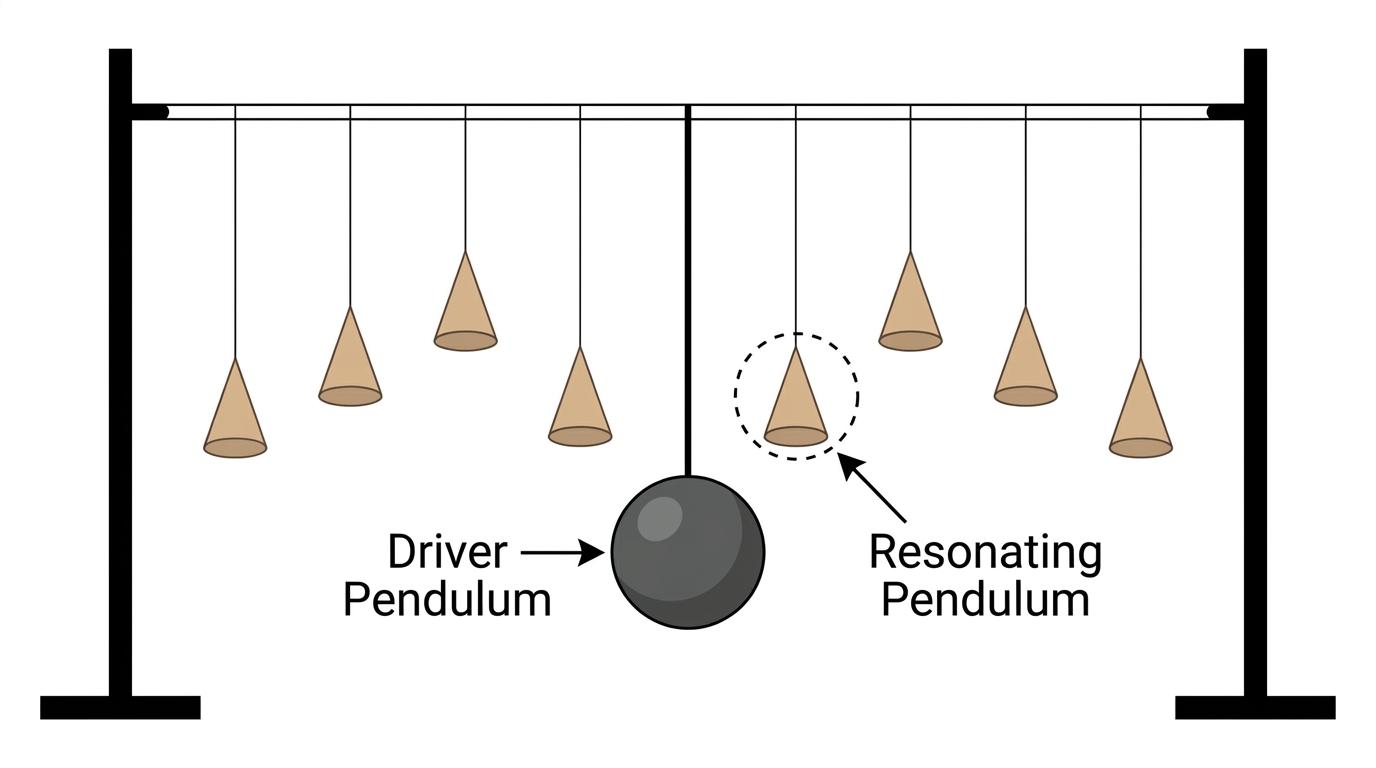
When the heavy driver pendulum is set swinging, it sends small periodic forces along the horizontal string. This forces all the lighter pendulums to vibrate at the driver's frequency.
Because the time period (and therefore frequency) of a simple pendulum depends only on its length, the light pendulum that is exactly the same length as the driver has the same natural frequency. This specific pendulum will resonate, exhibiting an enormous amplitude compared to the others.
Phase difference at resonance
AQA often asks about the phase relationship in Barton's pendulums. At resonance, the resonating pendulum has a phase difference of exactly π2\frac{\pi}{2}2π radians (90∘90^\circ90∘) lagging behind the driver pendulum. Pendulums much shorter than the driver will be roughly in phase (000 radians) with it, while pendulums much longer will be entirely out of phase (π\piπ radians).
Explaining a resonance context
A washing machine is resting on a wooden floor. During its spin cycle, as the motor slowly speeds up, the machine shakes violently at a particular speed. As the motor continues to speed up to its maximum spin, the machine stops shaking and spins smoothly. Explain this observation.
- The washing machine acts as a driven oscillator, and the rotating motor provides a periodic driving force. The system (the machine and floor) has a specific natural frequency, f0f_0f0.
- As the motor speeds up, the driving frequency fff increases. When fff matches the natural frequency f0f_0f0 of the system, resonance occurs.
- At resonance (f=f0f = f_0f=f0), there is maximum energy transfer from the motor to the machine, causing the machine to oscillate with maximum amplitude (violent shaking).
- As the motor continues to speed up, the driving frequency fff becomes greater than f0f_0f0. The system is no longer in resonance, so the amplitude of oscillation decreases significantly, resulting in a smooth spin.
The Effect of Damping on Resonance
In the real world, systems experience frictional forces that remove energy over time. This is called damping. Damping doesn't just slowly stop a free vibration; it dramatically changes how a system behaves during forced vibrations.
We can plot a resonance curve to show how the amplitude of the driven system changes as we vary the driving frequency.
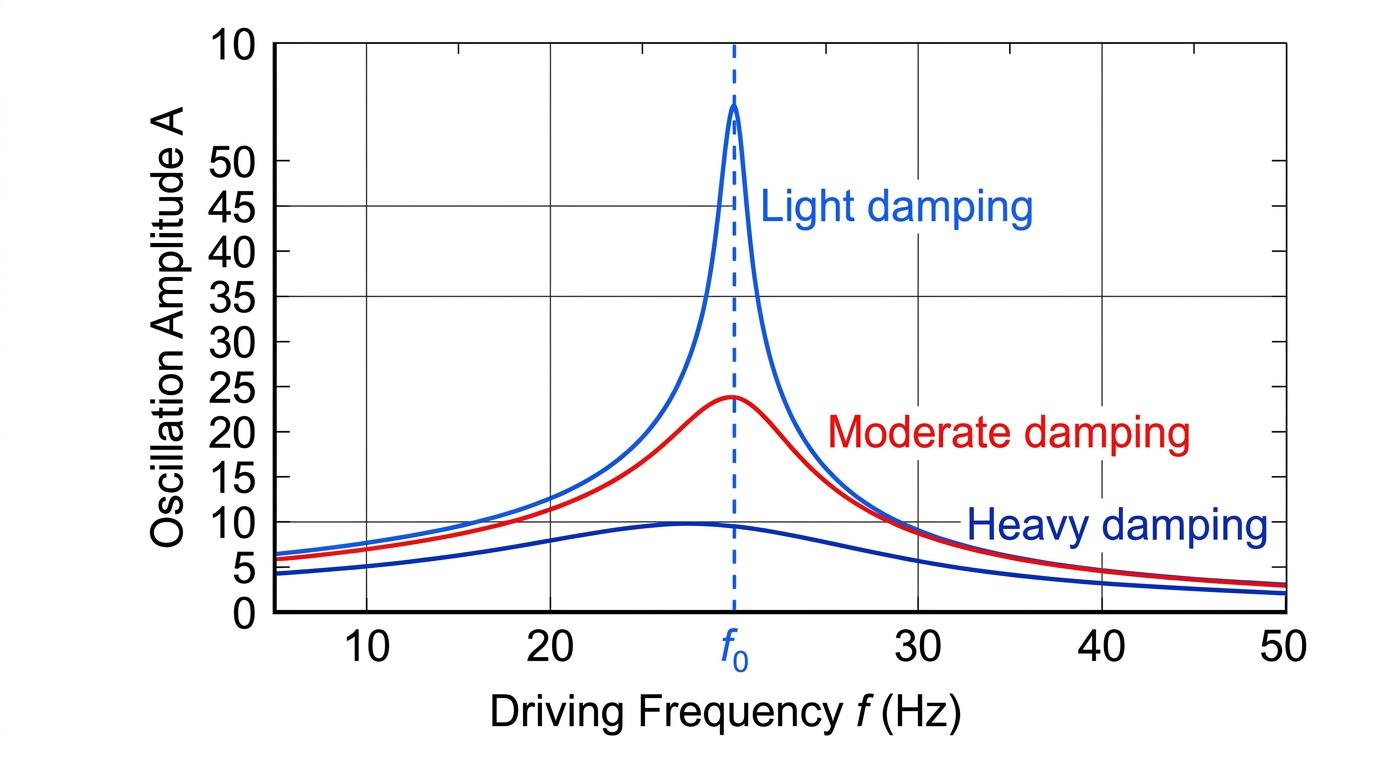
Look carefully at the graph above. As the degree of damping increases, three distinct things happen to the resonance curve:
- The maximum amplitude decreases. More energy is dissipated as heat due to friction, so less energy is stored in the oscillation.
- The peak becomes wider and flatter. We say the sharpness of resonance decreases. A lightly damped system will only resonate strongly if the driving frequency is exactly equal to f0f_0f0. A heavily damped system will respond moderately well to a much wider range of driving frequencies.
- The resonant frequency shifts slightly to the left. For a lightly damped system, the peak occurs exactly at f0f_0f0. But as heavy damping is introduced, the peak amplitude occurs at a driving frequency slightly lower than the natural frequency.
Forgetting the peak shift
When asked to sketch the effect of heavier damping on a resonance curve, many students draw a flatter curve but keep the peak exactly aligned vertically with the lightly damped peak. Remember to visibly shift the peak of the heavily damped curve slightly to the left!
Useful and Destructive Resonance
Resonance isn't just an abstract concept; it surrounds us in everyday physics. Sometimes we want to maximise it (useful resonance), and sometimes we want to avoid it at all costs (destructive resonance).
Examples of Useful Resonance:
- Stationary waves in instruments: The bodies of string instruments (like acoustic guitars) or the air columns in wind instruments are designed to resonate at specific frequencies, amplifying the sound.
- Microwave ovens: Microwaves are emitted into a cavity designed to set up stationary waves, resonating and transferring maximum energy to the water molecules in food.
- Tuning a radio: The electrical circuit inside a radio is tuned so that its natural electrical frequency perfectly matches the broadcasting frequency of the radio station you want to listen to.
Examples of Destructive Resonance:
- Bridges: Wind, or even the synchronized footsteps of a crowd, can act as a driving force. If the driving frequency matches the natural frequency of the bridge, the bridge can resonate with a dangerously high amplitude (e.g., the famous Millennium Bridge wobble). This is mitigated by installing heavy damping mechanisms (like shock absorbers) to flatten the resonance curve.
- Car suspensions: If a car drives over evenly spaced bumps at a speed where the bump frequency matches the natural frequency of the suspension springs, the car will bounce violently. Car shock absorbers provide heavy damping to prevent this.
In the exam
- When asked "State the condition for resonance", always write: "The driving frequency equals the natural frequency." Never just write "frequencies match" without specifying which frequencies.
- If asked to explain how to prevent destructive resonance in a structure, the answer is usually damping. Mention that installing dampers dissipates the energy, reducing the maximum amplitude and flattening the resonance curve.
- Be ready to link resonance to stationary waves. A stationary wave is essentially a system in resonance, where the wave travelling along the string or pipe interferes with its own reflection to produce nodes and antinodes.
Check yourself
- What happens to the energy transfer between the driver and the oscillating system at resonance?
- What three changes occur to a resonance curve when the amount of damping is increased?
- In Barton's pendulums, if the heavy driver pendulum has length LLL, what is the length of the light pendulum that will oscillate with the largest amplitude?
- Why do car suspension systems require heavy damping?