Ideal gases (A-level only)
Welcome to the thermal physics of gases! You already know that gases are made of particles zooming around randomly. In this section, we zoom out to look at the "big picture" (macroscopic) properties of a gas: pressure, volume, and temperature.
Here is what you'll learn:
- How the three experimental gas laws link pressure, volume, and temperature.
- How to extrapolate experimental graphs to find absolute zero.
- How to use the ideal gas equations (pV=nRTpV = nRTpV=nRT and pV=NkTpV = NkTpV=NkT) to find the state of a gas.
- How to calculate the work done when a gas expands or is compressed.
The Gas Laws and Absolute Zero
Before we can combine everything into one master equation, we need to look at the three historical gas laws. These laws show how two variables interact while the other variables (and the mass of the gas) are kept completely constant.
You will investigate two of these in Required Practical 8.
- Boyle's Law (Constant Temperature) For a fixed mass of gas at a constant temperature, the pressure ppp is inversely proportional to the volume VVV. If you halve the volume, you double the pressure.
- Charles's Law (Constant Pressure) For a fixed mass of gas at a constant pressure, the volume VVV is directly proportional to its absolute temperature TTT.
- The Pressure Law (Constant Volume) For a fixed mass of gas at a constant volume, the pressure ppp is directly proportional to its absolute temperature TTT.
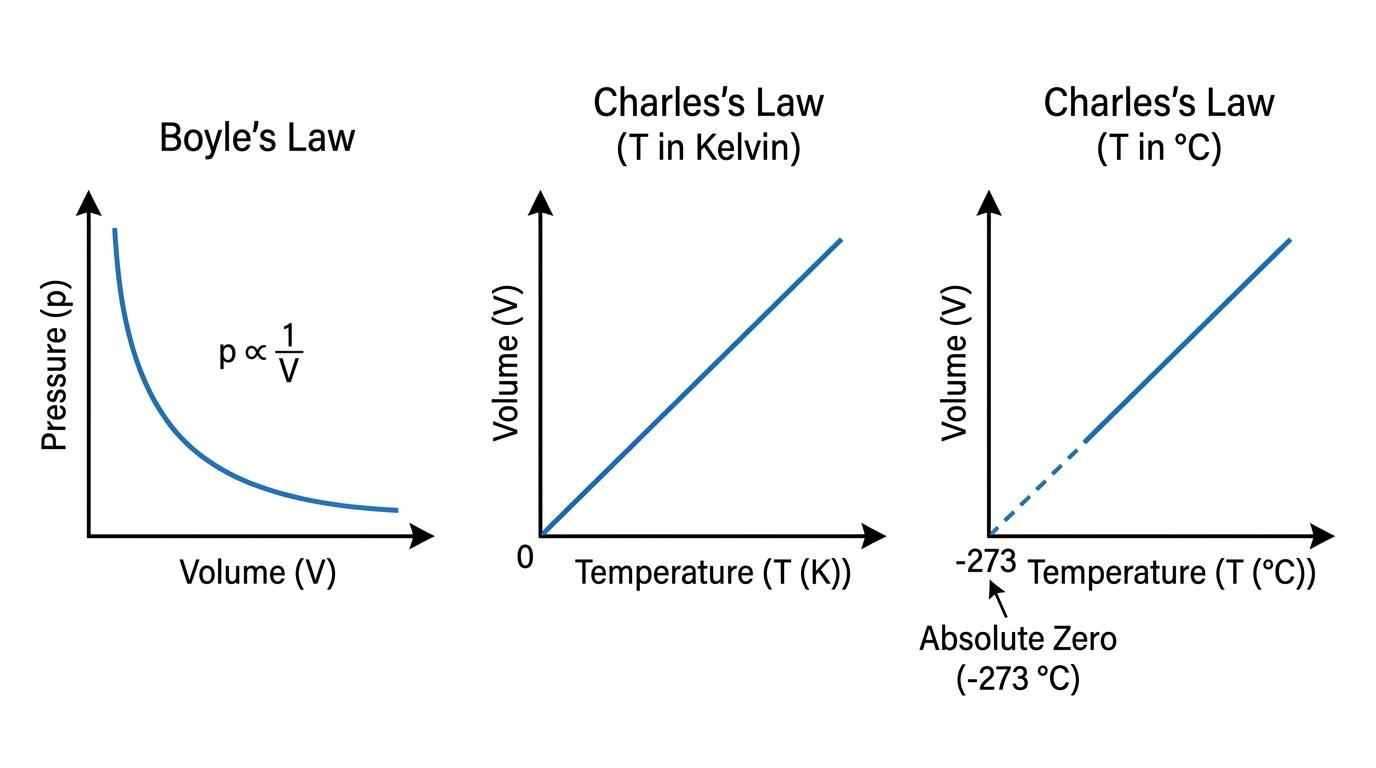
If you look at the third graph above, you'll see something fascinating. If you plot volume (or pressure) against temperature in degrees Celsius, you get a straight line that doesn't pass through the origin. However, if you extrapolate the line backwards, it crosses the temperature axis at exactly −273.15 ∘C-273.15 \text{ }^\circ\text{C}−273.15 ∘C.
Absolute Zero
Absolute zero (0 K0 \text{ K}0 K or −273.15 ∘C-273.15 \text{ }^\circ\text{C}−273.15 ∘C) is the lowest possible temperature. At this theoretical temperature, an ideal gas would have zero volume and zero pressure, and its particles would have zero kinetic energy.
Forgetting to use Kelvin
Charles's Law and the Pressure Law are only direct proportionalities if you measure temperature in Kelvin. Always add 273273273 to your Celsius temperature before doing any gas calculations. An increase of 1 ∘C1 \text{ }^\circ\text{C}1 ∘C is exactly the same as an increase of 1 K1 \text{ K}1 K, but the zero points are different!
Moles, Molecules, and Mass
To describe the amount of gas we have, we can either count the exact number of individual molecules, or we can count "batches" of molecules called moles.
- Number of molecules (NNN): The literal count of individual particles in the container.
- Number of moles (nnn): The number of batches. One batch (one mole) contains exactly 6.02×10236.02 \times 10^{23}6.02×10²³ particles. This number is the Avogadro constant (NAN_ANA).
To convert between them, you simply multiply the number of moles by the Avogadro constant:
N=nNA N = n N_A N=nNAWe also need to be careful with mass. In physics, you will encounter two very similar-sounding terms that mean very different things:
- Molecular mass (mmm): The tiny mass of one single molecule in kilograms (e.g. roughly 5×10⁻²⁶ kg5 \times 10^{-26} \text{ kg}5×10⁻²⁶ kg for an oxygen molecule).
- Molar mass (MMM): The mass of one whole mole of the substance.
Finding the mass of one molecule
If an exam question gives you the molar mass MMM (the mass of one mole) and asks for the mass of a single molecule mmm, just divide the molar mass by the number of molecules in a mole:
m=MNA m = \frac{M}{N_A} m=NAMThe Ideal Gas Equation
By combining Boyle's, Charles's, and the Pressure law, we get a single relationship: pV∝TpV \propto TpV∝T. To turn this into an equals sign, we need a constant of proportionality.
Depending on whether we want to work with moles or molecules, there are two versions of the ideal gas equation. You need to be completely comfortable using both.
Version 1: The Macroscopic Equation (Moles)
If you are dealing with the number of moles (nnn), use the molar gas constant (RRR), which is 8.31 J K−1 mol−18.31 \text{ J K}^{-1} \text{ mol}^{-1}8.31 J K−1 mol−1.
pV=nRT pV = nRT pV=nRTVersion 2: The Microscopic Equation (Molecules)
If you are dealing with the number of individual molecules (NNN), use the Boltzmann constant (kkk), which is 1.38×10⁻²³ J K−11.38 \times 10^{-23} \text{ J K}^{-1}1.38×10⁻²³ J K−1.
pV=NkT pV = NkT pV=NkTThe constants are linked!
The Boltzmann constant kkk is just the molar gas constant RRR divided by the Avogadro constant NAN_ANA. In other words, k=RNAk = \frac{R}{N_A}k=NAR. You can think of kkk as the gas constant for a single molecule, while RRR is the gas constant for a whole mole.
Calculating state variables using the ideal gas equation
A sealed canister contains 0.45 moles0.45 \text{ moles}0.45 moles of an ideal gas at a temperature of 22 ∘C22 \text{ }^\circ\text{C}22 ∘C and a pressure of 120 kPa120 \text{ kPa}120 kPa. Calculate the volume of the gas. (R=8.31 J K−1 mol−1R = 8.31 \text{ J K}^{-1} \text{ mol}^{-1}R=8.31 J K−1 mol−1)
- First, identify your known variables and convert everything to standard SI units (Pa\text{Pa}Pa, m3\text{m}^3m3, K\text{K}K). n=0.45 moln = 0.45 \text{ mol}n=0.45 mol T=22+273=295 KT = 22 + 273 = 295 \text{ K}T=22+273=295 K p=120×103 Pap = 120 \times 10^3 \text{ Pa}p=120×103 Pa
- State the correct ideal gas equation. Because we are given moles, we use the macroscopic version.
- Rearrange the equation to make volume (VVV) the subject.
- Substitute the values into the equation and calculate the final answer.
Work Done by a Gas
When a gas is heated, it might expand. If it expands against a resisting pressure (like the air pushing down on a moving piston), it has to do mechanical work to push that boundary outward.
For a gas expanding at a constant pressure, the work done can be calculated using:
W=pΔV W = p \Delta V W=pΔVWhere:
- WWW is the work done in joules (J\text{J}J)
- ppp is the constant pressure in pascals (Pa\text{Pa}Pa)
- ΔV\Delta VΔV is the change in volume in cubic metres (m3\text{m}^3m3)
Why does this work? Work done is force multiplied by distance (W=FΔxW = F \Delta xW=FΔx). We know that force is pressure multiplied by area (F=pAF = pAF=pA). So, W=pAΔxW = pA \Delta xW=pAΔx. Since the cross-sectional area multiplied by the distance moved is exactly the change in volume (ΔV=AΔx\Delta V = A \Delta xΔV=AΔx), the formula simplifies to W=pΔVW = p \Delta VW=pΔV.
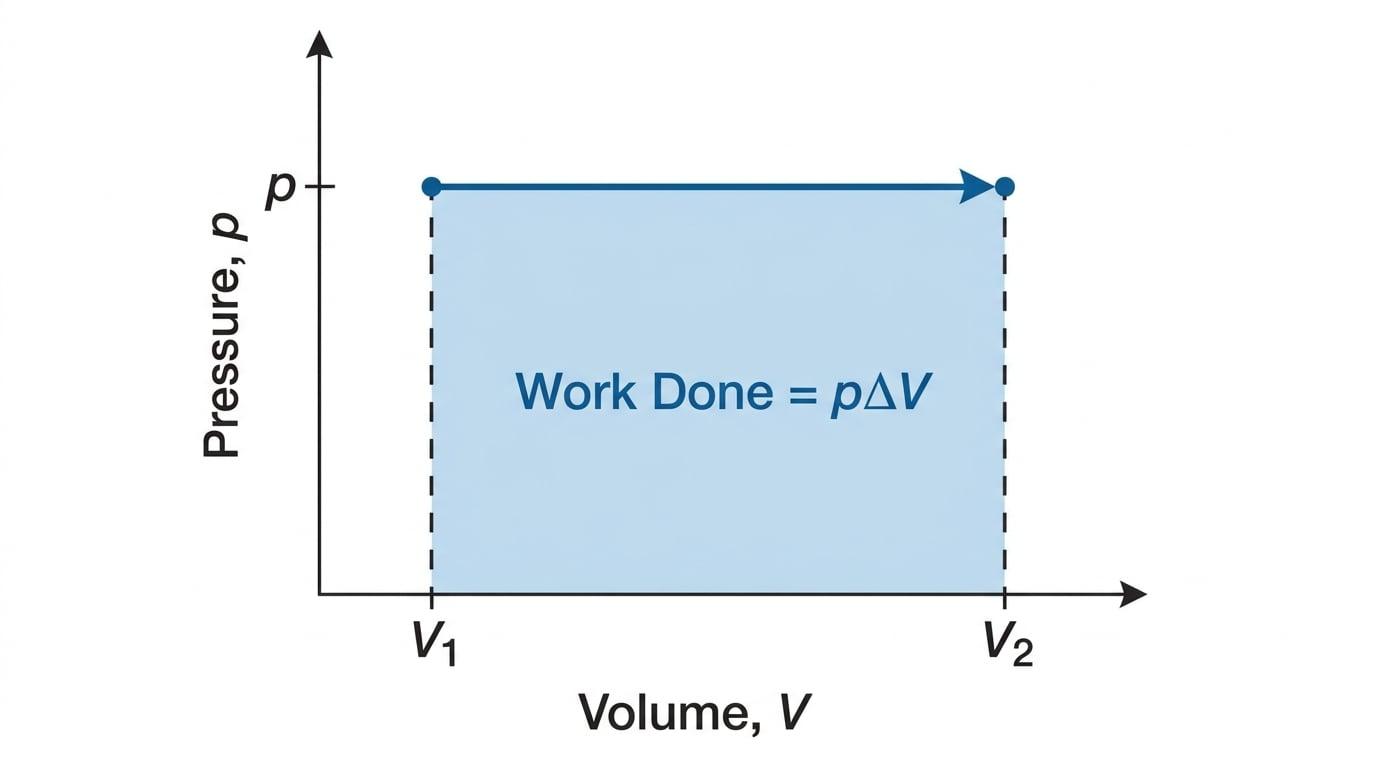
If the pressure isn't constant, you can still find the work done by looking at a ppp-VVV graph. The area under a pressure-volume graph is always equal to the work done.
Calculating work done during expansion
A cylinder with a movable piston contains a gas at a constant pressure of 1.5×10⁵ Pa1.5 \times 10^5 \text{ Pa}1.5×10⁵ Pa. The gas is heated and expands, pushing the piston outwards. Its volume increases from 3.0×10⁻³ m33.0 \times 10^{-3} \text{ m}^33.0×10⁻³ m3 to 7.5×10⁻³ m37.5 \times 10^{-3} \text{ m}^37.5×10⁻³ m3. Calculate the work done by the gas.
- First, calculate the change in volume (ΔV\Delta VΔV).
- State the formula for work done at constant pressure.
- Substitute the values into the equation.
Expansion vs Compression
If a gas expands (volume increases), the gas does work on its surroundings. If a gas is compressed (volume decreases), work is done on the gas by the surroundings. Make sure you read the physical situation carefully!
In the exam
- Always hunt for non-SI units. AQA examiners love to give pressure in kPa\text{kPa}kPa or MPa\text{MPa}MPa, volume in cm3\text{cm}^3cm3 or dm3\text{dm}^3dm3, and temperature in ∘C\text{ }^\circ\text{C} ∘C. Convert everything to Pa\text{Pa}Pa, m3\text{m}^3m3, and K\text{K}K before touching your calculator.
- Remember your volume conversions. To convert cm3\text{cm}^3cm3 to m3\text{m}^3m3, you must multiply by 10−610^{-6}10−6 (because there are 100×100×100100 \times 100 \times 100100×100×100 cubic centimetres in a cubic metre).
- Choose the right constant. If the question gives you the number of molecules (NNN), use kkk. If it gives you the number of moles (nnn), use RRR.
- Use ratios for "before and after" questions. If a fixed mass of gas changes state (e.g. moves from state 1 to state 2), you can often save time by using p1V1T1=p2V2T2\frac{p_1 V_1}{T_1} = \frac{p_2 V_2}{T_2}T1p1V1=T2p2V2 rather than finding nnn or NNN in an intermediate step.
Check yourself
- What is the difference between molar mass and molecular mass?
- What temperature scale must always be used in the ideal gas equations, and how do you convert to it from Celsius?
- How does the Boltzmann constant kkk relate to the molar gas constant RRR?
- How can you determine the work done by a gas from a pressure-volume graph?