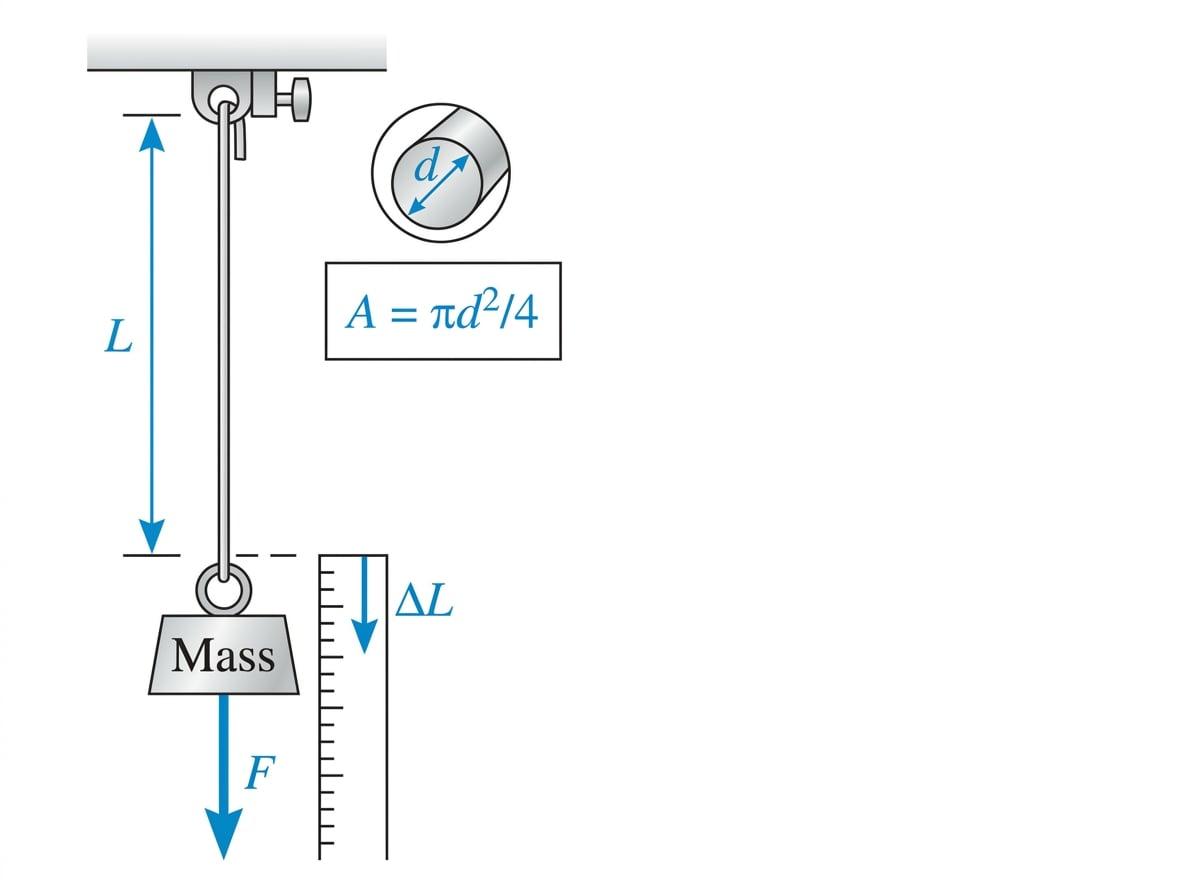
Welcome to the Young modulus! In the previous topic, you looked at Hooke's Law (F=kΔLF = k \Delta LF=kΔL), which tells us how a specific object (like a spring) behaves when you stretch it. But what if you want to compare the stiffness of copper and steel in general, regardless of their shape or thickness?
To do that, we need to strip away the dimensions of the object.
What you'll learn:
- How to calculate tensile stress and tensile strain.
- What the Young modulus is and how to calculate it.
- How to determine the Young modulus from a stress-strain graph.
- The standard practical method for measuring the Young modulus of a wire (Required Practical 4).
Moving beyond Hooke's Law
Imagine you have a thick steel cable and a thin steel guitar string. The thick cable is much harder to stretch than the thin string, so it has a much higher spring constant, kkk. But they are made of the exact same material!
To compare the materials fairly, we need to divide the force by the cross-sectional area (to adjust for thickness), and divide the extension by the original length (to adjust for how long the wire was to begin with).
This gives us two incredibly important new physics quantities: Stress and Strain.
Tensile Stress
When you apply a pulling force to a material, you are putting it under tensile stress.
Tensile Stress
Tensile stress (σ\sigmaσ) is the applied force per unit cross-sectional area.
σ=FA \sigma = \frac{F}{A} σ=AFWhere:
- FFF is the tensile force in newtons (N\text{N}N)
- AAA is the cross-sectional area in square metres (m2\text{m}^2m2)
- σ\sigmaσ is the tensile stress in pascals (Pa\text{Pa}Pa) or newtons per square metre (N m−2\text{N m}^{-2}N m−2)
Area of a wire
In A-Level exam questions, you are almost always dealing with round wires. Remember that the cross-sectional area is a circle. You can calculate it using the radius (A=πr2A = \pi r^2A=πr2) or the diameter (A=πd24A = \frac{\pi d^2}{4}A=4πd2). Since micrometers measure diameter, the diameter formula is often quicker and avoids the common mistake of forgetting to halve the diameter!
Tensile Strain
When a material is put under stress, it deforms. Tensile strain is a measure of how much it has stretched compared to its original length.
Tensile Strain
Tensile strain (ε\varepsilonε) is the extension per unit original length.
ε=ΔLL \varepsilon = \frac{\Delta L}{L} ε=LΔLWhere:
- ΔL\Delta LΔL is the extension in metres (m\text{m}m)
- LLL is the original length in metres (m\text{m}m)
- ε\varepsilonε is the tensile strain (it has no units, as it is a ratio of two lengths)
Sometimes strain is expressed as a percentage. For example, if a 2 metre wire extends by 0.02 metres, the strain is 0.010.010.01. As a percentage, this is a 1%1\%1% strain.
The Young modulus
If a material obeys Hooke's Law, the stress applied to it is directly proportional to the strain it experiences. The constant of proportionality is called the Young modulus.
The Young modulus
The Young modulus (EEE) is the ratio of tensile stress to tensile strain in the linear region of a material's elastic deformation.
E=tensile stresstensile strain=σε E = \frac{\text{tensile stress}}{\text{tensile strain}} = \frac{\sigma}{\varepsilon} E=tensile straintensile stress=εσBecause strain has no units, the Young modulus takes the units of stress: pascals (Pa\text{Pa}Pa) or N m−2\text{N m}^{-2}N m−2.
We can combine the equations for stress and strain to get a single, very useful equation for the Young modulus.
E=σεE=(FA)(ΔLL)E=FLAΔL \begin{aligned} E &= \frac{\sigma}{\varepsilon} \\ E &= \frac{\left( \frac{F}{A} \right)}{\left( \frac{\Delta L}{L} \right)} \\ E &= \frac{F L}{A \Delta L} \end{aligned} EEE=εσ=(LΔL)(AF)=AΔLFLMaterial vs Object
This is the big takeaway: The Young modulus is a property of the material itself. All solid copper wires have the same Young modulus (roughly 1.3×10¹¹ Pa1.3 \times 10^{11} \text{ Pa}1.3×10¹¹ Pa), regardless of whether they are long, short, thick, or thin. The spring constant (kkk) is a property of the specific object.
Let's look at how this appears in an exam-style calculation.
Calculating the Young modulus
A steel wire of original length 2.50 m and diameter 0.40 mm is suspended from a rigid support. A mass of 4.0 kg is hung from the free end, causing the wire to extend by 1.8 mm. Calculate the Young modulus of the steel. Give your answer to 2 significant figures. (g=9.81 m s−2g = 9.81 \text{ m s}^{-2}g=9.81 m s−2)
- First, convert all units to standard SI units. Diameter d=0.40×10⁻³ md = 0.40 \times 10^{-3} \text{ m}d=0.40×10⁻³ m Extension ΔL=1.8×10⁻³ m\Delta L = 1.8 \times 10^{-3} \text{ m}ΔL=1.8×10⁻³ m Length L=2.50 mL = 2.50 \text{ m}L=2.50 m
- Calculate the cross-sectional area AAA.
- Calculate the applied force FFF (the weight of the mass).
- Substitute all values into the Young modulus equation.
- Round to 2 significant figures (as given in the question data). The Young modulus is 4.3×10¹¹ Pa4.3 \times 10^{11} \text{ Pa}4.3×10¹¹ Pa.
Stress-Strain Graphs
Just as you plotted Force-Extension graphs for springs, you can plot Stress-Strain graphs for materials.
Because stress is proportional to strain up to the limit of proportionality, the initial part of a stress-strain graph for a metal is a straight line through the origin.
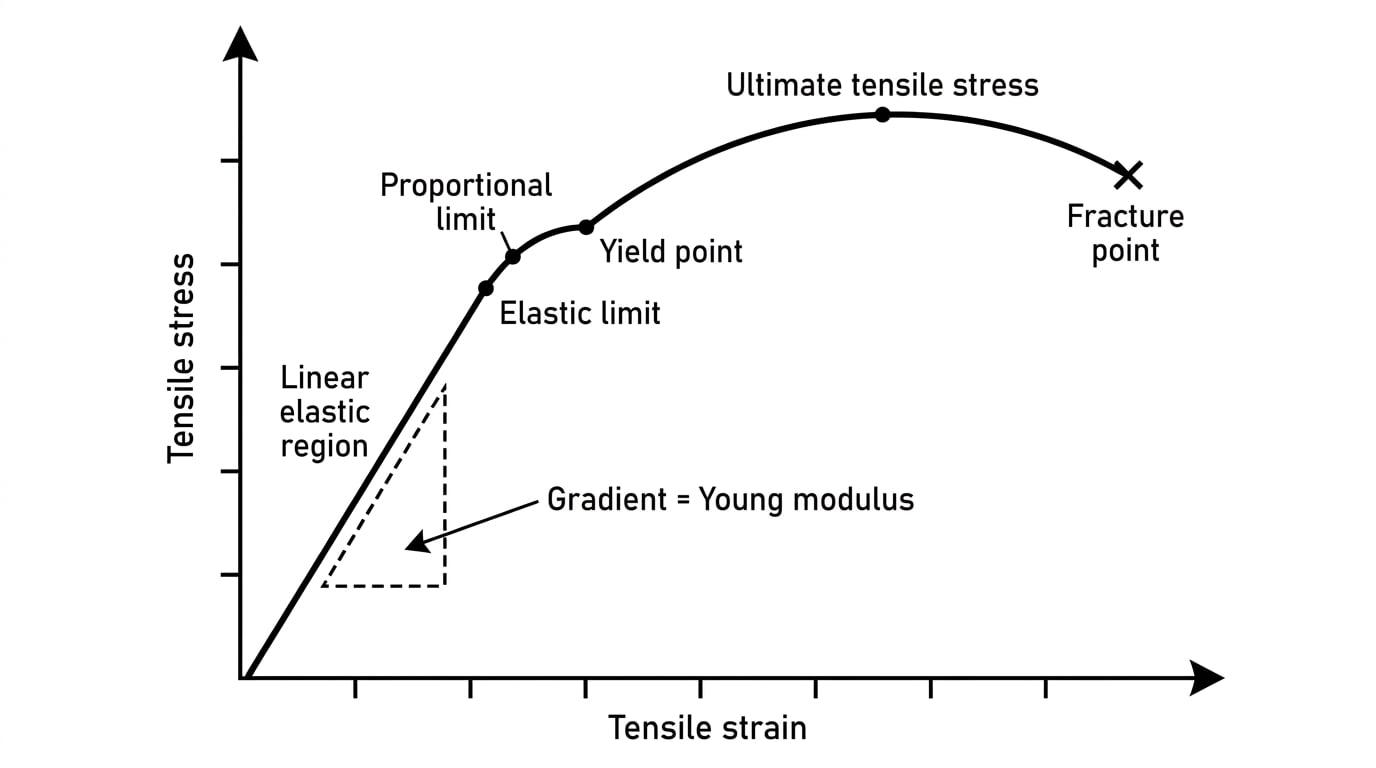
Look at the equation for a straight line: y=mx+cy = mx + cy=mx+c. If we plot stress (σ\sigmaσ) on the y-axis and strain (ε\varepsilonε) on the x-axis, the y-intercept ccc is zero. This leaves us with σ=mε\sigma = m \varepsilonσ=mε.
Comparing this to our definition E=σ/εE = \sigma / \varepsilonE=σ/ε, we can clearly see that: The gradient of the linear section of a stress-strain graph is equal to the Young modulus.
Watch out for axis prefixes
AQA examiners love to hide standard form prefixes on graph axes. The y-axis (stress) will almost always be in MPa\text{MPa}MPa (106 Pa10^6 \text{ Pa}106 Pa) or GPa\text{GPa}GPa (109 Pa10^9 \text{ Pa}109 Pa). The x-axis (strain) is sometimes given as ×10−3\times 10^{-3}×10−3 or as a percentage. Always check the axis labels carefully before calculating a gradient!
Required Practical 4: Measuring the Young modulus
You need to know how to determine the Young modulus of a metal wire using a simple experimental method.
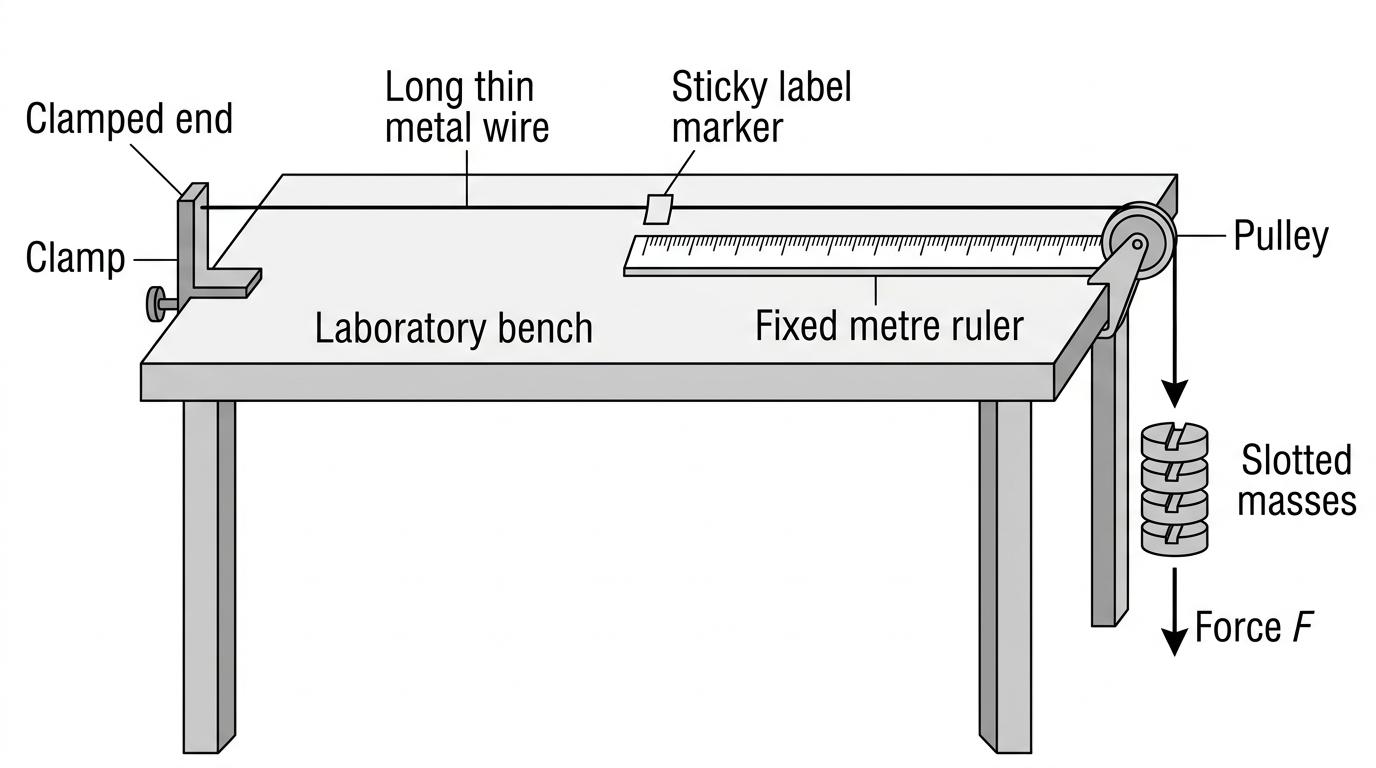
There are two common setups: a vertical setup (often using Searle's apparatus with a control wire) and a horizontal bench setup. Both rely on the same fundamental measurements.
The Method
- Measure the original length (LLL): Clamp the wire securely. Use a metre ruler to measure the length of the wire from the clamp to the marker sticker. A longer wire reduces the percentage uncertainty in the extension measurement.
- Measure the diameter (ddd): Use a micrometer screw gauge to measure the diameter of the wire. Because the wire might not be perfectly cylindrical, measure the diameter at at least three different points along the wire, and at different angles, then calculate an average.
- Apply a load (FFF): Hang a mass hangar on the end of the wire. The tension force is F=mgF = mgF=mg.
- Measure the extension (ΔL\Delta LΔL): Record the new position of the marker against the fixed ruler (or a vernier scale/travelling microscope for higher precision). The extension is the new position minus the original position.
- Repeat: Add masses one by one (e.g., in 500 g increments) and record the extension each time.
Analysing the Data
To find the Young modulus from your experimental data, you could calculate EEE for every single mass and find an average, but AQA expects you to use a graphical method.
Graphical analysis
- Calculate the cross-sectional area of the wire, A=πd24A = \frac{\pi d^2}{4}A=4πd2.
- For each mass, calculate the force applied (F=mgF = mgF=mg).
- You have two choices for the graph:
- Method A (Force-Extension): Plot FFF on the y-axis and ΔL\Delta LΔL on the x-axis. Find the gradient of the straight line portion (F/ΔLF / \Delta LF/ΔL). The Young modulus is then E=gradient×LAE = \text{gradient} \times \frac{L}{A}E=gradient×AL.
- Method B (Stress-Strain): Calculate stress (F/AF/AF/A) and strain (ΔL/L\Delta L/LΔL/L) for each point. Plot stress on the y-axis and strain on the x-axis. The gradient of the straight line is exactly equal to the Young modulus, EEE.
Confusing the gradient
If you plot Force against Extension, the gradient is not the Young modulus. The gradient is the spring constant, kkk. You must multiply the gradient by LA\frac{L}{A}AL to find EEE.
In the exam
- Hunt for prefixes: Whenever you are given a stress value, immediately look for "M" (mega, 10610^6106) or "G" (giga, 10910^9109). Look for "mm" in diameters and convert to metres (×10−3\times 10^{-3}×10−3) before squaring it for area.
- Micrometer justification: If asked why you use a micrometer to measure diameter instead of a ruler, state that it has a much higher resolution (typically 0.01 mm), which significantly reduces the percentage uncertainty in the measurement.
- Multiple diameter readings: If asked to outline the practical method, always explicitly state that you measure the diameter at several points and average them. This is a very common marking point for Required Practical 4.
- Sanity checking your answer: The Young modulus for metals is huge. Your final answer should almost always be in the region of 101010^{10}1010 to 1011 Pa10^{11} \text{ Pa}1011 Pa. If you get 450 Pa450 \text{ Pa}450 Pa, you've likely missed a milli- or micro- conversion!
Check yourself
- Can you write down the equations defining tensile stress and tensile strain from memory?
- Why does a stress-strain graph allow us to compare two different materials better than a force-extension graph?
- When measuring the diameter of a wire in the required practical, why should you take measurements at different points along the wire?
- On a stress-strain graph, what graphical feature represents the Young modulus?