

Welcome to the bulk properties of solids! In mechanics so far, we've often treated objects as perfect, rigid blocks that don't bend or break. In reality, everything stretches, squashes, or snaps when you push it hard enough.
What you'll learn in this topic:
- How to define and calculate density.
- How springs behave under tension (Hooke's Law) and how much energy they store.
- The difference between a whole object's stiffness and a material's inherent properties (Stress and Strain).
- How to read force-extension and stress-strain graphs to identify brittle and plastic materials.
- How engineers use these concepts to design safe, ethical transport.
Let's build this up step by step.
1. Density
Before we stretch anything, we need a basic property of solids: density. You will have met this at GCSE, but it remains a crucial foundation at A-Level.
Density
Density (ρ\rhoρ) is the mass per unit volume of a material.
ρ=mV \rho = \frac{m}{V} ρ=VmWhere mmm is mass in kg, VVV is volume in m3\text{m}^3m3, and ρ\rhoρ is density in kg m−3\text{kg m}^{-3}kg m−3.
When dealing with regular shapes, you can calculate the volume geometrically (e.g. V=l×w×hV = l \times w \times hV=l×w×h for a block, or V=πr2lV = \pi r^2 lV=πr2l for a wire). For irregular shapes, you might estimate the volume by submerging the object in water and measuring the displaced volume.
2. Hooke's Law and Springs
If you hang a weight from a spring, it extends. For many objects, the extension is directly proportional to the force applied, provided you don't stretch it too far.
Hooke's Law
Hooke's Law states that the extension of an elastic object is directly proportional to the force applied to it, up to the limit of proportionality.
F=kΔL F = k\Delta L F=kΔLWhere FFF is the force in N, ΔL\Delta LΔL is the extension in m, and kkk is the spring constant (or stiffness) in N m−1\text{N m}^{-1}N m−1.
The greater the value of kkk, the stiffer the spring. You need more force to get the same extension.
What happens if you pull too hard?
Eventually, Hooke's Law breaks down. If you plot a graph of Force against Extension, it starts as a straight line through the origin, but eventually begins to curve.
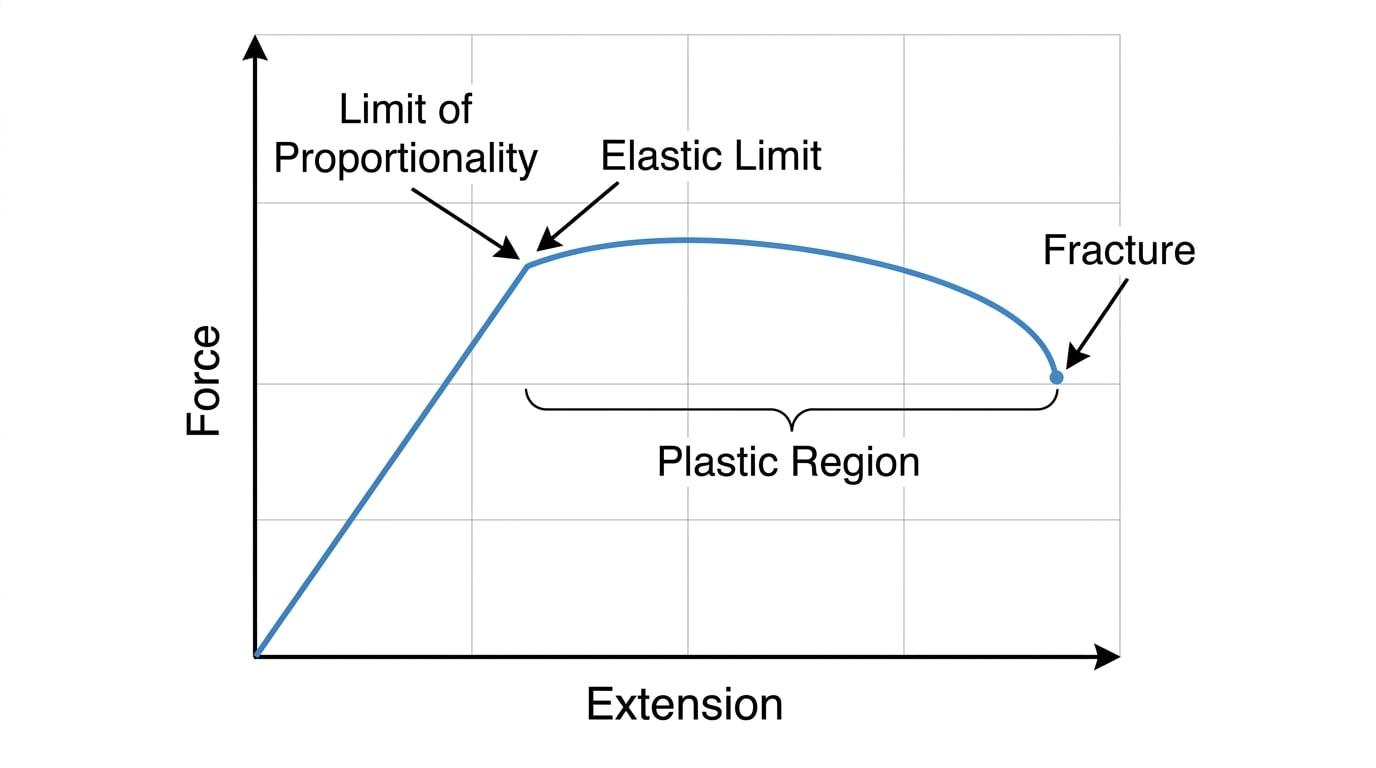
There are two critical points on this graph you must know:
- Limit of proportionality: The exact point where the graph stops being a straight line. Hooke's law is no longer obeyed beyond this point.
- Elastic limit: The maximum force you can apply without causing permanent deformation. If you stretch an object beyond its elastic limit, it will not return to its original length when the force is removed. This permanent stretch is called plastic deformation.
Confusing the two limits
Students often use "limit of proportionality" and "elastic limit" interchangeably. They are technically different! The limit of proportionality always happens slightly before the elastic limit. A material can stop obeying Hooke's Law (it curves) but still return to its original length.
3. Elastic Strain Energy
When you stretch a spring, you are doing work. This work is stored in the spring as elastic strain energy.
Area under the graph
The work done (and therefore the elastic strain energy stored) is equal to the area under the force–extension graph.
For the straight-line portion of the graph (where Hooke's Law is obeyed), the area is a triangle. The base is ΔL\Delta LΔL and the height is FFF.
E=12FΔL E = \frac{1}{2} F \Delta L E=21FΔLBecause F=kΔLF = k\Delta LF=kΔL, we can substitute FFF into the energy equation to get a second, incredibly useful version:
E=12k(ΔL)2 E = \frac{1}{2} k (\Delta L)^2 E=21k(ΔL)2Energy Conservation in Action
Springs are fantastic for storing energy and releasing it as Kinetic Energy (KE) or Gravitational Potential Energy (GPE). If a spring is used to launch a projectile vertically, the elastic strain energy converts first to kinetic energy, and then to GPE as the projectile climbs.
Vertical spring launch
A spring with a stiffness of 400 N m−1400 \text{ N m}^{-1}400 N m−1 is compressed by 0.05 m0.05 \text{ m}0.05 m. A ball of mass 0.15 kg0.15 \text{ kg}0.15 kg is placed on top. The spring is released. Calculate the maximum height the ball reaches above its starting position. Assume air resistance is negligible.
- First, calculate the elastic strain energy initially stored in the spring using E=12k(ΔL)2E = \frac{1}{2}k(\Delta L)^2E=21k(ΔL)2.
- State the energy conversion. By the principle of conservation of energy, all the elastic strain energy converts into gravitational potential energy at the maximum height (since the ball stops momentarily, KE is zero).
- Rearrange for Δh\Delta hΔh and substitute the values (using g=9.81 m s−2g = 9.81 \text{ m s}^{-2}g=9.81 m s−2).
4. Stress and Strain
The spring constant kkk is great for a specific object (like "that one specific spring on your desk"). But what if we want to compare the stiffness of copper vs steel?
A thick steel wire is harder to stretch than a thin steel wire. A long steel wire stretches more than a short steel wire under the same force. To compare materials, we need to remove the dimensions (length and thickness) from the equation. We do this by calculating Stress and Strain.
Tensile Stress
Tensile stress (σ\sigmaσ) is the force applied per unit cross-sectional area.
σ=FA \sigma = \frac{F}{A} σ=AFWhere FFF is the tension force in N, and AAA is the cross-sectional area in m2\text{m}^2m2. The unit of stress is the Pascal (Pa\text{Pa}Pa), which is equivalent to N m−2\text{N m}^{-2}N m−2.
Tensile Strain
Tensile strain (ε\varepsilonε) is the extension per unit original length.
ε=ΔLL \varepsilon = \frac{\Delta L}{L} ε=LΔLWhere ΔL\Delta LΔL is the extension in m, and LLL is the original length in m. Strain is a ratio of two lengths, so it has no units.
Area of a wire
In exam questions, wires are almost always cylindrical. To find the cross-sectional area AAA, you will usually be given the diameter ddd. Remember to halve it to get the radius rrr, and then use A=πr2A = \pi r^2A=πr2.
5. Material Behaviours and Stress-Strain Curves
Just as we plotted force against extension for a specific object, we can plot Stress against Strain for a specific material. The shape of this curve tells us how the material behaves under extreme tension.
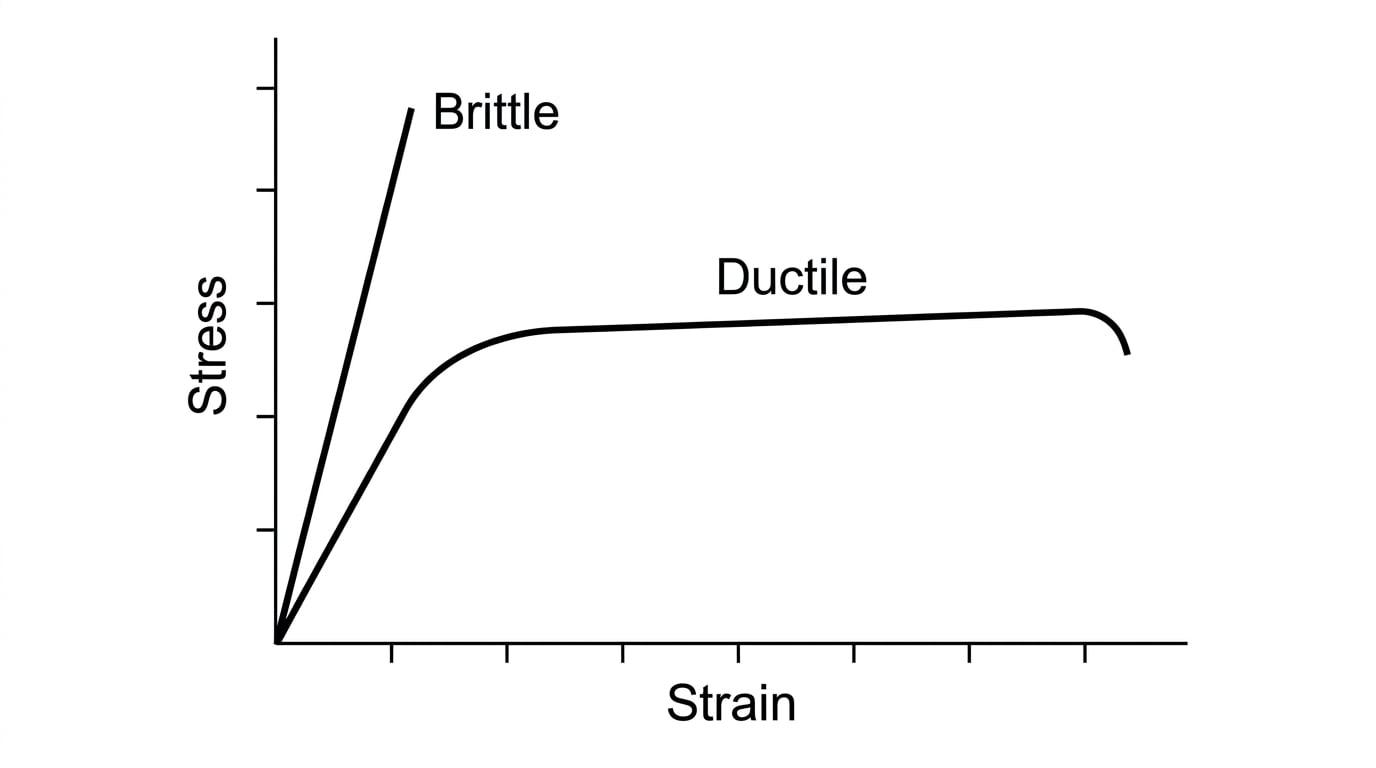
Let's define some key behaviours shown on these graphs:
- Elastic behaviour: The material returns to its original length when the stress is removed.
- Plastic behaviour: The material permanently deforms. On a molecular level, layers of atoms are sliding past each other.
- Ductile: A ductile material (like copper) has a large plastic region. It can be easily drawn into wires because it stretches a lot before breaking.
- Brittle: A brittle material (like glass or cast iron) snaps without any noticeable plastic deformation. Its graph is a steep straight line that just abruptly ends. It doesn't "give" before it shatters.
- Fracture: The point where the material physically snaps.
- Breaking stress (Ultimate Tensile Stress): The maximum stress a material can withstand before it breaks. It is the peak of the stress-strain curve.
Calculating Breaking Stress
A steel wire of original length 2.5 m2.5 \text{ m}2.5 m and diameter 0.8 mm0.8 \text{ mm}0.8 mm hangs vertically. It breaks when a mass of 120 kg120 \text{ kg}120 kg is attached to the end. Calculate the breaking stress of the steel.
- First, calculate the cross-sectional area in m2\text{m}^2m2. The diameter is 0.8 mm0.8 \text{ mm}0.8 mm, so the radius is 0.4 mm=0.4×10⁻³ m0.4 \text{ mm} = 0.4 \times 10^{-3} \text{ m}0.4 mm=0.4×10⁻³ m.
- Calculate the force (weight) that caused the wire to break.
- Calculate the breaking stress using σ=FA\sigma = \frac{F}{A}σ=AF.
6. Ethical Transport Design
Physics isn't just about abstract wires; it saves lives. AQA specifically wants you to appreciate how energy conservation and material properties apply to ethical transport design.
When a car crashes, its massive kinetic energy has to go somewhere.
- If the car is completely rigid, the kinetic energy is transferred rapidly to the passengers, causing huge forces and lethal injuries.
- Modern cars are designed with crumple zones. These are parts of the car chassis engineered to undergo plastic deformation during a crash.
By deforming plastically, the crumple zone does two things:
- It absorbs a huge amount of the kinetic energy (converting it into the work done to permanently deform the metal, and heat).
- It increases the time taken for the car to come to a stop, which reduces the deceleration and therefore reduces the force on the passengers.
The Ethical Balance: Engineers face ethical decisions. They must balance passenger safety with the mass of the vehicle (heavier, highly-reinforced cars burn more fuel and release more emissions) and cost (making a perfectly safe car might make it completely unaffordable for the average family).
In the exam
- Watch your prefixes: Strain and extension questions are notorious for mixing units. You will see lengths in metres, extensions in millimetres, diameters in micrometres, and stresses in MegaPascals (MPa\text{MPa}MPa). Convert absolutely everything to standard SI units (m\text{m}m, N\text{N}N, Pa\text{Pa}Pa) before pressing a button on your calculator.
- Squaring errors: When using A=πr2A = \pi r^2A=πr2, don't forget to square the ×10−3\times 10^{-3}×10−3 part of the radius if you are converting from millimetres! Writing (0.5×10⁻³)2(0.5 \times 10^{-3})^2(0.5×10⁻³)2 is safer than doing it in your head.
- Read the graph axes: If you are asked to find energy from a graph, check the xxx-axis. Is it in m\text{m}m or mm\text{mm}mm? If it's in mm\text{mm}mm, your area calculation will be off by a factor of 1000 unless you convert it.
Check yourself
- Can you write down the equations for density, stress, and strain from memory, including their SI units?
- What is the difference between the limit of proportionality and the elastic limit?
- How would you spot a brittle material from its stress-strain curve compared to a ductile one?
- Why do crumple zones in cars rely on plastic deformation rather than elastic deformation?
