What you'll learn
- Why the traditional wave model of light couldn't explain how metals emit electrons.
- How Einstein's photon model solves the mystery using threshold frequency and the work function.
- How to calculate the maximum kinetic energy of emitted electrons using Einstein's photoelectric equation.
- What stopping potential is and how it links to electron energy.
The gold-leaf electroscope mystery
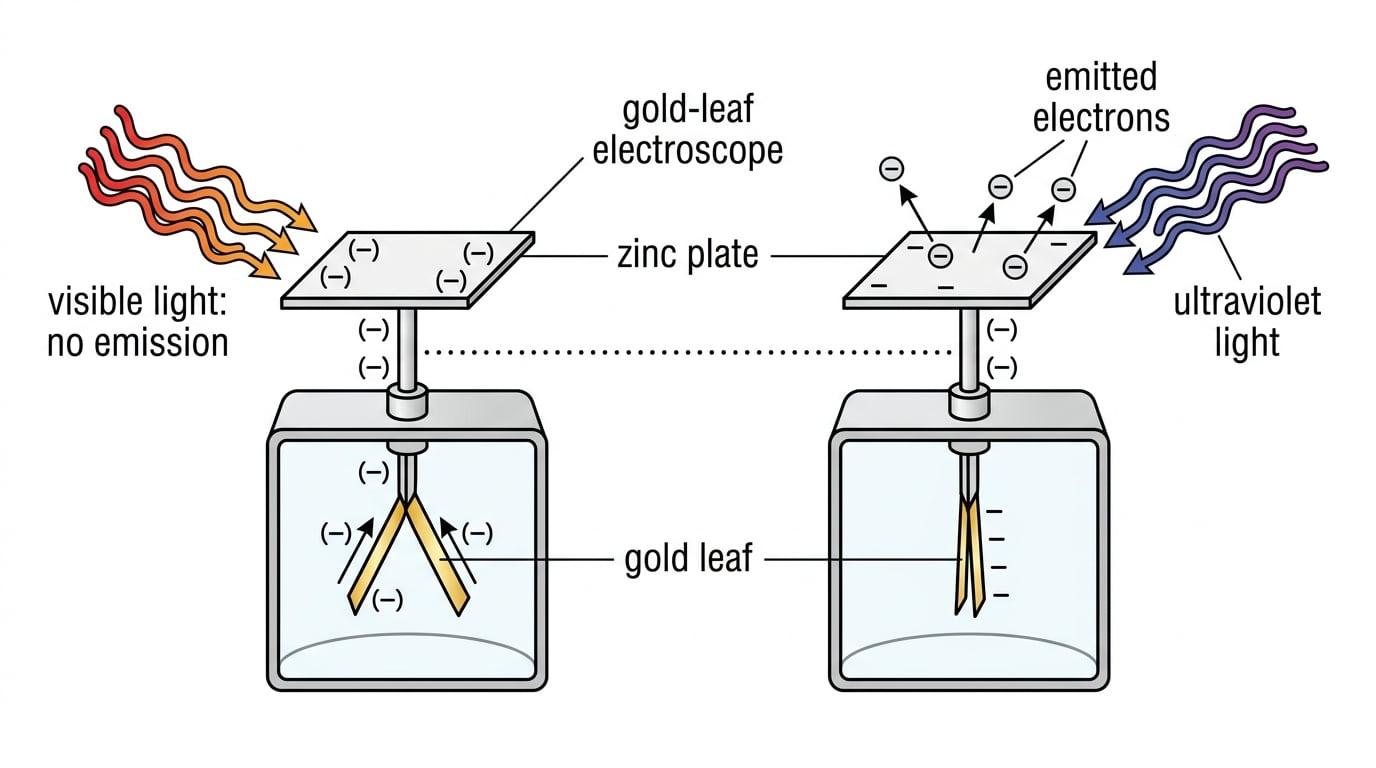
If you shine visible light onto a negatively charged zinc plate, absolutely nothing happens. However, if you shine ultraviolet (UV) light onto the exact same plate, it rapidly loses its negative charge. This phenomenon is known as the photoelectric effect.
When electromagnetic radiation of a high enough frequency hits the surface of a metal, it ejects electrons from the surface. These ejected electrons are called photoelectrons.
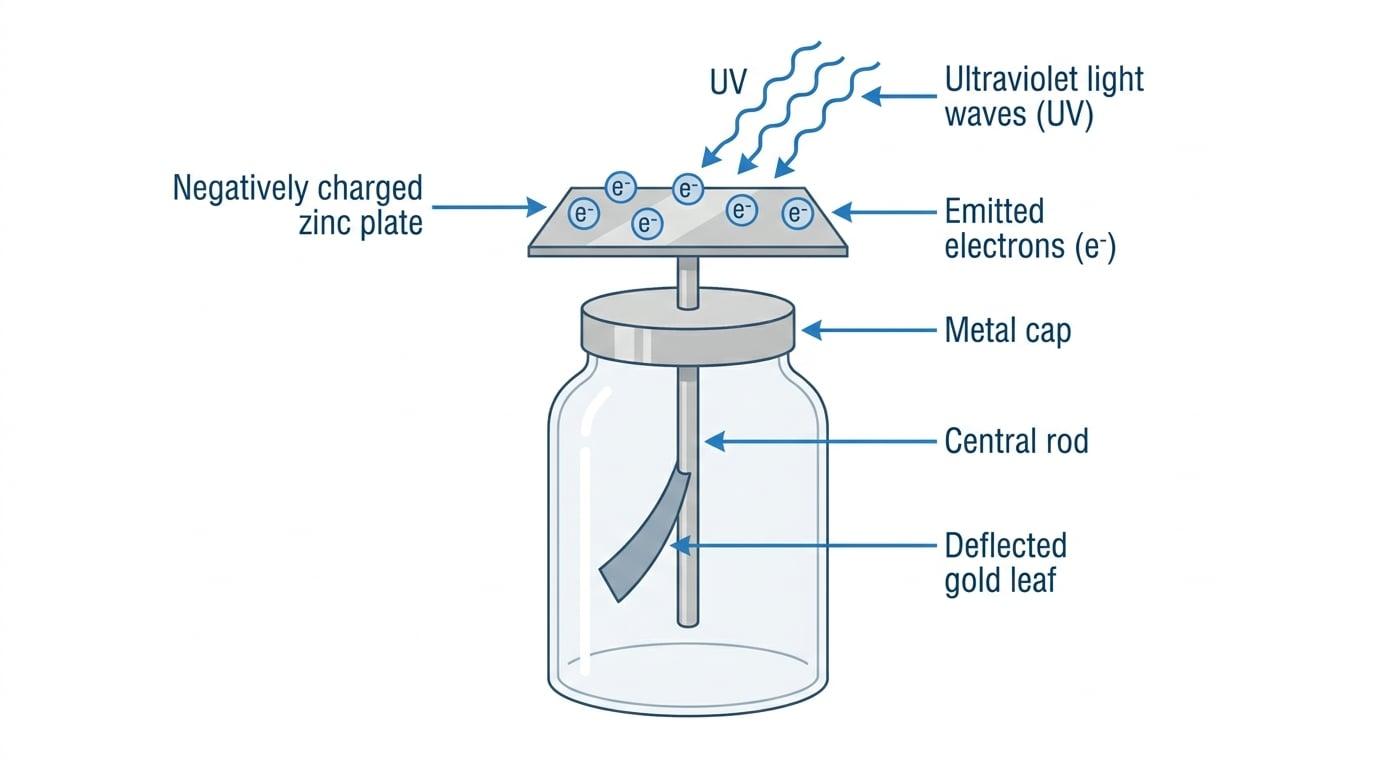
A classic way to demonstrate this in the lab is using a gold-leaf electroscope. When the zinc plate on top of the electroscope is given a negative charge, the gold leaf is repelled by the metal stem and sticks out. When UV light hits the plate, electrons are emitted, the plate loses its negative charge, and the gold leaf instantly falls back down.
The failure of the wave model
Before the photoelectric effect was understood, physicists believed light was a continuous wave. But the wave model completely failed to explain the results of the electroscope experiment.
According to the wave model of light:
- Energy should build up over time: If you shine a low-frequency light on the metal for long enough, the wave energy should eventually accumulate and give an electron enough energy to escape.
- Intensity should matter: A very bright, low-frequency light should be able to eject electrons because it carries more total energy per second than a dim light.
However, experiments showed the exact opposite:
- Emission is instantaneous: If emission is going to happen, it happens the exact millisecond the light hits the metal. There is no build-up time.
- Frequency is everything: If the light's frequency is too low, no electrons are ever emitted—no matter how bright the light is or how long you leave it shining.
The photon explanation
To solve this problem, Albert Einstein proposed a radical idea: light doesn't arrive as a continuous wave, but as a stream of discrete, indivisible packets of energy called photons.
The energy of a single photon depends entirely on its frequency, given by the equation E=hfE = hfE=hf, where hhh is the Planck constant and fff is the frequency of the radiation.
The vending machine
Think of an electron in a metal like a vending machine that only accepts a single £1 coin. You want a snack, but you only have a handful of 10p coins. Even if you have fifty 10p coins (high-intensity, low-frequency light), the machine won't accept them because it only takes exactly one coin per transaction. The interaction in the photoelectric effect is strictly one-to-one: a single photon interacts with exactly one electron.
Because of this one-to-one interaction, an electron can only escape if it absorbs a single photon that contains enough energy to break the bonds holding the electron inside the metal.
Work function and threshold frequency
Electrons near the surface of a metal are trapped in a potential well. They need a specific minimum amount of energy to escape.
Work function
The work function (ϕ\phiϕ) of a material is the minimum energy required to completely remove an electron from the surface of the metal. It is typically measured in joules (J) or electronvolts (eV).
Because the energy of a photon is directly proportional to its frequency, this minimum energy requirement means there must also be a minimum frequency requirement.
Threshold frequency
The threshold frequency (f0f_0f0) is the minimum frequency of incident electromagnetic radiation required to emit photoelectrons from the surface of a metal.
If the frequency of the incident light is exactly equal to the threshold frequency, the photon provides just enough energy to overcome the work function, leaving the electron with zero kinetic energy. We can link these two concepts mathematically:
ϕ=hf0\phi = h f_0ϕ=hf0Einstein's photoelectric equation
What happens if a photon has more energy than the work function? The principle of conservation of energy tells us that the leftover energy must go somewhere. It becomes the kinetic energy of the emitted photoelectron.
This gives us Einstein's photoelectric equation:
hf=ϕ+Ek(max)hf = \phi + E_{k(\max)}hf=ϕ+Ek(max)Where:
- hfhfhf is the total energy of the incoming photon.
- ϕ\phiϕ is the work function of the metal.
- Ek(max)E_{k(\max)}Ek(max) is the maximum kinetic energy of the emitted photoelectron.
Missing the 'max' in kinetic energy
A common error is assuming all emitted electrons have the same kinetic energy. The equation gives the maximum possible kinetic energy (Ek(max)E_{k(\max)}Ek(max)). Electrons that are deeper inside the metal require more energy than the work function to fight their way to the surface. Therefore, they will be emitted with less kinetic energy than the maximum.
Calculating maximum kinetic energy
Light of frequency 1.50×10¹⁵ Hz1.50 \times 10^{15} \text{ Hz}1.50×10¹⁵ Hz is shone onto a zinc plate with a work function of 6.88×10⁻¹⁹ J6.88 \times 10^{-19} \text{ J}6.88×10⁻¹⁹ J. Calculate the maximum kinetic energy of the emitted photoelectrons. The Planck constant is 6.63×10⁻³⁴ J s6.63 \times 10^{-34} \text{ J s}6.63×10⁻³⁴ J s.
- First, calculate the total energy of the incident photons using E=hfE = hfE=hf. E=6.63×10−34×1.50×1015E=9.945×10⁻¹⁹ J\begin{aligned} E &= 6.63 \times 10^{-34} \times 1.50 \times 10^{15} \\ E &= 9.945 \times 10^{-19} \text{ J} \end{aligned}EE=6.63×10−34×1.50×1015=9.945×10⁻¹⁹ J
- State Einstein's photoelectric equation and rearrange it to make maximum kinetic energy the subject. hf=ϕ+Ek(max)Ek(max)=hf−ϕ\begin{aligned} hf &= \phi + E_{k(\max)} \\ E_{k(\max)} &= hf - \phi \end{aligned}hfEk(max)=ϕ+Ek(max)=hf−ϕ
- Substitute your values to find the final answer. Ek(max)=9.945×10⁻¹⁹−6.88×10⁻¹⁹Ek(max)=3.065×10⁻¹⁹ J\begin{aligned} E_{k(\max)} &= 9.945 \times 10^{-19} - 6.88 \times 10^{-19} \\ E_{k(\max)} &= 3.065 \times 10^{-19} \text{ J} \end{aligned}Ek(max)Ek(max)=9.945×10⁻¹⁹−6.88×10−19=3.065×10⁻¹⁹ J
Stopping potential
In a laboratory, we cannot easily measure the speed of individual tiny electrons flying through a vacuum. Instead, physicists measure the maximum kinetic energy using an electric field.
If we place a negatively charged metal plate in front of the emitted photoelectrons, the electric field will repel them. By turning up the negative voltage on this plate until even the fastest, most energetic electrons are stopped and turned back, we can measure their energy.
Stopping potential
The stopping potential (VsV_sVs) is the minimum potential difference required to stop the fastest moving photoelectrons entirely.
The work done by the electric field to stop the electron is equal to the electron's initial maximum kinetic energy. The work done on a charge moving through a potential difference is W=QVW = QVW=QV. For an electron, the charge is the elementary charge (eee). This gives us the equation:
Ek(max)=eVsE_{k(\max)} = e V_sEk(max)=eVsCalculating stopping potential
The maximum kinetic energy of photoelectrons emitted from a sodium surface is 2.40×10⁻¹⁹ J2.40 \times 10^{-19} \text{ J}2.40×10⁻¹⁹ J. Calculate the stopping potential required to prevent these electrons from reaching an anode. The elementary charge is 1.60×10⁻¹⁹ C1.60 \times 10^{-19} \text{ C}1.60×10⁻¹⁹ C.
- Recall the equation linking maximum kinetic energy to stopping potential. Ek(max)=eVsE_{k(\max)} = e V_sEk(max)=eVs
- Rearrange the equation to make stopping potential VsV_sVs the subject. Vs=Ek(max)eV_s = \frac{E_{k(\max)}}{e}Vs=eEk(max)
- Substitute the given kinetic energy and the elementary charge to calculate the voltage. Vs=2.40×10−191.60×10⁻¹⁹Vs=1.50 V\begin{aligned} V_s &= \frac{2.40 \times 10^{-19}}{1.60 \times 10^{-19}} \\ V_s &= 1.50 \text{ V} \end{aligned}VsVs=1.60×10−192.40×10−19=1.50 V
Graphical representation
AQA frequently tests your mathematical skills by asking you to interpret a graph of maximum kinetic energy Ek(max)E_{k(\max)}Ek(max) against frequency fff.
If we rearrange the photoelectric equation to make Ek(max)E_{k(\max)}Ek(max) the subject, we get:
Ek(max)=hf−ϕE_{k(\max)} = hf - \phiEk(max)=hf−ϕIf we compare this to the equation of a straight line, y=mx+cy = mx + cy=mx+c:
- yyy is Ek(max)E_{k(\max)}Ek(max)
- xxx is fff
- mmm (the gradient) is hhh
- ccc (the y-intercept) is −ϕ-\phi−ϕ
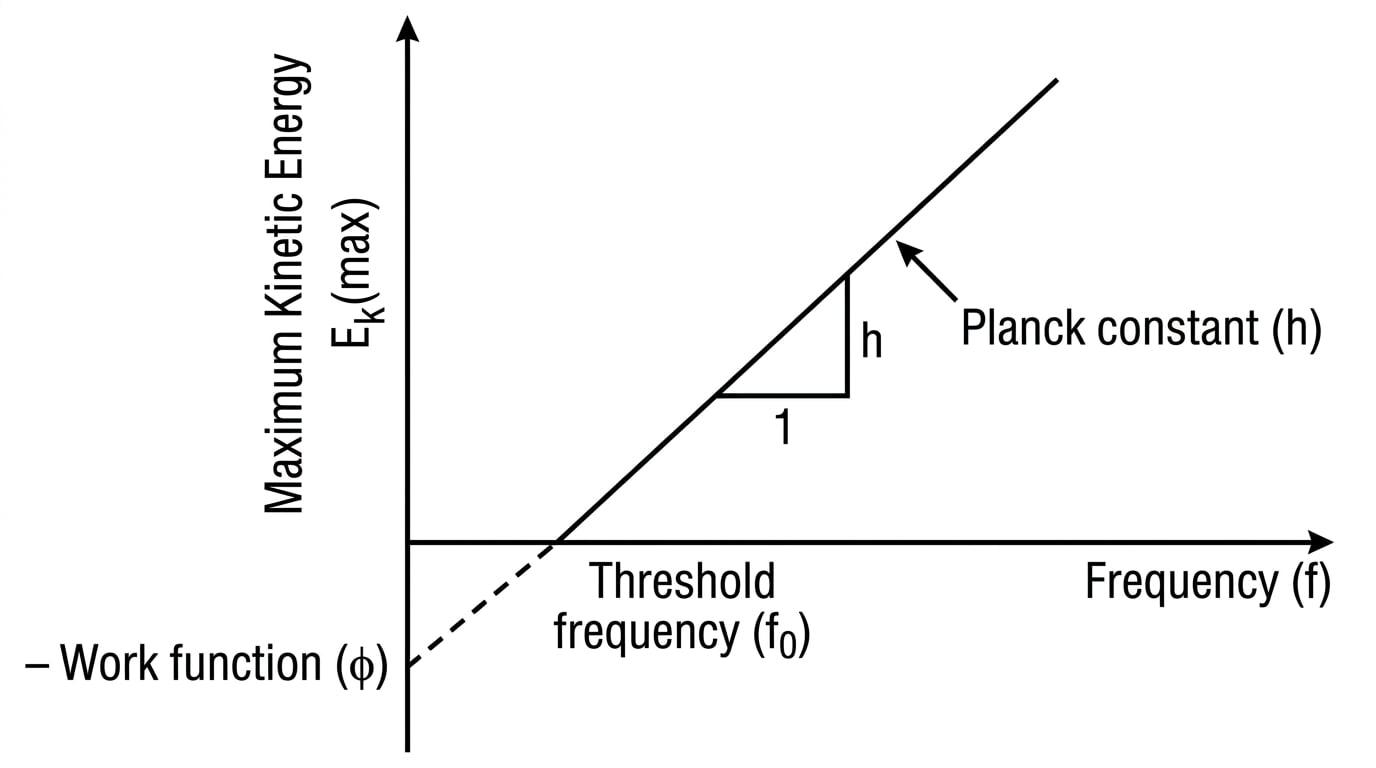
Because the Planck constant (hhh) is a universal constant, the gradient of this graph is identical for every single metal in the universe. If you plot lines for different metals on the same axes, they will always be perfectly parallel. The only difference is that metals with higher work functions will have lines shifted further to the right (a higher threshold frequency).
Reading the graph
The line stops at the x-axis because you cannot have a negative kinetic energy (the electron simply isn't emitted). However, you can use a ruler to extrapolate the dashed line backwards to find the y-intercept, which gives you the negative value of the work function!
In the exam
- When answering written word questions about why the wave theory fails, clearly state the "one-to-one" nature of photon-electron interactions.
- If an AQA question asks how to find the Planck constant from an Ek(max)E_{k(\max)}Ek(max) against fff graph, state explicitly that you would "draw a line of best fit and calculate its gradient".
- Watch out for units! Energy is often given in electronvolts (eV) instead of joules (J) in AQA questions. Always check if you need to multiply by 1.60×10−191.60 \times 10^{-19}1.60×10⁻¹⁹ to convert eV to J before using E=hfE = hfE=hf.
Check yourself
- Can you explain why increasing the intensity of light below the threshold frequency still results in zero electrons being emitted?
- What physical constant does the gradient of an Ek(max)E_{k(\max)}Ek(max) against frequency graph represent?
- Why does the photoelectric equation calculate the maximum kinetic energy rather than the exact kinetic energy of every emitted electron?
- How is the stopping potential related to the maximum kinetic energy of the photoelectrons?