What you'll learn:
- The core conservation laws that govern all particle interactions.
- How to track the "change of quark character" during beta decay.
- How to use conservation laws to prove whether an interaction is possible.
- How to identify an unknown particle in a reaction equation.
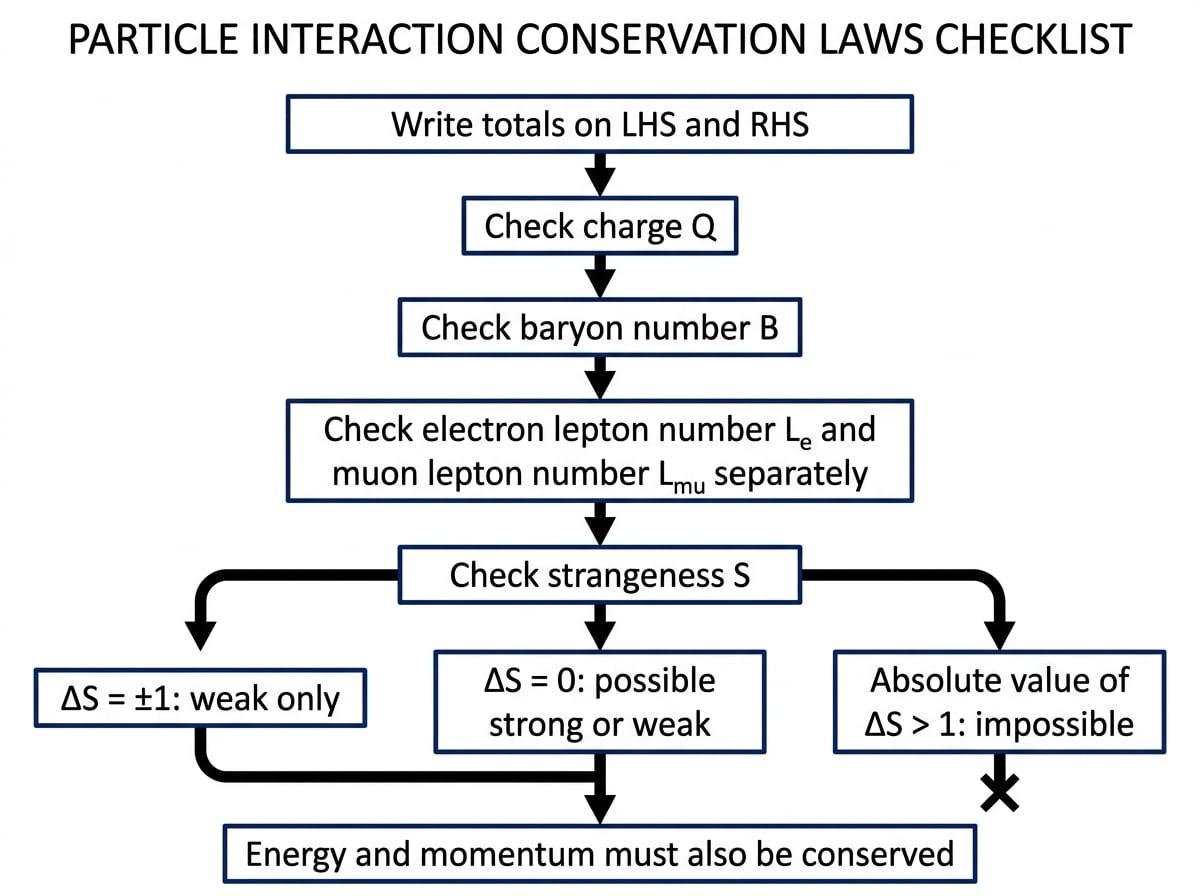
In classical physics, you learn that energy and momentum are always conserved. In particle physics, the universe has a few extra accounting books it insists on keeping balanced. By checking these "books", you can predict whether a specific particle interaction can happen, or figure out the identity of a missing particle.
The Absolute Rules
For any particle interaction to happen, several quantities must be strictly conserved. If even one of these is broken, the interaction is physically impossible.
Conservation Law
A rule stating that the total value of a specific quantity must remain exactly the same before and after an interaction. The sum of the values on the left-hand side (LHS) of the equation must equal the sum on the right-hand side (RHS).
The absolute quantities you must always check are:
- Charge (QQQ): The total electrical charge.
- Baryon Number (BBB): The total number of baryons (where anti-baryons count as −1-1−1).
- Lepton Number (LLL): This must be conserved for each specific branch of the lepton family. You must check the electron lepton number (LeL_eLe) and the muon lepton number (LμL_\muLμ) completely separately.
- Energy and Momentum: Total mass-energy and total momentum remain constant (though mass can become energy and vice versa).
There is one "conditional" rule:
- Strangeness (SSS): Strangeness is conserved in strong interactions, but it can change by 000, +1+1+1, or −1-1−1 in weak interactions.
Beta Decay and Quark Changes
Let's apply these rules to something you've seen before: beta decay. The weak interaction is responsible for beta decay, and it is unique because it is the only force that can change one "flavour" (type) of quark into another.
Beta-Minus (β−\beta^-β−) Decay
In β−\beta^-β− decay, a neutron turns into a proton, emitting an electron and an electron antineutrino.
- A neutron is made of one up quark and two down quarks (udd).
- A proton is made of two up quarks and one down quark (uud).
For a neutron to become a proton, one down quark must change into an up quark.
d→u+e−+νˉe \text{d} \to \text{u} + e^- + \bar{\nu}_e d→u+e−+νˉeBeta-Plus (β+\beta^+β+) Decay
In β+\beta^+β+ decay, a proton turns into a neutron, emitting a positron and an electron neutrino.
- The proton (uud) becomes a neutron (udd).
For this to happen, one up quark must change into a down quark.
u→d+e++νe \text{u} \to \text{d} + e^+ + \nu_e u→d+e++νe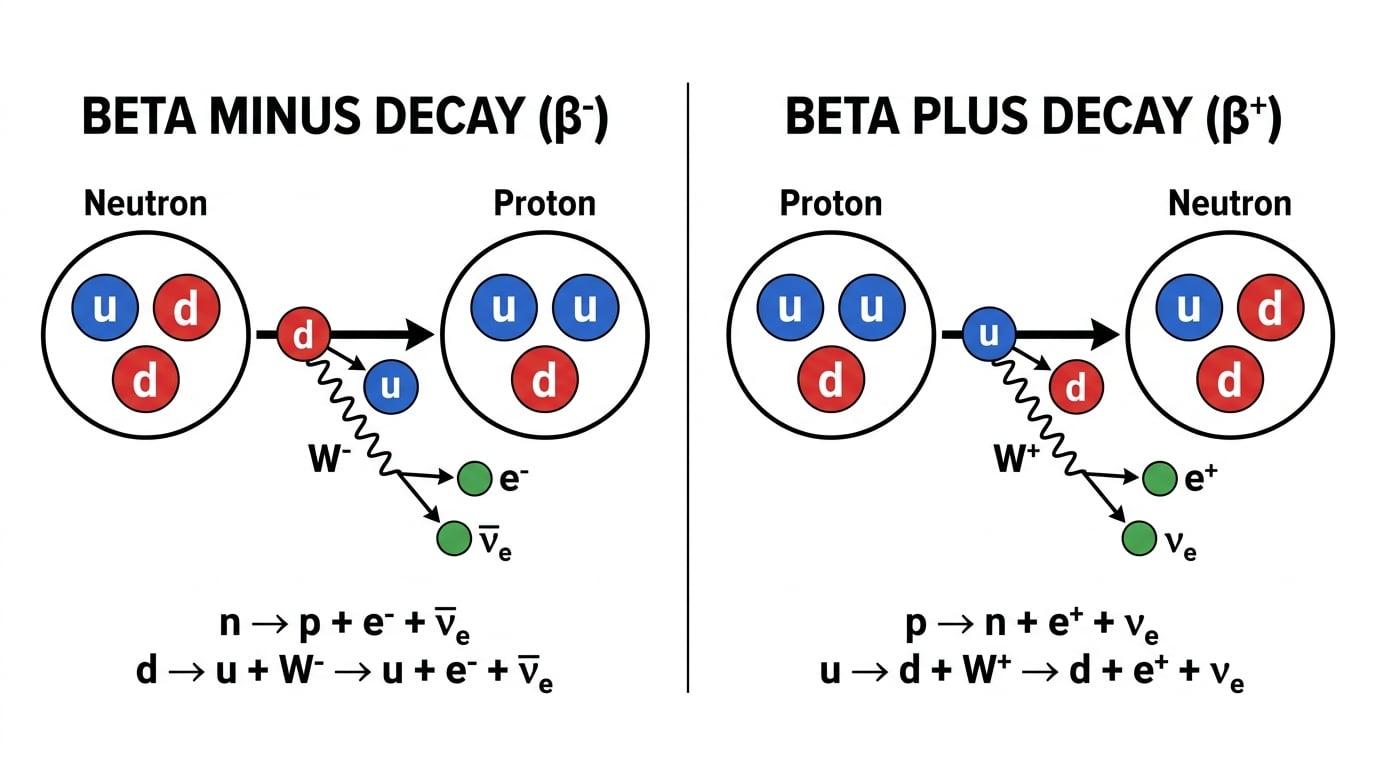
Quark Character
Whenever a question asks you to describe the "change in quark character" during beta decay, you just need to state which quark changes into which. For β−\beta^-β−: down changes to up. For β+\beta^+β+: up changes to down.
Let's look at a worked example verifying that β−\beta^-β− decay obeys the universal rules.
Proving beta-minus decay is possible
Show, using conservation laws, that the fundamental quark interaction for β−\beta^-β− decay is possible:
d→u+e−+νˉe \text{d} \to \text{u} + e^- + \bar{\nu}_e d→u+e−+νˉe- Check Charge (QQQ): LHS: Down quark has Q=−13Q = -\frac{1}{3}Q=−31. RHS: Up quark has Q=+23Q = +\frac{2}{3}Q=+32, electron has Q=−1Q = -1Q=−1, antineutrino has Q=0Q = 0Q=0.
Charge is conserved.
- Check Baryon Number (BBB): LHS: Down quark is a single quark, so B=+13B = +\frac{1}{3}B=+31. RHS: Up quark has B=+13B = +\frac{1}{3}B=+31. Electrons and neutrinos are leptons, so B=0B = 0B=0.
Baryon number is conserved.
- Check Lepton Number (LeL_eLe): LHS: Down quark is a hadron, so Le=0L_e = 0Le=0. RHS: Up quark has Le=0L_e = 0Le=0, electron has Le=+1L_e = +1Le=+1, electron antineutrino has Le=−1L_e = -1Le=−1.
Lepton number is conserved.
- Conclusion: Because QQQ, BBB, and LeL_eLe are all conserved, the interaction is possible.
Identifying Unknown Particles
In the exam, you will frequently be given a reaction equation with a mystery particle, usually labelled XXX. To identify XXX, you simply balance the equation for QQQ, BBB, LLL, and SSS.
Handling unknown particles
If an exam question includes a particle you don't recognise (e.g., a Σ+\Sigma^+Σ+ or an Ω−\Omega^-Ω−), don't panic! The AQA specification explicitly states that data will be provided for particles outside those specified in your course. Just read the table they give you.
Finding an unknown particle
A proton and an antiproton annihilate to produce two particles: a neutral kaon and an unknown particle XXX.
p+pˉ→K0+X p + \bar{p} \to K^0 + X p+pˉ→K0+XGiven that the neutral kaon (K0K^0K0) has a strangeness of +1+1+1, identify the properties of particle XXX and suggest what particle it might be.
-
Calculate totals for the Left-Hand Side (LHS): Proton: Q=+1Q = +1Q=+1, B=+1B = +1B=+1, L=0L = 0L=0, S=0S = 0S=0. Antiproton: Q=−1Q = -1Q=−1, B=−1B = -1B=−1, L=0L = 0L=0, S=0S = 0S=0. Total LHS: Q=0Q = 0Q=0, B=0B = 0B=0, L=0L = 0L=0, S=0S = 0S=0.
-
Set up equations for the Right-Hand Side (RHS): K0K^0K0: Q=0Q = 0Q=0, B=0B = 0B=0, L=0L = 0L=0, S=+1S = +1S=+1. Particle XXX: Properties are QXQ_XQX, BXB_XBX, LXL_XLX, SXS_XSX. Total RHS must equal Total LHS.
-
Solve for XXX: Charge: 0=0+QX⇒QX=00 = 0 + Q_X \Rightarrow Q_X = 00=0+QX⇒QX=0 Baryon Number: 0=0+BX⇒BX=00 = 0 + B_X \Rightarrow B_X = 00=0+BX⇒BX=0 Lepton Number: 0=0+LX⇒LX=00 = 0 + L_X \Rightarrow L_X = 00=0+LX⇒LX=0 Strangeness: 0=+1+SX⇒SX=−10 = +1 + S_X \Rightarrow S_X = -10=+1+SX⇒SX=−1
-
Identify the particle: Particle XXX has Q=0Q = 0Q=0, B=0B = 0B=0, L=0L = 0L=0, and S=−1S = -1S=−1. Because B=0B = 0B=0 but it has strangeness, it must be a meson. A neutral meson with a strangeness of −1-1−1 is the anti-neutral kaon (Kˉ0\bar{K}^0Kˉ0).
A Note on Energy and Momentum
The specification highlights that you must recognise energy and momentum are always conserved in these interactions.
When particles interact or decay, the total rest mass of the products is often less than the total rest mass of the starting particles. This might look like energy is disappearing, but it isn't! The "missing" mass is converted into the kinetic energy of the outgoing products (using E=mc2E = mc^2E=mc2). Momentum dictates the exact angles and velocities at which these products fly apart.
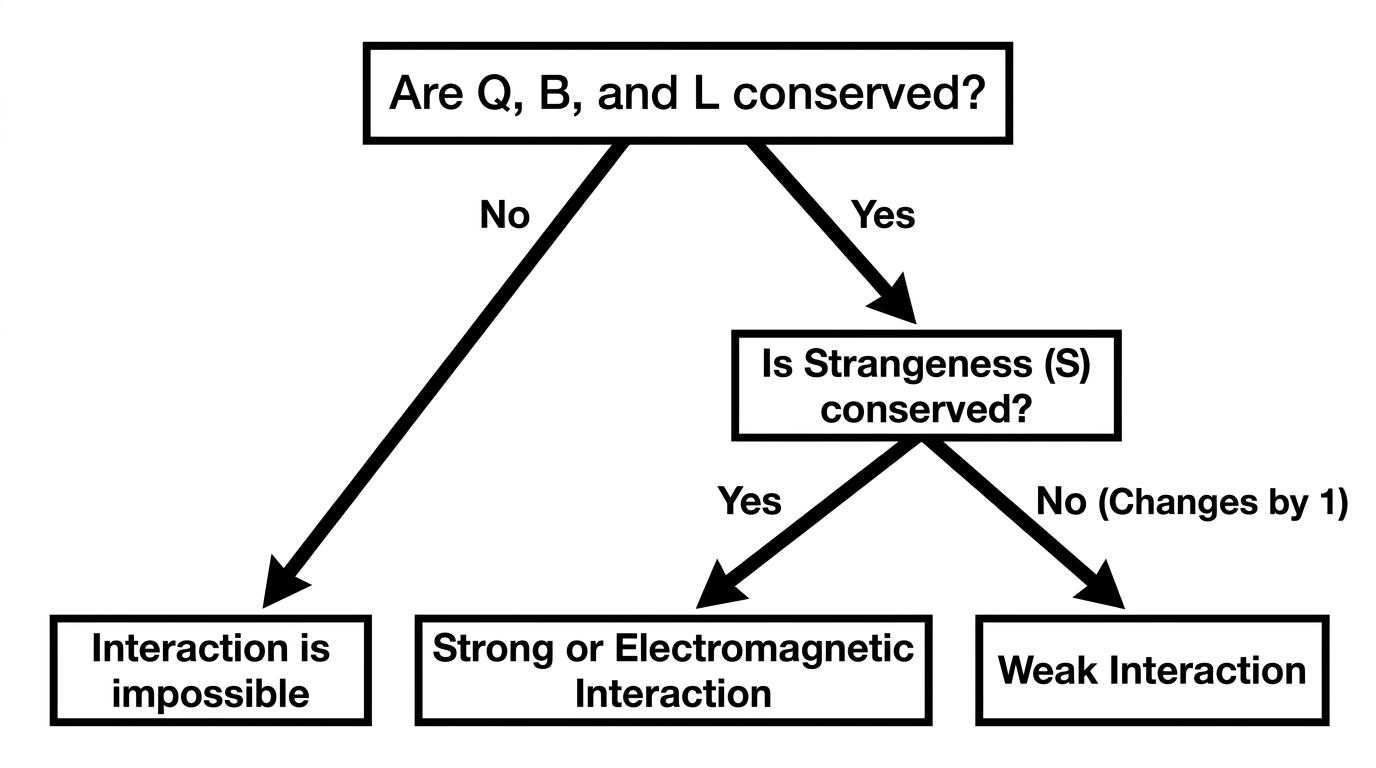
The Strangeness Flowchart
Strangeness is the trickiest property because it behaves differently depending on the fundamental force causing the interaction.
- Strong Interactions: Strangeness must be exactly conserved (ΔS=0\Delta S = 0ΔS=0). Strange particles are produced in pairs via the strong force (e.g., a +1+1+1 and a −1-1−1 created together so total SSS remains 000).
- Weak Interactions: Strangeness does not have to be conserved. It can change by 000, +1+1+1, or −1-1−1. Strange particles decay via the weak force.
Assuming a reaction is impossible if S changes
Students often declare an interaction impossible because the strangeness on the left doesn't match the strangeness on the right. If ΔS=±1\Delta S = \pm 1ΔS=±1, the reaction is possible—it just means it is happening via the weak interaction! Only if ΔS=±2\Delta S = \pm 2ΔS=±2 or more is it truly impossible.
In the exam
- When asked if a reaction is possible, structure your answer clearly. Address QQQ, BBB, and LLL one by one, showing the sums for both sides.
- Don't forget that anti-particles have opposite signs for everything except mass. An antiproton has B=−1B = -1B=−1, and a positron has Le=−1L_e = -1Le=−1.
- Pay close attention to the lepton families. If an interaction produces a muon (μ−\mu^-μ−), it must also involve a muon antineutrino (νˉμ\bar{\nu}_\muνˉμ), not an electron antineutrino (νˉe\bar{\nu}_eνˉe). The separate rules for LeL_eLe and LμL_\muLμ are a very common trap.
- If asked to name the interaction responsible for a particle decay where strangeness changes, always state "Weak Interaction".
Check yourself
- What happens to the quark character during a β+\beta^+β+ decay?
- If a reaction creates an electron and an electron antineutrino, what is the net change in lepton number?
- Can a strong interaction reaction change the total strangeness of the system?
- Why do strange particles always decay via the weak interaction?