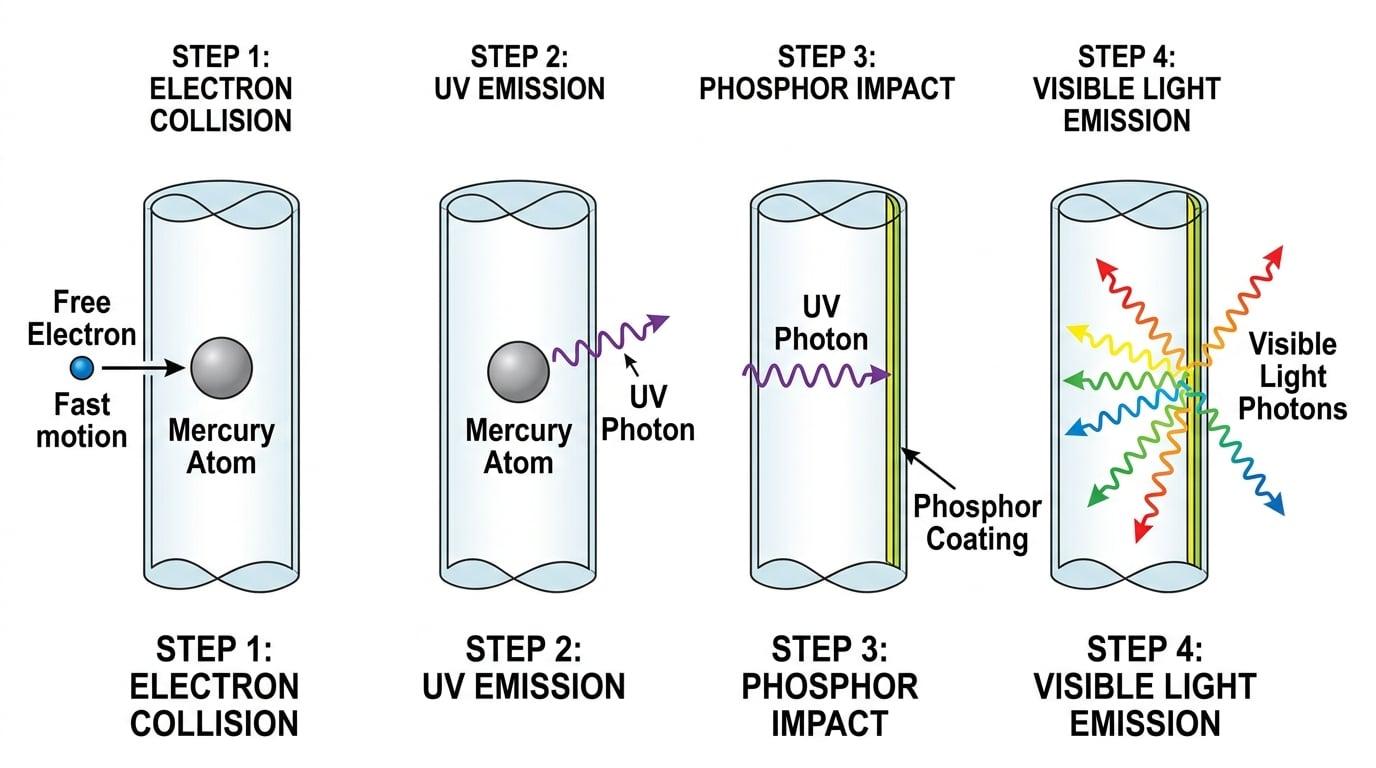
Here is the exact sequence of events you need to know:
- Acceleration: A high voltage is applied across the tube. This accelerates free electrons through the tube.
- Collision and Excitation: These fast-moving free electrons collide with the mercury atoms. The free electrons transfer some of their kinetic energy to the orbital electrons of the mercury atoms, causing excitation.
- De-excitation and UV Emission: The excited orbital electrons in the mercury atoms quickly fall back down to their ground state (de-excitation). As they drop, they lose energy by emitting ultraviolet (UV) photons.
- Absorption by the Coating: These high-energy UV photons fly outwards and hit the inner wall of the tube, where they are absorbed by the atoms in the phosphor coating. This causes the orbital electrons in the phosphor atoms to excite to high energy levels.
- Emission of Visible Light: The electrons in the phosphor atoms de-excite. Crucially, they do this in a series of smaller steps, cascading down through intermediate energy levels. Because the energy drops are smaller, the emitted photons have lower energy and lower frequency than UV—they are emitted as visible light photons.
Exam technique
In the exam
When answering a 6-mark "explain how a fluorescent tube works" question, examiners look for very specific keywords:
- State that free electrons collide with mercury atoms.
- State that this causes the mercury atoms to excite and then de-excite, emitting UV photons.
- State that the phosphor coating absorbs the UV photons.
- State that the coating de-excites, emitting lower-energy visible light photons.
Self review
Check yourself
- Can you define 1 electron volt?
- If a free electron has 4.0 eV4.0\text{ eV}4.0 eV of kinetic energy, but an atom requires 4.5 eV4.5\text{ eV}4.5 eV to excite, what happens when they collide?
- Why does the phosphor coating emit visible light rather than re-emitting UV light?
- What is the difference between excitation and ionisation?