The Michelson-Morley experiment (A-level only)
What you'll learn:
- What the "luminiferous ether" was and why physicists believed it existed.
- How the Michelson-Morley interferometer splits and recombines light.
- Why the experiment's famous "null result" proved that absolute motion cannot be detected.
- How this led directly to the revolutionary idea that the speed of light is invariant.
The Search for the Ether
In the late 19th century, physicists had a problem. They knew that light was a wave, and all the waves they had studied so far required a physical medium to travel through. Sound travels through air, water waves travel through water, and seismic waves travel through rock.
Because light can travel from the Sun to the Earth through the vacuum of space, scientists proposed the existence of the luminiferous ether (or simply, the ether). They believed the ether was a massless, rigid substance that filled the entire universe and acted as the medium for light waves.
If the ether filled all of space, it was considered an "absolute" frame of reference. Because the Earth orbits the Sun, it must be hurtling through this stationary ether. This motion should create an "ether wind", much like how you feel a wind against your face when driving an open-top car on a still day.
The Michelson-Morley experiment was designed to detect this ether wind, thereby proving the existence of the ether and demonstrating the Earth's absolute motion through space.
Absolute motion
Motion measured relative to a fixed, universal, and stationary frame of reference (such as the proposed ether).
The Principle of the Interferometer
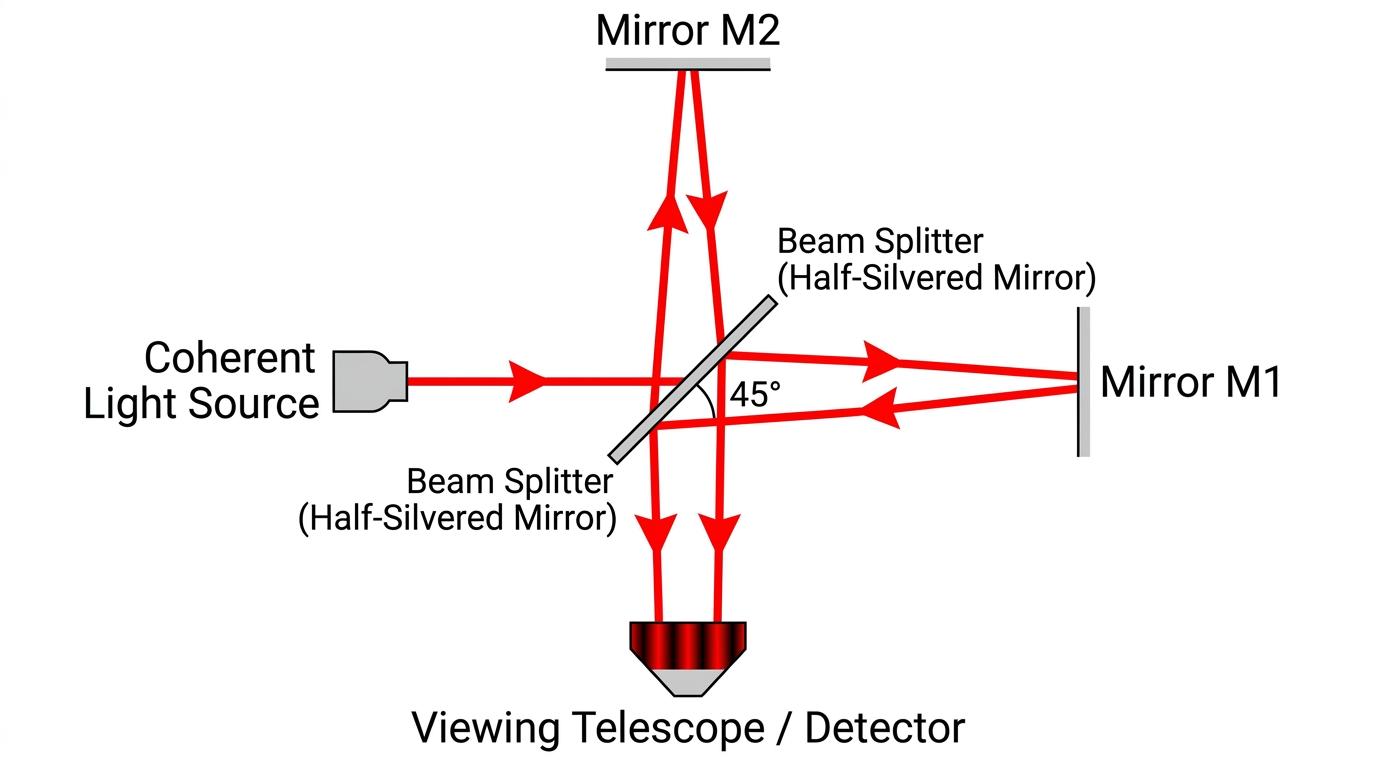
To detect the ether wind, Albert Michelson and Edward Morley built a highly sensitive device called an interferometer.
Here is how the apparatus works:
- A beam of monochromatic light is directed at a half-silvered mirror (acting as a beam splitter), angled at 45 degrees.
- Half of the light passes straight through to a plane mirror (M1M_1M1), while the other half is reflected at 90 degrees to a second plane mirror (M2M_2M2).
- Both mirrors are set at exactly the same distance, LLL, from the beam splitter.
- The mirrors reflect the light back to the beam splitter, where the two beams recombine.
- The recombined beam is directed into a viewing telescope.
Because the two beams have travelled different paths, they will undergo superposition when they recombine, creating an interference pattern of alternating light and dark fringes in the telescope.
The River Swimmer Analogy
Imagine two swimmers racing in a river that has a strong current (representing the ether wind). One swimmer swims upstream and back down (parallel to the current). The other swims directly across the river and back (perpendicular to the current). Even if they swim at the exact same speed and cover the exact same distance, the perpendicular swimmer will always win the race.
According to the ether theory, the beam of light travelling parallel to the ether wind should take a slightly different amount of time to return than the beam travelling perpendicular to it.
Rotating the Apparatus
Michelson and Morley floated their heavy stone apparatus on a pool of liquid mercury so it could be smoothly rotated.
The plan was simple:
- Observe the interference fringes in the telescope.
- Slowly rotate the entire apparatus through 90 degrees.
- As the apparatus rotates, the path that was parallel to the ether wind becomes perpendicular, and vice versa.
- This swap in travel times should cause the beams to arrive slightly more or less out of phase than before, resulting in a fringe shift in the telescope.
Based on the known speed of the Earth in its orbit, they calculated that they should see a shift of about 0.40.40.4 of a fringe width.
The Null Result
When Michelson and Morley performed the experiment, they observed no significant fringe shift whatsoever.
No matter what time of day they ran it, or what season of the year (as the Earth changed direction in its orbit), the interference pattern never shifted. This failure to observe the expected outcome is known in physics as a null result.
Confusing 'null result' with 'failed experiment'
A "null result" does not mean the experiment failed! The equipment worked perfectly and the measurements were incredibly precise. The null result simply means the effect they were looking for (the ether wind) was proven not to exist. In fact, this is one of the most successful "failed" experiments in history!
Significance of the Failure to Detect Absolute Motion
The null result was a shock to the physics community. It had profound implications:
- The ether does not exist. Light does not need a physical medium to travel through space.
- Absolute motion cannot be detected. There is no "stationary background" to the universe against which you can measure your speed.
Relativity Principle
The laws of physics are exactly the same in all uniformly moving (inertial) frames of reference. You cannot do an experiment enclosed in a smoothly moving train—or on a moving Earth—that will tell you how fast you are going without looking out the window.
The Invariance of the Speed of Light
If the speed of light were affected by the Earth's motion, the travel times in the interferometer would have been different. Since the travel times were identical regardless of orientation, this meant the light was travelling at the exact same speed along both paths.
This led directly to a radical new idea, which Albert Einstein later formalized as the second postulate of Special Relativity:
Invariance of the speed of light
The speed of light in a vacuum, ccc, is a universal constant. It is exactly the same for all observers, regardless of the motion of the light source or the motion of the observer.
If you shine a torch from a stationary car, the light leaves you at ccc (approximately 3×10⁸ m s−13 \times 10^8 \text{ m s}^{-1}3×10⁸ m s−1). If you shine the torch forwards from a rocket travelling at 0.9c0.9c0.9c, the light still leaves you at ccc, and an observer on the ground will also measure that light travelling at exactly ccc!
AQA-style written answer
Question: The Michelson-Morley experiment was designed to detect the absolute motion of the Earth. Outline the principle of this experiment and state the significance of its result. (6 marks)
Model Answer:
- A beam of monochromatic light is split into two perpendicular paths by a half-silvered mirror.
- The two beams travel to plane mirrors and are reflected back to the beam splitter.
- The recombined beams form an interference pattern (fringes) at a detector/telescope.
- If the Earth was moving through a stationary ether, rotating the apparatus by 90 degrees would alter the relative travel times of the two beams.
- This change in travel times would cause a measurable shift in the interference fringes.
- The experiment yielded a null result (no fringe shift was observed). The significance is that the ether does not exist, absolute motion cannot be detected, and the speed of light in a vacuum is invariant.
In the exam
- When describing the apparatus, always specify that the beams travel perpendicular paths and are reflected back by plane mirrors to recombine at the beam splitter.
- Remember the key phrase: "Failure to detect absolute motion". Don't just say "they didn't find the ether". You must explicitly state that absolute motion cannot be detected.
- If asked for the conclusion of the experiment regarding light, explicitly write "the speed of light is invariant" or "the speed of light is constant for all observers".
- Make sure you know that the expected shift was due to rotating the apparatus by 90 degrees.
Check yourself
- Can you explain why the beam is split into two perpendicular paths rather than parallel ones?
- What would a fringe shift have physically meant for the interference of the two light waves?
- What are the two main conclusions drawn from the null result of the experiment?
- How does the Michelson-Morley experiment support Einstein's postulates of Special Relativity?