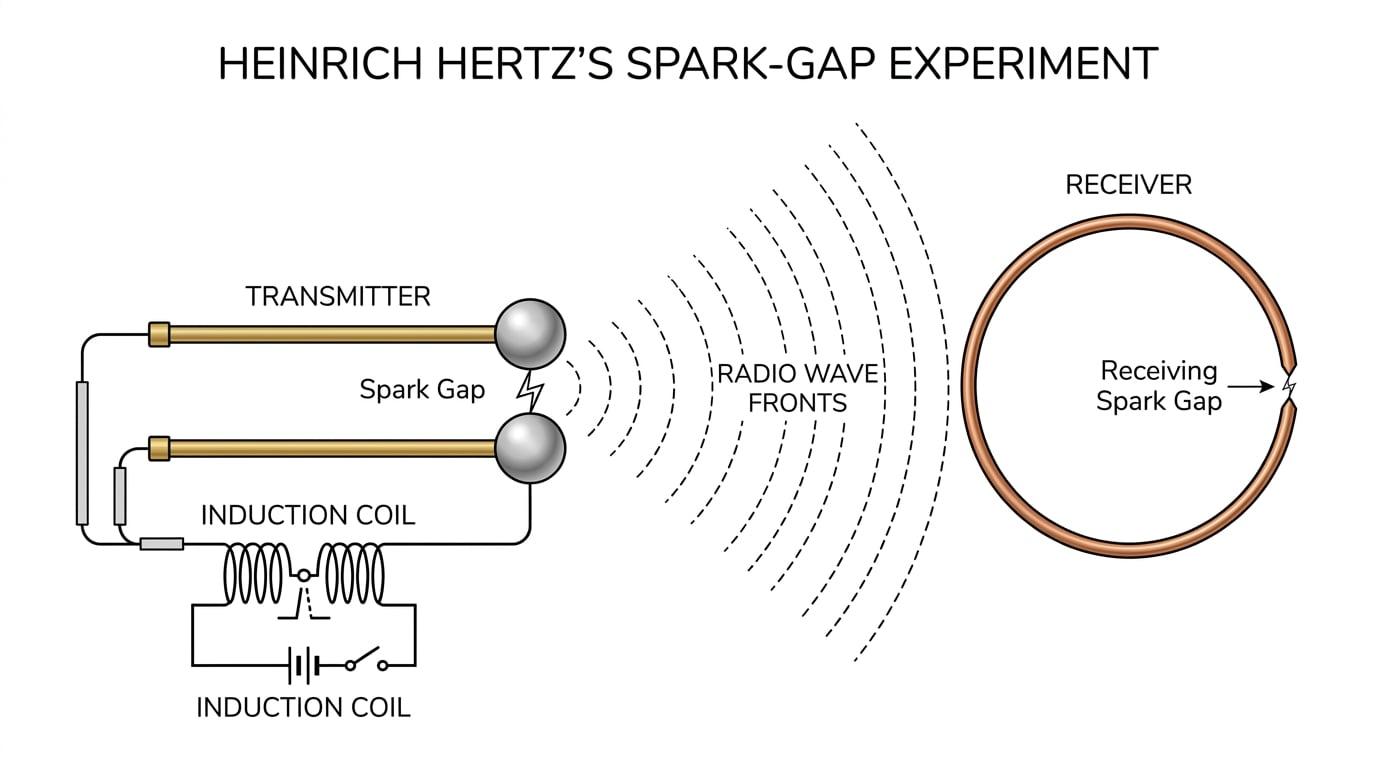
Measuring the Speed of Radio Waves
Just proving they existed wasn't enough; Hertz wanted to prove they travelled at the speed of light. To do this, he set up a flat metal sheet behind his receiver to reflect the waves back toward the transmitter.
The outgoing waves interfered with the reflected waves, creating a stationary (standing) wave.
Stationary Wave Reminder
In a stationary wave, the distance between two adjacent nodes (points of zero amplitude) is exactly half a wavelength (λ2\frac{\lambda}{2}2λ). You learned this in your first year waves topic—it applies to radio waves just as it does to waves on a string!
By moving his detector, Hertz found the positions of the nodes where no sparking occurred. He measured the distance between these nodes to find the wavelength (λ\lambdaλ). Because he knew the frequency (fff) of his transmitter circuit, he could calculate the wave speed using the wave equation: v=fλv = f \lambdav=fλ.
Calculating the speed of radio waves
Hertz uses an oscillator with a frequency of 50 MHz50 \text{ MHz}50 MHz to generate radio waves. He reflects the waves off a metal sheet and uses a detector to locate nodes. He measures the distance between a node and the adjacent node to be 3.0 m3.0 \text{ m}3.0 m. Calculate the speed of the radio waves.
- Note the given values: f=50×106 Hzf = 50 \times 10^6 \text{ Hz}f=50×106 Hz Distance between adjacent nodes =3.0 m= 3.0 \text{ m}=3.0 m
- Relate nodal distance to wavelength. The distance between two adjacent nodes is λ2\frac{\lambda}{2}2λ. λ2=3.0 m\frac{\lambda}{2} = 3.0 \text{ m}2λ=3.0 m
- Calculate the wavelength: λ=2×3.0=6.0 m\lambda = 2 \times 3.0 = 6.0 \text{ m}λ=2×3.0=6.0 m
- Use the wave equation to find the speed: v=fλv = f \lambdav=fλ
- Substitute the values: v=(50×106)×6.0v = (50 \times 10^6) \times 6.0v=(50×106)×6.0
- Compute the final result: v=3.0×10⁸ m s−1v = 3.0 \times 10^8 \text{ m s}^{-1}v=3.0×10⁸ m s−1 The result is the speed of light, confirming that radio waves are EM waves.
In the exam
- Definitions matter: If asked to define ε0\varepsilon_0ε0 or μ0\mu_0μ0 in the context of Maxwell's equation, strictly use the AQA phrasing: ε0\varepsilon_0ε0 relates to the electric field strength due to a charged object in free space, and μ0\mu_0μ0 relates to the magnetic flux density due to a current-carrying wire in free space.
- Fizeau's Wheel: Always check whether the question states the light is blocked by the adjacent tooth, or a tooth further along. If it's the adjacent tooth, the time taken is 12Nf\frac{1}{2Nf}2Nf1.
- Nodes and Antinodes: In Hertz's experiment questions, remember that the metal reflector acts as a node for the electric field. Read carefully whether a distance given is node-to-node (λ2\frac{\lambda}{2}2λ) or node-to-antinode (λ4\frac{\lambda}{4}4λ).
Check yourself
- What two types of oscillating fields make up an electromagnetic wave, and at what angle do they sit relative to each other?
- What physical constants are represented by μ0\mu_0μ0 and ε0\varepsilon_0ε0 in Maxwell's equation?
- In Fizeau's experiment, why does the light suddenly disappear when the wheel reaches a specific rotational frequency?
- How did Hertz determine the wavelength of his radio waves?