Supernovae, neutron stars and black holes (A-level only)
What you'll learn:
- How supernovae produce as much energy in a few days as the Sun will in its entire lifetime.
- Why Type 1a supernovae act as "standard candles" and how they led to the discovery of dark energy.
- The extreme composition and density of neutron stars.
- How to define a black hole and calculate its event horizon (the Schwarzschild radius).
When stars reach the end of their lives, the delicate balance between gravity pulling inwards and radiation pressure pushing outwards is broken. For massive stars, this battle ends in catastrophic collapse, giving birth to some of the most extreme objects in the universe.
Supernovae
A supernova is the explosive death of a star. The defining property of a supernova is a rapid and massive increase in its absolute magnitude. Over just a few days, a dying star can become billions of times brighter, often briefly outshining its entire host galaxy!
To understand just how powerful these explosions are, AQA wants you to compare a supernova's energy output to that of our Sun.
- Over its 10-billion-year main sequence lifetime, the Sun will output roughly 1044 J10^{44}\text{ J}1044 J of energy.
- A typical supernova releases this exact same amount of energy—1044 J10^{44}\text{ J}1044 J—in a matter of weeks.
Type 1a Supernovae and Standard Candles
There are several types of supernovae, but Type 1a supernovae are exceptionally important to astrophysicists. A Type 1a supernova occurs in a binary star system when a white dwarf accretes (steals) mass from its companion star. Once the white dwarf's mass reaches a critical threshold (the Chandrasekhar limit, about 1.41.41.4 times the mass of the Sun), it becomes unstable and detonates.
Because they all explode at the exact same critical mass, every Type 1a supernova produces exactly the same peak power output.
Standard Candle
A standard candle is an astronomical object of known absolute magnitude. Because we know how intrinsically bright it is, we can measure its apparent magnitude from Earth and calculate its distance.
Since all Type 1a supernovae have a known peak absolute magnitude (M≈−19.3M \approx -19.3M≈−19.3), they are perfect standard candles for measuring distances to incredibly distant galaxies.
The Type 1a Light Curve
A light curve is simply a graph showing how an object's brightness changes over time. You must be familiar with the shape of the Type 1a light curve.
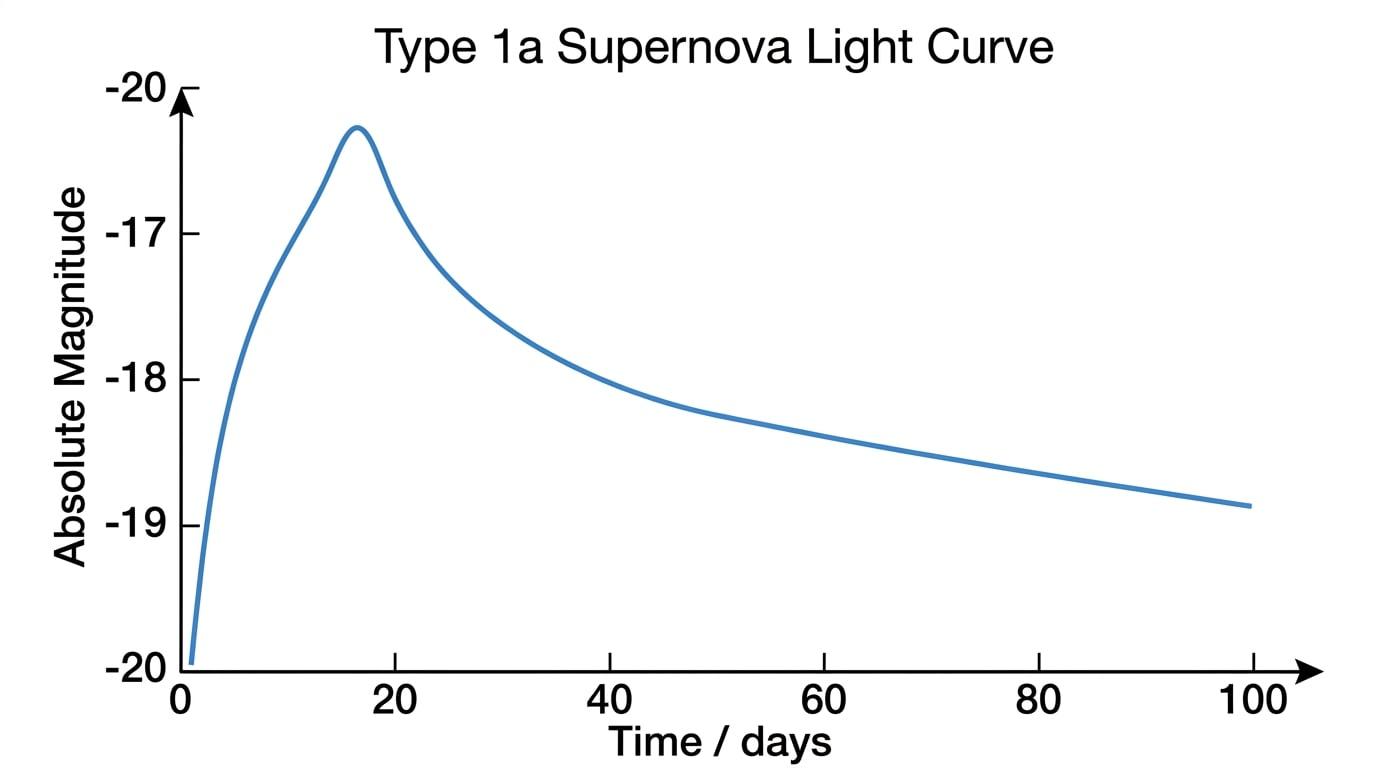
Notice two key features:
- A very steep, rapid rise to a sharp peak (occurring around 20 days after the initial explosion).
- A much slower, gradual exponential decay in brightness over several months. (Remember that the magnitude scale is inverted: a more negative number means a brighter object!)
Calculating distance using a Type 1a supernova
A Type 1a supernova is observed in a distant galaxy. At its peak, it has an apparent magnitude of m=12.5m = 12.5m=12.5. Assuming the peak absolute magnitude of a Type 1a supernova is M=−19.3M = -19.3M=−19.3, calculate the distance to the galaxy in parsecs (pc).
- Identify the relevant formula. Since we have both apparent and absolute magnitude, we use the distance modulus equation:
- Substitute the given values into the equation:
- Simplify the left-hand side:
- Divide by 5 to isolate the logarithm:
- Take 101010 to the power of both sides to remove the base-10 log:
- Multiply by 10 to find the distance ddd:
Dark Energy and the Accelerating Universe
In the late 1990s, astronomers used Type 1a supernovae to measure the distances to very faraway galaxies. They expected to find that the universe's expansion was slowing down due to gravity.
Instead, they found that distant supernovae were noticeably dimmer than expected. If they were dimmer, they must be further away than the standard expansion models predicted. This controversial discovery led to the conclusion that the expansion of the Universe is actually accelerating.
To explain this acceleration, physicists proposed the existence of dark energy—a mysterious repulsive force that permeates all space. Because dark energy is poorly understood and we cannot yet detect it directly, it remains one of the biggest controversies and open questions in modern cosmology.
Neutron Stars
When a giant star (between about 888 and 202020 solar masses) goes supernova, its core collapses inwards. Gravity squeezes the core so tightly that electrons are forced into protons, combining to form neutrons. The remnant left behind is a neutron star.
Properties of a Neutron Star
- Composition: Made almost entirely of neutrons.
- Density: Unimaginably dense, roughly equivalent to the density of an atomic nucleus (≈1017 kg m−3\approx 10^{17}\text{ kg m}^{-3}≈1017 kg m−3). A teaspoon of neutron star material would weigh billions of tonnes!
- Size: Very small, typically only about 10 km10\text{ km}10 km to 20 km20\text{ km}20 km in radius.
Gamma Ray Bursts
When supergiant stars finally collapse to form either a neutron star or a black hole, the violent implosion can fire out twin jets of highly energetic radiation from the poles. We observe these across the universe as gamma ray bursts (GRBs). These bursts are fleeting but represent some of the most luminous electromagnetic events in the universe.
Black Holes
If the dying star's core is incredibly massive (greater than about 333 solar masses), not even the outward pressure of tightly packed neutrons can halt the gravitational collapse. The core collapses indefinitely to a single point of infinite density, called a singularity. This creates a black hole.
Black Hole
An object whose escape velocity is greater than the speed of light (v>cv > cv>c).
Because nothing can travel faster than the speed of light, absolutely nothing—not even photons of light—can escape the gravitational pull once it passes a certain boundary.
Supermassive Black Holes
While standard "stellar-mass" black holes form from dying stars, there is another terrifyingly large class of black holes. Supermassive black holes contain the mass of millions or even billions of Suns. Astronomers now believe that a supermassive black hole resides at the centre of almost every major galaxy, including our own Milky Way (which hosts a black hole called Sagittarius A*).
The Schwarzschild Radius
The boundary around a black hole where the escape velocity becomes exactly equal to the speed of light (ccc) is called the event horizon. The distance from the singularity to the event horizon is known as the Schwarzschild radius (RsR_sRs).
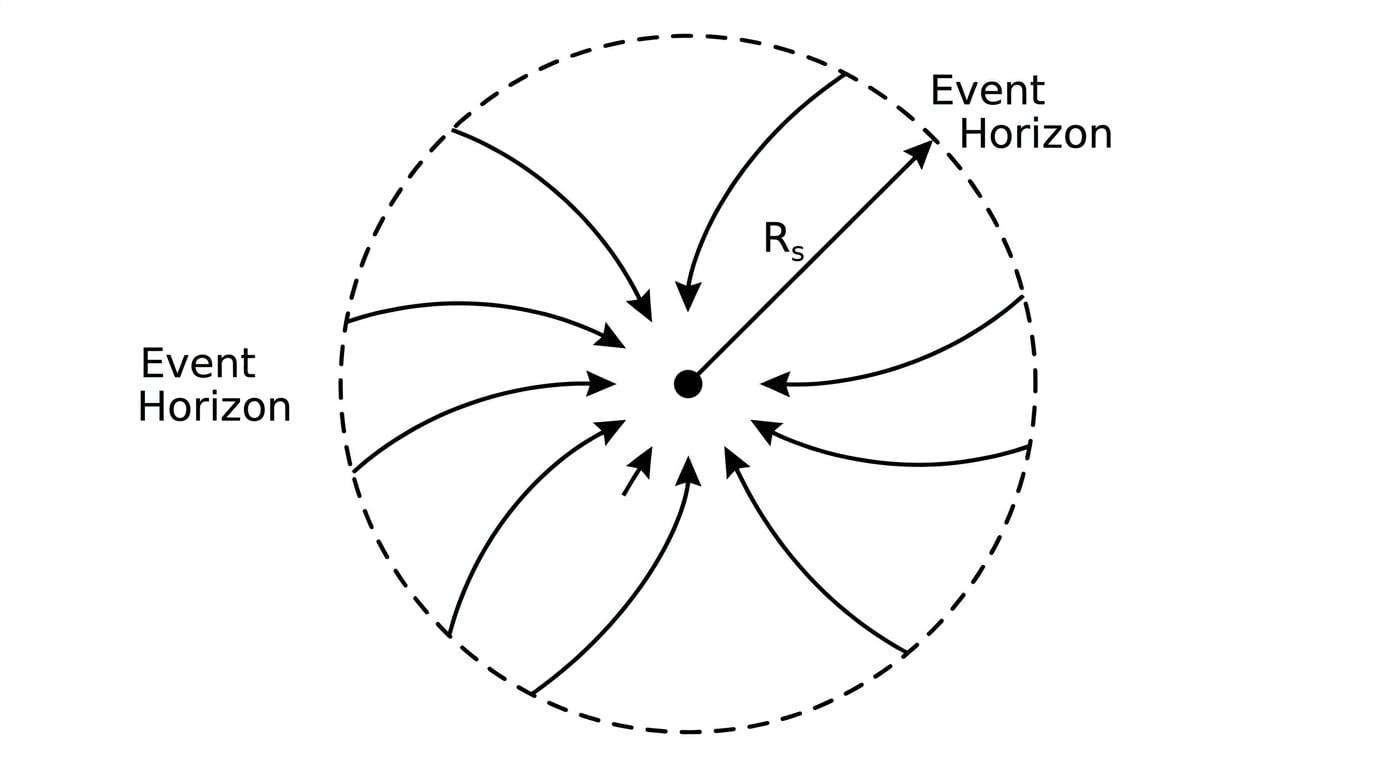
You can calculate this radius using the formula:
Rs≈2GMc2 R_s \approx \frac{2GM}{c^2} Rs≈c22GMWhere:
- RsR_sRs is the Schwarzschild radius in metres (m\text{m}m)
- GGG is the gravitational constant (6.67×10⁻¹¹ N m2 kg−26.67 \times 10^{-11}\text{ N m}^2\text{ kg}^{-2}6.67×10⁻¹¹ N m2 kg−2)
- MMM is the mass of the black hole in kilograms (kg\text{kg}kg)
- ccc is the speed of light in a vacuum (3.00×10⁸ m s−13.00 \times 10^8\text{ m s}^{-1}3.00×10⁸ m s−1)
Don't forget to square!
The most common mistake when calculating RsR_sRs is forgetting to square the speed of light (ccc) in the denominator. Always double-check your calculator inputs!
Calculating the size of a supermassive black hole
A supermassive black hole at the centre of a galaxy has a mass of 4.5×1064.5 \times 10^64.5×10⁶ times the mass of the Sun. Calculate its Schwarzschild radius. (Mass of the Sun, M⊙=1.99×1030 kgM_\odot = 1.99 \times 10^{30}\text{ kg}M⊙=1.99×1030 kg)
- Calculate the total mass (MMM) of the black hole in kilograms:
- State the Schwarzschild radius formula:
- Substitute the values, remembering the constants GGG and ccc:
- Calculate the numerator:
- Calculate the denominator (c2c^2c2):
- Divide to find the final radius:
In the exam
- Know the light curve shape: You may be asked to sketch or identify a Type 1a light curve. Ensure your peak is sharp, the decay is gradual, and you label the peak magnitude correctly if asked (around −19-19−19).
- Standard candles: Be ready to state exactly why Type 1a supernovae are standard candles (they all reach the same peak absolute magnitude).
- Compare energies properly: If asked to compare a supernova's energy to the Sun, state explicitly that the supernova releases the Sun's entire lifetime energy output in a very short period.
- Link GRBs to formation: Don't just say "stars emit gamma rays." Specifically state that gamma ray bursts are produced during the collapse of a supergiant star to form a neutron star or a black hole.
Check yourself
- Can you describe the defining property of a supernova in terms of absolute magnitude?
- Why did the observation of distant Type 1a supernovae lead to the theory of dark energy?
- What is the defining physical property of a black hole in terms of velocity?
- Roughly what density would you expect a neutron star to have, and what is this comparable to?