Doppler effect (A-level only)
What you'll learn
- How relative motion between a light source and an observer changes the observed frequency and wavelength.
- How to use the Doppler equation z=Δλλ=vcz = \frac{\Delta \lambda}{\lambda} = \frac{v}{c}z=λΔλ=cv for speeds much less than the speed of light.
- How to calculate the velocity of receding galaxies and quasars using cosmological redshift.
- How to determine the orbital speed of spectroscopic binary stars from the periodic shifting of their spectral lines.
The Doppler Effect for Light
You likely already know the Doppler effect from everyday life: when an ambulance drives past you, the pitch of its siren sounds higher as it approaches and lower as it drives away. The exact same principle applies to electromagnetic waves, including visible light and radio waves.
When a source of waves moves relative to an observer:
- If the source moves towards the observer, the waves are compressed. The observed wavelength decreases and the frequency increases. For visible light, the spectrum shifts towards the blue end.
- If the source moves away from the observer, the waves are stretched out. The observed wavelength increases and the frequency decreases. For visible light, the spectrum shifts towards the red end.
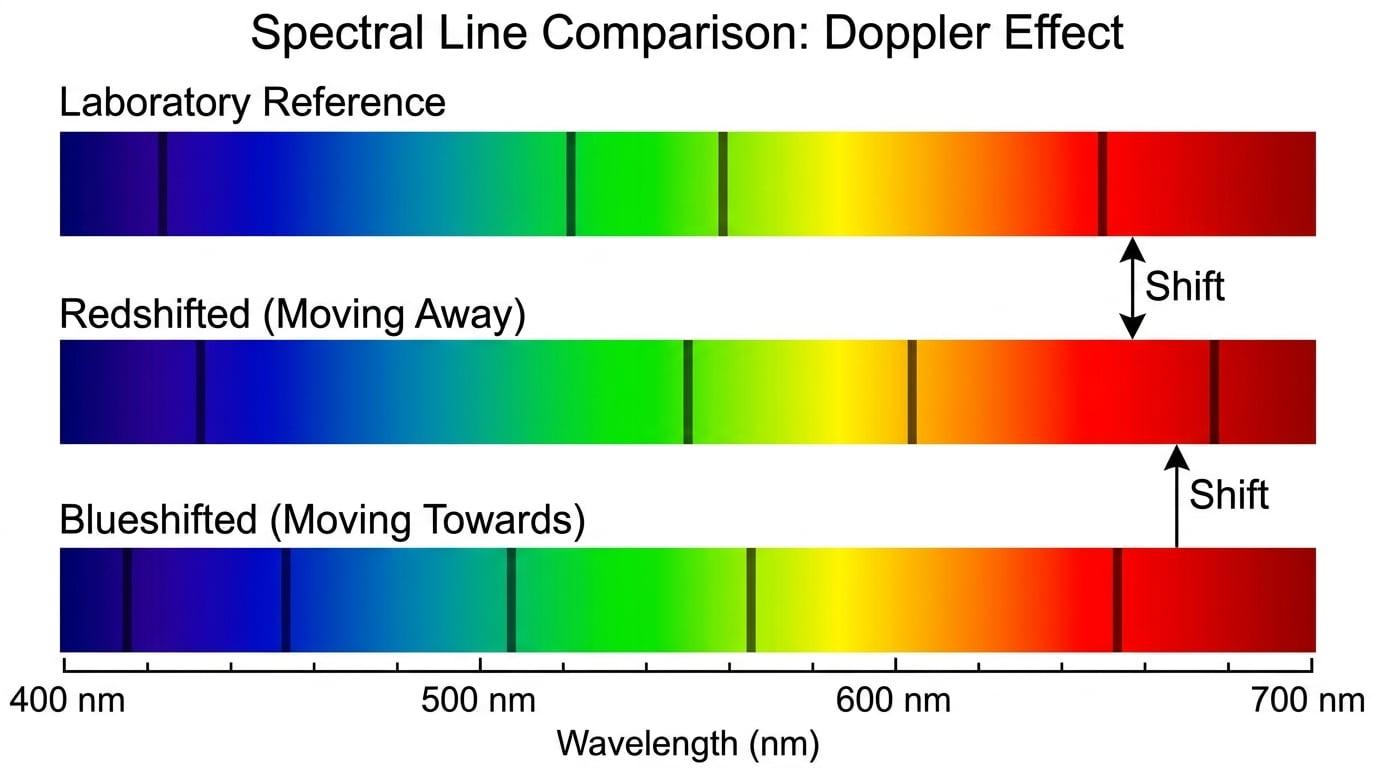
Redshift and Blueshift
Redshift (zzz) is the fractional increase in wavelength (or decrease in frequency) due to the source moving away from the observer.
Blueshift is the corresponding decrease in wavelength when a source approaches the observer.
Astrophysicists measure this by looking at absorption lines in stellar spectra. Elements in a star's atmosphere absorb specific, known wavelengths of light. By comparing the position of these dark lines to a stationary laboratory sample, we can instantly tell if a star or galaxy is moving towards or away from us.
The Doppler Equations
To calculate the exact speed of the source, AQA provides two versions of the Doppler equation. For a source moving with relative velocity vvv, emitting light of original frequency fff and original wavelength λ\lambdaλ:
Δff=vc \frac{\Delta f}{f} = \frac{v}{c} fΔf=cv z=Δλλ=−vc z = \frac{\Delta \lambda}{\lambda} = -\frac{v}{c} z=λΔλ=−cvWhere:
- Δf\Delta fΔf is the change in frequency (Hz\text{Hz}Hz)
- fff is the true (laboratory) frequency (Hz\text{Hz}Hz)
- Δλ\Delta \lambdaΔλ is the change in wavelength (m\text{m}m)
- λ\lambdaλ is the true (laboratory) wavelength (m\text{m}m)
- vvv is the relative velocity of the source (m s−1\text{m s}^{-1}m s−1)
- ccc is the speed of light in a vacuum (3.00×10⁸ m s−13.00 \times 10^8 \text{ m s}^{-1}3.00×10⁸ m s−1)
- zzz is the redshift parameter (a dimensionless number)
The negative sign convention
In the AQA specification, the formula is written as z=Δλλ=−vcz = \frac{\Delta \lambda}{\lambda} = -\frac{v}{c}z=λΔλ=−cv.
The negative sign simply accounts for vector directions. If a source is moving towards you (approach velocity is positive), the wavelength decreases (Δλ\Delta \lambdaΔλ is negative), keeping the equation balanced.
In exam calculations, it is almost always safer to calculate the magnitude of the shift using z=Δλλ=vcz = \frac{\Delta \lambda}{\lambda} = \frac{v}{c}z=λΔλ=cv and then explicitly state whether the object is moving towards or away based on whether it is blueshifted or redshifted.
The Crucial Condition: v≪cv \ll cv≪c
The equations above are approximations. They rely on classical physics and only work accurately if the relative velocity of the source is much less than the speed of light (v≪cv \ll cv≪c).
If an object is moving at a significant fraction of the speed of light (e.g., v>0.1cv > 0.1cv>0.1c), special relativity takes over. Time dilation means the simple classical formula breaks down, and a more complex relativistic Doppler formula (which you don't need to know for A-level) must be used.
When to use the simple formula
Always use Δλλ=vc\frac{\Delta \lambda}{\lambda} = \frac{v}{c}λΔλ=cv unless the question explicitly asks you to discuss its limitations. If a multi-part question asks you why your calculated value for a distant quasar might be inaccurate, the answer is always that the v≪cv \ll cv≪c condition is not met, so relativistic effects must be considered.
Calculating the recession velocity of a galaxy
A distant galaxy emits a prominent hydrogen absorption line. In a laboratory on Earth, this line has a wavelength of 656.28 nm656.28 \text{ nm}656.28 nm. When observed from the galaxy, the line is detected at 660.12 nm660.12 \text{ nm}660.12 nm.
Calculate the velocity of the galaxy relative to Earth and state its direction.
- Identify the true wavelength λ\lambdaλ and calculate the shift Δλ\Delta \lambdaΔλ.
- State the Doppler equation for magnitude.
- Rearrange for vvv and substitute the values (you can leave both wavelengths in nm\text{nm}nm because the units cancel in the ratio).
- State final answer to an appropriate number of significant figures, with the direction. The observed wavelength is longer (redshifted), so the galaxy is moving away. v=1.76×10⁶ m s−1v = 1.76 \times 10^6 \text{ m s}^{-1}v=1.76×10⁶ m s−1, moving away from Earth.
Galaxies and Quasars
The Doppler effect is our primary tool for studying the large-scale structure of the universe. When astronomers observe distant galaxies, almost all of them exhibit redshift. This cosmological redshift tells us that the universe is expanding.
Quasars (quasi-stellar radio sources) are among the most distant and luminous objects in the universe. Because they are so far away, the expansion of the universe carries them away from us at tremendous speeds.
- Quasars display huge redshifts, often with zzz values greater than 111.
- A zzz value greater than 111 implies Δλ>λ\Delta \lambda > \lambdaΔλ>λ, which would absurdly suggest v>cv > cv>c if you strictly applied the classical z=v/cz = v/cz=v/c formula!
- This confirms that for quasars, the classical approximation v≪cv \ll cv≪c is invalid, and relativistic formulas are required.
Spectroscopic Binary Stars
A binary star system consists of two stars orbiting their common centre of mass. Often, these stars are too far away from Earth to be resolved individually by a telescope—they just look like a single point of light. However, we can prove it's a binary system using the Doppler effect.
If we view the system in the plane of its orbit (edge-on), the stars will alternately move towards us and away from us as they complete their orbits.
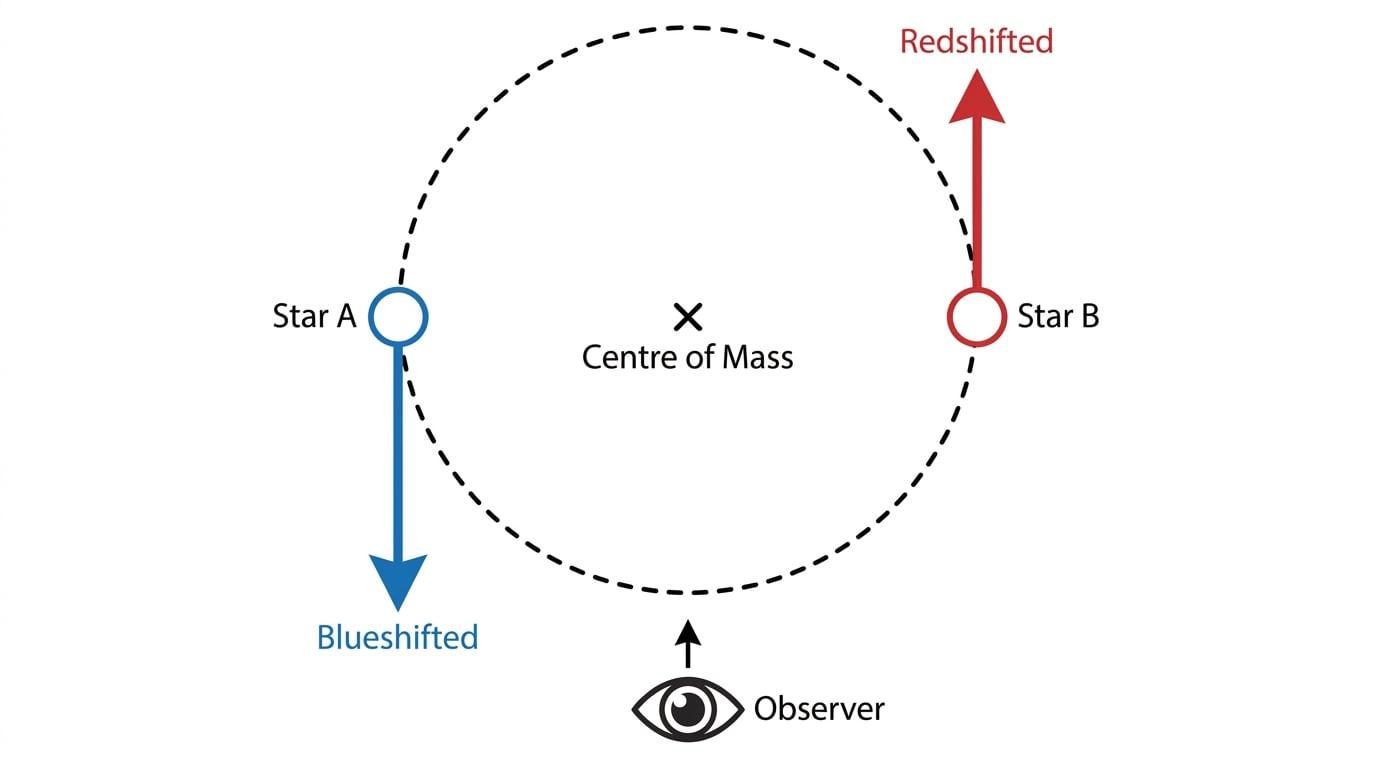
If both stars are roughly the same brightness and have similar spectral lines, we will see the spectral lines split into two and then recombine periodically:
- As Star A moves towards us, its lines blueshift.
- At the same time, Star B moves away from us, so its lines redshift.
- The separation between the lines reaches a maximum when the stars are moving directly along our line of sight (one straight towards us, one straight away).
- When the stars are moving perpendicular to our line of sight (across the sky), there is zero relative velocity towards/away from us, so the lines merge back into their rest positions.
What if one star is much brighter?
If one star completely outshines the other, you won't see splitting lines. Instead, you will see a single set of spectral lines smoothly oscillating back and forth between a redshift and a blueshift as the bright star completes its orbit.
Orbital speed of a binary star
A spectroscopic binary system consists of two identical stars in a circular orbit. An absorption line, known to have a laboratory wavelength of 580.000 nm580.000 \text{ nm}580.000 nm, is observed to periodically split. The maximum recorded wavelength for this line during the cycle is 580.058 nm580.058 \text{ nm}580.058 nm.
Calculate the orbital speed of the stars.
- Identify the maximum wavelength shift, Δλ\Delta \lambdaΔλ. This occurs when the star is moving directly away from us at its full orbital speed.
- Use the Doppler equation to find the orbital velocity vvv.
- Rearrange and calculate.
- State the final answer. The orbital speed is 3.0×10⁴ m s−13.0 \times 10^4 \text{ m s}^{-1}3.0×10⁴ m s−1 (or 30 km s−130 \text{ km s}^{-1}30 km s−1).
Confusing maximum shift with total line separation
In binary star questions, an exam might tell you the maximum difference in wavelength between the two split lines (the gap between Star A's blueshift and Star B's redshift). If the stars are identical, this gap represents 2×Δλ2 \times \Delta \lambda2×Δλ. You must halve this value to find the true Δλ\Delta \lambdaΔλ for one star before calculating its orbital speed!
In the exam
- Always check your wavelength units. While the ratio Δλ/λ\Delta \lambda / \lambdaΔλ/λ is dimensionless (so both can stay in nm\text{nm}nm), make sure you don't accidentally mix nm\text{nm}nm for one and m\text{m}m for the other.
- Read the question carefully to see if it provides the observed wavelength or the change in wavelength (Δλ\Delta \lambdaΔλ).
- If a calculation gives a velocity greater than about 3×10⁷ m s−13 \times 10^7 \text{ m s}^{-1}3×10⁷ m s−1 (which is 0.1c0.1c0.1c), be prepared for a 1-mark follow-up question asking why the value might not be perfectly accurate. The magic phrase is "the formula assumes v≪cv \ll cv≪c".
- For binary stars, orbital speed vvv is calculated from the maximum Doppler shift, which occurs when the velocity vector points directly along the observer's line of sight.
Check yourself
- What happens to the observed frequency of light when the source is moving towards the observer?
- In the Doppler equation, what does the symbol zzz represent, and what is its unit?
- Why can the simple formula Δf/f=v/c\Delta f / f = v / cΔf/f=v/c not be used for distant quasars?
- In a spectroscopic binary system viewed edge-on, at what point in the orbit do the spectral lines show zero Doppler shift?