Stable and unstable nuclei
Welcome to the heart of the atom! You already know that the nucleus contains protons and neutrons. But if protons are all positively charged, shouldn't they repel each other and blow the nucleus apart?
In this section, we will answer that question and look at what happens when a nucleus cannot hold itself together.
What you'll learn
- How the strong nuclear force balances electromagnetic repulsion to keep nuclei stable.
- The precise distances over which the strong nuclear force is attractive and repulsive.
- How unstable nuclei decay via alpha and beta emission.
- Why the neutrino had to be invented to save the law of conservation of energy.
The Strong Nuclear Force
Inside the nucleus, protons experience a massive force of repulsion due to the electromagnetic force. Because they are packed incredibly close together, this repulsive force is huge.
To prevent the nucleus from flying apart, there must be an even stronger attractive force pulling the nucleons (protons and neutrons) together.
Strong Nuclear Force
The fundamental force that acts between all nucleons (protons and neutrons) to hold the nucleus together. It is independent of electric charge, meaning it acts equally between proton-proton, neutron-neutron, and proton-neutron pairs.
The range of the strong nuclear force
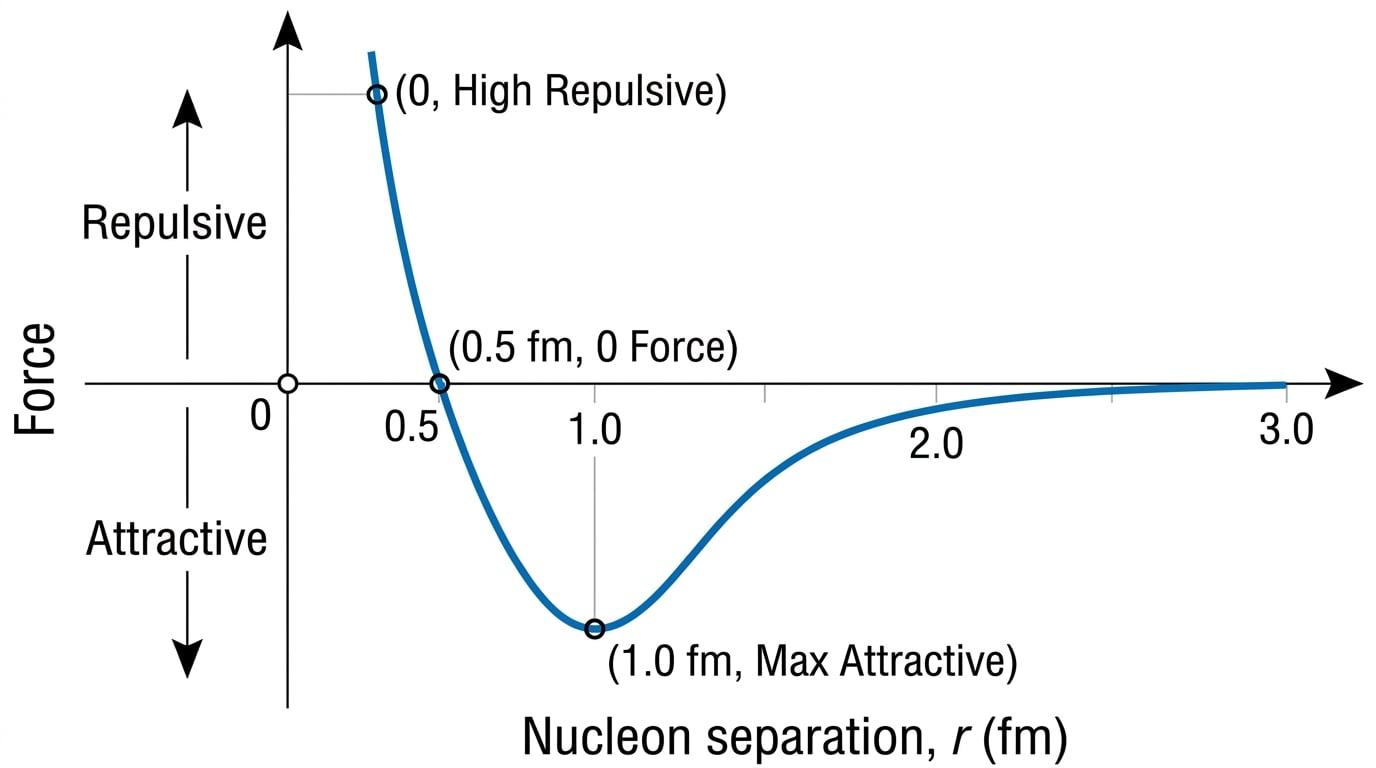
The strong nuclear force has a very unusual, complex behaviour depending on the distance between the nucleons. We measure these tiny distances in femtometres. One femtometre (fm\text{fm}fm) is 10−15 m10^{-15} \text{ m}10−15 m.
- At extremely short distances (less than 0.5 fm0.5 \text{ fm}0.5 fm): The strong nuclear force is fiercely repulsive. If it weren't, the nucleons would crush into a single point under their own attraction.
- At short distances (between roughly 0.5 fm0.5 \text{ fm}0.5 fm and 3 fm3 \text{ fm}3 fm): The force is highly attractive. This is what binds the nucleus together. The maximum attractive force occurs at roughly 1 fm1 \text{ fm}1 fm.
- At larger distances (beyond 3 fm3 \text{ fm}3 fm): The force falls rapidly to zero. It is a strictly short-range force.
Balancing forces
For a nucleus to be stable, the attractive strong nuclear force must perfectly balance the repulsive electromagnetic force. If the balance is off, the nucleus is unstable and will eventually decay.
Confusing the crossing point
Students often forget where the graph crosses the x-axis. Remember: the force is zero at exactly 0.5 fm0.5 \text{ fm}0.5 fm. This is the equilibrium separation where the strong force switches from being repulsive to being attractive!
Unstable Nuclei and Alpha Decay
When a nucleus is simply too massive (typically those with more than 82 protons), the strong nuclear force cannot stretch far enough to hold the outer nucleons together against the electromagnetic repulsion. To become more stable, the nucleus emits an alpha particle.
Alpha Particle
A particle consisting of two protons and two neutrons (a helium nucleus, 24He_2^4\text{He}24He). It has a charge of +2e+2e+2e.
When a parent nucleus emits an alpha particle, it loses 4 from its mass number (AAA) and 2 from its atomic number (ZZZ), transmuting into a completely different element. We write the general equation for alpha decay as:
ZAX→Z−2A−4Y+24α_Z^A \text{X} \to _{Z-2}^{A-4} \text{Y} + _2^4 \alphaZAX→Z−2A−4Y+24αWriting an alpha decay equation
Uranium-238 (92238U^{238}_{92}\text{U}92238U) undergoes alpha decay to become Thorium (Th\text{Th}Th). Write the full nuclear equation for this decay.
- First, write down the parent nucleus on the left side of the equation:
- Next, add the alpha particle to the right side:
- Use conservation of mass number (the top numbers must balance): 238−4=234238 - 4 = 234238−4=234. The new mass number is 234234234.
- Use conservation of atomic number (the bottom numbers must balance): 92−2=9092 - 2 = 9092−2=90. The new atomic number is 909090.
- Write the final equation using the symbol for Thorium:
Beta Minus (β−\beta^-β−) Decay
Sometimes a nucleus isn't necessarily too massive overall, but it has too many neutrons compared to its protons. The strong force balance is wrong. To fix this, a neutron inside the nucleus transforms into a proton, emitting a fast-moving electron called a beta-minus particle.
Beta-minus Particle
A high-energy, high-speed electron emitted from the nucleus during beta decay, represented as −10β_{-1}^0 \beta−10β or −10e_{-1}^0 \text{e}−10e.
The general equation for β−\beta^-β− decay requires careful attention to a hidden particle, the antineutrino (νˉe\bar{\nu}_eνˉe):
ZAX→Z+1AY+−10β+νˉe_Z^A \text{X} \to _{Z+1}^{A} \text{Y} + _{-1}^0 \beta + \bar{\nu}_eZAX→Z+1AY+−10β+νˉeThe Mystery of the Missing Energy
In the early 20th century, physicists noticed a major problem with beta decay. If a parent nucleus purely split into a daughter nucleus and a beta particle, the rules of momentum and energy conservation dictated that the beta particle should always fly out with exactly the same amount of kinetic energy.
However, experiments showed that beta particles were emitted with a continuous spectrum of energies—anything from near zero up to a maximum value. Some energy appeared to be vanishing!
The Neutrino Hypothesis
To save the fundamental law of Conservation of Energy, Wolfgang Pauli hypothesised that a third, unseen particle was being emitted alongside the beta particle. This particle carried away the "missing" energy.
This ghost particle was named the neutrino (literally "little neutral one"). It had to have zero charge and virtually zero mass, making it incredibly difficult to detect.
Note for A-Level: In β−\beta^-β− decay, the specific particle emitted is an antineutrino (νˉe\bar{\nu}_eνˉe). The normal neutrino (νe\nu_eνe) is emitted in β+\beta^+β+ decay (which you will meet later).
Writing a beta decay equation
Carbon-14 (614C^{14}_6\text{C}614C) is a neutron-rich isotope used in radiocarbon dating. It decays via β−\beta^-β− emission into Nitrogen (N\text{N}N). Write the full decay equation.
- Write the parent nucleus and the known decay products:
- Balance the mass numbers (top numbers). The beta particle and antineutrino have a mass number of 000, so the new nucleus must keep the mass number of 141414.
- Balance the atomic numbers (bottom numbers). The beta particle has an atomic number of −1-1−1. To ensure the left side (666) equals the right side, the new nucleus must have an atomic number of 777 (since 7−1=67 - 1 = 67−1=6).
- State the final equation:
Quick check for beta equations
In β−\beta^-β− decay, the atomic number of the daughter nucleus always goes up by one, while the mass number stays the same! You are turning a neutral neutron into a positive proton.
In the exam
- State the ranges clearly: If asked to describe the strong nuclear force, always state it is repulsive below ≈0.5 fm\approx 0.5 \text{ fm}≈0.5 fm, attractive between ≈0.5 fm\approx 0.5 \text{ fm}≈0.5 fm and 3 fm3 \text{ fm}3 fm, and negligible beyond 3 fm3 \text{ fm}3 fm. Do not just say "short range".
- Include the neutrino: When writing a beta decay equation, losing a mark for forgetting the antineutrino (νˉe\bar{\nu}_eνˉe) is one of the most common errors. Always check your equations have three products on the right-hand side.
- Use the phrase "conservation of energy": If asked why the neutrino was hypothesised, the examiner is specifically looking for the phrase "to account for conservation of energy".
Check yourself
- Can you sketch the graph of strong nuclear force against nucleon separation and label the crossing point?
- Why doesn't the strong nuclear force pull the protons and neutrons into an infinitely dense point?
- What are the atomic and mass numbers of an alpha particle and a beta particle?
- Why did physicists believe another particle must exist in beta decay before they could even detect it?