

What you'll learn
- What antiparticles are and how they compare to normal matter.
- How to calculate the energy of a photon (a "packet" of light) using the Planck constant.
- The amazing processes of annihilation (matter destroying antimatter to make light) and pair production (light creating matter and antimatter).
- How to calculate the frequencies and wavelengths of the photons involved in these processes using rest energies in MeV\text{MeV}MeV.
The mirror world: Antiparticles
In the 1920s, physicist Paul Dirac combined quantum mechanics with relativity and found that his equations had two solutions. One described the electron, but the other described a completely new particle: exactly like an electron, but with a positive charge. He had predicted the existence of antimatter.
Antiparticle
An antiparticle is a particle with the same mass and rest energy as its corresponding matter particle, but with exactly the opposite charge.
For every type of particle in the universe, there is a corresponding antiparticle.
- Mass: The mass is identical. A proton and an antiproton are equally heavy.
- Rest Energy: Because their masses are identical, their rest energies are also identical.
- Charge: The charge is exactly opposite. An electron has a charge of −1.60×10⁻¹⁹ C-1.60 \times 10^{-19}\text{ C}−1.60×10⁻¹⁹ C, so a positron has a charge of +1.60×10⁻¹⁹ C+1.60 \times 10^{-19}\text{ C}+1.60×10⁻¹⁹ C.
Naming the antiparticles
For most particles, you simply put the prefix "anti-" in front of the name. The electron is the famous exception; its antiparticle has a special name.
Here are the four pairs you must know for AQA:
| Particle | Symbol | Antiparticle | Symbol |
|---|---|---|---|
| Electron | e−\text{e}^{-}e− | Positron | e+\text{e}^{+}e+ |
| Proton | p\text{p}p | Antiproton | p‾\overline{\text{p}}p |
| Neutron | n\text{n}n | Antineutron | n‾\overline{\text{n}}n |
| Neutrino | ν\nuν | Antineutrino | ν‾\overline{\nu}ν |
Notice the notation: we usually denote an antiparticle by drawing a bar over the particle's symbol (like p‾\overline{\text{p}}p for antiproton). The positron is an exception and is written as e+\text{e}^{+}e+.
Neutral antiparticles
You might think that because a neutron has zero charge, it is its own antiparticle. This is incorrect! The antineutron also has zero charge, but it is made of antimatter (specifically, antiquarks, which we will look at in a later topic). A neutron and an antineutron will still annihilate if they meet!
Rest energy and the MeV
Albert Einstein famously proved that mass and energy are interchangeable. If an object has mass, it acts as a "store" of energy, even when it is completely stationary. This is its rest energy.
Rest energy
The minimum energy required to create a particle, or the energy released when a particle's mass is completely converted into energy. It is denoted by E0E_0E0.
While Einstein's equation is E=mc2E = mc^2E=mc2, you do not need to use E=mc2E = mc^2E=mc2 in AQA calculations for this topic. Instead, the AQA data sheet provides the rest energy (E0E_0E0) for all the standard particles directly in a unit called the mega-electronvolt (MeV\text{MeV}MeV).
Converting between MeV and Joules
Energy in physics is usually measured in Joules (J\text{J}J). An electronvolt (eV\text{eV}eV) is a very small unit of energy. One mega-electronvolt (1 MeV1\text{ MeV}1 MeV) is one million electronvolts.
To convert from MeV\text{MeV}MeV to J\text{J}J, multiply by 1.60×10−131.60 \times 10^{-13}1.60×10⁻¹³.
For example, the data sheet tells us the rest energy of an electron is 0.510999 MeV0.510999\text{ MeV}0.510999 MeV. Because a positron is its antiparticle, the rest energy of a positron is exactly the same: 0.510999 MeV0.510999\text{ MeV}0.510999 MeV.
The Photon Model of Electromagnetic Radiation
Before we look at how matter and antimatter interact, we need to understand how light transfers energy.
In classical physics, light is a continuous wave. However, in quantum physics, electromagnetic radiation behaves as a stream of tiny, discrete "packets" of energy. We call these packets photons.
The energy of a single photon is directly proportional to the frequency of the electromagnetic wave.
E=hf=hcλE = hf = \frac{hc}{\lambda}E=hf=λhcWhere:
- EEE is the photon energy in Joules (J\text{J}J)
- hhh is the Planck constant (6.63×10⁻³⁴ J s6.63 \times 10^{-34}\text{ J s}6.63×10⁻³⁴ J s)
- fff is the frequency of the radiation in Hertz (Hz\text{Hz}Hz)
- ccc is the speed of light in a vacuum (3.00×10⁸ m s−13.00 \times 10^8\text{ m s}^{-1}3.00×10⁸ m s−1)
- λ\lambdaλ is the wavelength in metres (m\text{m}m)
Calculating photon energy
Calculate the energy, in Joules, of a photon of red light with a wavelength of 650 nm650\text{ nm}650 nm.
- Identify the given values and convert to standard SI units. The wavelength λ=650 nm=650×10−9 m\lambda = 650\text{ nm} = 650 \times 10^{-9}\text{ m}λ=650 nm=650×10−9 m.
- Select the correct version of the photon energy equation. Since we are given wavelength, we use E=hcλE = \frac{hc}{\lambda}E=λhc.
- Substitute the values from the data sheet and calculate the result.
Annihilation: Matter meets Antimatter
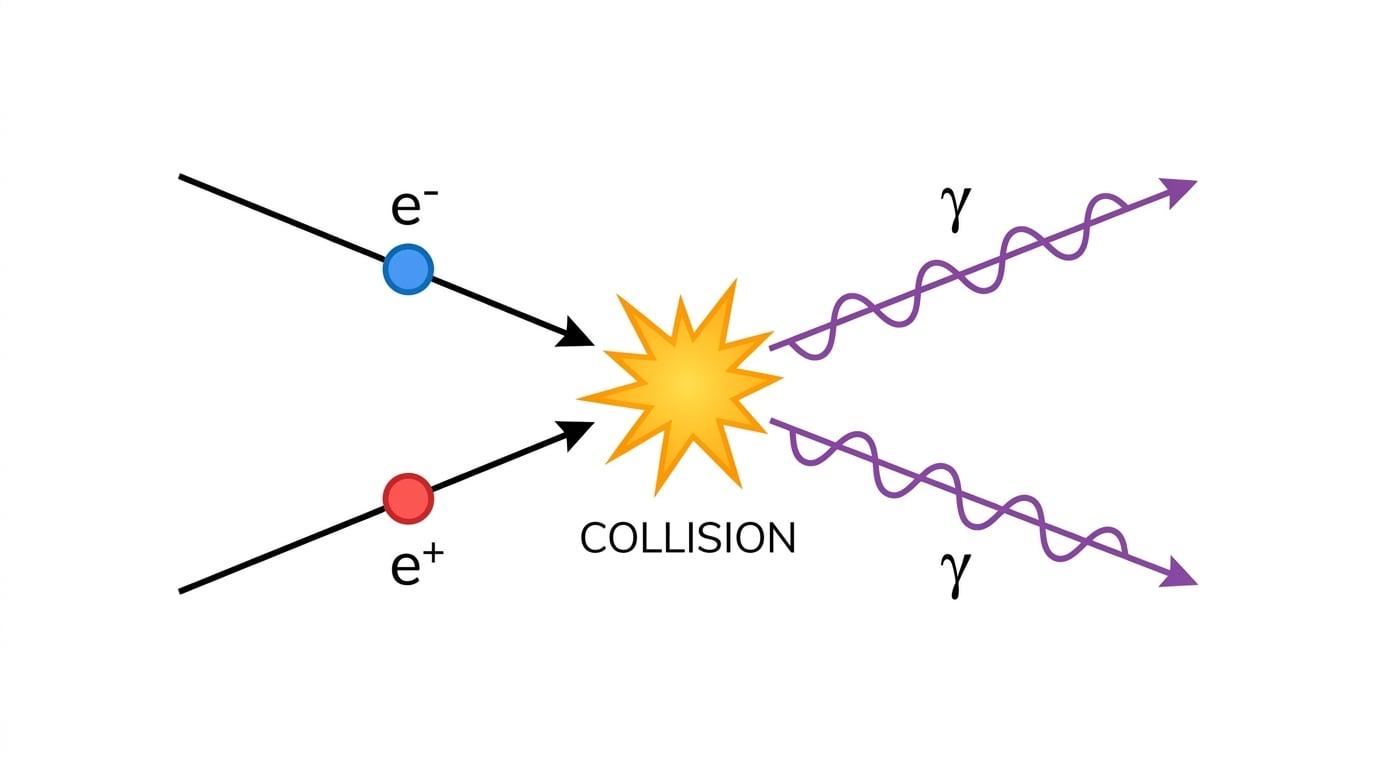
What happens when a particle meets its corresponding antiparticle? They cannot coexist. They destroy each other completely in a process called annihilation, and all of their mass is converted into pure energy in the form of electromagnetic radiation (photons).
Why two photons?
When a particle and its antiparticle annihilate (assuming they are moving very slowly, so we can ignore kinetic energy), they produce two gamma ray photons moving in exactly opposite directions.
Why two? Conservation of momentum. If a stationary electron and positron annihilate, their total initial momentum is zero. If only one photon were produced, it would carry momentum in one direction, violating the law of conservation of momentum. Two photons of equal energy firing in opposite directions cancel out each other's momentum, keeping the total at zero.
Calculating annihilation energies
Let's look at the energy balance. The total initial energy is the rest energy of the particle plus the rest energy of the antiparticle (E0+E0=2E0E_0 + E_0 = 2E_0E0+E0=2E0). The total final energy is the energy of the two photons (hf+hf=2hfhf + hf = 2hfhf+hf=2hf).
By equating them, we get:
2E0=2hfmin2E_0 = 2hf_{\text{min}}2E0=2hfminWhich simplifies to:
E0=hfminE_0 = hf_{\text{min}}E0=hfminMinimum frequency
We refer to fminf_{\text{min}}fmin (minimum frequency) because we usually assume the colliding particles are "slow" (they have zero kinetic energy). If they were moving quickly, they would have extra kinetic energy, meaning the resulting photons would have more total energy, and therefore a higher frequency.
Calculating gamma photon frequency in annihilation
A slow-moving electron and a slow-moving positron annihilate. Calculate the minimum frequency of the gamma photons produced. (Rest energy of an electron = 0.511 MeV0.511\text{ MeV}0.511 MeV. Planck constant = 6.63×10⁻³⁴ J s6.63 \times 10^{-34}\text{ J s}6.63×10⁻³⁴ J s)
- State the energy relationship. The rest energy of ONE particle provides the energy for ONE photon.
- Convert the rest energy from MeV\text{MeV}MeV into Joules.
- Rearrange the photon equation to solve for frequency (fminf_{\text{min}}fmin).
Medical Application: The PET Scanner
A brilliant real-world application of annihilation is the PET (Positron Emission Tomography) scanner used in hospitals. A patient is injected with a radioactive tracer that emits positrons. When a positron meets an electron inside the patient's body, they annihilate, emitting two gamma photons in exactly opposite directions. The scanner ring detects these two photons arriving simultaneously, and a computer traces their paths back to pinpoint exactly where the annihilation happened, mapping out a 3D image of the patient's internal organs!
Pair Production: Energy creates Mass
Pair production is the exact opposite of annihilation. Instead of mass turning into energy, pure energy turns into mass.
If a single high-energy photon passes near a heavy nucleus (which helps to conserve momentum), it can spontaneously vanish and its energy converts into a particle-antiparticle pair.
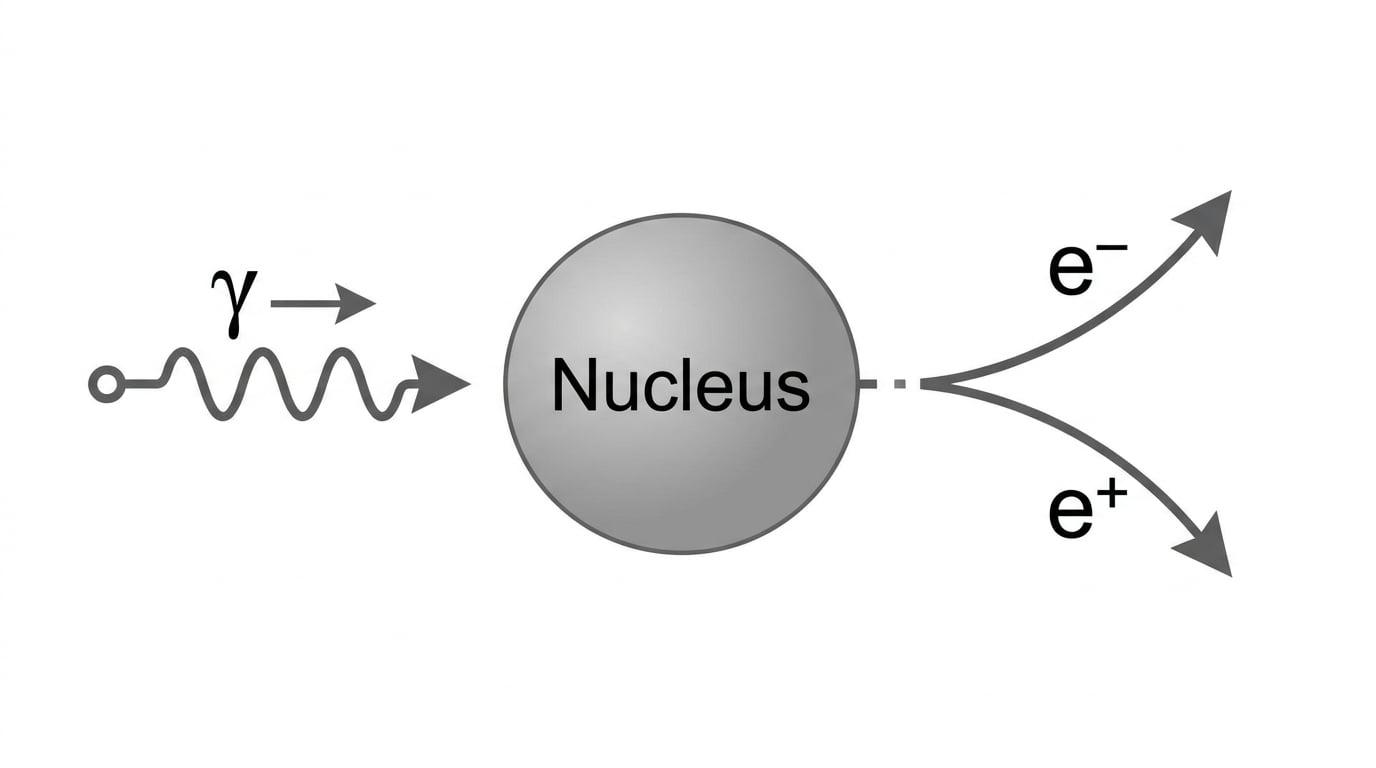
For this to happen, the incoming photon must have enough energy to "pay" for the mass of both new particles. The minimum energy the photon needs is exactly equal to the combined rest energy of the two particles.
hfmin=2E0hf_{\text{min}} = 2E_0hfmin=2E0If the photon has more energy than this minimum requirement, the leftover energy is converted into the kinetic energy of the newly created particle and antiparticle, meaning they will fly away from each other at higher speeds.
Calculating minimum photon energy for pair production
Calculate the minimum photon energy, in Joules, required to undergo pair production and create a proton and an antiproton. (Rest energy of a proton = 938 MeV938\text{ MeV}938 MeV)
- Identify the relationship for minimum photon energy. The photon must have enough energy to create BOTH particles.
- Calculate the total rest energy required in MeV\text{MeV}MeV.
- Convert this total energy from MeV\text{MeV}MeV to Joules.
Why not just an electron?
Could a photon undergo pair production to create just an electron? No! This would violate several conservation laws, such as the conservation of charge. An electron has a charge of −1-1−1, but the original photon had a charge of 000. By creating an electron (−1-1−1) and a positron (+1+1+1) simultaneously, the total charge remains 000.
In the exam
- Check your units early. The biggest pitfall in this topic is mixing up MeV\text{MeV}MeV and Joules. Before plugging any rest energy into E=hfE=hfE=hf, make absolutely sure you have multiplied it by 1.60×10−131.60 \times 10^{-13}1.60×10⁻¹³.
- Count the particles. In annihilation, 222 particles create 222 photons. So 111 particle's rest energy = 111 photon's energy (E0=hfE_0 = hfE0=hf). In pair production, 111 photon creates 222 particles. So 111 photon's energy = 2×2 \times2× particle rest energy (hf=2E0hf = 2E_0hf=2E0).
- Use the data sheet. Do not try to memorize the rest energies of electrons or protons. They are listed on your data sheet, and you must use those exact values (often to 3 or 4 significant figures depending on the question) to avoid rounding errors.
- "Minimum frequency" means zero kinetic energy. If a question asks for minimum frequency/energy, assume the particles are completely stationary. If they have kinetic energy, you add it to the rest energy.
Check yourself
- What is the difference between a particle and its corresponding antiparticle?
- Which unit conversion factor do you use to convert from MeV\text{MeV}MeV to Joules?
- Why must two photons be produced when an electron and a positron annihilate?
- In pair production, why can a single photon not produce two electrons?
