Constituents of the atom
What you'll learn
- The properties of protons, neutrons, and electrons in both relative and SI units.
- How to decode standard nuclide notation.
- What an isotope is and why isotopic data is useful.
- How to calculate the specific charge of particles, nuclei, and ions.
The simple model of the atom
To understand the universe, we first need to understand its smallest building blocks. The standard A-Level model of the atom consists of a dense, positively charged central nucleus surrounded by negatively charged electrons orbiting in shells.
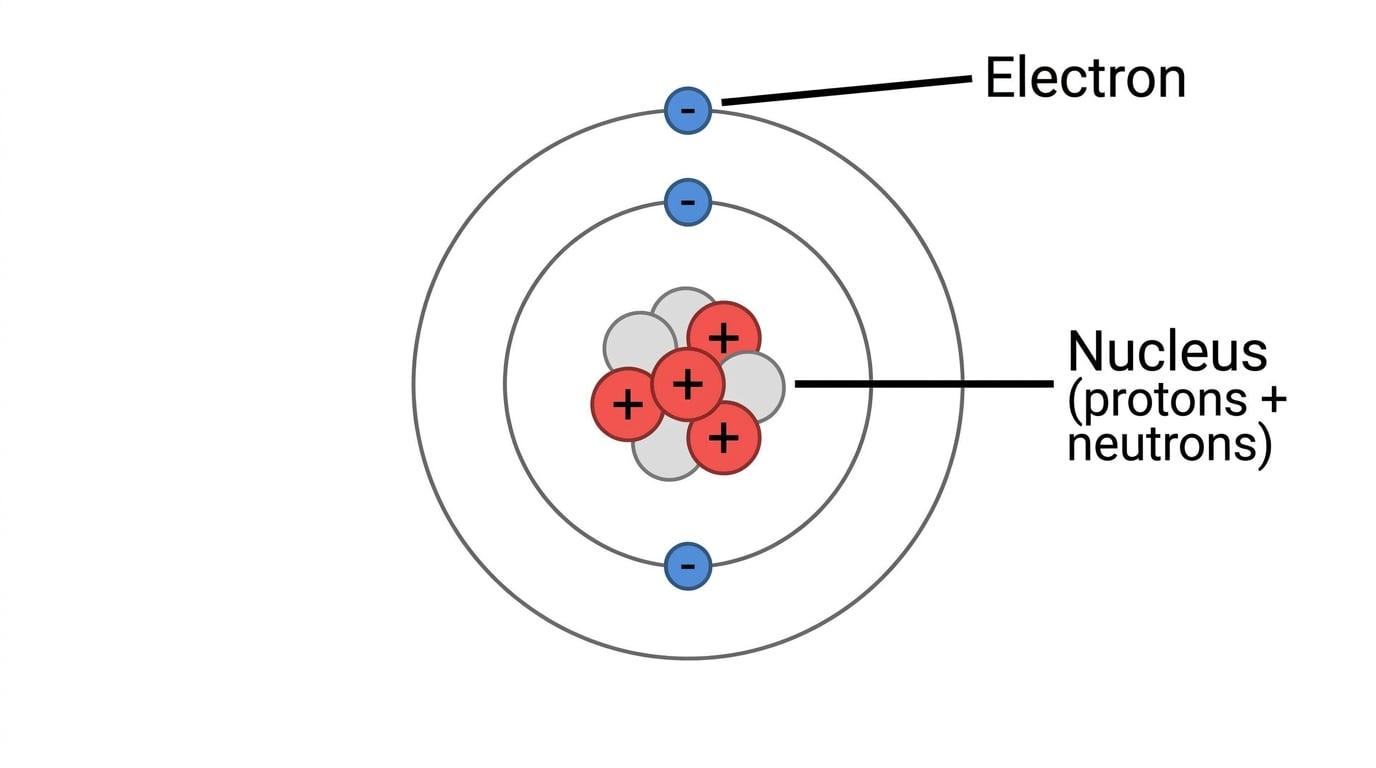
The nucleus itself is made up of two types of particles, collectively called nucleons:
- Protons (which are positively charged)
- Neutrons (which have no charge)
Because atoms are electrically neutral overall, the number of orbiting electrons is always exactly equal to the number of protons in the nucleus.
Charge and mass: Relative vs SI units
At GCSE, you likely used "relative" units to describe atomic particles (saying a proton has a mass of 111 and a charge of +1+1+1). At A-Level, you need to use precise SI units: kilograms (kg) for mass, and coulombs (C) for charge.
The basic "unit" of charge at the atomic scale is the elementary charge, given the symbol eee.
Elementary Charge ()
The magnitude of the charge on a single electron or proton. It is a fundamental constant equal to 1.60×10⁻¹⁹ C1.60 \times 10^{-19}\text{ C}1.60×10⁻¹⁹ C.
Here are the precise values you need to know (these are provided in your AQA data sheet, so you don't need to memorise them, but you must know how to use them):
| Particle | Relative Charge | SI Charge (C) | Relative Mass | SI Mass (kg) |
|---|---|---|---|---|
| Proton | +1+1+1 | +1.60×10⁻¹⁹+1.60 \times 10^{-19}+1.60×10⁻¹⁹ | 111 | 1.67×10−271.67 \times 10^{-27}1.67×10⁻²⁷ |
| Neutron | 000 | 000 | 111 | 1.67×10−271.67 \times 10^{-27}1.67×10⁻²⁷ |
| Electron | −1-1−1 | −1.60×10⁻¹⁹-1.60 \times 10^{-19}−1.60×10⁻¹⁹ | ≈0.0005\approx 0.0005≈0.0005 | 9.11×10−319.11 \times 10^{-31}9.11×10⁻³¹ |
Notice that the proton and neutron have nearly identical masses, while the electron is roughly 200020002000 times lighter.
Confusing relative and SI units
If a question asks for the charge of a nucleus in coulombs, do not just write down the number of protons! A nucleus with 666 protons has a relative charge of +6+6+6, but an SI charge of 6×1.60×10−19=9.60×10⁻¹⁹ C6 \times 1.60 \times 10^{-19} = 9.60 \times 10^{-19}\text{ C}6×1.60×10−19=9.60×10⁻¹⁹ C. Always check the units requested.
Nuclide Notation
To describe exactly what is inside a specific nucleus (a nuclide), physicists use a standard notation.
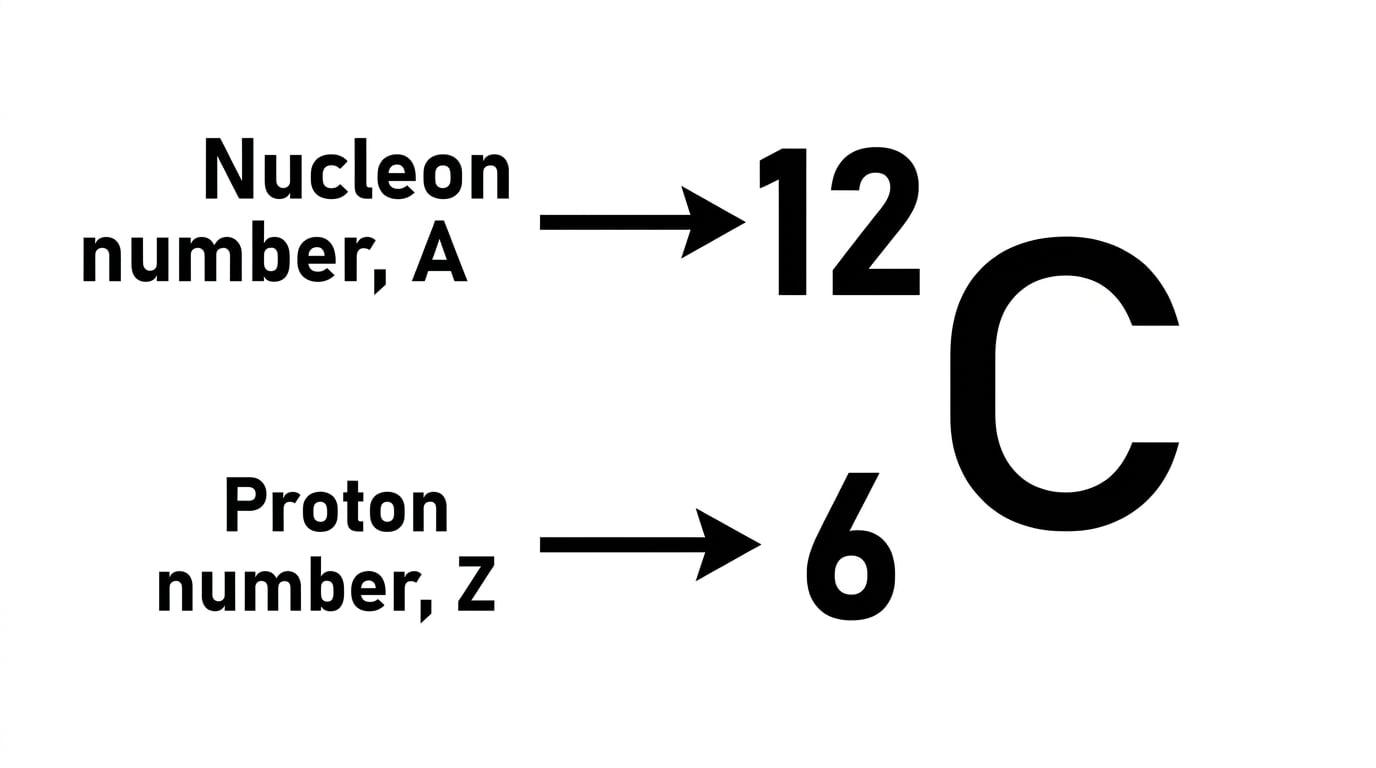
Nuclide Notation
The format ZAX{}_{Z}^{A}\text{X}ZAX is used to represent a specific nucleus, where:
- X\text{X}X is the chemical symbol of the element.
- AAA is the nucleon number (or mass number). It represents the total number of protons + neutrons.
- ZZZ is the proton number (or atomic number). It represents the total number of protons.
If you need to find the number of neutrons (NNN) in a nucleus, you simply subtract the proton number from the nucleon number:
N=A−ZN = A - ZN=A−ZDecoding nuclide notation
How many protons, neutrons, and electrons are in a neutral atom of 92238U{}_{92}^{238}\text{U}92238U?
- Identify the proton number (ZZZ). The bottom number is 929292. This means there are 929292 protons.
- Identify the electron count. Because the atom is neutral, the number of electrons equals the number of protons. There are 929292 electrons.
- Calculate the number of neutrons. Subtract the proton number from the nucleon number (AAA): Neutrons=A−Z=238−92=146\begin{aligned} \text{Neutrons} &= A - Z \\ &= 238 - 92 \\ &= 146 \end{aligned}Neutrons=A−Z=238−92=146
- State the final answer: 929292 protons, 146146146 neutrons, and 929292 electrons.
Isotopes
Not all atoms of the same element are identical. While the chemical identity of an element is strictly determined by its proton number (ZZZ), the number of neutrons can vary.
Isotope
Isotopes are atoms of the same element that have the same number of protons (same ZZZ) but a different number of neutrons (different AAA).
Because isotopes have the exact same number of electrons in their outer shells, they have identical chemical properties (they react the same way). However, having a different number of neutrons means they have different masses, and often different nuclear stability—which is why some isotopes are radioactive while others are stable.
Isotopic Data
Scientists use isotopic data—information about the relative abundances of different isotopes in a sample—for various applications. For example, by comparing the amount of the unstable isotope Carbon-14 to the stable isotope Carbon-12 in organic material, archaeologists can determine the age of ancient artefacts (radiocarbon dating).
Specific Charge
This is arguably the most important mathematical concept in this topic. You will frequently be asked to calculate it in exam papers.
Specific Charge
The specific charge of a particle is its charge divided by its mass. It tells you how much electrical charge the particle carries per kilogram.
Specific Charge=ChargeMass\text{Specific Charge} = \frac{\text{Charge}}{\text{Mass}}Specific Charge=MassChargeThe units are coulombs per kilogram (C kg−1\text{C kg}^{-1}C kg−1).
You can calculate the specific charge of fundamental particles, entire nuclei, or ions. The electron has the highest specific charge of any particle because its mass is so incredibly tiny compared to its charge.
Calculating Specific Charge for a Nucleus
When dealing with a nucleus, you only consider the protons and neutrons. The charge comes entirely from the protons, and the mass comes from both the protons and the neutrons.
Specific charge of a nucleus
Calculate the specific charge of a Carbon-12 nucleus, 612C{}_{6}^{12}\text{C}612C.
- Identify the composition of the nucleus. It has 666 protons and 666 neutrons (so 121212 nucleons in total).
- Calculate the total charge (QQQ). Only protons have charge: Q=6×(1.60×10−19 C)=9.60×10⁻¹⁹ C\begin{aligned} Q &= 6 \times (1.60 \times 10^{-19}\text{ C}) \\ &= 9.60 \times 10^{-19}\text{ C} \end{aligned}Q=6×(1.60×10−19 C)=9.60×10⁻¹⁹ C
- Calculate the total mass (mmm). We use the approximation that protons and neutrons have the same mass (1.67×10⁻²⁷ kg1.67 \times 10^{-27}\text{ kg}1.67×10⁻²⁷ kg), so we can just multiply the nucleon number (AAA) by the mass of one nucleon: m=12×(1.67×10−27 kg)=2.004×10⁻²⁶ kg\begin{aligned} m &= 12 \times (1.67 \times 10^{-27}\text{ kg}) \\ &= 2.004 \times 10^{-26}\text{ kg} \end{aligned}m=12×(1.67×10−27 kg)=2.004×10⁻²⁶ kg
- Compute the specific charge: Specific Charge=Qm=9.60×10−192.004×10−26=4.79×10⁷ C kg−1\begin{aligned} \text{Specific Charge} &= \frac{Q}{m} \\ &= \frac{9.60 \times 10^{-19}}{2.004 \times 10^{-26}} \\ &= 4.79 \times 10^{7}\text{ C kg}^{-1} \end{aligned}Specific Charge=mQ=2.004×10−269.60×10−19=4.79×10⁷ C kg−1
Nucleus vs. Atom
Read the question carefully! The specific charge of a neutral atom is always 0 C kg−10\text{ C kg}^{-1}0 C kg−1 because the overall charge is zero. The specific charge of a nucleus only counts the nuclear mass and the positive proton charge.
Calculating Specific Charge for an Ion
An ion is an atom that has gained or lost electrons, giving it a net overall charge.
Specific charge of an ion
Calculate the specific charge of a Magnesium ion, 1224Mg2+{}_{12}^{24}\text{Mg}^{2+}1224Mg2+.
- Identify the net charge of the ion. The 2+2+2+ means it has lost two electrons, leaving a net charge of +2e+2e+2e. Q=+2×(1.60×10−19 C)=3.20×10⁻¹⁹ C\begin{aligned} Q &= +2 \times (1.60 \times 10^{-19}\text{ C}) \\ &= 3.20 \times 10^{-19}\text{ C} \end{aligned}Q=+2×(1.60×10−19 C)=3.20×10⁻¹⁹ C
- Calculate the total mass of the ion. The mass is heavily dominated by the 242424 nucleons in the nucleus. The mass of the remaining electrons is so tiny that AQA allows you to ignore it in these calculations. m≈24×(1.67×10−27 kg)=4.008×10⁻²⁶ kg\begin{aligned} m &\approx 24 \times (1.67 \times 10^{-27}\text{ kg}) \\ &= 4.008 \times 10^{-26}\text{ kg} \end{aligned}m≈24×(1.67×10−27 kg)=4.008×10⁻²⁶ kg
- Compute the specific charge: Specific Charge=Qm=3.20×10−194.008×10−26=7.98×10⁶ C kg−1\begin{aligned} \text{Specific Charge} &= \frac{Q}{m} \\ &= \frac{3.20 \times 10^{-19}}{4.008 \times 10^{-26}} \\ &= 7.98 \times 10^{6}\text{ C kg}^{-1} \end{aligned}Specific Charge=mQ=4.008×10−263.20×10−19=7.98×10⁶ C kg−1
Sanity Checking Your Answers
Specific charge values are typically very large numbers. For a nucleus or an ion, expect an answer in the region of 10610^6106 to 108 C kg−110^8\text{ C kg}^{-1}108 C kg−1. For an electron, it's roughly 1.76×10¹¹ C kg−11.76 \times 10^{11}\text{ C kg}^{-1}1.76×10¹¹ C kg−1. If you get a tiny decimal like 10−810^{-8}10−8, you've likely divided mass by charge instead of charge by mass!
In the exam
- Check the object: Always underline whether the question asks for the specific charge of an ion, a nucleus, or an atom. This completely changes the charge value you use.
- Use the data sheet: Don't rely on memory for particle masses or the elementary charge. Copy the values exactly as they appear on the AQA formula sheet.
- Show your working: If you write out the QQQ and mmm calculations clearly before dividing them, you will usually pick up a method mark even if you press the wrong button on your calculator at the end.
- Ignore electron mass for ions: Unless explicitly asked otherwise, you can safely assume the mass of an ion is just the mass of its nucleons. The missing/extra electrons won't change the mass enough to affect an answer given to 3 significant figures.
Check yourself
- Can you define what an isotope is without looking at the notes?
- What is the difference between nucleon number and proton number?
- If you were asked to find the specific charge of an O2−\text{O}^{2-}O2− ion, what would be the value of the charge QQQ you use?
- Why do isotopes of the same element react identically in chemical reactions?