https://assets.mathsgenie.co.uk/notes/8125963b-dfef-4ffa-9936-e5ff17a7808c.jpeg)
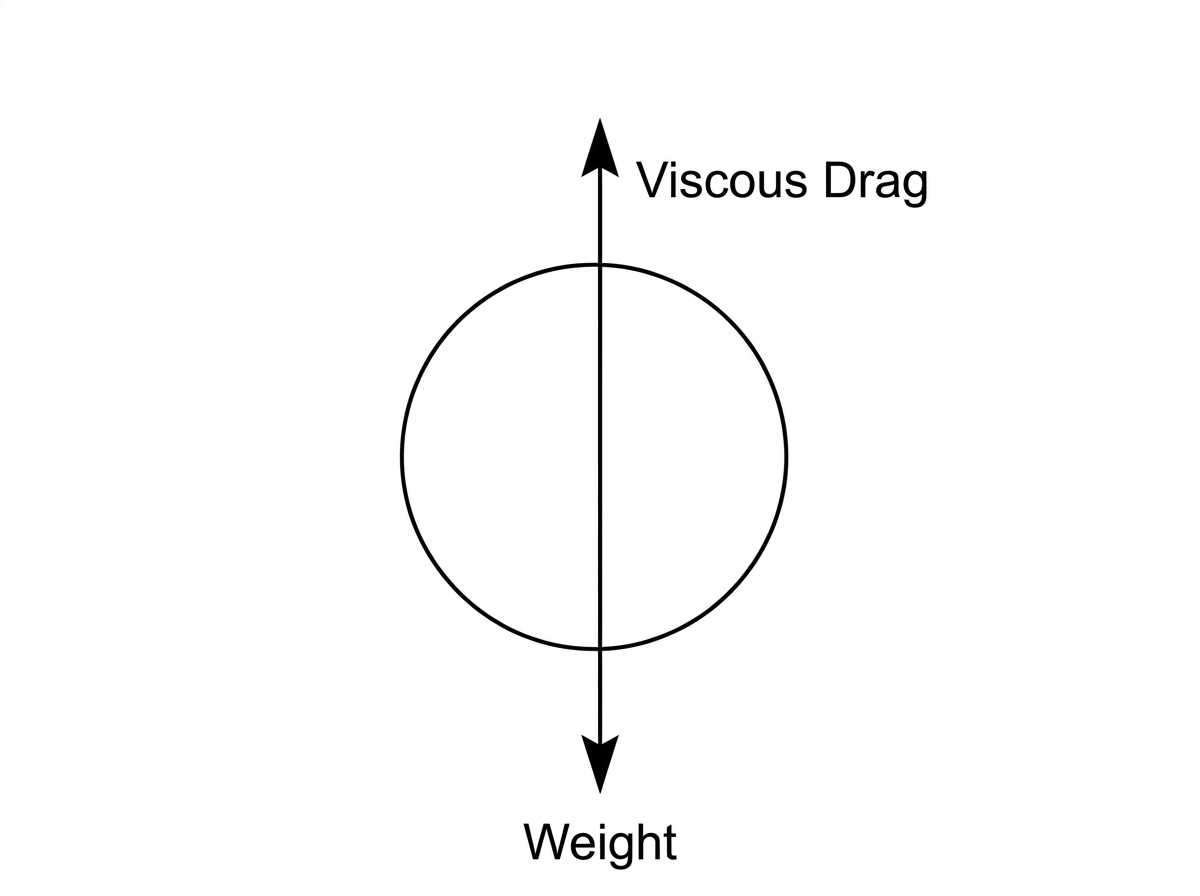
We calculate the viscous drag using Stokes' Law.
Stokes' Law
For a small sphere falling at a low speed through a fluid, the viscous drag force FFF is:
F=6πηrv F = 6\pi\eta rv F=6πηrvWhere:
- η\etaη (eta) is the coefficient of viscosity of the fluid (for air, this is roughly 1.8×10⁻⁵ N s m−21.8 \times 10^{-5}\text{ N s m}^{-2}1.8×10⁻⁵ N s m−2)
- rrr is the radius of the sphere (in m\text{m}m)
- vvv is the terminal velocity (in m s−1\text{m s}^{-1}m s−1)
At terminal velocity, Weight = Drag:
mg=6πηrv mg = 6\pi\eta rv mg=6πηrvWe still have a problem. This equation has two unknowns: mass mmm and radius rrr. To solve this, we use the density of the oil.
Density is ρ=massvolume\rho = \frac{\text{mass}}{\text{volume}}ρ=volumemass, and the volume of a sphere is 43πr3\frac{4}{3}\pi r^334πr3. Therefore, the mass of the drop is:
m=43πr3ρ m = \frac{4}{3}\pi r^3 \rho m=34πr3ρIf we substitute this expression for mmm into our balance equation, we get:
43πr3ρg=6πηrv \frac{4}{3}\pi r^3 \rho g = 6\pi\eta rv 34πr3ρg=6πηrvNow we can rearrange this to find rrr. Once we calculate rrr, we can use it to find the mass mmm, and then finally use mmm in the stationary drop equation to find the charge QQQ! Let's see this in action.
Calculating the charge of an oil drop
An oil drop is falling at a terminal velocity of 1.20×10⁻⁴ m s−11.20 \times 10^{-4}\text{ m s}^{-1}1.20×10⁻⁴ m s−1 with the electric field off. The density of the oil is 880 kg m−3880\text{ kg m}^{-3}880 kg m−3 and the viscosity of air is 1.80×10⁻⁵ N s m−21.80 \times 10^{-5}\text{ N s m}^{-2}1.80×10⁻⁵ N s m−2.
- First, set up the rearranged Stokes' Law equation to find r2r^2r2.
Cancel rrr from both sides, and rearrange for r2r^2r2:
r2=18πηv4πρg=9ηv2ρg r^2 = \frac{18\pi\eta v}{4\pi\rho g} = \frac{9\eta v}{2\rho g} r2=4πρg18πηv=2ρg9ηv- Substitute the values to calculate the radius rrr.
- Use the radius to find the mass mmm of the drop.
- The field is switched on. A potential difference of 4000 V4000\text{ V}4000 V across plates separated by 0.015 m0.015\text{ m}0.015 m holds this same drop stationary. Calculate the charge QQQ.
Forgetting to square or cube the radius
When moving between r2r^2r2 in the Stokes' Law rearrangement and r3r^3r3 in the volume formula, students frequently make substitution errors on their calculator. Always write down your calculated value for rrr explicitly before moving on to calculate mmm.
Motion WITH an Electric Field
Sometimes AQA will test your understanding by asking what happens if the electric field is on, but it is not strong enough to hold the drop stationary. The drop will fall, but at a slower constant terminal velocity because the upward electric force is helping the drag fight gravity.
If the drop falls at a steady speed with the field ON, the forces balance like this:
Weight (down)=Electric Force (up)+Viscous Drag (up) \text{Weight (down)} = \text{Electric Force (up)} + \text{Viscous Drag (up)} Weight (down)=Electric Force (up)+Viscous Drag (up) mg=QVd+6πηrvnew mg = \frac{QV}{d} + 6\pi\eta rv_{\text{new}} mg=dQV+6πηrvnewUp thrust?
Strictly speaking, there is also an upward buoyancy force (upthrust) on the drop equal to the weight of the air displaced. In AQA physics, unless you are specifically given the density of air and asked to account for it, you should ignore upthrust as it is negligibly small compared to the weight of the oil.
The Significance of Millikan's Results
Millikan repeated this incredibly tedious process for hundreds of drops over several years. He found that the charge QQQ on the droplets was never a random continuous value.
Instead, he got results like:
- 1.6×10⁻¹⁹ C1.6 \times 10^{-19}\text{ C}1.6×10⁻¹⁹ C
- 3.2×10⁻¹⁹ C3.2 \times 10^{-19}\text{ C}3.2×10⁻¹⁹ C
- 4.8×10⁻¹⁹ C4.8 \times 10^{-19}\text{ C}4.8×10⁻¹⁹ C
- 8.0×10⁻¹⁹ C8.0 \times 10^{-19}\text{ C}8.0×10⁻¹⁹ C
He noticed that every single value he calculated was an integer multiple of a base amount: 1.60×10⁻¹⁹ C1.60 \times 10^{-19}\text{ C}1.60×10⁻¹⁹ C.
A drop might have gained 1 electron, 2 electrons, or 5 electrons, but it could never gain 1.5 electrons. This base amount is the fundamental electronic charge, eee.
Quantisation of Charge
Millikan's experiment proved that electric charge is quantised. It exists only in discrete packets (quanta) rather than as a continuous fluid. The smallest possible packet of free charge is the charge of a single electron, e=1.60×10⁻¹⁹ Ce = 1.60 \times 10^{-19}\text{ C}e=1.60×10⁻¹⁹ C.
In the exam
- Be rigorous with your algebra. The derivation of r2=9ηv2ρgr^2 = \frac{9\eta v}{2\rho g}r2=2ρg9ηv is a common 3- or 4-mark question. Practice starting from mg=6πηrvmg = 6\pi\eta rvmg=6πηrv and substituting m=43πr3ρm = \frac{4}{3}\pi r^3 \rhom=34πr3ρ until you can do it without looking.
- Watch the units. Plate separation ddd is often given in mm, and viscosity η\etaη or density ρ\rhoρ might have strange prefixes. Convert everything to pure SI units (m\text{m}m, kg\text{kg}kg, s\text{s}s) before touching your calculator.
- Number of electrons. If asked "how many electrons are on the drop?", divide your calculated QQQ by 1.60×10−191.60 \times 10^{-19}1.60×10⁻¹⁹. The answer must be an integer. If you get 3.5, you have made a calculation error.
Check yourself
- Can you write down the equation linking voltage, plate spacing, mass, and charge for a stationary drop?
- Why must the electric field be turned off to find the mass of the drop?
- How did the results of Millikan's experiment show that charge is quantised?