Simple harmonic systems (A-level only)
What you'll learn:
- How to calculate the time period for a mass-spring system and a simple pendulum.
- Why the "small-angle approximation" is vital for pendulums.
- How kinetic and potential energy continuously interchange during Simple Harmonic Motion (SHM).
- The difference between light, heavy, and critical damping, and how they affect oscillations.
The Mass-Spring System
If you hang a mass from a spring, pull it down, and let it go, it will bounce up and down. Because the restoring force provided by the spring follows Hooke's Law (F=−kΔxF = -k \Delta xF=−kΔx), the force is directly proportional to the displacement. This is the exact condition required for Simple Harmonic Motion (SHM).
The time it takes for one complete bounce (the time period, TTT) depends on only two things: the mass mmm, and the stiffness of the spring kkk.
Mass-Spring Period Equation
The time period TTT of a mass-spring system is given by:
T=2πmk T = 2\pi\sqrt{\frac{m}{k}} T=2πkmWhere:
- TTT = time period in seconds (s\text{s}s)
- mmm = mass in kilograms (kg\text{kg}kg)
- kkk = spring constant in newtons per metre (N m−1\text{N m}^{-1}N m−1)
Notice that the acceleration due to gravity (ggg) is not in this equation. A mass on a spring will have the exact same time period on Earth as it would in deep space or on the Moon (assuming the spring behaves identically)!
Proportionality shortcuts
If you quadruple the mass (m×4m \times 4m×4), the time period doubles (T×2T \times 2T×2) because of the square root. If you use a spring that is four times stiffer (k×4k \times 4k×4), the time period halves (T÷2T \div 2T÷2).
Calculating mass from period
A spring with a constant of 45 N m−145\text{ N m}^{-1}45 N m−1 is observed to oscillate with a time period of 0.85 s0.85\text{ s}0.85 s. Calculate the mass suspended from the spring.
- State the known values: k=45 N m−1k = 45\text{ N m}^{-1}k=45 N m−1, T=0.85 sT = 0.85\text{ s}T=0.85 s.
- Write down the formula:
- Rearrange to make mmm the subject. First, divide by 2π2\pi2π:
- Square both sides to remove the square root:
- Multiply by kkk:
- Substitute the values and calculate:
The Simple Pendulum
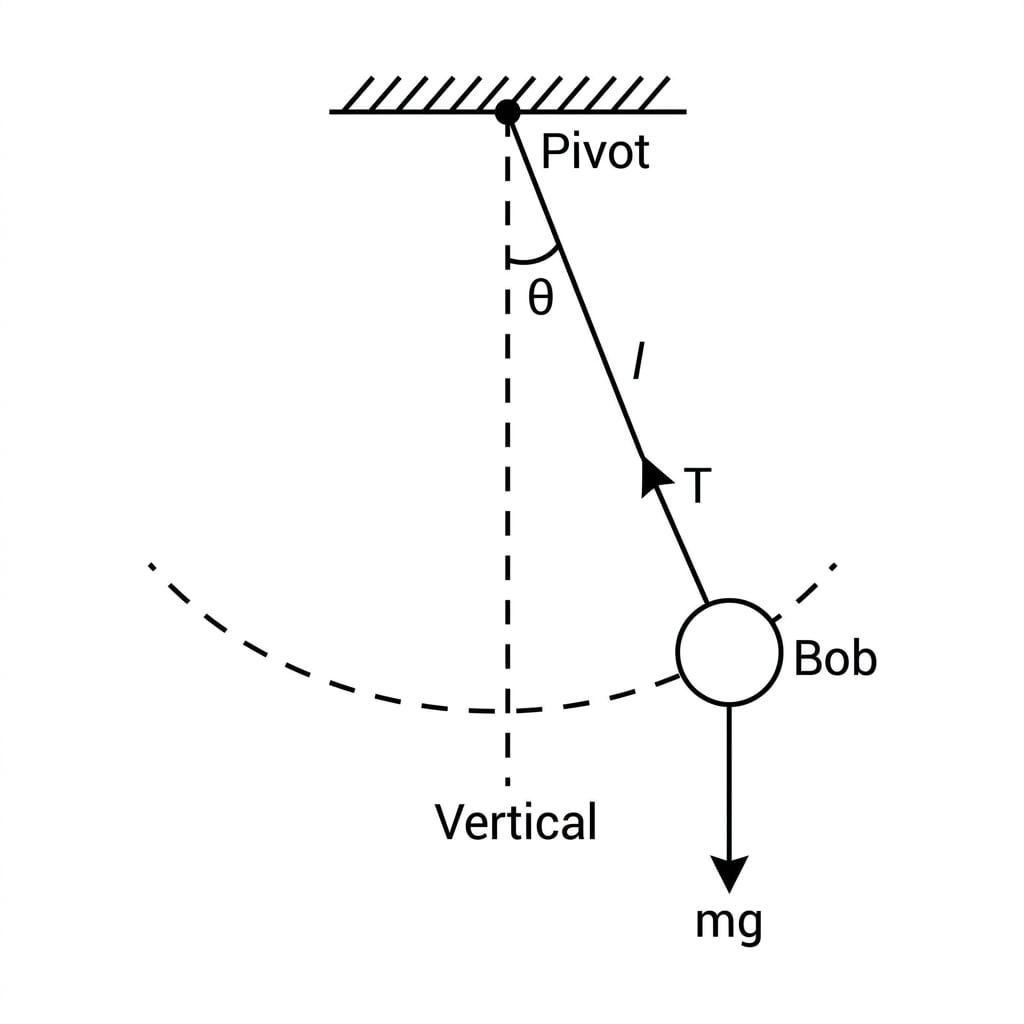
A simple pendulum consists of a dense mass (the bob) hanging from a light, inextensible string. When pulled to the side and released, it swings back and forth.
Unlike the mass-spring system, the restoring force here is a component of the bob's weight.
Simple Pendulum Period Equation
The time period TTT of a simple pendulum is given by:
T=2πlg T = 2\pi\sqrt{\frac{l}{g}} T=2πglWhere:
- TTT = time period in seconds (s\text{s}s)
- lll = length of the pendulum in metres (m\text{m}m)
- ggg = gravitational field strength in newtons per kilogram (N kg−1\text{N kg}^{-1}N kg−1) or m s−2\text{m s}^{-2}m s−2
Mass doesn't matter
Students often instinctively think a heavier pendulum bob will swing faster. It doesn't! The mass mmm cancels out in the derivation. A bowling ball and a small pebble on identical 1 m1\text{ m}1 m strings will have the exact same time period.
The Small-Angle Approximation
There is a catch to the pendulum equation. For a pendulum to undergo true SHM, the restoring force must be directly proportional to the displacement angle θ\thetaθ.
However, the restoring force is actually proportional to sinθ\sin \thetasinθ.
We can only treat the pendulum as an SHM system if sinθ≈θ\sin \theta \approx \thetasinθ≈θ (when θ\thetaθ is measured in radians). This is known as the small-angle approximation and is only valid for angles less than about 10∘10^\circ10∘. If you swing a pendulum from a 45∘45^\circ45∘ angle, it is no longer performing simple harmonic motion, and the time period equation T=2πlgT = 2\pi\sqrt{\frac{l}{g}}T=2πgl will give you an incorrect, shorter time than reality.
Pendulum on a new planet
An astronaut uses a simple pendulum of length 0.60 m0.60\text{ m}0.60 m to determine the gravitational field strength on a newly discovered planet. The pendulum takes 32.0 s32.0\text{ s}32.0 s to complete 20 full oscillations. Calculate ggg on this planet.
- Find the time period TTT for a single oscillation.
- State the pendulum formula:
- Rearrange for ggg. Divide by 2π2\pi2π and square both sides:
- Invert both sides (or cross-multiply) to make ggg the subject:
- Substitute the values:
Energy in Simple Harmonic Motion
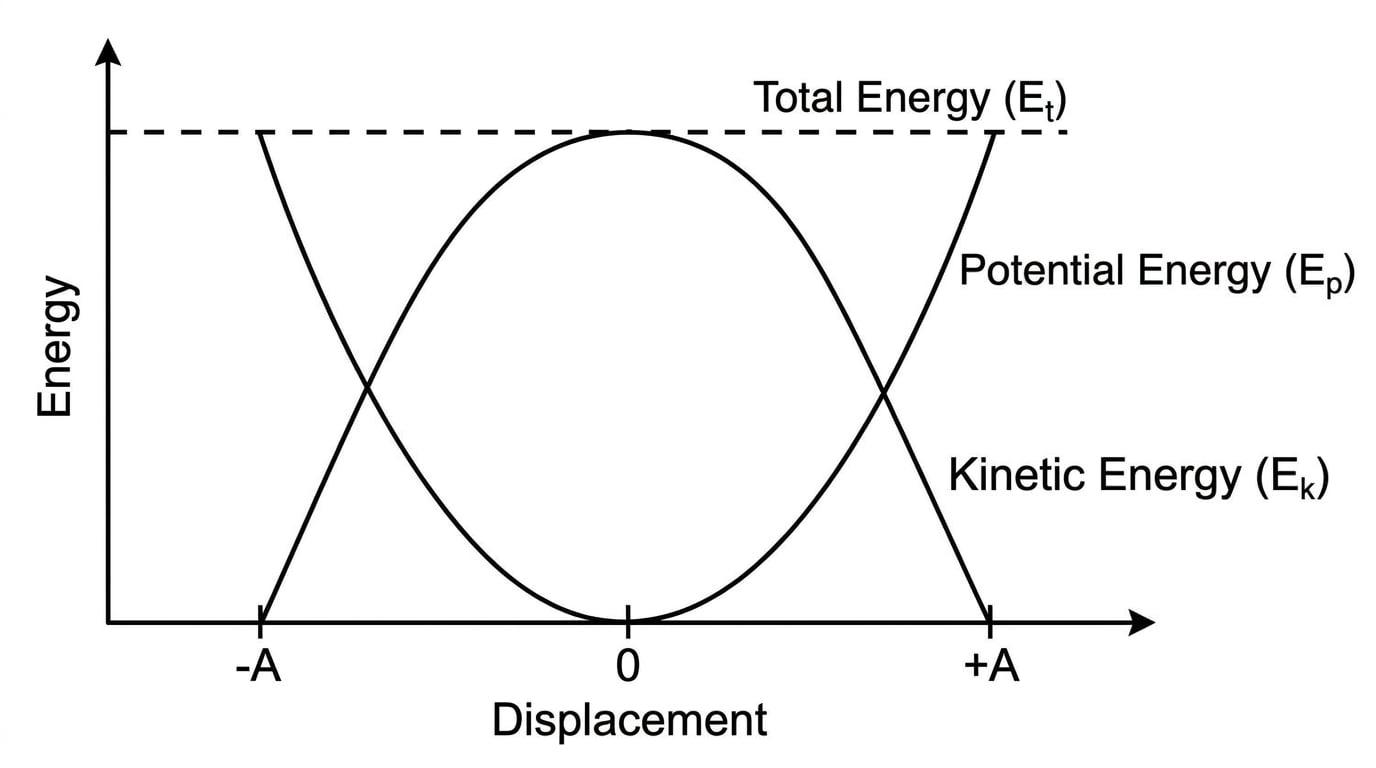
As an object undergoes SHM, energy constantly transfers back and forth between kinetic energy (EkE_kEk) and potential energy (EpE_pEp).
- Potential Energy (EpE_pEp): This is maximum at the extremes of the oscillation (maximum displacement, ±A\pm A±A) where the object momentarily stops. For a spring, this is elastic potential energy. For a pendulum, it is gravitational potential energy.
- Kinetic Energy (EkE_kEk): This is maximum as the object flies through the equilibrium position (zero displacement) because it is moving at its maximum speed.
If the system has no damping (no energy lost to friction or air resistance), the total energy (Etotal=Ek+EpE_{\text{total}} = E_k + E_pEtotal=Ek+Ep) remains perfectly constant.
Energy-Time Graphs
If you plot energy against time instead of displacement, both EkE_kEk and EpE_pEp form continuous wave patterns.
Crucially, in one complete time period of the oscillation TTT, the object passes through the equilibrium point twice, and hits maximum displacement twice. Therefore, the kinetic and potential energy go through two complete cycles during one full oscillation.
Energy frequency
The frequency of the energy changes is exactly twice the frequency of the displacement. If a pendulum swings back and forth with a frequency of 0.5 Hz0.5\text{ Hz}0.5 Hz, its kinetic energy peaks at a frequency of 1.0 Hz1.0\text{ Hz}1.0 Hz.
The Effects of Damping
In the real world, oscillators don't swing forever. Air resistance and internal friction transfer energy out of the system, usually as heat. This process is called damping. Damping reduces the total energy of the system, which causes the amplitude of the oscillations to decrease over time.
There are three main categories of damping you need to know:
- Light damping: The resistive forces are small. The amplitude slowly decreases over many oscillations, following an exponential decay curve. The time period remains almost entirely unaffected.
- Heavy damping: The resistive forces are large. The system takes a long time to return to the equilibrium position and might not oscillate at all. Imagine a pendulum swinging in thick treacle.
- Critical damping: The exact amount of damping required to return the system to equilibrium in the shortest possible time without overshooting (oscillating).
Car suspension
Car suspension systems are designed to be critically damped. When you hit a bump, you want the car to return to its normal ride height as quickly as possible without bouncing up and down (which would be under-damped) or taking ages to settle (which would be heavy/over-damped).
In the exam
- When calculating TTT for a mass-spring system or pendulum, make sure your length lll is in metres and mass mmm is in kilograms. Exam questions often sneak in lengths in cm\text{cm}cm or masses in g\text{g}g.
- If an energy question asks for the velocity at equilibrium, equate the maximum potential energy at the amplitude to the maximum kinetic energy at the centre: 12mvmax2=Total Energy\frac{1}{2}mv_{\text{max}}^2 = \text{Total Energy}21mvmax2=Total Energy.
- When asked to define critical damping, explicitly state "returns to equilibrium in the shortest possible time without oscillating". Missing the "shortest possible time" part loses marks.
- For Required Practical questions (like finding ggg using a pendulum), you are expected to plot a graph. For a pendulum, plotting T2T^2T2 on the y-axis and lll on the x-axis gives a straight line through the origin with a gradient of 4π2g\frac{4\pi^2}{g}g4π2.
Check yourself
- If you take a pendulum clock to a planet with a weaker gravitational field, will it run fast or slow?
- How does the amplitude of a lightly damped oscillator change over time?
- Why is it important to keep the swing angle small when performing a pendulum experiment?
- At what displacement is the kinetic energy of an oscillator exactly equal to its potential energy?