Simple harmonic motion (SHM) (A-level only)
Welcome to Simple Harmonic Motion (SHM). If you have ever watched a pendulum swing back and forth, or a mass bounce up and down on a spring, you have seen periodic motion. SHM is a very specific, mathematically perfect type of periodic motion.
What you'll learn:
- The strict mathematical condition that makes a motion "simple harmonic".
- How to calculate an object's displacement, velocity, and acceleration at any moment in time.
- How to interpret and sketch the displacement–time, velocity–time, and acceleration–time graphs for an oscillating object.
The Condition for Simple Harmonic Motion
Imagine a mass resting on a frictionless table, attached to a spring. When the mass is sitting completely still, the spring is neither stretched nor compressed. We call this central resting point the equilibrium position.
If you pull the mass to the right and let go, the spring pulls it back towards the centre. If you push the mass to the left, the spring pushes it back towards the centre. This force that always points back to the equilibrium position is called a restoring force.
By Newton's second law, a force causes an acceleration. Because the restoring force points towards the centre, the acceleration must also point towards the centre. Furthermore, the further you pull the mass, the harder the spring pulls back. Therefore, the acceleration is directly proportional to how far the mass is from the centre (its displacement, xxx).
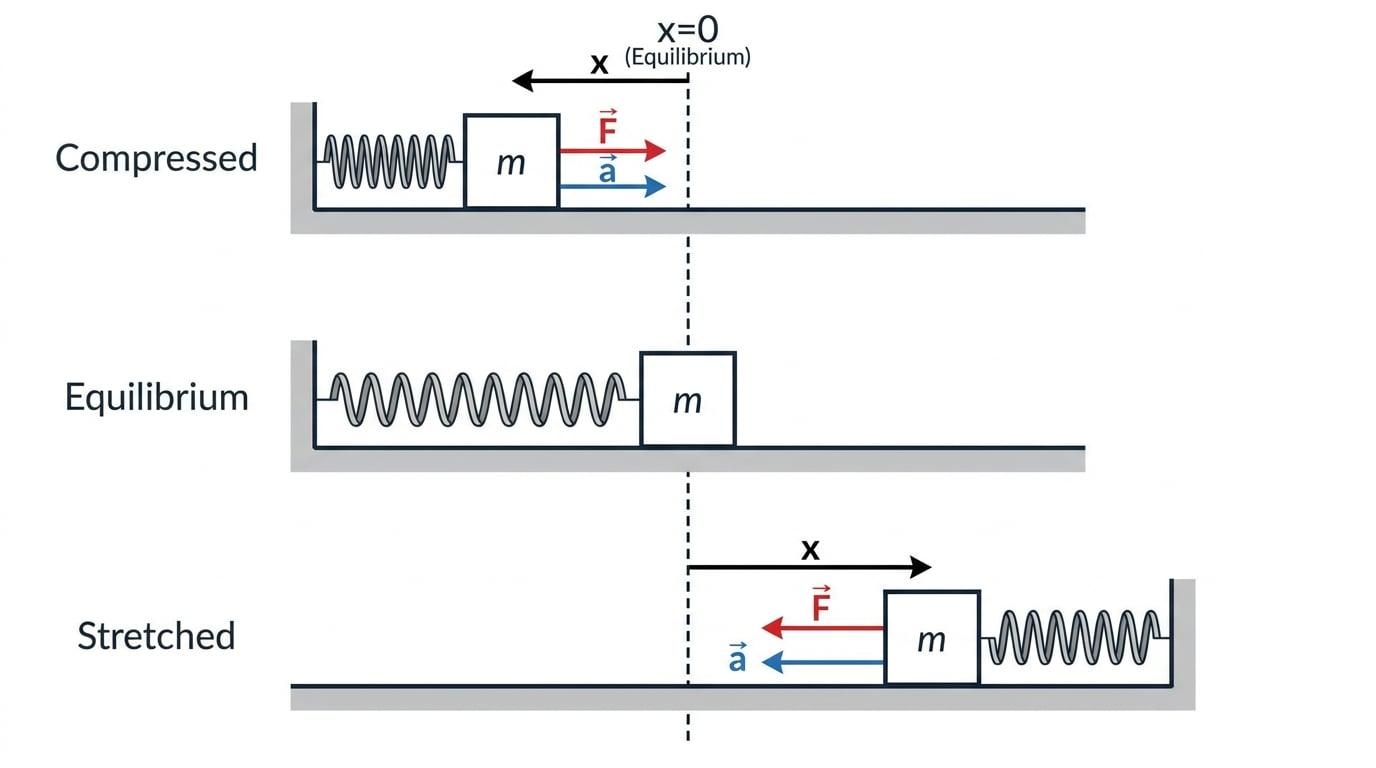
Simple Harmonic Motion (SHM)
Simple Harmonic Motion is a type of oscillation where the acceleration of the oscillator is directly proportional to its displacement from the equilibrium position, and is always directed towards that equilibrium position.
Mathematically, this is written as:
a∝−x a \propto -x a∝−xTo turn this proportionality into an equation, we introduce a constant of proportionality. In SHM, this constant is ω2\omega^2ω2, where ω\omegaω is the angular frequency of the oscillation. This gives us the defining equation of SHM:
a=−ω2x a = -\omega^2 x a=−ω2x- aaa is the acceleration in m s⁻²
- ω\omegaω is the angular frequency in rad s⁻¹
- xxx is the displacement from equilibrium in m
- The negative sign is crucial: it shows that acceleration aaa and displacement xxx are always in opposite directions. When xxx is positive (to the right), aaa is negative (pulling left).
Recall from your earlier studies of circular motion and waves that angular frequency is related to the standard frequency fff and the time period TTT:
ω=2πf=2πT \omega = 2\pi f = \frac{2\pi}{T} ω=2πf=T2πCalculating acceleration in SHM
A mass on a spring is oscillating with simple harmonic motion. It has a frequency of 2.0 Hz. Calculate the magnitude of its acceleration when its displacement is 0.050 m.
- First, find the angular frequency ω\omegaω using the given frequency.
- State the defining equation for SHM. We only need the magnitude, so we can ignore the negative sign for the final answer.
- Substitute your values into the equation to find the acceleration.
- State the final magnitude with correct units. The magnitude of the acceleration is 7.9 m s⁻².
Displacement and Velocity in SHM
If you start a stopwatch (t=0t = 0t=0) at the exact moment you release the mass from its maximum positive displacement (the amplitude, AAA), its position over time follows a cosine wave. The equation for displacement is:
x=Acosωt x = A \cos \omega t x=AcosωtAs the mass moves, its velocity vvv constantly changes. It is stationary for a tiny instant at the extreme ends of its swing (maximum displacement), and it moves fastest when it rushes through the central equilibrium position. The velocity at any given displacement xxx is given by:
v=±ωA2−x2 v = \pm \omega \sqrt{A^2 - x^2} v=±ωA2−x2The ±\pm± symbol simply tells us that at any given position, the mass could be moving in the positive direction (away from the centre) or the negative direction (back towards it).
Maximum values in SHM
You can quickly find the absolute maximum speed and maximum acceleration by looking at the extreme points of the motion:
- Maximum speed occurs at the equilibrium position (x=0x = 0x=0). Substitute x=0x = 0x=0 into the velocity equation, and it simplifies to:
- Maximum acceleration occurs at the maximum displacement (x=Ax = Ax=A). Substitute x=Ax = Ax=A into the defining equation, and its magnitude is:
Finding speed at a specific displacement
A pendulum bob undergoes SHM with an amplitude of 0.12 m and a time period of 1.5 s. Calculate its speed when it is 0.04 m from the equilibrium position.
- Calculate the angular frequency ω\omegaω from the time period TTT.
- State the velocity–displacement equation.
- Substitute the known values (A=0.12A = 0.12A=0.12, x=0.04x = 0.04x=0.04, and ω≈4.189\omega \approx 4.189ω≈4.189) to find the speed.
- The question asks for "speed", which is a scalar magnitude, so we drop the ±\pm± sign. The speed is 0.47 m s⁻¹.
Graphical Representations of SHM
One of the most important skills in this topic is being able to link the graphs of displacement, velocity, and acceleration against time.
If we assume the oscillator starts at its maximum positive displacement (x=Ax = Ax=A), the displacement–time graph is a standard cosine curve.
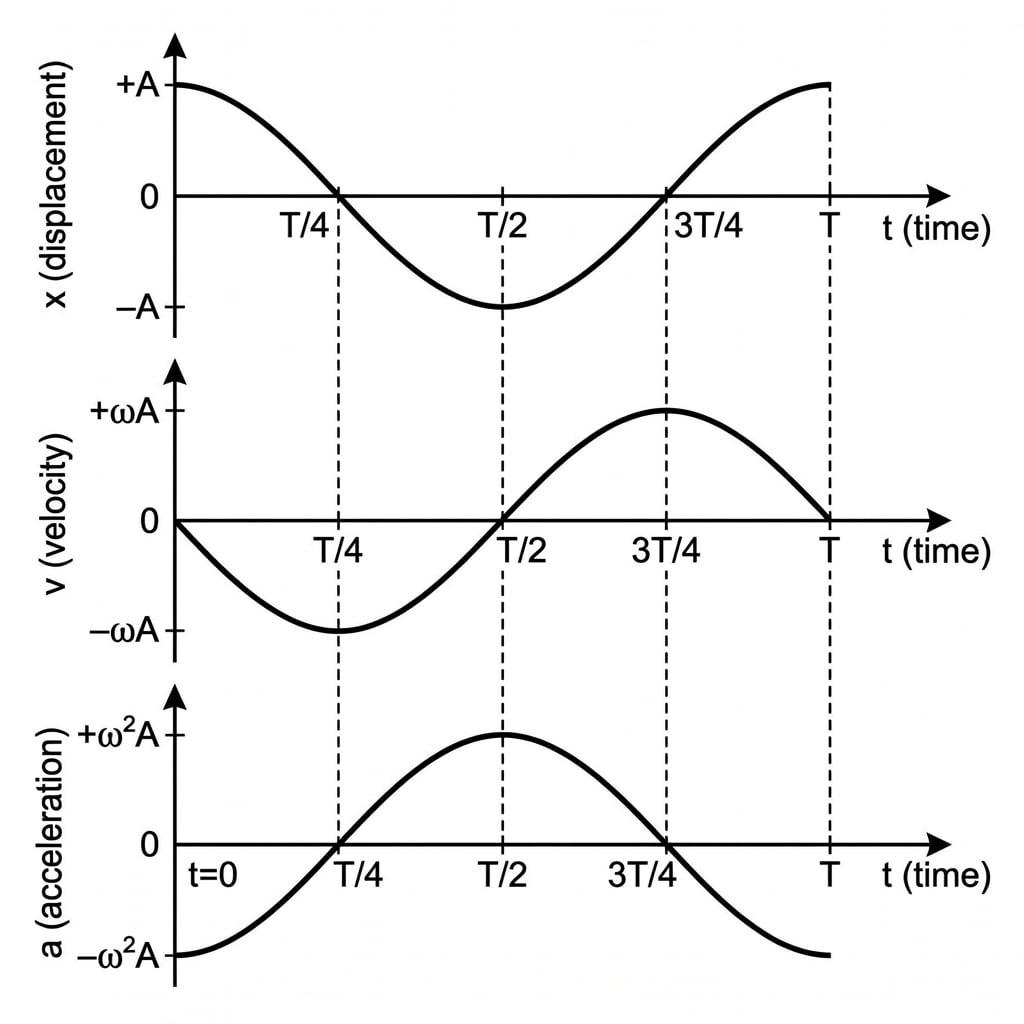
Notice how the graphs align perfectly with each other vertically. This is because of the calculus relationship between the quantities:
- Velocity is the rate of change of displacement. Therefore, the v−tv - tv−t graph is derived from the gradient of the x−tx - tx−t graph. Whenever the x−tx - tx−t graph is flat (at the peaks and troughs), the gradient is zero, so velocity is zero.
- Acceleration is the rate of change of velocity. Therefore, the a−ta - ta−t graph is derived from the gradient of the v−tv - tv−t graph.
Looking closely at the phase relationships (how the waves shift left or right relative to one another):
- Velocity is a quarter of a cycle (a phase difference of π2\frac{\pi}{2}2π radians) out of phase with displacement.
- Acceleration is half a cycle (a phase difference of π\piπ radians) out of phase with displacement. Whenever displacement is a positive maximum, acceleration is a negative maximum. This perfectly matches our defining condition, a∝−xa \propto -xa∝−x.
Confusing maximums and zeros
A very common mistake in exams is assuming that when displacement is large, everything else must be large too. Look at the graphs: when displacement is at its maximum peak, the velocity is strictly zero. Velocity is only maximum when displacement is zero. Take a moment to trace the vertical dashed lines in the diagram to lock this into your memory.
In the exam
- Check your calculator mode. Every single calculation in SHM involving sine or cosine waves uses angular frequency ω\omegaω. This means the angle ωt\omega tωt is measured in radians. Your calculator must be in radian mode, or your answers will be entirely wrong.
- Watch the signs. If a question asks for "acceleration", the sign might matter depending on the coordinate system given. If it asks for the "magnitude of the acceleration", always give a positive value.
- Use the gradients. If you are given an x−tx - tx−t graph and asked to find maximum speed, you could read the time period from the graph, calculate ω\omegaω, and use vmax=ωAv_{\text{max}} = \omega Avmax=ωA. Alternatively, simply draw a tangent at x=0x = 0x=0 and find its gradient!
Check yourself
- Can you state the defining equation for simple harmonic motion and explain the meaning of the negative sign?
- At what point in an oscillator's swing is its speed zero, and at what point is it maximum?
- If the displacement–time graph is a sine curve starting at zero, what shape will the velocity–time graph be? (Hint: think about the gradient at t=0t=0t=0).